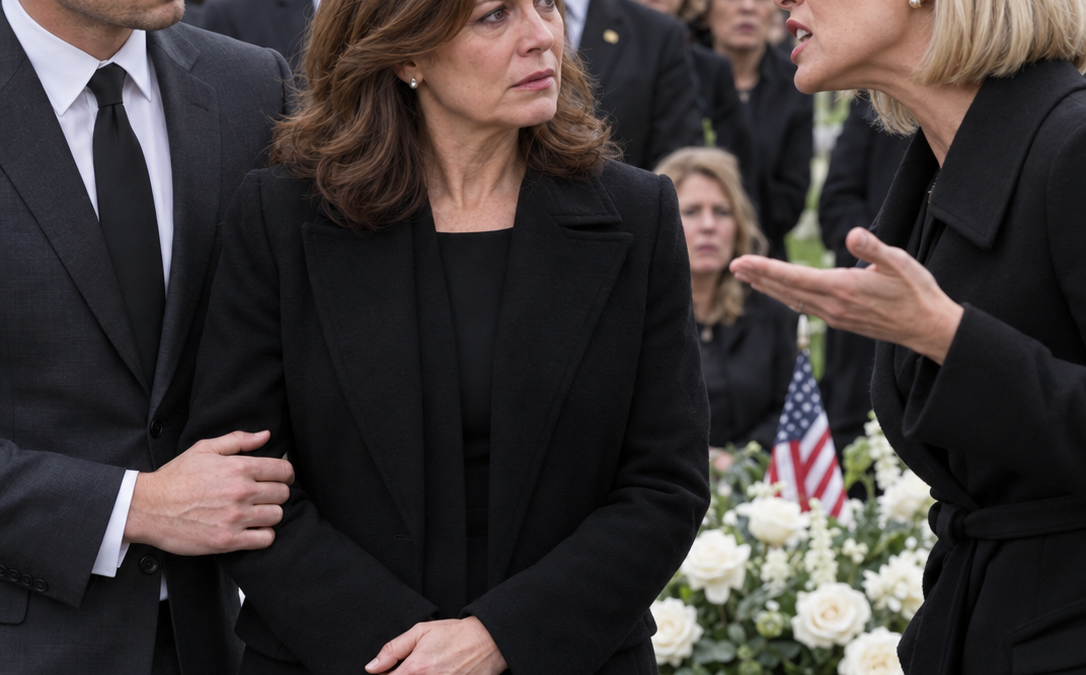
“Mary isn’t even her real daughter!” my sister announced beside our mother’s open grave. Fourteen mourners stared. I had paid for the funeral, slept beside Mom’s hospice bed, and measured every dose of her medication. Linda leaned closer. “The real daughter gets the house.” My son grabbed my arm. But Linda hadn’t seen what Mom had left with her attorney.
PART 1 — THE REAL DAUGHTER
“Mary isn’t even her real daughter.”
My sister said it while the cemetery workers were still waiting to lower our mother into the ground.
Linda stood beside a spray of white roses, adjusting the cuff of her black coat. Fourteen relatives and family friends turned toward me.
“She was adopted,” she continued. “Mom just never wanted anyone to know.”
My son, Jake, stepped forward.
“What the hell is wrong with you?”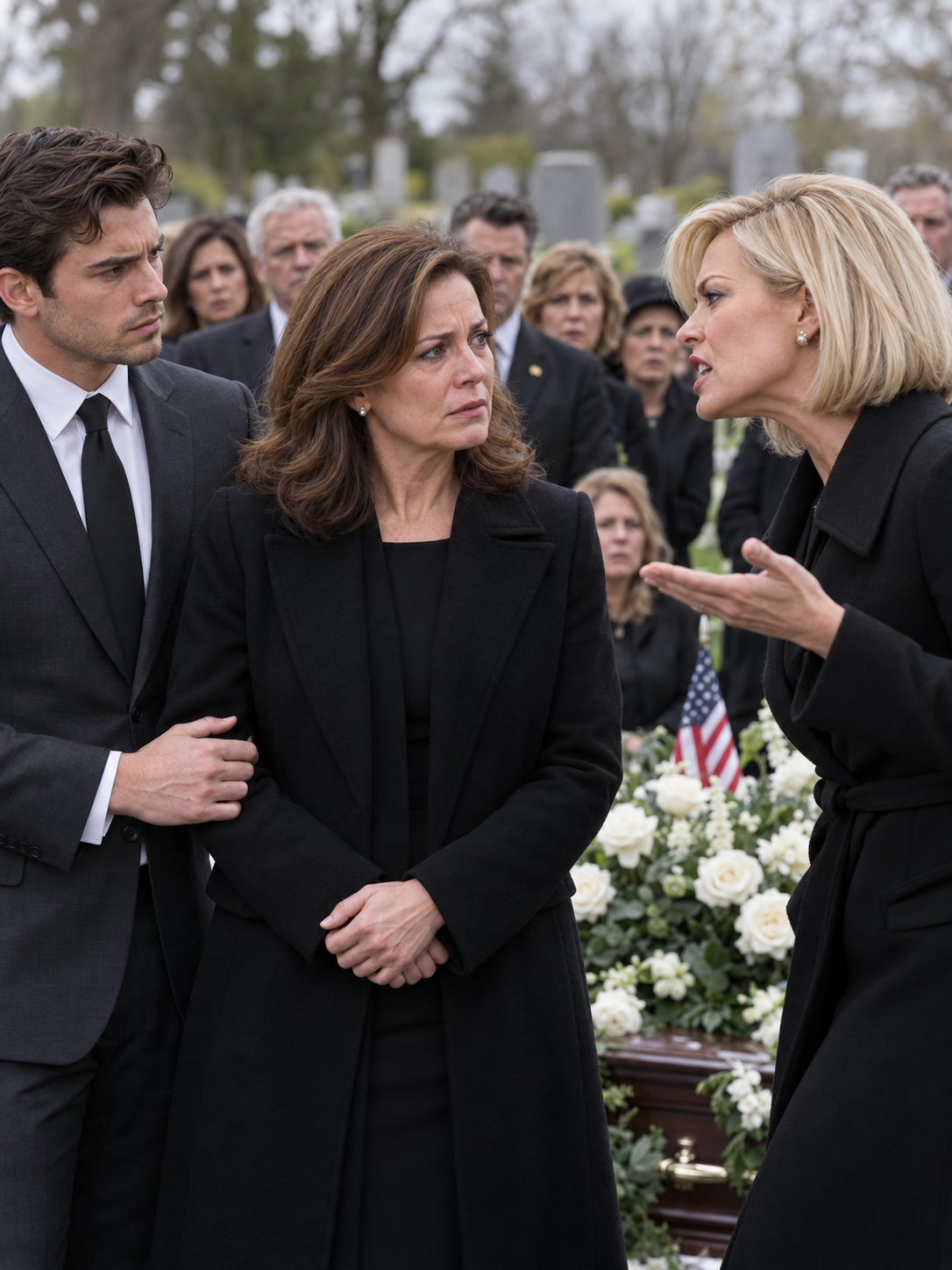
Linda ignored him. She watched me instead, checking whether her announcement had landed where she wanted it.
I was fifty-two years old. I had spent the past month measuring liquid medication into syringes, arguing with insurance representatives, and sleeping in a recliner beside our mother’s hospice bed.
Now I was standing beside her grave, apparently expected to defend my place in the family.
“Where did you get that?” I asked.
Linda gave a small shrug.
“Some things come out after people die.”
Then she moved close enough that the others couldn’t hear.
“It’s time the real daughter takes what belongs to her.”
I looked at the fresh dirt on her expensive boots.
That morning, she had asked whether the funeral home accepted payment plans. I had already paid the bill.
“Mom died,” I said. “You’re discussing inventory.”
Her smile disappeared.
Jake took my elbow and guided me toward the parking lot. Behind us, someone murmured that grief made people say terrible things.
That explanation had paid Linda’s bills for decades.
Four years separated us. By adulthood, almost everything else did, too.
I taught high school English in the Pennsylvania town where we grew up. My house had two bedrooms, a thirty-year mortgage, and a kitchen drawer full of takeout menus I rarely used.
Linda moved between apartments, jobs, and men who invariably became “controlling” the week they stopped lending her money.
When my marriage ended after fifteen years, I hired an attorney, split the furniture, and went back to work on Monday.
Linda called that depressing.
“You’re allowed to enjoy your life, Mary.”
She delivered this advice from my guest room, where she had been staying rent-free for six weeks.
I helped anyway.
There were security deposits, car repairs, groceries charged to my Visa. Every loan arrived with an emergency and left without a repayment date.
Mom helped more.
Five years before she died, Linda opened a store credit card using Mom’s information. The balance passed two thousand dollars before a statement arrived in the mail.
I sat at Mom’s kitchen table with the envelope between us.
“This is fraud.”
“She’s embarrassed.”
“She bought boots. You’re embarrassed.”
Mom folded the statement into thirds.
“I’m not putting my daughter through that.”
So she paid it.
Linda brought supermarket flowers the next Sunday and complained that nobody trusted her.
After that, things started leaving the house.
An antique vase. Silver serving spoons. A bracelet Dad had given Mom for their thirtieth anniversary.
“Mom said I could have it,” Linda would say.
Sometimes Mom had. Sometimes she looked surprised, then too tired to argue.
I started photographing the rooms, telling myself it was for insurance.
I knew why I was doing it. I simply didn’t want to say it aloud.
When Mom’s cancer spread, I rearranged my life around a refrigerator calendar.
Blue ink meant oncology. Green meant prescriptions. Red meant a bill I needed to call about before it became another problem.
Linda said I was lucky teaching gave me so much flexibility.
I was using unpaid leave.
One afternoon, she arrived carrying Starbucks and wearing sunglasses she kept on indoors.
“Must be nice,” she said, looking at me in yesterday’s sweatshirt. “Getting all this time with her.”
I held out the calendar.
“Thursday. Nine-thirty. Can you take her?”
She checked her phone.
“This week’s bad.”
“Pick another week.”
“Why do you always make it a competition?”
From the recliner, Mom asked us to stop.
Linda stayed seventeen minutes.
I knew because I had put Mom’s soup in the microwave when she arrived, and it was still sitting there when she left.
During the final month, hospice delivered equipment that turned our living room into a place where everything beeped, clicked, or needed charging.
Jake helped install a small indoor camera near the kitchen entrance after Mom fell trying to reach the bathroom at night. With her permission, we used it to check whether she was moving around when I stepped outside or went upstairs.
Its view included the hallway and the basement door.
Mom disliked it until Jake showed her how to wave at him through the app.
After that, she called it her television debut.
Linda visited twice.
On the second visit, Mom asked whether she could stay for dinner.
“Wish I could. Something came up.”
Mom nodded and smoothed the blanket over her knees.
After Linda left, she asked me to bring the little blue recipe box from the kitchen.
“Your lemon bars are too thick,” she said.
“They’re your recipe.”
“You don’t listen to the recipe either.”
I laughed. She smiled without opening her eyes.
Three mornings later, I was making tea when her breathing changed.
I left the kettle running.
For weeks afterward, that unfinished task bothered me in ways I couldn’t explain. I could remember every appointment and medication, but I couldn’t remember turning off the stove.
Jake came down from Boston and handled whatever I put in front of him.
He answered the funeral director’s emails. Bought groceries. Found the photograph where Mom looked like herself instead of a patient.
Linda called to ask whether we had found the will.
“Hello to you, too,” Jake said.
She hung up.
After the funeral, friends gathered at my house with deli trays and casseroles. Jake stayed to help clean up while I went to Mom’s.
“I’ll come with you,” he said.
“I’m getting the recipe box and some photographs.”
“Then I’ll carry them.”
I wanted a few minutes in the house without anyone watching me grieve.
“I’ll call when I’m leaving.”
He didn’t like it, but he handed me my coat.
That promise was one of the things I remembered later on the basement floor.
Mom’s house sat halfway down a quiet street lined with bare maples.
Mrs. Parker was on her porch next door, bundled in a cardigan under her coat.
“Need anything, honey?”
“No. Thank you.”
“I’m here.”
I raised a hand and went inside.
The house still held the practical evidence of someone who had expected another day: reading glasses beside the recliner, lotion near the sink, a shopping list held to the refrigerator with a magnet from Cape May.
I put my purse and phone on the kitchen counter.
The recipe box was where it belonged. The photographs weren’t.
Then I remembered moving several cartons downstairs when the hospice bed arrived.
I switched on the basement light and started down.
Halfway to the bottom, the front door opened.
“Linda?”
Her heels crossed the kitchen.
She appeared at the top of the stairs, still in her funeral clothes.
“We need to talk about the house.”
“We need to talk about what you said at the cemetery.”
“Oh, please.”
“Show me whatever you claim you found.”
She came down two steps.
“Move your car when you leave. You’re blocking the driveway.”
“Answer me.”
“You’ve been walking around here like you own everything.”
I stood on the second step above the concrete floor, one hand on the rail.
“I’ve been taking care of our mother.”
“Right. Saint Mary. We’ve all heard.”
She descended another step.
There wasn’t room to pass without one of us turning sideways.
“Back up,” I said.
Instead, she put both hands against my shoulders.
The shove sent me backward before I could tighten my grip.
My heel caught the edge of the step.
I landed badly. There was a sharp crack, and my right leg stopped feeling like something attached to me and started feeling like something trapping me.
For a moment, I couldn’t get enough air to speak.
Linda stood above me.
“Call an ambulance.”
She looked at my leg.
“Linda. My phone’s upstairs.”
She crouched beside me, and I thought she was finally going to help.
Her hand went into my coat pocket.
She took my keys.
“What are you doing?”
She climbed the stairs.
“Don’t you close that door.”
She stopped at the top.
I remember the brass knob in her hand. I remember waiting for her to turn around, because even then I couldn’t quite accept what she was about to do.
“Linda.”
The door closed.
A key scraped inside the old lock.
Then the light went out.
I shouted until my throat hurt.
Between shouts, I listened.
A car door. An engine. Then the ordinary sounds of the house: furnace, pipes, a faint vibration from the refrigerator upstairs.
I tried to shift my weight and nearly passed out.
My phone was on the kitchen counter. Jake thought I wanted privacy. Everyone else thought I was surrounded by family.
I pressed my palms against the concrete and dragged myself a few inches toward an old storage bin.
That was all I could manage.
Inside it were Christmas decorations, including the crocheted stockings Mom refused to replace.
I pulled one of her old tablecloths over myself.
Then I started yelling again.
Eventually, someone knocked upstairs.
“Mary?”
Mrs. Parker.
I shouted her name so hard it came out broken.
The knocking stopped.
For several seconds, I thought she had left.
Then her voice came through the narrow basement window near the driveway.
“Mary, can you hear me?”
“Yes!”
“Help is coming. Don’t move.”
I started explaining. She cut me off.
“Save your breath, honey. Tell them when they get here.”
She stayed beside that window, talking about absolutely nothing.
The weather. Her dog. How the ambulance would find us because she had turned on every porch light she owned.
I concentrated on her voice.
At the hospital, a surgeon explained the fracture and why it needed an operation.
Jake arrived before they took me upstairs.
He looked at the splint, then at my face.
“Tell me she didn’t.”
I couldn’t make the sentence gentler.
“She pushed me. She took the keys and locked the door.”
He set his phone on the bed.
Very carefully.
An officer took my statement. Later, he returned after speaking with Linda.
“She says you had been drinking.”
“I hadn’t.”
“She says you fell, and she left because she believed you weren’t seriously hurt.”
Jake turned toward him.
“And the locked door?”
“We’re documenting how the responders found it.”
The officer wasn’t dismissing me. He was collecting facts.
Still, hearing her version repeated beside my hospital bed felt like being shut downstairs a second time.
“Please get my bloodwork,” I said. “And speak to Mrs. Parker.”
“We will.”
After he left, I asked Jake to find a number in my contacts.
“Who?”
“Mr. Carter.”
“The attorney?”
“Yes.”
Jake picked up my phone.
For once, nobody asked me to sleep on it.
Mr. Carter came the next afternoon with a legal pad and a coffee he forgot to drink.
He had handled a property dispute for me years earlier. He listened without interrupting.
When I finished, he asked, “What do you want?”
“To stop hearing that she’s my sister as if that settles anything.”
He nodded.
“Then we start with what can be preserved.”
Mrs. Parker’s porch camera showed Linda arriving after me and leaving in a hurry.
In her hand was my key ring, identifiable by the ridiculous red apple charm Jake had given me during his first year of school.
The footage didn’t show the stairs.
Mr. Carter was careful about that.
“It supports your account. We don’t ask it to show more than it shows.”
Mrs. Parker gave a statement about hearing me call for help. The responders documented the locked door.
Jake found the messages Linda had sent during Mom’s illness.
Enjoy playing favorite. We’ll see what happens when the house gets settled.
Another read:
You won’t be standing in my way forever.
I had answered neither.
“I thought ignoring her would help,” I said.
Mr. Carter photographed the screen.
“Keep the originals.”
Then he obtained the will from the attorney who had prepared it.
Mom had left me the house and its contents.
I read the relevant paragraph three times.
There were no conditions about being a “real” daughter. No family vote. No reward for whoever shouted loudest at the cemetery.
Just my name.
Jake sat beside me while I lowered the page.
“She must have known Linda would fight.”
“Maybe,” he said. “She definitely knew who was there.”
That evening, he opened his laptop to help me sort medical emails.
A notification appeared from the camera app.
He stopped typing.
“What?” I asked.
“The hospice camera.”
I had forgotten it existed.
So had Linda.
Jake checked the saved recordings, then moved his chair closer to my bed.
The hallway appeared on his screen.
Linda came into view at the basement door.
My voice rose from below, thin through the tiny speaker.
“Please. Call someone.”
Jake reached for the volume.
On the screen, Linda slid my key into the lock.
PART 2 — THIS TIME, SHE HAD TO FINISH
Jake paused the recording.
“Do you want me to stop?”
“No.”
He pressed play.
Linda tested the handle after turning the key.
That small movement was worse than her rushing away.
She checked.
She made certain the door would hold.
Then she switched off the basement light and walked out of the frame while I was still calling her name.
Jake closed his eyes.
I watched the empty hallway until the recording ended.
“Save it,” I said.
He downloaded the original file. Mr. Carter arranged for it to be preserved and provided to the detective.
The camera hadn’t recorded the shove. It had recorded what Linda did afterward, and what she could hear while she did it.
Her story about an unremarkable fall now had a locked door in the middle of it.
Recovery required a humiliating amount of planning.
Getting to the bathroom involved crutches, instructions, and Jake pretending he wasn’t listening from the hallway in case I fell.
A shower took most of an afternoon.
My school arranged a long-term substitute. Colleagues brought books, meals, and a packet of student notes.
One student wrote, Please come back. The sub accepts “very unique.”
I laughed hard enough that Jake came in to check on me.
For a few seconds, I was a teacher again.
Then my phone buzzed.
A cousin wanted to know whether we could “keep things from getting uglier.”
I looked down at the brace supporting my leg.
I sent back a photograph of it.
He didn’t reply.
Other relatives called about Linda’s cemetery announcement.
I gave them the same answer.
“She lied. And being adopted wouldn’t have made me less Mom’s daughter anyway.”
That part mattered.
I wouldn’t defend my place in the family by agreeing that someone else’s place could be taken away.
Two weeks after surgery, Mr. Carter arranged a meeting at his office.
Linda agreed to attend with an attorney. The detective joined us for part of it, with everyone clear that the criminal investigation was separate from any discussion about property or restitution.
I wore loose slacks over the brace and the navy sweater Mom always said made me look awake.
Jake drove.
“Want me in there?”
“Yes.”
He parked close to the entrance and brought the crutches around without another word.
Linda was already in the conference room.
Her handbag occupied the chair beside her. She moved it when Jake pulled out that chair for me.
She glanced at my leg.
“You’re really making a production of this.”
Jake started to speak.
I put a hand on his wrist.
“I’d have preferred a different funeral activity.”
Mr. Carter waited until we were seated.
Then he asked Linda whether she wanted to correct anything she had previously said.
“No. She fell.”
“Were you present?”
“I’d just gotten there.”
“Did you take her keys?”
Linda leaned back.
“I found them.”
Mr. Carter opened the first recording.
Mrs. Parker’s camera showed Linda leaving the house.
He paused on the red apple charm.
“For safekeeping,” Linda added.
“My purse was on the kitchen counter,” I said. “You could have put them there.”
“I wasn’t thinking.”
Mr. Carter changed files.
The hallway filled the television screen.
Linda’s attorney stopped writing.
We listened to my recorded voice asking for an ambulance.
We watched Linda turn the key.
Nobody spoke when the clip ended.
The detective broke the silence.
“You told the responding officer you didn’t lock that door.”
Linda looked at me.
“You had a camera?”
“For Mom,” Jake said.
“You were recording people without—”
Her attorney touched her sleeve.
Linda stopped.
Mr. Carter placed copies of her messages on the table.
Then the will.
She recognized the document before he explained it.
“Oh, of course.”
“Linda,” her attorney said.
“No. Let her hear it. She camps out there for two years, shuts everyone else out, and gets a house.”
I pulled my phone from my bag.
“Thursday, nine-thirty.”
“What?”
“The appointment you couldn’t take. Would you like the other dates?”
She stared at me.
“I asked you to help. Repeatedly.”
“You liked being needed.”
“I liked sleeping. I stopped doing much of that.”
Linda shoved the papers away.
“Mom always chose you.”
“Mom paid off the credit card you opened in her name.”
Her attorney turned toward her.
Linda’s mouth tightened.
“That has nothing to do with this.”
“It has everything to do with why you thought there would be another cleanup.”
The detective asked about the stairs.
Linda’s account changed.
Maybe she had bumped me. Maybe we had both been upset. Maybe I had moved too quickly.
“You didn’t trip,” I said. “You put both hands on my shoulders.”
“I didn’t mean for your leg to break.”
The room went still.
Her attorney leaned toward her and asked for a break.
Linda stood so abruptly that her chair struck the wall.
“You’re going to ruin my life over one bad night.”
I looked at the crutches beside my chair.
“You left me on a concrete floor and drove away.”
“I knew someone would find you.”
“Who?”
She said nothing.
“Name the person you called.”
Her attorney stood.
The detective wrote something down.
Linda looked around the room, searching for somebody willing to finish the excuse for her.
For the first time I could remember, nobody did.
During the break, Mr. Carter asked what outcome I wanted him to pursue on my behalf.
He didn’t promise a conviction. He didn’t suggest we could erase the investigation with a signed agreement.
“The prosecutor makes charging decisions,” he said. “Your wishes matter, but they aren’t the only consideration.”
“I understand.”
I wanted protection. The property returned. Help with the expenses her attack had created.
And I wanted the truth delivered to the people who had heard her lie.
“Do you want contact with her after this?”
“No.”
The answer came without effort.
We discussed a written admission, repayment and return of estate property, and asking for formal restrictions on contact through the appropriate court process.
I told him I would support a resolution that required supervision, counseling, and consequences for violations.
“I don’t need to manage her punishment,” I said. “I need to stop managing her.”
When the meeting resumed, Linda’s attorney did most of the talking.
Linda stared at the table.
The arrangements took longer than a dramatic signature and a handshake. There were follow-up calls, documents to review, and a separate legal process.
I let the professionals handle them.
For once, keeping Linda comfortable wasn’t on my list.
Before the no-contact restrictions took effect, she agreed through counsel to attend one final family meeting at Mom’s house.
Everyone invited was told why.
There would be no ambush disguised as dinner, no opportunity to claim we had tricked her into a room.
Mrs. Parker arrived first.
She brought a lemon cake in a glass dish.
“People still need to eat,” she said.
I let her put it on the counter.
Relatives gathered in the living room. Some had been at the cemetery. Others had heard Linda’s claim by telephone before I had even reached the hospital.
Mr. Carter sat near the dining table with the written statement. Linda’s attorney accompanied her.
Jake helped me settle into Mom’s sturdy armchair.
Linda stood near the fireplace, holding two sheets of paper.
She began quietly.
“I want to clear up some misunderstandings.”
Mr. Carter looked up.
“That isn’t the statement you agreed to give.”
Her attorney spoke to her under his breath.
She started again.
“I lied when I said Mary was adopted.”
Nobody interrupted.
“She is my biological sister. I had no documents or information supporting what I said.”
My aunt lowered her gaze to her hands.
Linda swallowed and continued.
“After the funeral, I pushed Mary on the basement stairs. She fell and was seriously injured.”
The refrigerator motor clicked on in the kitchen.
“I took her keys. I locked the basement door. I heard her asking for help, and I left without calling anyone.”
She stopped reading.
This was the point where Mom would have reached for her, or somebody would have offered a glass of water and changed the subject.
I stayed in the chair.
Linda finished.
“The things I said about her drinking and falling on her own were false.”
She put the pages down.
“I’m sorry.”
I looked at her.
“I heard you.”
She waited.
That was all I had.
With my permission, Mr. Carter played the hallway recording.
I watched the relatives instead of the screen.
My uncle leaned forward at the sound of my voice. A cousin put her phone facedown on her knee.
Mrs. Parker watched Linda.
When the recording ended, my aunt spoke.
“Why didn’t you call an ambulance?”
Linda rubbed the edge of her sleeve.
“I was upset.”
“We were all upset,” my aunt said. “We’d just buried your mother.”
Linda looked toward me again.
I couldn’t help her answer that question.
Her signed admission and the property arrangements were handled through the attorneys. The criminal case continued through its own process.
When Linda left, nobody asked me to walk her to the door.
Jake did it.
He came back carrying the empty water glass she had used and put it in the dishwasher.
Such an ordinary action.
I watched him close it and realized I was no longer waiting for another argument to begin.
The eventual court resolution included supervision, counseling, restitution, and restrictions on contact.
I didn’t get to dictate every detail. I did get to speak about what had happened and what I needed to feel safe.
The judge listened.
Linda’s lawyer had explanations. Grief. Financial trouble. Poor judgment.
There were documents in front of the judge that required more than explanations.
I went home exhausted.
Jake ordered pizza and put a ridiculous comedy on the television.
We ate from paper plates because neither of us wanted to wash anything.
That night, when I woke at three, I checked the time instead of the door.
Mom’s belongings came back through Mr. Carter’s office.
The silver spoons arrived wrapped in newspaper. The vase came in a grocery bag with a towel around it.
Her bracelet was inside a small plastic jewelry pouch.
I sat in the car with that pouch in my hand for several minutes.
Dad had fastened the bracelet around Mom’s wrist at their anniversary dinner. I remembered her holding out her arm under the restaurant light.
Linda had treated it like cash waiting to happen.
I took it home.
Reports of compliance came through the appropriate channels: appointments attended, payments made, employment found at a grocery store.
I read what I needed to read.
I didn’t ask which shift she worked. I didn’t look up the store. Whether she liked her supervisor was finally somebody else’s conversation.
A relative suggested that perhaps, in time, we could start with a birthday card.
“No,” I said.
He accepted it.
I wished I had known years earlier how little explanation that word required.
Physical therapy was repetitive, inconvenient, and occasionally discouraging.
There were days when walking from the parking lot used up most of my patience.
My therapist measured progress in small increments. I measured it in things I could do without asking Jake to hover.
Carry a mug.
Get into the shower.
Stand at the kitchen counter long enough to make dinner.
When I returned to school, the student who had complained about “very unique” left a corrected worksheet on my desk.
I wrote Excellent work across the top.
Then I taught a full class and went home tired for an ordinary reason.
I sorted Mom’s house slowly.
Some afternoons I cleared a drawer. Others I sat on the porch and did nothing useful at all.
Jake removed the old exterior lock from the basement door.
“Want the whole door replaced?”
I considered it.
“No. Just that.”
He filled the holes and painted over them.
Later, I went downstairs with him to retrieve the photographs I had originally come for.
We brought up three boxes.
I found one picture of Linda and me in winter coats, standing beside Mom after a school concert. Linda had lost a mitten. I was holding her bare hand inside mine.
I kept the photograph.
I didn’t have to pretend none of the good years had happened to acknowledge what came after them.
The following spring, Jake visited for a long weekend.
I made lemon bars from the blue recipe box while he worked at the kitchen table.
“Thinner,” he said.
I turned around.
“What?”
“Grandma would say thinner.”
I pointed the spatula at him.
“You’re very close to buying your own dessert.”
He grinned and went back to his laptop.
Outside, daffodils stood along the fence where Mom and I had planted them.
My leg ached when rain was coming. There was a scar I no longer bothered hiding. I still sometimes reached for my phone to tell Mom something before remembering.
But the afternoon belonged to us.
Coffee on the counter. My son at the table. A recipe card with butter stains on the corner.
When the timer rang, I took the pan from the oven and set it down between us.
Jake examined it.
“She’d approve.”
I cut him the first square.