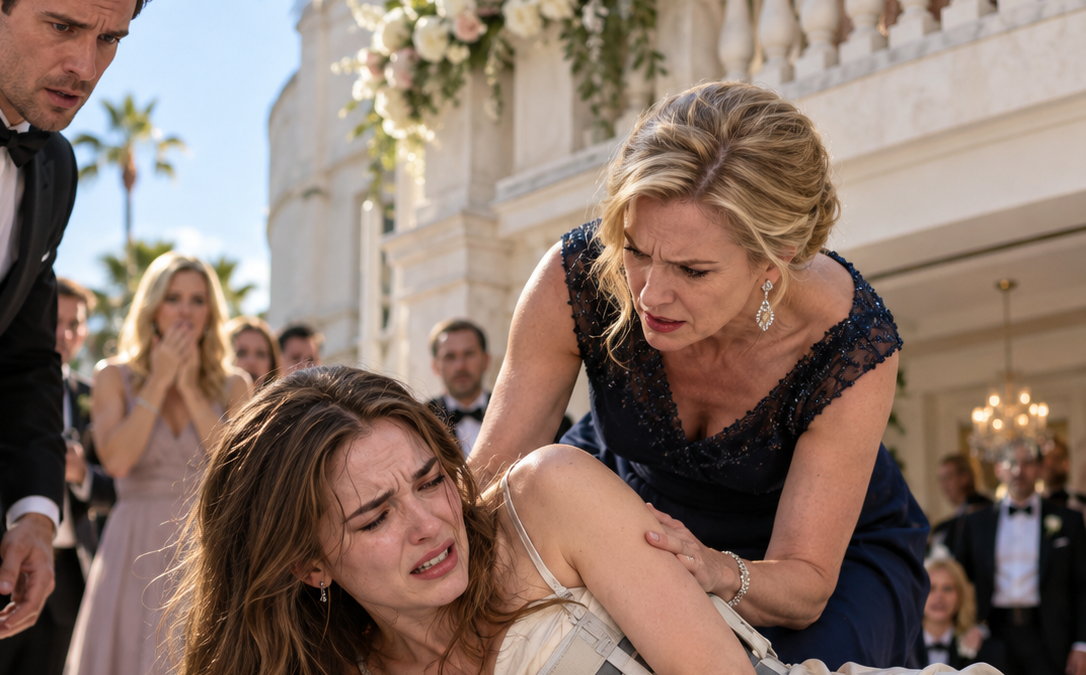
“It was for views!” my sister laughed from the balcony as I lay ten feet below, my back brace cracked against marble. I couldn’t feel my foot. Guests screamed for an ambulance, but Mom bent over me and hissed, “Get up. You’re ruining the wedding.” My cousin kept filming from above. None of them knew what the security cameras had recorded.
Part 1: The Fall That Was Supposed to Make Her Famous
“It was for views! God, Sloane, you always ruin everything!”
My sister shouted those words from a balcony ten feet above me while I lay on a marble floor, struggling to breathe.
My medical back brace had cracked open. Something sharp was digging into my side. I tried moving my right foot.
Nothing happened.
Around me, wedding guests were screaming. Someone yelled for an ambulance. A woman in a navy evening gown dropped to her knees beside me and told everyone not to touch my back.
And above all that noise, my younger sister, Delphine, was laughing.
Not because she was nervous.
Not because she didn’t understand what had happened.
She was looking directly into her cousin’s phone, smiling like she’d just delivered the funniest punch line on TikTok.
I’d spent thirty-four years protecting that woman from the consequences of her decisions.
That night, she nearly killed me for a fifteen-second video.
But the worst part wasn’t the fall.
It was what my parents did afterward.
And what I discovered when I finally reached the emergency room made me realize the three of them had crossed a line they couldn’t come back from.
My name is Sloane Whitmore. I’m thirty-four years old, and until two months before my sister’s wedding, I had a job that paid me $210,000 a year.
I’m a commercial crane and rigging risk assessor.
Most mornings, I put on steel-toed boots, a hard hat, and a reflective vest before walking through construction sites where one missed safety defect could kill somebody.
I inspect lifting equipment, review engineering reports, and make very expensive recommendations that contractors don’t always appreciate hearing.
Nobody cares how nice my hair looks when I’m standing sixty feet above the ground examining a damaged crane connection.
They care whether I can identify the problem before someone gets hurt.
I like that about my job.
I built my career without family connections, inherited money, or somebody’s husband getting me a position.
Every promotion came from work I could prove I’d done.
My parents never understood that.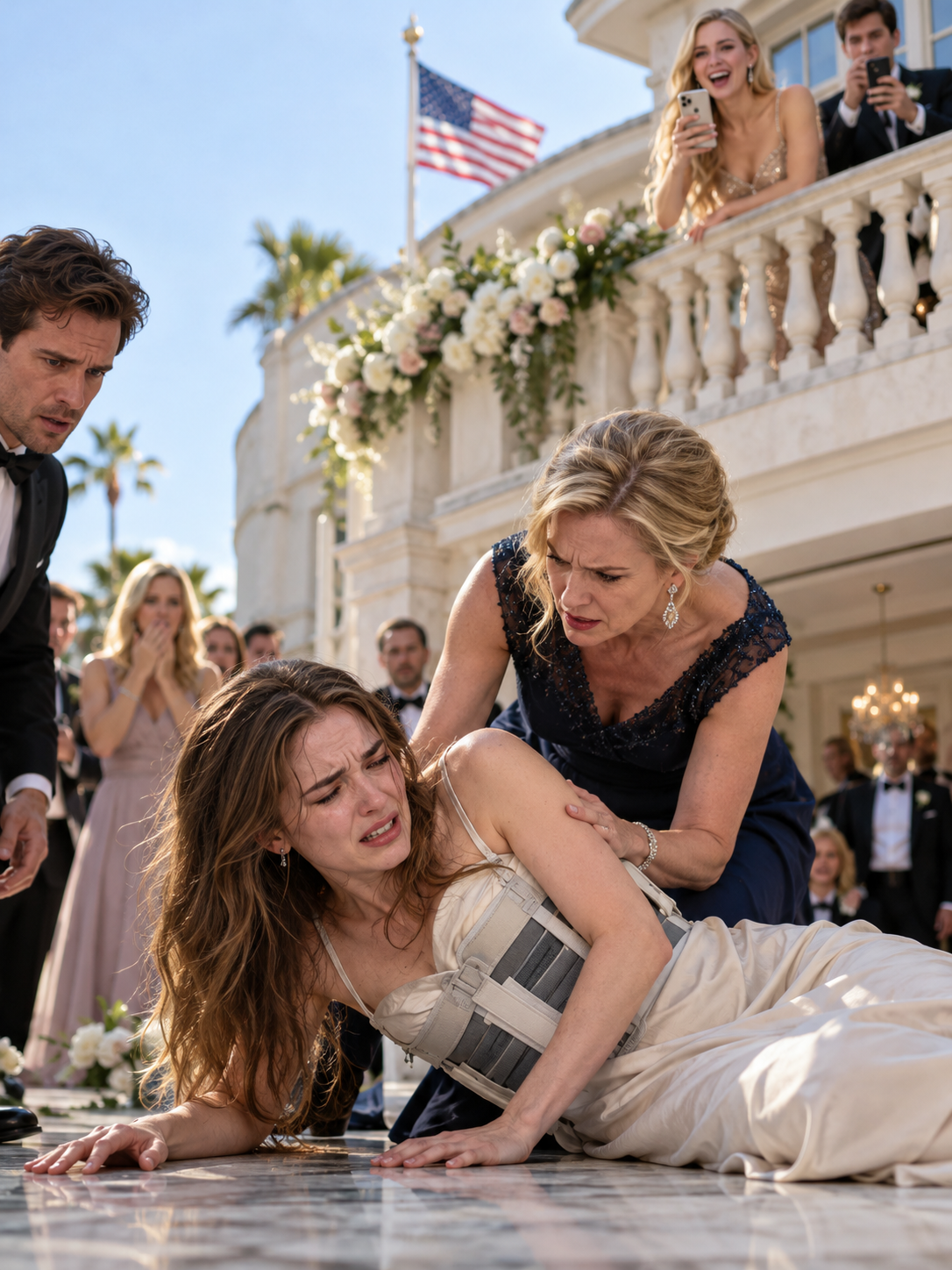
My father, Garrison, called my profession “construction work with a fancy title.”
My mother, Una, preferred telling people I worked in corporate consulting.
Apparently, that sounded better at their country club.
Delphine was different.
According to our mother, Delphine was a creative genius with an exceptional future.
According to Delphine’s Instagram biography, she was a luxury event art director.
According to anyone who had ever tried to hire her, she was an unemployed twenty-something with expensive taste and no actual business.
She posted pictures outside five-star hotels, photographed other people’s designer handbags, and spent afternoons ordering $14 matcha lattes.
Our parents paid her rent.
They covered her credit cards.
Whenever she wanted something, they figured out how to make it happen.
Whenever I needed something, they reminded me how independent I was supposed to be.
I’d learned that difference when I was nineteen.
I was working late shifts at a twenty-four-hour diner while attending community college. I smelled like fryer oil and industrial cleaning spray most nights, but after two years, I’d saved $5,000.
It was supposed to buy my first car.
Nothing extravagant. Just a used Honda that could get me to an engineering internship across town.
One afternoon, I tried buying coffee before class.
My debit card was declined.
I checked the banking app.
Zero dollars.
Every penny was gone.
I went home convinced someone had stolen my identity.
My father was watching golf in the living room when I demanded to know what happened.
He barely looked away from the television.
“I moved it.”
I stared at him.
“Moved what?”
“Your savings. Delphine needed some cheering up.”
She’d been rejected from the varsity cheerleading squad.
That was the emergency.
My father had taken two years of my wages and bought her a designer handbag and a luxury spa weekend with her friends.
When I started shouting, my mother appeared in the doorway.
“Lower your voice, Sloane.”
“He stole my money!”
“You’re strong. You’ll earn it again.”
“That was my car!”
“Your sister has been terribly upset. Sometimes people need a little extra support.”
I remember standing there with my work shoes still on, holding the bank statement I’d printed at the ATM.
My father actually sighed.
“Don’t be selfish over a few dollars.”
Five thousand dollars.
At nineteen, that was nearly everything I owned.
They made me apologize to Delphine for upsetting her.
I did it because I still lived under their roof, and they made it clear that refusing would have consequences.
Three months later, I moved out.
I took out student loans, worked evenings, and spent hours on buses getting to internships.
I eventually earned an engineering degree, then worked my way into industrial risk assessment.
By thirty-four, I owned a house, had a healthy retirement account, and hadn’t asked my parents for a cent in fifteen years.
They hadn’t changed.
I’d simply become harder to exploit.
At least, that’s what I believed.
Then came the accident.
Sixty days before Delphine’s wedding, I was inspecting a high-rise construction site in Chicago.
A subcontractor had improperly secured a temporary scaffolding section.
When I stepped onto it, the platform shifted.
I heard metal scrape against metal.
Then the floor disappeared under my boots.
My safety harness caught me after roughly fifteen feet, but the momentum swung me straight into a concrete support column.
I remember the impact.
I remember trying to inhale.
I don’t remember the ambulance.
The hospital scans showed fractures in two thoracic vertebrae.
My surgeon explained how close the damage was to my spinal cord.
Another serious impact could leave me permanently disabled.
I spent weeks in the hospital before going home in a rigid thoracolumbar brace that covered most of my torso.
No bending.
No twisting.
No lifting anything heavier than my doctor’s instructions allowed.
Getting out of bed required planning.
Showering required assistance.
Walking from my bedroom to the kitchen could leave me exhausted.
And Delphine’s wedding was eight weeks away.
I called my mother and told her I couldn’t attend.
She acted like I’d announced I was refusing to attend out of spite.
“You cannot miss your sister’s wedding.”
“Mom, I have two broken vertebrae.”
“You’re not in the hospital anymore.”
“That doesn’t mean I’m recovered.”
She lowered her voice.
“Merrick’s family will be there. Do you understand how embarrassing it would be if people asked why the bride’s sister couldn’t make an effort?”
I put the phone on speaker and set it down.
“My surgeon said I’m not ready to travel.”
“Then ask him for something stronger for the pain.”
I actually laughed.
“You want me to ask my doctor for more narcotics so I can stand in wedding pictures?”
“Don’t twist my words.”
“That’s exactly what you said.”
She hung up.
Then she called the next morning.
And the morning after that.
Eventually, my father joined in.
He said Delphine was devastated.
He said I was ruining the most important weekend of her life.
He said families made sacrifices.
Apparently, the sacrifice was always supposed to be mine.
Against my doctor’s advice, I agreed to travel, arranging assistance at the airport and wheelchair transportation through the terminal.
It was a terrible decision.
By the time I arrived at the luxury resort on the Carolina coast, my back felt as though someone had tightened a vise around it.
I checked into my room, swallowed my prescribed medication, and spent twenty minutes trying to get dressed without twisting.
Then I made my way to the bridal suite.
My mother opened the door.
She looked at me from head to toe.
“You’re wearing that hideous thing?”
I glanced down at the brace beneath my clothes.
“The thing holding my spine together? Yes.”
“Couldn’t you take it off for photographs?”
“No.”
“Just for fifteen minutes?”
“Mom, it’s a medical device, not an ugly necklace.”
She rolled her eyes and stepped aside.
Inside, Delphine was having her hair done while a makeup artist worked around a dozen expensive champagne glasses.
My sister glanced at me in the mirror.
“Wow. You look terrible.”
“Nice to see you too.”
“Seriously, Sloane. You couldn’t find something that hides all that?”
I stood there with my overnight bag in one hand and my cane in the other.
“Good thing this isn’t my wedding.”
She turned back toward the mirror.
“Exactly. Try remembering that.”
I should have gone home.
Instead, I stayed.
Friday night’s rehearsal dinner was being held in the atrium of a historic luxury estate.
The place had towering marble columns, a glass ceiling, elaborate floral displays, and an upper mezzanine overlooking the main reception floor.
I’d been there once before.
Six months earlier, I’d participated in a commercial risk assessment of the building through my firm.
I knew its general layout, its emergency access points, and the venue’s procedures for documenting serious incidents.
That knowledge would matter later.
At the time, I was mostly thinking about finding a chair.
I arrived wearing an emerald silk gown that concealed most of my brace.
I still couldn’t walk normally.
Every movement had to be deliberate, and the cane helped me keep my balance.
A few of Merrick’s relatives approached to ask whether I was feeling okay.
Before I could answer, Delphine appeared.
“Sloane’s fine. She’s just been milking this accident for weeks.”
One older woman looked at my cane.
“That looks like a serious injury.”
Delphine smiled.
“She loves attention.”
I didn’t respond.
Arguing with my sister was like trying to negotiate with a smoke alarm.
It made noise until somebody gave it what it wanted.
I excused myself and headed toward a chair near the catering tables.
That’s when Merrick found me.
He was Delphine’s fiancé, a thirty-six-year-old logistics executive who worked for a major technology company.
I’d always liked him.
He was thoughtful, funny without trying too hard, and genuinely interested when other people spoke.
He took one look at me and pulled out a padded chair.
“Sit down, Sloane. Please.”
“Is that an order?”
“Absolutely. And don’t tell your sister I’m finally putting my management experience to useful work.”
I smiled and lowered myself carefully.
He crouched beside the chair.
“I talked to the photographer. You don’t have to stand for the group pictures if you’re hurting.”
“Delphine won’t like that.”
“Delphine will survive.”
He paused.
“Your back matters more than a photograph.”
Those were the kindest words anyone in my family had offered me all weekend.
I thanked him.
Across the room, Delphine was watching us.
Her smile had disappeared.
She gripped her champagne flute and stared at Merrick as though he’d committed some terrible betrayal.
Then she looked at my cane.
Then at the mezzanine balcony.
She beckoned our cousin Kiva over.
Kiva was twenty-five and spent most of her time filming Delphine’s life for social media.
They were constantly planning content.
Delphine called it building a brand.
I called it two unemployed women creating more reasons to use their phones at dinner.
They whispered near the floral display.
Kiva raised her phone.
I caught a few words.
“Livestream.”
“Watch her fall.”
I couldn’t hear the rest over the string quartet.
For one second, I wondered whether I’d misunderstood.
Then the wedding coordinator announced that the bridal party needed to gather upstairs for photographs.
I told her I should remain seated.
She said she’d been instructed that all immediate family members had to appear in the group portrait.
I asked whether there was an accessible route.
She directed me toward an elevator at the far end of the building, and I used it rather than attempting the grand staircase.
By the time I reached the mezzanine, I was tired enough to consider leaving without saying goodbye.
The photographer began arranging people near the glass railing.
He placed me at one end of the group.
“Right there, Sloane. Perfect.”
I checked the space behind me.
The railing was lower than I liked, especially with my brace limiting my movement.
“I’d rather stand closer to the wall.”
“We’ll only need a few shots.”
I moved slightly forward anyway, away from the edge.
A camera flashed.
Someone complained about the lighting.
Then Delphine walked over.
“Oh, Sloane. Your dress is twisted.”
“It’s fine.”
“Let me fix it.”
“Don’t touch me.”
She smiled brightly.
“You’re so dramatic.”
The photographer looked down to adjust his lens.
Kiva raised her phone from a few feet away.
Delphine stepped behind me.
I felt her hand brush the back of my dress.
Then her hip slammed into my lower body.
At almost the same instant, her shoulder drove into my rigid brace.
I couldn’t twist quickly enough to recover.
My cane struck the floor.
My feet slipped.
The low railing hit the backs of my legs.
And suddenly, there was nothing beneath me.
I remember seeing the glass ceiling.
I remember somebody screaming my name.
Then I hit the marble.
The brace cracked.
Pain shot across my back, sharp enough to make my vision go white.
I tried to breathe.
My lungs wouldn’t cooperate.
I tried to move my legs.
One foot responded.
The other didn’t.
That’s when I heard Delphine laughing above me.
“Oh my God, Kiva! Did you get that?”
Kiva didn’t answer.
Someone below shouted, “Call 911!”
I could hear shoes striking the marble as guests hurried toward me.
A woman knelt near my head.
“Don’t move, sweetheart. An ambulance is coming.”
Then my mother’s face appeared above mine.
She wasn’t crying.
She looked furious.
“Sloane, get up.”
I blinked at her.
“I can’t.”
“You’re embarrassing everyone.”
“My back—”
“Stop making a scene.”
I tried to speak again.
The pain interrupted me.
My father pushed through the guests.
“What’s all this?”
“Your daughter fell from the balcony!” somebody shouted.
My father leaned over me.
“Delphine says it was an accident.”
“She pushed me.”
He looked toward the balcony.
“Don’t start.”
“I can’t feel my toes.”
My mother’s expression changed for half a second.
Then she looked around at the watching guests.
“Well, we can’t have you lying here in front of everyone.”
The woman beside me snapped, “She needs to stay still until paramedics arrive.”
My father ignored her.
He grabbed me under my arms.
I screamed.
He stopped for a moment, then ordered a nearby staff member to help him.
The woman tried to interfere.
I remember her saying, “You could damage her spine!”
My father responded, “She’s my daughter.”
As though that gave him the right.
Against the protests of several guests, my parents moved me toward a side exit.
Every shift of my body sent another burst of pain through my back.
Somebody was still yelling for them to stop.
My father told the valet to arrange a car.
Then he handed the driver fifty dollars.
“Take her to the emergency room.”
The driver stared at me.
“Sir, shouldn’t we wait for an ambulance?”
“Just drive.”
My mother adjusted the front of her expensive dress.
“We’ll check on you after dinner.”
I looked at her through the open car door.
“You’re staying?”
She gave me the same irritated expression she’d used when I was nineteen and upset about my stolen savings.
“Sloane, we have three hundred guests.”
Then she closed the door.
Neither parent got in.
I watched them walk back into the venue while a stranger drove me toward a hospital.
The driver called ahead and helped emergency staff get me onto a stretcher when we arrived.
After a CT scan and neurological examination, a spine specialist came to speak with me.
He pulled a chair beside my bed.
“The impact has caused significant additional compression damage to the vertebrae that were already fractured.”
I watched him turn the tablet toward me.
The images showed the damage.
“Will I walk again?”
“We’re going to do everything we can to protect your spinal cord. Right now, I need you to understand that this is a serious injury.”
He explained the need for further stabilization, close neurological monitoring, and a long rehabilitation period.
It could take a year before I was ready to return to physically demanding work.
Possibly longer.
I’d been scheduled to lead a major inspection contract in two weeks.
The commission was worth $120,000.
Now somebody else would have to take it.
I looked at the ceiling until the doctor finished speaking.
After he left, a nurse brought me water.
“Is there someone we can call?”
I thought about my parents.
My sister.
The people still drinking champagne ten minutes from where I’d nearly died.
“No family,” I said.
“Anyone else?”
I gave her the number of my closest friend.
Then I asked for my phone.
There was a message from an unknown number.
I saw what she did. The security cameras caught everything.
Attached was a short video clip.
I pressed play.
There was Delphine, stepping behind me.
There was Kiva, filming.
And there was my sister shoving me toward the railing.
I watched it once.
Then I forwarded the message to my personal email and saved the sender’s number.
I didn’t know who had sent it.
But somebody had decided that the truth mattered more than protecting Delphine.
For the first time that night, I had evidence.
Then I remembered something.
When my mother was supposedly searching for my insurance card, she’d taken my handbag.
My handbag contained my wallet.
And my wallet contained a corporate emergency credit card that was supposed to be used only for authorized business expenses.
I opened my banking app.
My personal accounts looked normal.
Then I checked the corporate card portal.
One transaction was sitting at the top of the screen.
PENDING CHARGE — $62,000.00
Merchant: Atrium Luxury Lighting & Floral.
I stared at it.
Then I checked the timestamp.
The charge had been made while I was receiving emergency treatment.
My parents had used my company-issued card to pay the final balance on Delphine’s wedding decorations.
They hadn’t just abandoned me after my sister broke my spine.
They’d stolen from my employer while I was barely conscious.
And if my company believed I had authorized the charge, I could be facing an investigation before I even got out of the hospital.
I locked the card immediately and downloaded the transaction record.
Then I called the one man who could help me handle the evidence properly.
Vaughn Mercer.
My former supervisor.
Now the director of corporate legal investigations at my firm.
He answered on the second ring.
“Sloane? It’s almost three in the morning.”
“I’m in the hospital.”
His tone changed.
“What happened?”
“My sister pushed me off a balcony. I have the video. And my parents stole sixty-two thousand dollars from the company card.”
There was a pause.
“Are you safe?”
“I’m being treated. I need you to secure the financial records before anyone tries to blame me.”
“Done. I’ll contact the card issuer and our legal team.”
“There’s something else.”
“Tell me.”
“The venue has security cameras. I need the original footage preserved.”
“I’ll make the calls. You stay with your doctors.”
I closed my eyes.
“Vaughn?”
“Yeah?”
“Delphine’s wedding is tomorrow.”
“I know.”
“I don’t want them getting another chance to bury this.”
He was silent for a moment.
Then he said something I would remember for the rest of my life.
“Then we’re not going to ask your family for permission to tell the truth.”
I thought that was the most important thing he’d say that night.
I was wrong.
Because ten minutes later, he called me back.
“Sloane, the venue manager just checked something for me.”
“What?”
“Your father’s sixty-two-thousand-dollar payment wasn’t the only thing recorded yesterday.”
I tightened my grip on the phone.
“Then what else did they find?”
Vaughn lowered his voice.
“Delphine’s livestream account. There was a private recording before the fall. And apparently, she explained exactly what she intended to do to you.”
Part 2: The Wedding That Never Happened
“She called it the Broken Sister Challenge.”
Vaughn said the words slowly, as though he wanted to make sure I’d heard every syllable.
I was lying in a hospital bed with an IV in my arm and a spinal injury that could keep me out of work for a year.
And somehow, that sentence made me forget about the pain for a moment.
“What?”
“The private recording. Your sister told her subscribers she was planning a prank involving you.”
I stared at the phone.
“What kind of prank?”
“She said she’d make you fall in front of the wedding guests. Kiva was supposed to capture your reaction.”
“She knew about my spine.”
“I know.”
“She knew I couldn’t bend or catch myself.”
Vaughn took a breath.
“Sloane, don’t make yourself watch it tonight. We’ve arranged for the venue to preserve the original footage and the recording.”
I looked toward the hospital window.
Outside, the parking lot was nearly empty.
I pictured Delphine sitting in her bridal suite, having champagne, complaining about the inconvenience I’d caused.
“Does Merrick know?”
“He knows there was an incident. I don’t think he knows the rest.”
“Then somebody needs to tell him.”
“I’ll handle it.”
“No.”
My voice was stronger than I’d expected.
“I want him to hear what she said. He deserves to know who he’s marrying.”
By eight the following morning, the venue’s security department had preserved footage from three cameras.
The first showed Delphine speaking privately with Kiva near the rehearsal dinner.
The second captured the shove.
The third showed what happened immediately afterward.
My mother ordering me to stand.
My father moving me despite the warnings of other guests.
Both of them watching the car drive away before returning inside.
There was no misunderstanding.
No unfortunate angle.
No convincing explanation involving a twisted dress or a crowded balcony.
The footage showed exactly what happened.
The venue’s operations director, Reese Bennett, had also received an archived copy of Delphine’s private livestream recording from someone who’d watched it.
In it, Delphine stood in front of her phone wearing her white rehearsal dress.
She was smiling.
“My sister’s been turning this wedding into her personal medical documentary,” she told the camera. “Tonight, we’re going to give her a little reality check.”
Kiva laughed offscreen.
“What if she actually falls?”
Delphine rolled her eyes.
“Then we finally get some decent content.”
I watched the clip once on the tablet Vaughn had sent over.
That was enough.
It wasn’t proof she had planned to fracture my spine.
It was proof she had planned to frighten or humiliate me, fully aware that I was badly injured.
Then the security footage supplied the missing part.
She had deliberately shoved me near a ten-foot drop.
The distinction didn’t make me feel any better.
The hospital specialist repeated my neurological examination that morning.
Fortunately, the numbness in my foot had begun to improve, and further imaging had not shown the spinal cord damage we’d feared.
I still had serious compression fractures, needed rigid stabilization, and faced months of rehabilitation.
The doctor made the restrictions clear.
No standing without permission.
No independent transfers.
No unnecessary movement.
Once I was medically stable and fitted with a new brace, I could leave under a carefully supervised transport plan.
Vaughn initially wanted me to remain in the hospital while he handled everything.
So did my best friend, who had arrived before sunrise.
I understood why.
But I also knew that if my family controlled what the wedding guests heard, they’d turn me into the villain again.
I agreed to go only after the medical team approved my discharge and transport.
Vaughn arranged a wheelchair-accessible van with medical assistance.
He also brought a thick folder containing the card transaction report, the dispute confirmation, and correspondence from our company’s legal department.
The card had been frozen.
The fraudulent charge had been reported.
My professional access had been temporarily reviewed and documented, so there would be no suggestion that I’d approved the payment.
For once, my family’s favorite strategy—deny everything and make Sloane clean up the mess—wasn’t going to work.
It was shortly after ten when we reached the estate.
Staff were carrying flowers through the lobby.
A wedding coordinator was speaking urgently into a headset.
Outside, expensive cars lined the circular driveway.
The ceremony was supposed to begin in less than two hours.
Vaughn walked beside me as the medical transport attendant guided my wheelchair toward the private elevator.
“Last chance to let me handle this,” he said.
I looked down at the new rigid brace surrounding my torso.
“Vaughn, I’ve spent thirty-four years letting somebody else decide what happens to me.”
He nodded.
“Fair enough.”
Reese met us upstairs.
He’d arranged a private conversation in the bridal suite and had already spoken to the police about the evidence.
“The footage is secure,” he assured me. “No one’s altering or deleting anything.”
“Thank you.”
He hesitated.
“Ms. Whitmore, I’m sorry about what happened here.”
“You’re the first person associated with this wedding who’s apologized without asking me to do something in return.”
He gave a small, uncomfortable smile.
Then he opened the door.
Delphine was sitting in front of an enormous gold-framed mirror.
Her wedding gown was covered in hand-sewn beads. A makeup artist was finishing her lipstick while Kiva filmed a short video of the veil being arranged.
My mother was wearing a champagne-colored designer dress.
My father stood near a silver tray of pastries, reviewing the reception schedule.
They all looked up.
For a moment, nobody spoke.
Then Delphine saw my wheelchair.
“Oh, you’ve got to be kidding me.”
I said nothing.
She stood.
“Are you seriously doing this on my wedding day?”
“What exactly am I doing?”
“Showing up like that!”
She pointed at my medical brace.
“Nobody wants those depressing hospital pictures in the wedding album.”
My mother hurried toward the door.
“Sloane, I specifically told you to rest at your hotel.”
“I spent the night in an emergency room.”
“Well, obviously you’re well enough to come here.”
I looked at her.
“Is that your medical opinion?”
She ignored the question.
“We have guests arriving. Whatever this is, it can wait.”
My father stepped forward.
“Your sister deserves one day that isn’t about you.”
I studied his face.
He looked annoyed.
Not concerned.
Not guilty.
Just irritated that I’d interrupted the schedule.
“You’re right, Dad.”
He blinked.
“I am?”
“Delphine deserves to be the center of attention today.”
Then I looked at my sister.
“And I think she’s about to get her wish.”
The door opened behind me.
Merrick walked in.
He was wearing his tuxedo, but his tie hung loose around his neck.
He looked like he hadn’t slept.
Delphine immediately changed her expression.
“Baby, thank God. Tell Sloane to stop this.”
Merrick didn’t move toward her.
Instead, he looked at my brace.
“Sloane, I’m sorry.”
That was all he said at first.
Two words.
No excuses.
No attempt to explain away what he’d witnessed.
Then he turned to Delphine.
“I watched the security footage.”
She froze.
“What?”
“And the recording you made with Kiva.”
Kiva lowered her phone.
Delphine gave a short laugh.
“Oh, come on. You’re not seriously believing her?”
“I watched you shove her.”
“It was an accident.”
“I watched you move behind her and push her toward the railing.”
“You’re making it sound violent!”
Merrick stared at her.
“She fell ten feet.”
“She was fine!”
I looked down at my wheelchair.
“Fantastic news. I’ll inform the orthopedic department.”
My father snapped, “Enough sarcasm, Sloane.”
Merrick turned on him.
“No, sir. Enough.”
The room went quiet.
“I heard Delphine say something to Kiva before the fall. I didn’t understand it at the time.”
He pointed toward the phone in Kiva’s hand.
“Now I do.”
Delphine’s lips parted.
“Merrick—”
“You told people you were going to make your injured sister fall for entertainment.”
“It was just a joke!”
“Then explain the funny part.”
She stared at him.
He waited.
Nobody spoke.
“Go ahead,” he said. “Tell me what’s funny about somebody landing on marble with a broken spine.”
Delphine looked toward our mother.
“Mom?”
Una stepped forward.
“Merrick, sweetie, everybody is very emotional right now.”
“Don’t call me sweetie.”
My mother’s mouth closed.
Merrick looked back at Delphine.
“I’m not marrying you.”
The makeup artist quietly put down her brush.
Delphine laughed again.
It was a small, disbelieving sound.
“Stop. That’s not funny.”
“I’m not joking.”
“You can’t cancel our wedding two hours before the ceremony.”
“I can.”
“Three hundred people are coming!”
“Then three hundred people are going to find out why.”
She grabbed his arm.
“You’re embarrassing me!”
He stepped away.
“Sloane almost lost the ability to walk. You’re worried about being embarrassed.”
Delphine started crying.
I had seen those tears dozens of times.
When our father refused to buy her a car at sixteen.
When a designer store wouldn’t accept a return.
When her friends went on vacation without inviting her.
Usually, somebody rushed to make the problem disappear.
This time, Merrick took off his engagement ring and placed it on the coffee table.
“I’ll have my attorney contact you about the arrangements.”
Then he walked out.
Delphine screamed his name.
He didn’t come back.
My father turned toward me.
“Are you happy now?”
“Not particularly.”
“You’ve destroyed your sister’s future.”
I looked him directly in the eye.
“I didn’t push anybody off a balcony.”
“She made a mistake!”
“And you made another one.”
I nodded to Vaughn.
He opened the folder.
My father frowned.
“What’s that?”
“A transaction record,” I said. “For sixty-two thousand dollars.”
Una stopped adjusting Delphine’s veil.
I watched her face.
She knew.
My father tried to look confused.
“What transaction?”
“The payment to Atrium Luxury Lighting and Floral.”
I placed a copy of the statement on the glass table.
“Made using my corporate emergency credit card while I was in the hospital.”
My father looked at the paper.
His expression changed.
Just slightly.
But after thirty-four years, I knew every version of his face.
He was calculating.
“That was an emergency.”
I leaned back carefully.
“An emergency?”
“The vendor was threatening to suspend services.”
“So you stole my company card?”
“We borrowed it.”
“You didn’t have my permission.”
“We intended to pay it back.”
“When?”
He didn’t answer.
I looked at my mother.
She folded her arms.
“You’re making more than enough money to help your family.”
“That money doesn’t belong to me.”
She waved a hand.
“Oh, please. Don’t start with the technicalities.”
Vaughn spoke for the first time.
“Mrs. Whitmore, those technicalities include unauthorized use of a corporate payment card and potential criminal charges.”
My father turned toward him.
“And who exactly are you?”
“Vaughn Mercer. Director of Legal Investigations.”
He handed my father his business card.
“I’ve already reported the transaction to the card issuer and our internal compliance department. We’re preserving the financial evidence and cooperating with the appropriate authorities.”
My father stared at the card.
Then at me.
“You reported your own parents?”
“I reported fraud.”
“That’s the same thing!”
“No, Dad. It really isn’t.”
Una’s voice grew sharp.
“After everything we’ve done for you!”
I actually smiled.
“Would you like to start with the five thousand dollars you stole when I was nineteen?”
My father looked away.
“That was years ago.”
“And apparently, you learned nothing.”
Delphine threw her veil onto the sofa.
“Why are we talking about money? Merrick just left me!”
I looked at her.
“You’re right. We should probably talk about the assault instead.”
That’s when Reese stepped into the room carrying his laptop.
He introduced himself and explained that the hotel had retained the original security recordings.
My father immediately pointed toward the door.
“You’re an employee. We paid a fortune to rent this property. I want these people removed.”
Reese didn’t raise his voice.
“Sir, the venue is cooperating with a police investigation into a serious injury that occurred on the property.”
Delphine backed toward the mirror.
“You can’t show that video.”
Reese looked at her.
“The footage has already been preserved and provided to the investigating officers.”
“It’s private!”
“It documents an incident in a monitored common area.”
Vaughn opened the laptop to review the copy with us.
The video began.
I watched myself standing beside the railing.
I saw Delphine approach.
Then the shove.
My cane hit the ground.
My body disappeared over the edge.
The camera angle changed.
There I was on the marble.
Motionless.
My mother approached.
Then my father.
Then the footage showed them removing me despite people trying to stop them.
My mother gripped the edge of the coffee table.
My father stared at the screen.
Kiva looked physically sick.
Delphine suddenly shouted, “It’s edited!”
Nobody answered.
“She’s lying! Sloane made them change it!”
Merrick had returned to the open doorway with his older sister, Lyra.
He’d heard the accusation.
“Delphine,” he said, “I was standing there.”
She turned toward him.
“Then why didn’t you stop it?”
He stared at her.
For the first time, she seemed to realize what she’d said.
Merrick shook his head.
“That’s what I’ve been asking myself all night.”
He turned toward Lyra.
“Please tell everyone the ceremony is canceled.”
Lyra nodded.
Then she left to notify the guests.
Within minutes, word was spreading through the estate.
Merrick’s relatives began collecting their belongings.
Guests who’d witnessed the fall were speaking with security.
The photographer turned over his images.
One of the bridesmaids offered to give a statement.
And the woman who’d tried to protect my neck and spine on the marble floor came forward to describe exactly what my parents had done.
Delphine’s carefully managed version of events was falling apart.
She couldn’t edit every witness.
She couldn’t delete the venue’s surveillance files.
And she couldn’t tell Merrick that his own eyes were lying.
The police arrived soon afterward.
Two uniformed officers entered the bridal suite with Reese.
They spoke separately with the people who’d witnessed the incident.
Delphine insisted it had been accidental.
Then an officer asked her to explain the private recording.
Her answer changed three times.
First, she’d been joking.
Then Kiva had misunderstood.
Then she claimed she hadn’t intended to make me fall.
The officer listened.
After reviewing the evidence available and consulting with the investigators handling the complaint, he informed her that she was being taken into custody on suspicion of felony assault.
Delphine started screaming.
She looked toward our mother.
“Do something!”
Una stood motionless.
Then Delphine turned toward me.
“Sloane, please!”
She rushed toward my wheelchair, stopping when an officer stepped between us.
“I’m your little sister!”
I didn’t answer.
“It was stupid, okay? I was stupid! I didn’t mean for you to actually get hurt!”
I watched her struggle to stop crying long enough to speak.
“You always protect me!”
That finally got a response.
“No, Delphine.”
She stared at me.
“I used to protect you. There’s a difference.”
“Please don’t let them take me out in this dress.”
I looked at the white silk gown.
The expensive hand-sewn beads.
The veil lying abandoned on the sofa.
The entire outfit probably cost more than my first year’s rent after college.
“Then you should have made better decisions while wearing it.”
She looked at our father.
He said nothing.
The officers escorted her from the room.
A few minutes later, the woman who’d planned to become Mrs. Merrick Hale was sitting in the back of a police vehicle.
Her wedding never took place.
My parents didn’t try apologizing until the police had gone.
My father sat across from me, looking exhausted.
“That company charge,” he began. “We can work something out.”
“The company is handling it.”
“Couldn’t you withdraw the report?”
“No.”
“Sloane, I’m your father.”
“I noticed.”
Una sat beside him.
“We didn’t think you would suffer any consequences. We just needed help covering the final bills.”
I stared at her.
“You used my corporate credit card without permission while I was seriously injured.”
“We were going to tell you.”
“When?”
She said nothing.
I leaned my head against the wheelchair’s support.
“Do you know how much commission I’ve lost because of this injury?”
My father looked at the floor.
“One hundred and twenty thousand dollars.”
His head came up.
“What?”
“That’s the contract I can’t complete. Before we even discuss medical expenses.”
My mother whispered, “That’s not our responsibility.”
I watched her for several seconds.
“You dragged me off a marble floor with broken vertebrae because you didn’t want an ambulance at the wedding.”
“We didn’t know how serious it was.”
“I told you I couldn’t feel my toes.”
Neither of them answered.
I looked at Vaughn.
“I’m ready to go.”
My father stood.
“Sloane, we need to discuss how to resolve this.”
“We will.”
He seemed relieved.
“Good.”
“Through attorneys.”
His expression fell.
“And Dad?”
“Yes?”
“I won’t be accepting another apology that requires me to pay for the damage.”
The months that followed were nothing like the revenge fantasies people enjoy watching online.
There wasn’t one magical courtroom appearance where everybody confessed and the judge handed me a check.
There were depositions.
Medical evaluations.
Insurance disputes.
Attorneys’ letters.
Repeated requests for records.
And rehabilitation appointments that sometimes left me too exhausted to make dinner.
The credit card investigation confirmed that the wedding charge was unauthorized.
My employer recovered the funds through the appropriate financial and legal process, and I was cleared of any wrongdoing.
My parents faced financial and legal consequences for the transaction.
Meanwhile, my attorney pursued compensation for my injuries and documented economic losses.
The medical expenses were substantial.
So was the loss of my commission.
And the footage of my parents moving me after the fall became an important part of the investigation into their actions.
For once, they couldn’t solve the problem by telling me to be reasonable.
They hired attorneys.
They fought over costs.
They disputed what they could.
Eventually, the financial pressure became impossible to ignore.
They had spent years financing Delphine’s lifestyle while pretending to be far wealthier than they were.
The wedding had finished the job.
They carried debt on their cars, credit cards, and personal loans.
They’d exhausted most of their liquid savings.
And they owned a downtown condominium that had become the last substantial asset they could use to settle their obligations.
That property was worth approximately $250,000.
I’d been there many times.
My mother called it their private retreat.
It had dated floral wallpaper, velvet curtains, and furniture she believed made it look European.
I remembered her sitting in that apartment years earlier, laughing when I told her I’d received my first major promotion.
“Just make sure you find a husband before you’re too old,” she’d said.
Now that apartment was part of the settlement negotiations.
The eventual agreement involved documented restitution and compensation, with the condominium transferred to me as part of a broader settlement approved and reviewed by counsel.
There was no magical signature in a bridal suite.
No threat to conceal a crime.
The investigations proceeded separately.
The property transfer occurred through the proper legal process, with independent representation and signed settlement documents.
When the deed was finally recorded, Vaughn called me.
“It’s official.”
I was sitting beside the window in my rehabilitation center.
For a moment, I didn’t say anything.
Then I asked, “And the other payments?”
“Scheduled under the agreement.”
I looked at my wheelchair.
“Okay.”
Vaughn paused.
“That’s it?”
“What were you expecting?”
“I don’t know. Fireworks?”
I smiled.
“Not really my style.”
But after we hung up, I sat quietly for a long time.
I’d spent fifteen years believing my family could take anything they wanted from me.
For the first time, there were enforceable boundaries.
And nobody could demand that I apologize for having them.
Delphine’s criminal case moved forward over the following months.
The security recordings, witness statements, and livestream clip became central evidence.
Ultimately, her case ended in a felony conviction.
Because she had no prior criminal record, she received a sentence that included three years of supervised probation, extensive community service, and strict compliance requirements rather than a lengthy prison term.
Merrick never reconciled with her.
The engagement ended permanently.
His family wanted nothing to do with mine.
Delphine lost the few event-planning opportunities she had managed to secure.
People who once paid her to promote products stopped returning her messages.
Her social media accounts gradually went quiet.
She couldn’t maintain the expensive apartment.
Her designer bags started appearing on resale websites.
Eventually, she moved into the small two-bedroom apartment my parents had rented after selling their house and cars.
She took a night-shift cashier job at a grocery store.
I didn’t celebrate that.
Working in a grocery store is honest work.
I’d spent years working service jobs myself.
But I did find it remarkable that a woman who once mocked people for carrying discount-store handbags was now learning what it meant to earn her own rent.
My parents were not doing well either.
They had spent decades prioritizing appearances over financial stability.
Without the big house, imported cars, and expensive social life, there wasn’t much left of the image they’d worked so hard to maintain.
They stopped attending country club events.
My father sold his golf clubs.
My mother stopped posting photographs of expensive brunches.
And neither of them contacted me directly.
Not after the investigations.
Not after the settlement.
Not even when my birthday came around.
The silence was unexpectedly useful.
I could focus on something that actually deserved my attention.
Getting better.
Recovery wasn’t a straight line.
There were weeks when I could stand a little longer.
Then days when nerve pain kept me awake until three in the morning.
Sometimes I progressed.
Sometimes I needed to repeat exercises I’d already mastered.
Learning to trust my legs again was harder than I expected.
The first time my physical therapist asked me to walk across the treatment room using only a walker, I stared at the distance.
Maybe fifteen feet.
I’d spent my career climbing industrial equipment.
Now fifteen feet looked like a major undertaking.
“You ready?” she asked.
“No.”
She smiled.
“That’s okay. We’ll do it anyway.”
I took one step.
Then another.
By the time I reached the other side, I was sweating through my shirt.
My therapist held out her fist.
I bumped it.
“See you Thursday,” she said.
That became my life.
Small goals.
Repeat appointments.
Pain charts.
Medical bills.
And eventually, progress that nobody could take away from me.
A little over a year after the wedding, my specialist cleared me for a carefully managed return to work.
I wasn’t immediately climbing cranes again.
I began with engineering reviews, equipment records, remote audits, and site-level risk assessments that didn’t require strenuous physical activity.
Later, with further clearance and conditioning, I resumed more demanding assignments.
My employer supported the transition.
Within six months of returning, I helped secure a major international aviation risk-assessment contract.
The project earned me a substantial bonus.
And for the first time in years, I spent a significant amount of money on something simply because I wanted it.
I renovated the downtown condominium.
The floral wallpaper came down.
The velvet curtains disappeared.
I installed hardwood floors, modern lighting, and furniture I actually liked.
I turned the smaller bedroom into an office.
Near the windows, I placed a wide leather chair where I could sit comfortably and watch the city.
I kept the place quiet.
No elaborate parties.
No obligatory family dinners.
No one complaining that my medical equipment was spoiling the photographs.
Just a home that was finally mine.
Last Tuesday, my mother’s older sister sent me a text.
Aunt Celia had always been the family’s unofficial negotiator.
Whenever somebody behaved terribly, she appeared with an explanation about stress, misunderstandings, or forgiveness.
Her message was long.
She said my parents were struggling financially.
She said they were aging quickly.
She said Delphine was miserable.
She said the family had been punished enough.
Then came the actual request.
Your mother and father loved that downtown property. Giving it back would show everyone that you’ve moved on and you’re capable of grace.
I read the message twice.
Then I set my phone down and made coffee.
I didn’t answer immediately.
That evening, I opened it again.
One sentence bothered me more than the others.
You’ve already won, Sloane. There’s no reason to keep making them suffer.
Won.
As though a year of medical treatment were a contest.
As though the ability to walk without assistance were a trophy.
As though the permanent changes to my spine could be balanced against an expensive apartment.
I thought about being nineteen and watching my father dismiss two years of wages as “a few dollars.”
I thought about my mother asking me to remove the brace that protected my spine.
I thought about Delphine smiling into Kiva’s phone.
And I thought about my parents returning to their guests while I was taken to the hospital.
Then I replied.
Aunt Celia, I didn’t win anything.
I spent more than a year recovering from injuries caused by Delphine. My parents took money they had no right to use and exposed me to a corporate fraud investigation.
The condominium was transferred as part of a legally negotiated settlement for documented losses and injuries. I’m not reversing that settlement because they’re unhappy with the consequences.
They still have the opportunity to rebuild their lives. I hope they do.
But they will have to do it without taking anything else from me.
I pressed send.
She called immediately.
I declined.
She called again.
I turned off the ringer.
Then I made dinner.
A few nights later, Merrick sent me a message.
We hadn’t spoken much since the canceled wedding.
He’d moved to another city and was doing well.
He said he’d heard I was back at work.
He wanted to congratulate me.
Then he added something unexpected.
I still think about that night. I wish I’d gotten to you sooner. I should have seen what she was capable of.
I read it while sitting beside my living room window.
Then I typed back.
You brought me a chair when nobody else cared whether I could stand. You believed what you saw. And you told the truth when it mattered.
That’s more than my own family did.
He replied a few minutes later.
I’m glad you’re doing better, Sloane.
I smiled.
Me too.
I placed the phone on the table.
Outside, traffic moved through the streets below.
Someone was walking a golden retriever past the coffee shop across from my building.
A delivery driver was struggling to parallel park.
Ordinary things.
Nothing dramatic.
Nothing worth filming.
And I realized how much I’d missed being able to enjoy a perfectly uneventful evening.
For years, I’d believed that being a good daughter meant being endlessly available.
A good sister absorbed insults.
A successful woman paid everyone’s bills.
And when somebody in the family behaved badly, I was supposed to make the consequences disappear.
I wasn’t doing that anymore.
My parents are still responsible for fulfilling their legal obligations.
Delphine still has to complete the terms of her sentence.
The wedding never happened.
And the woman who once thought her life was valuable only when strangers were watching now has to live with what happened when the cameras were on.
As for the condominium?
I’m keeping it.
Not because I want my parents to suffer.
Not because I enjoy seeing my sister struggle.
I’m keeping it because the settlement was made to compensate me for losses I never should have suffered, and I am under no obligation to surrender that compensation to make the people responsible feel better.
Last weekend, I bought a small framed photograph for my office.
It shows me standing on a construction site, wearing a hard hat and reflective vest, three years before the accident.
There’s a crane behind me.
My boots are covered in mud.
I’m smiling because we’d just finished an inspection that uncovered a potentially dangerous equipment defect before anybody was injured.
My mother hated that photograph.
She once told me it made me look too masculine.
Delphine said nobody wanted to see construction equipment on Instagram.
I hung it beside my desk anyway.
Underneath it, I placed something else.
A copy of the first pay stub from the diner where I’d earned those stolen five thousand dollars.
Every morning, before I start working, I see both.
One reminds me where I started.
The other reminds me what I built.
And neither belongs to my family.
People sometimes ask whether I would ever forgive my parents.
Maybe someday.
I don’t spend much time trying to answer that question.
Forgiveness isn’t a refund.
It doesn’t erase a criminal record, pay medical bills, or restore damaged vertebrae.
And it certainly doesn’t require handing back property that was transferred through a lawful settlement.
What matters is that I’m alive.
I’m working.
I can walk into my own kitchen, make my own coffee, and decide exactly who gets to come through my front door.
My sister once pushed me off a balcony because she thought watching me fall would make her famous.
She got her audience.
She just didn’t get the ending she wanted.
And after thirty-four years of being the person my family expected to sacrifice everything, I finally learned the one thing they never wanted me to understand:
I was allowed to save myself.