“Some men are born to succeed, and others are born to sit around doing nothing,” my father announced at my younger brother’s wedding. Then he pointed his wineglass at me and smiled. “Unfortunately, my oldest son belongs to the second group.”
Chapter 2
I stared at the foreclosure notice while Emily twisted her engagement ring around her finger. The loan amounts were staggering, and several carried interest rates that would have frightened even an experienced businessman. Every document pointed toward a business that was running out of time.
“Brandon told me everything was handled,” she said. “He said the company was expanding, and that he’d made investments for our future. When I asked about the missing payments, he screamed at me.”
I had never seen her look so defeated. Emily was a kind woman who volunteered at children’s charities and worked as an elementary school counselor despite her family’s wealth. She loved my brother, but she had begun to realize she didn’t know the man she planned to marry.
“Does your father know?” I asked.
She shook her head. “He already thinks Brandon spends too much money. If he learns about this, he’ll demand that I cancel the wedding.”
I couldn’t promise her everything would be fine. Instead, I told her I would help her understand the situation and urged her not to ignore what she had discovered.
That afternoon, I went directly to the garage and asked Dad to show me the company’s financial records. He refused at first, insisting that Brandon had everything under control. When I showed him the foreclosure notice, his face turned gray.
“Those loans are temporary,” he muttered. “Brandon says we’ll have them paid off when the luxury division takes off.”
“Then let’s look at the numbers together,” I replied.
He finally opened the office filing cabinet.
The truth was worse than I expected. Brandon had persuaded Dad to mortgage the building and borrow heavily to finance a supposed luxury detailing operation. The expensive cars displayed outside were leased, the advertising costs were enormous, and almost no genuine revenue was coming in.
Meanwhile, longtime customers had stopped bringing their vehicles to the shop. Brandon considered ordinary repairs beneath the image he wanted to create. Dad had allowed him to gamble away decades of honest work because he wanted to believe his youngest son was a brilliant businessman.
“You have to tell Emily,” I said.
Dad slammed the folder shut. “Don’t you dare interfere with your brother’s wedding. Once he’s married, he’ll have connections that can help us get through this.”
I stared at him. “You expect her family to rescue a business they don’t even know is failing?”
Patricia appeared in the doorway, having heard our raised voices. She looked frightened for an instant, then her expression hardened.
“Brandon is trying to build something important,” she snapped. “You wouldn’t understand because you’ve never run a real business.”
I had spent years managing complex operations and enormous supply budgets. But explaining that to Patricia would have been like arguing with a locked door.
“This isn’t about me,” I answered. “It’s about telling the truth before more people get hurt.”
Dad pointed toward the exit. “Leave my shop, Matthew.”
The next morning, Kevin called with terrible news. My father had collapsed at work and had been rushed to the hospital.
Doctors said he had suffered a severe blood pressure crisis brought on by prolonged stress. When I entered his room, he looked smaller than I remembered. The man who once seemed capable of lifting an engine by himself could barely raise his head from the pillow.
For a moment, I wanted to forget everything and simply hold his hand.
Then he spoke.
“Don’t start lecturing me about Brandon,” he said weakly. “He’s handling things.”
Before I could answer, an elderly visitor appeared at the door. Mr. Walter Jenkins, a respected Korean War veteran who had known my grandfather, stopped when he recognized me.
“Colonel Bennett,” he said, straightening with an effort. “I heard you were home. I’ve been meaning to thank you for the work your unit did during those coastal floods. My daughter was among the people evacuated.”
He offered a salute, which I returned.
“Those Marines did the hard work, sir,” I told him.
Walter shook his head. “Good leaders never take enough credit. Your grandmother would have been mighty proud.”
After he left, Dad looked at me with an expression I couldn’t read. For one brief moment, I thought he might ask about my service.
Instead, he turned toward the window.
“Well, I suppose you’ve kept busy,” he muttered.
I left the hospital feeling more tired than I had after any deployment.
That evening, I drove to Grandma Eleanor’s farmhouse. She had left it to me years earlier, but I rarely visited. The porch still creaked beneath my boots, and the rooms smelled faintly of cedar and dried lavender.
While opening the windows, I discovered an old wooden box in her bedroom closet. Inside were family photographs, a bankbook, and a sealed letter bearing my name.
I recognized her handwriting immediately.
“My precious Matthew,” it began. “If you are reading this, I hope you have learned what I tried so hard to teach you. Your worth was never determined by your father’s approval.”
She explained that she had quietly established a trust for me when I was born. She knew my college savings had disappeared after Patricia took control of the household finances, and she wanted me to have security independent of my father’s decisions.
There was one request.
“Please don’t use this gift to rescue people from the consequences of their dishonesty. Build something worthwhile with it. Protect what deserves protecting, but never confuse love with allowing others to harm you.”
I read the letter three times before finally letting myself cry.
For years, I had wondered whether I was somehow difficult to love. Sitting on that bed, holding the evidence of my grandmother’s devotion, I understood how wrong that question had been.
Later, on the porch, I thought about Emily. She had agreed to postpone any financial commitments to Brandon, but she still wanted the ceremony to proceed while she confronted him about their future. I worried that she was hoping for a miracle.
I couldn’t make her decisions for her.
What I could do was prevent the wedding vendors and their employees from being caught in Brandon’s unpaid promises. I called Emily and explained what I intended to cover from my personal savings. I made it clear that my help carried no obligation and that she was free to change her plans.
“Why would you do that for me?” she asked.
“Because you haven’t done anything wrong,” I answered. “And because sometimes a person needs one decent thing to happen while everything else is falling apart.”
Over the following day, I arranged direct payments to the venue, caterer, florist, photographer, and musicians. The money came from savings I had accumulated throughout my military career, not Grandma’s trust.
I asked the vendors to handle my contribution discreetly. I wasn’t interested in applause, and I certainly didn’t want Dad or Brandon using my help as proof that their financial problems had been solved.
Emily knew what I had done, but I asked her not to make an announcement.
She agreed.
On the morning of the wedding, she called again.
“Matthew, Brandon promised he’d tell my father everything after the ceremony,” she said. “I want to believe him.”
I closed my eyes.
“Emily, a promise only means something when the person making it is willing to keep it.”
She was quiet for a long moment.
Then she said, “I guess we’ll find out who he really is today.”
Chapter 3
The wedding took place beneath a brilliant Carolina sky at an elegant country club overlooking a lake. White roses lined the entrance, musicians played softly, and guests arrived in luxury cars. It was exactly the celebration Brandon had always imagined for himself.
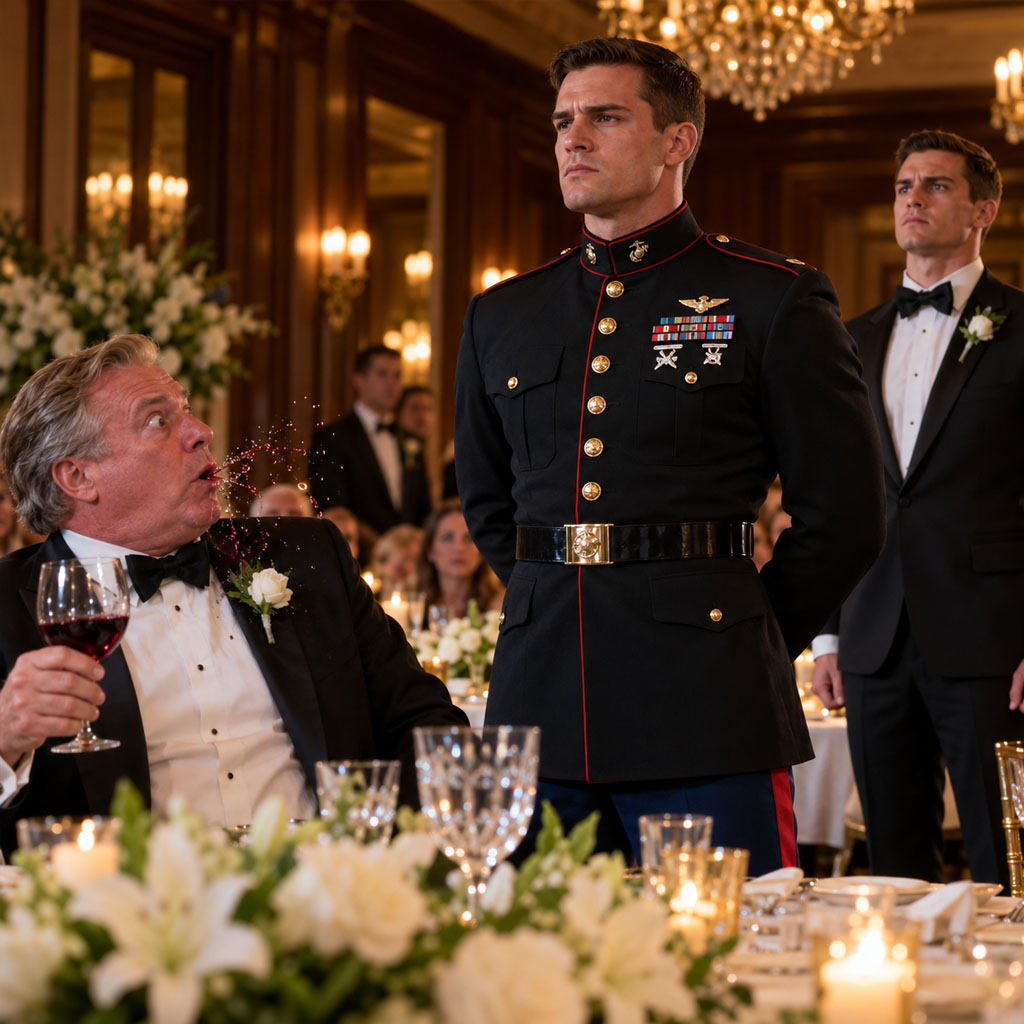
I parked my aging pickup near the service entrance and walked inside wearing my dress blues. Several guests looked at my uniform with polite curiosity. My father barely acknowledged it.
Brandon wore an ivory dinner jacket and an expensive watch. He looked confident as he shook hands with Emily’s relatives, although I noticed he avoided meeting my eyes.
The ceremony went ahead, and Emily looked beautiful. Still, there was sadness in her expression as she exchanged vows with my brother. I wondered whether she was celebrating the man she loved or holding on to the man she hoped he would become.
At the reception, I found my table near the back. Six Marines who had served alongside me were waiting there, including Staff Sergeant Daniel Brooks and Captain James Porter. They had been invited months earlier through a mixture of family courtesy and Brandon’s desire to impress important people.
“Nice place, sir,” Daniel said, glancing at the enormous chandeliers.
“Expensive place,” I corrected.
James smiled. “You sound like you’re reviewing a supply contract.”
“Old habits.”
For the first time that day, I laughed.
Dinner began pleasantly enough. Emily’s father, Thomas Whitmore, welcomed the guests and spoke about the importance of honesty, loyalty, and building a marriage on mutual respect. His words drew warm applause.
Then my father stood to deliver his toast.
He praised Brandon as the future of Bennett Auto Repair, describing ambitious expansion plans and the supposed success of the luxury division. He told stories about expensive clients and impressive business opportunities, none of which resembled the accounts I had examined.
Brandon basked in the attention.
Then Dad noticed me.
“And, of course, there’s Matthew,” he said, raising his glass. “He’s been in the Marines so long I doubt he remembers what a real day’s work looks like.”
Several guests chuckled.
Dad grinned. “Brandon is building a business empire, while his older brother has made a career out of following orders. Some people are born to lead, and some are content to do nothing.”
The laughter grew louder.
I felt the same old humiliation crawl up my neck. Thirty-six years old, a lieutenant colonel, and somehow I was standing in my father’s garage again, listening to him tell everyone I was worthless.
But before I could decide whether to leave, Daniel rose from his chair.
James stood beside him, followed by the other Marines. Their sudden, disciplined movement drew every eye in the room.
“Sir,” Daniel said to my father, “with respect, I need to correct something.”
Dad frowned. “Excuse me?”
“The man you’re talking about is Lieutenant Colonel Matthew Bennett, our commanding officer. He’s responsible for people who trust him with their lives.”
A hush fell over the ballroom.
James took a step forward. “During the coastal flooding two years ago, Colonel Bennett coordinated emergency support that helped evacuate thousands of civilians. He worked through the night to get food, water, and medical supplies to communities cut off by the storm.”
Daniel looked directly at Dad.
“When our convoy was stranded during a deployment, he stayed with us until every Marine was accounted for. He could have taken an easier position, but he chose to share the hardship.”
His voice thickened.
“Sir, I have two children who still have their father because of decisions your son made. I won’t sit quietly while anyone calls him lazy.”
Nobody laughed now.
My father stared at the men in disbelief. His eyes shifted toward the rank insignia on my uniform, as though he were seeing them for the first time.
“Lieutenant colonel?” he whispered.
I stood and motioned gently for the Marines to sit.
“Thank you, gentlemen,” I said. “You’ve made your point.”
But Daniel remained standing just long enough to add one final sentence.
“With all due respect, sir, you should be proud of your son.”
Dad lowered his glass.
Across the ballroom, Thomas Whitmore watched the exchange with a troubled expression. Emily sat completely still, her hands folded in her lap.
Then she stood.
“Dad,” she said softly, addressing Thomas, “there’s something I need to tell you.”
Brandon reached for her hand, but she pulled away.
“Please don’t,” she whispered.
Thomas approached the head table, and Emily began explaining what she had discovered about the unpaid wedding bills and Brandon’s business debts. She spoke slowly, struggling to keep her voice steady.
Brandon interrupted.
“Emily, this is a private matter. We can discuss it later.”
“No,” she answered. “I gave you that chance.”
She turned toward her father.
“Brandon told me the business was thriving. But the cars are rented, the garage is buried in debt, and he kept promising money that never existed. He told me he would explain everything before we got married, and he didn’t.”
Thomas looked at my brother.
“Is that true?”
Brandon said nothing.
Patricia hurried forward, insisting that the problems were temporary and that the family simply needed access to better financing.
Thomas’s expression hardened.
“Are you suggesting my daughter’s marriage was supposed to solve your financial problems?”
Nobody answered him.
Emily wiped tears from her cheeks.
“The wedding almost didn’t happen because so many bills were unpaid,” she continued. “Someone else covered them so the people working here wouldn’t be left with nothing.”
She looked toward me.
“Matthew paid those bills out of his own savings. He asked for no recognition. He just didn’t want anyone else hurt.”
The ballroom erupted into shocked conversation.
Dad stared at me as if I had become a stranger.
“You paid for all this?” he asked.
“Enough to settle the outstanding wedding expenses,” I replied. “That doesn’t fix what happened at the garage.”
Brandon finally found his voice.
“You had no right to interfere in my business!”
I looked at him.
“Your business? You mortgaged Dad’s livelihood, stopped paying honest workers, and lied to the woman you married. Which part of that was supposed to stay hidden?”
He opened his mouth, then closed it.
Emily removed her wedding ring and placed it on the table.
“I wanted to believe you,” she said. “But I can’t build a marriage with someone who keeps choosing appearances over the truth.”
She turned to her father and quietly asked him to take her home. The celebration ended in confusion as guests began gathering their coats, and the musicians stopped playing.
I didn’t stay to watch the aftermath.
Outside, the evening air was cool and smelled of freshly cut grass. I had nearly reached my truck when I heard someone calling my name.
“Matthew! Son, please.”
Dad stumbled toward me, his jacket hanging open and his face drained of color.
For a moment, neither of us spoke.
Then he asked the question I had waited my entire life to hear.
“Why didn’t you ever tell me who you really were?”
I looked at him beneath the parking lot lights.
“Dad, I tried. For years.”
His eyes filled with tears.
“And every time I came home, you told me I was nothing.”
Chapter 4
Dad leaned against my truck, struggling to find words. He looked older than he had that morning. The expensive tuxedo could no longer disguise a frightened man who had just watched his carefully constructed world fall apart.
“I didn’t know about all those debts,” he said. “Brandon kept telling me everything was going to work out.”
“You signed the loans, Dad,” I replied. “You didn’t ask questions because you liked the answers he gave you.”
He stared at the pavement.
“I thought I was building something important.”
“You already had something important. Grandpa helped you start that garage, and people trusted you. You didn’t have to turn it into a luxury empire to make it worthwhile.”
Dad rubbed his face with trembling hands.
“I’ve treated you terribly,” he whispered.
I said nothing.
He finally looked up.
“Can you help me save the business?”
There it was. The request I had expected, arriving only minutes after his first acknowledgment of how he had treated me.
“I won’t pay Brandon’s debts,” I said. “And I won’t pretend any of this is a temporary misunderstanding. You have to face what happened.”
“But we’ll lose everything.”
“Then you’ll have to decide what matters enough to rebuild.”
He began crying quietly.
I had imagined that moment many times during my childhood. I thought seeing Dad humbled might somehow erase the years of humiliation. Instead, I felt only sadness for everything we had wasted.
“I’m not shutting you out forever,” I told him. “But if we ever have a relationship, it has to be honest. I can’t keep coming home to be insulted, and I won’t buy your respect.”
I drove away before he could answer.
Three months passed.
Emily began the process of ending her marriage, supported by her family. Brandon’s debts continued to surface, along with evidence that he had misused company funds.
When creditors demanded repayment, Brandon disappeared after taking the last remaining money from the business account. Patricia left shortly afterward, filing for divorce and moving to Florida.
Dad was left alone with a failing garage and a house he could no longer afford.
Kevin occasionally told me how things were going. I never asked him to watch my father, but news traveled quickly in a small town. Eventually, he mentioned that the bank had begun foreclosure proceedings.
I thought about Grandma Eleanor’s letter for several nights.
She had warned me not to rescue people from their own dishonesty. But she had also told me to protect what deserved protecting.
My grandfather’s old repair shop had once provided steady work for local families. It wasn’t the building’s fault that the people managing it had lost their way.
After consulting an attorney and reviewing the company’s financial position, I approached the bank about purchasing the property and business assets through a properly structured sale. I used part of Grandma’s trust, taking care to keep the transaction separate from Dad’s personal debts.
When the paperwork was completed, Bennett Auto Repair belonged to me.
I returned to North Carolina on a cold November morning.
The flashy sports cars were gone. Weeds pushed through cracks in the parking lot, and the once-busy garage stood silent beneath gray clouds.
Inside, I found Dad wearing his old blue coveralls. He was packing tools into a battered metal chest.
“Matthew?” he said, surprised.
I placed the documents on his workbench.
“The bank has completed the sale,” I told him. “I bought the shop and its equipment.”
He looked at the papers, then at me.
“You saved it?”
“I bought it,” I said gently. “There’s a difference.”
Dad lowered himself onto a stool.
“I suppose you’ll want me out of here.”
“Actually, I need a mechanic.”
He looked up.
“I know how to manage budgets, organize supplies, and coordinate people,” I continued. “But you’re still the best mechanic I’ve ever known. I’d like to hire you as the shop’s lead technician.”
His mouth trembled.
“You’d give me a job?”
“A fair wage, clear responsibilities, and an honest set of books. No more pretending we’re something we’re not. We’ll repair cars for the people who live around here.”
Dad stared at his hands.
“And if I make a mistake?”
“We fix it. But if you lie to me, we stop working together.”
For a long time, he remained silent.
Then he nodded.
“I understand.”
We shook hands across the workbench.
Rebuilding the business wasn’t easy. I hired a reliable local manager to handle daily operations while I continued my Marine Corps career. Dad worked with two younger mechanics, and I supervised the finances during leave and through regular meetings.
We restored the original Bennett Auto Repair sign. We offered straightforward prices, kept our promises, and gradually welcomed back customers who had stopped trusting the business.
Some evenings, Dad and I stayed after closing to organize the shop or clean the repair bays. At first, our conversations were careful and awkward. Years of hurt couldn’t disappear because of one business agreement.
Then, one afternoon, everything changed.
We were working beneath an old Ford pickup when Dad asked me to hand him a breaker bar. I passed it over, and he loosened a stubborn bolt with a satisfied grunt.
He wiped his forehead and looked at me.
“Matt, there’s something I’ve been meaning to say.”
I waited.
“I was jealous of you.”
That was the last thing I expected to hear.
“When you left for the Marines, I figured you’d come running home,” he continued. “Then you started doing well. Every time you got promoted, I felt proud for a moment, and then I felt ashamed.”
“Why?”
“Because you were becoming a good man without any help from me. I didn’t know how to admit that I’d been wrong about you.”
He set down the wrench.
“Brandon was easy to praise because he told me what I wanted to hear. You made me look at the kind of father I’d been, and I hated what I saw. So I kept putting you down.”
His eyes grew wet.
“I let Patricia treat you like you didn’t belong. I made you feel unwanted in your own home. There isn’t an excuse for that.”
For once, he didn’t blame anyone else.
“I’m sorry, Matthew,” he said. “Not because you bought the shop. Not because you turned out successful. I’m sorry because you were my little boy, and I should have loved you better.”
I stood beneath that old truck, holding a flashlight, and felt something inside me finally loosen.
“I needed you to say that a long time ago, Dad.”
“I know.”
I thought about the frightened eighteen-year-old who had walked away carrying everything he owned in one duffel bag. I wished that boy could have heard those words.
“I forgive you,” I said.
Dad began crying.
I put my hand on his shoulder and stood beside him until he was ready to return to work.
A year later, Bennett Auto Repair was profitable again. It wasn’t making anyone rich, but it paid its employees, served its customers, and gave my father a reason to get up each morning.
We celebrated Thanksgiving at Grandma Eleanor’s farmhouse.
Kevin joined us, along with Emily, who had gradually become a close friend. She had finished the legal process of ending her marriage and was rebuilding her life with quiet determination.
Dad arrived carrying a homemade pecan pie. He wore a clean flannel shirt and seemed happier than I’d seen him in years.
After dinner, he stood with his glass of iced tea.
“I’d like to say something,” he announced.
The room grew quiet.
“For a long time, I thought success meant money, cars, and having people admire me,” he began. “I nearly destroyed my family chasing things that didn’t matter.”
He turned toward me.
“I had a son who was brave, hardworking, and decent, and I was too foolish to recognize him. I can’t give him back those lost years, but I can spend whatever time I have left being the father he deserved.”
His voice cracked.
“Matthew, I’m proud of your service. I’m proud of the way you treat people. But most of all, I’m proud you’re my son.”
Kevin raised his glass. Emily smiled through her tears.
I looked around Grandma’s old dining room, remembering how safe I had always felt beneath that roof.
For most of my life, I had believed I needed to accomplish something extraordinary before my father would finally love me. I had chased promotions, accepted dangerous assignments, and carried responsibilities that sometimes kept me awake at night.
But that Thanksgiving, I understood what Grandma had been trying to teach me.
My worth had never depended on my father’s approval. His change of heart was a gift, but it wasn’t what made me worthy of love.
I raised my glass toward him.
“Thank you, Dad.”
Outside, autumn leaves drifted across the farmhouse porch, and the old oak trees stood firm against the November wind.
For the first time in my life, I wasn’t trying to prove that I belonged.
I was simply home.
THE END.