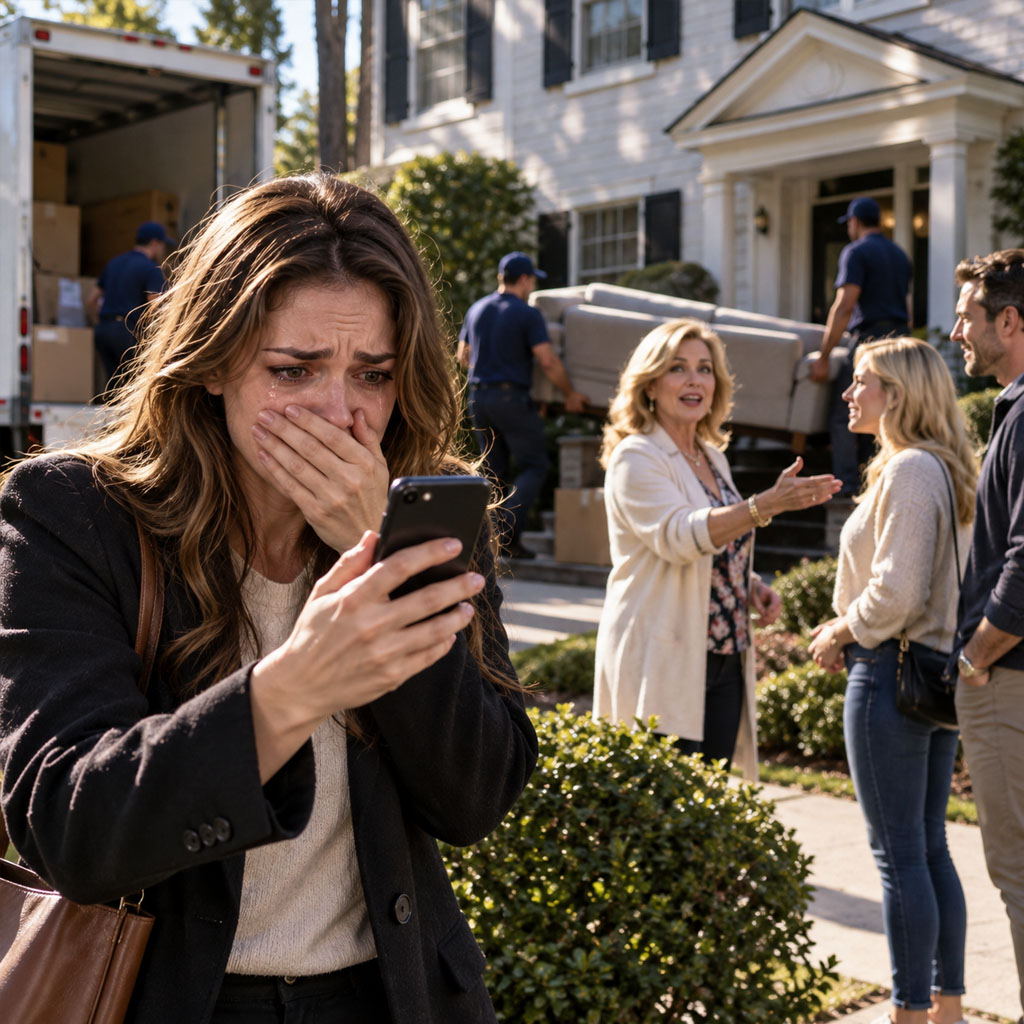
My mother stood on the front porch of the house I’d spent ten years working toward, smiling as strangers carried furniture through my front door. I was four hundred miles away when my neighbor sent me the photograph. What frightened me most wasn’t the moving truck in my driveway, but the fact that my parents had apparently decided I no longer had a right to the home I owned.
Chapter 2
I stared at the document until the words blurred together. Someone had written my name, imitated my signature, and used the paperwork to make my parents appear to be the lawful owners. They hadn’t merely tried to sell my house behind my back; they’d created a false ownership record to make the sale possible.
Rachel found me sitting at her kitchen table just before sunrise.
“You look like you haven’t slept,” she said.
I turned the laptop toward her.
“My parents forged my signature.”
She studied the document, then quietly poured me a cup of coffee. Her large gray cat, Chairman, watched from the windowsill as though he disapproved of the entire situation.
“Well,” Rachel said, “that explains why your mother looked so pleased with herself yesterday.”
I managed a tired smile, but it disappeared almost immediately.
The following morning, Rebecca walked me through the documents in her King of Prussia office. A quitclaim deed purportedly transferred the property from me to my parents. Once it appeared in the public record, they’d arranged a private sale through a local real estate contact.
The notarial acknowledgment made the situation even more serious.
“I was in Cleveland that day,” I said. “I have my airline itinerary and hotel receipts.”
“Those records will matter,” Rebecca replied. “The signature and acknowledgment require investigation. We’re taking immediate steps to protect the property.”
She’d already notified the title company and obtained a hold on the pending closing while seeking emergency court relief. The buyers’ deposit remained in escrow, and the supposed sale had not been completed.
Then she told me something I hadn’t considered.
“The people moving into your home appear to be innocent purchasers. They believed your parents had authority to sell.”
Their names were Daniel and Claire Collins. They had a six-year-old daughter, Sophie, and had recently sold their previous house. They’d planned to move into mine before the school year began.
I felt sick.
My parents hadn’t simply betrayed me. They’d dragged another family into their scheme.
“I want to make sure they aren’t abandoned in the middle of this,” I told Rebecca.
“We’ll determine their actual losses and the appropriate claims,” she said. “But remember, you didn’t create this situation.”
That afternoon, Rachel drove me home to inspect the property and collect my truck. The movers were gone, and the police had cleared the scene. Several boxes remained near the garage, but most of my belongings appeared undisturbed.
Inside, the air smelled faintly of unfamiliar perfume.
I walked through the rooms slowly. My favorite chair stood near the fireplace, and Grandma’s oak dining table remained beneath the kitchen window. Everything looked familiar, yet I felt as though someone had stepped into my life and tried to erase me.
Rachel stood in the doorway.
“You okay?”
I touched the back of the dining chair.
“I used to think buying this house meant I’d finally made something nobody could take away.”
She answered gently.
“The house is still here, Matthew. And you’re fighting for it.”
Before the emergency hearing, I went to my parents’ home. Rachel came along, and I asked her to remain nearby while we spoke.
Derek was sitting on the couch scrolling through his phone. Mom stood beside the fireplace, and Dad folded his arms as soon as I entered.
“You’re making a terrible mistake,” he announced.
I placed a folder on the coffee table.
“That’s a copy of the deed you filed. That’s the emergency petition, and those are the records showing I wasn’t in Pennsylvania when someone supposedly witnessed my signature.”
Mom’s face drained of color.
“Why are you doing this to us?” she whispered.
I stared at her.
“Why did you do this to me?”
Derek finally looked up.
“Matt, come on. Mom and Dad were just trying to help with the wedding.”
“Did you know they were selling my house?”
He shifted uncomfortably.
“They said they were figuring out some financing.”
“Did they mention my house?”
He didn’t answer.
“Derek.”
“They said you’d be fine,” he muttered. “You always figure things out.”
Something inside me went painfully still.
I looked at my younger brother, the boy whose happiness had always come first. He hadn’t personally signed those documents, but he’d known enough to warn me that something was wrong.
Instead, he’d remained silent because he wanted his wedding.
Dad stepped between us.
“Family takes care of family. That’s what we’ve taught you both.”
“No,” I replied. “You’ve taught Derek that someone else will pay for whatever he wants.”
Mom began crying.
“We spent our lives raising you. Doesn’t that count for anything?”
“It counts for love and respect,” I said. “It doesn’t give you ownership of my home.”
I left the folder on the table and walked out.
The next morning, Rebecca arranged a meeting with the Collins family before the court hearing. Daniel was a tall, soft-spoken man, and Claire looked exhausted from worry. Sophie sat beside her mother clutching a stuffed rabbit.
“We honestly thought everything was legitimate,” Daniel said.
“I believe you,” I answered.
Claire wiped her eyes.
“We already told our landlord we were leaving. Sophie was so excited about having her own room.”
Sophie looked up.
“I was going to paint it purple,” she said. “With little silver stars.”
My throat tightened.
I thought about my parents smiling while helping this family move into a house they had no right to sell. They’d treated real people, including a child, as obstacles to be handled after Derek’s celebration was paid for.
“I’m sorry you’ve been put through this,” I told them. “I’ll cooperate fully so you can recover what you’re owed.”
At the emergency hearing, Judge Evelyn Wong reviewed the ownership records, my travel documentation, and the contested deed. My parents’ attorney argued that they’d believed the property could be treated as a shared family resource.
The judge regarded him steadily.
“Your clients’ beliefs about family obligations do not establish ownership of real estate,” she said.
Rebecca explained that I’d never authorized a transfer or sale. She also submitted the documentation showing that the notarized signature was dated while I was away on business.
The judge granted emergency relief to halt the transaction and protect the recorded title pending further proceedings. The sale was stopped, and the buyers were able to begin the process of recovering their escrowed funds.
The apparent forgery was referred for criminal investigation.
When we emerged into the hallway, Mom hurried toward me.
“Matthew, please,” she cried. “You can’t let us go to prison over a misunderstanding.”
I looked at the woman who’d taught me to say please and thank you, to respect other people’s property, and to tell the truth.
“You had a hundred chances to stop,” I said. “You chose not to.”
Dad’s face reddened.
“You’ve destroyed Derek’s wedding!”
“No, Dad. You endangered our family because you couldn’t tell Derek no.”
For once, my father had nothing to say.
Chapter 3
The criminal investigation moved forward over the following months. Investigators examined the deed, the purported signature, the circumstances of its notarization, and the communications surrounding the proposed sale. They also reviewed additional irregularities involving attempts to establish financial and utility arrangements connected to my property.
The evidence revealed planning that had begun well before my trip to Ohio.
That discovery hurt almost as much as the forged signature.
My father had asked about my travel dates because my absence gave them an opportunity. My mother had volunteered to collect the mail because she wanted access to my home. The affectionate promises they’d made before my departure had concealed what they intended to do.
I remembered how warmly Mom had smiled while accepting my spare keys.
For weeks, I found myself replaying ordinary conversations and wondering which moments had been genuine.
Rachel helped me through the worst days. She never pretended that the situation was simple, and she never told me what I should feel.
One evening, while we sat on her back patio, she asked whether I missed my family.
“That’s the strange part,” I admitted. “I miss the family I thought I had.”
She nodded.
“Sometimes those are two different things.”
I’d spent my childhood trying to earn the same approval Derek received without effort. When I graduated college, my parents congratulated me, then immediately discussed Derek’s latest achievement. When I bought my house, Mom admired the kitchen before suggesting I should help Derek save for a car.
I had mistaken their dependence on me for respect.
They called me reliable because they expected me to endure whatever they demanded.
As the investigation continued, the notary who had acknowledged the disputed deed came under professional scrutiny. Authorities found serious failures in the identification and verification procedures. Although they did not establish that she knowingly participated in the alleged scheme, she ultimately lost her notarial commission.
My parents were charged with offenses related to the fraudulent transfer and attempted sale. They denied criminal wrongdoing and insisted they had believed their actions were justified by an informal family understanding.
Their attorney repeated that explanation at nearly every opportunity.
Meanwhile, Derek’s wedding began falling apart.
First, the destination ceremony was postponed. Then the resort canceled several reservations after outstanding payments weren’t made. Finally, Vanessa ended the engagement.
I learned the news from my aunt Carol, who called one Saturday morning.
“Vanessa says she can’t marry someone who knew his parents were doing something like this and stayed quiet,” she told me.
I sat down on the porch steps.
“How is Derek taking it?”
“Badly. He blames you.”
I looked toward the maple tree beside my driveway.
“Of course he does.”
Aunt Carol hesitated.
“Matthew, I don’t agree with what your parents did. But they’re frightened, and they’re getting older. Couldn’t you find some way to make this easier?”
“I didn’t make their decisions.”
“I know, honey.”
She sounded weary.
“But families have a way of hurting each other and then expecting everyone to keep coming to Thanksgiving.”
I understood what she meant. For years, I’d been the one expected to make peace, overlook insults, and remember that blood mattered more than anything else.
But I was beginning to understand that reconciliation required more than one person willing to forgive.
The criminal case eventually went to trial.
I attended every day, sitting beside Rebecca while prosecutors presented the ownership records, travel evidence, testimony, and communications. The defense continued to argue that my parents had misunderstood their authority.
But the evidence was difficult to reconcile with an innocent misunderstanding.
They’d taken steps to make themselves appear to own a house they knew I’d purchased. They’d entered an agreement to sell it without telling me. They’d allowed another family to begin moving in before the transaction was complete.
The jury deliberated for several hours.
When the verdict was announced, both my parents were found guilty of the principal charges arising from the fraudulent property transaction.
Mom covered her mouth.
Dad stared at the courtroom floor.
At sentencing two weeks later, the judge imposed four years of imprisonment for my father and three for my mother, with release eligibility governed by their sentences and applicable law.
I felt no satisfaction watching them led away.
Only a terrible sadness.
Afterward, Derek confronted me in the hallway.
“Are you happy now?” he shouted. “Mom and Dad are going to prison, Vanessa left me, and our whole family is ruined!”
I looked at him for a moment.
“Did you ever once ask what would have happened to me if they’d succeeded?”
He opened his mouth, then closed it.
“They were trying to give me a beautiful wedding,” he finally said.
“And they were willing to take my home to do it.”
“You could’ve bought another house.”
I almost couldn’t believe the words.
“With what money, Derek?”
He looked away.
“You always figure things out.”
There it was again.
The expectation that my hard work made my possessions available to everyone else.
“I spent years figuring things out because nobody was coming to rescue me,” I told him. “That doesn’t mean you get to take everything I build.”
He shook his head.
“You’re cold, Matt. Just like Dad.”
“No,” I said. “I’m finally learning to protect myself.”
He walked away without another word.
A separate civil judgment later awarded approximately $73,000 in damages and recoverable costs associated with the scheme. My parents’ finances were severely strained, and collecting the judgment would be a long process. Their former comfortable life had collapsed under legal expenses and the consequences of their convictions.
The Collins family eventually found another house.
It wasn’t the colonial they’d expected to buy, but Claire sent me a photograph of Sophie standing in her new bedroom beneath a ceiling painted with silver stars.
“She got her purple room after all,” Claire wrote.
I smiled for the first time that day.
The picture reminded me that the damage hadn’t ended when the attempted sale stopped. Other people had been hurt, too, and some had spent months rebuilding plans my parents had casually disrupted.
Through all of it, Rachel remained beside me.
Our friendship slowly became something neither of us had expected.
We began sharing Saturday breakfasts, taking walks through the neighborhood, and spending quiet evenings cooking dinner while Chairman supervised from his favorite chair. Rachel never pressured me to talk about my parents, but she listened whenever I needed to.
One night, as we washed dishes together, she touched my arm.
“You know you don’t have to earn a place in someone’s life by giving them everything,” she said.
I stood there holding a wet plate.
It was such a simple sentence.
And it took me thirty years to understand it.
Chapter 4
Eight months after the sentencing, I visited my mother in prison.
I hadn’t gone because anyone pressured me. I went because there were things I needed to say, and I wanted to say them while looking her in the eyes.
When she entered the visiting room, I barely recognized her. Her hair had turned noticeably grayer, and the confident woman who once directed every family gathering seemed smaller and exhausted.
“Matthew,” she whispered. “I’m so glad you came.”
I sat across from her.
“Mom, I need you to understand why I’m here.”
She nodded, already crying.
“What you did wasn’t helping Derek. You took something that belonged to me because you believed his happiness mattered more than my security.”
“I know,” she said softly.
I waited.
For once, she didn’t immediately defend herself.
“We thought you could handle it,” she continued. “Your father said you’d always land on your feet.”
I shook my head.
“Do you realize how unfair that is? You raised me to be independent, then used my independence as a reason to take from me.”
Tears rolled down her face.
“I never thought we’d end up here.”
“Neither did I.”
She reached toward my hand, then stopped.
“Can you forgive me?”
I looked at her for a long moment.
“I don’t know if I can. But I know I can’t go back to pretending what happened was normal.”
She began crying harder.
“What happens when we get out?”
“That’s something you’ll have to figure out. I need distance, Mom. I need a life where I’m not constantly afraid that loving my family means losing what I’ve worked for.”
She whispered that she understood.
Then, just before our time ended, she asked whether I could help Derek because he was struggling financially.
I closed my eyes.
Even now.
Even here.
Her instinct was to ask me to rescue him.
“No, Mom,” I said gently. “Derek is an adult. He has to learn to take care of himself.”
My father’s visit was shorter.
He sat down with his jaw set and his hands folded tightly.
“Come to see what you’ve done to us?” he asked.
“No. I’ve come to tell you what you did to me.”
He looked away.
I told him how it felt to learn he’d arranged to sell my house. I described the fear of watching strangers carry furniture into my living room while I was hundreds of miles away.
I reminded him that he’d questioned me about my travel plans while preparing to misuse my absence.
He listened without apologizing.
Finally, he said, “Derek needed a good start in life.”
“So did I.”
“You were always capable.”
“Because I had to be.”
Dad stared at me.
For a moment, I thought he might finally understand.
Instead, he shook his head.
“You’ve always been stubborn.”
I stood.
“Maybe. But being stubborn is what kept you from taking my home.”
I left without asking him to agree.
On the drive home, I felt a strange mixture of grief and relief. For years, I’d believed that if I found the perfect words, my parents would finally understand how deeply they’d hurt me.
Now I accepted that understanding might never come.
Rachel was waiting at her house when I arrived. She’d made coffee and left a plate of sandwiches on the kitchen counter. Chairman climbed onto my lap the moment I sat down.
“How did it go?” she asked.
“I said what I needed to say.”
“And how do you feel?”
I looked at her across the table.
“Sad,” I admitted. “But lighter.”
Over the following years, I kept my distance.
Derek occasionally tried to reach me through relatives, but I wasn’t ready to rebuild our relationship. I didn’t wish him harm, and I hoped he would eventually create a stable life without expecting someone else to finance it.
When my parents were released after serving the required portions of their sentences, their circumstances were very different from before.
They had sold their home, lost most of their savings to legal expenses, and struggled to find steady work. They eventually settled into subsidized housing and lived on modest incomes.
For years, they’d sacrificed my needs to protect Derek from disappointment.
Yet when they needed practical help after their release, Derek said he couldn’t afford to support them. He was focused on rebuilding his own future.
I heard about his response from Aunt Carol.
The irony wasn’t lost on me.
The son they’d tried to give everything to had finally learned to put his own interests first.
Perhaps that was one lesson our parents had taught him too well.
I didn’t celebrate their hardship. I simply refused to accept responsibility for repairing consequences I hadn’t created.
My own life moved forward.
Rachel and I became a couple, and eventually she moved into my house with Chairman and a surprising amount of art equipment. We converted the smallest bedroom into her design studio and repainted the kitchen a warm shade of cream.
We divided expenses fairly and talked openly about decisions, even small ones.
I discovered that partnership didn’t require one person to surrender everything for the other.
Sometimes love looked like Rachel bringing me coffee before an early meeting. Sometimes it meant taking care of Chairman when she had a deadline. Sometimes it was as ordinary as discussing which flowers to plant beside the porch.
There were no elaborate demands, no threats, and no arguments about what family supposedly owed.
Just two people choosing to treat each other with care.
One autumn afternoon, nearly five years after that terrible phone call from Cleveland, Rachel and I planted a young dogwood tree in the front yard.
The house looked different now. We’d repaired the porch railing, replaced the aging kitchen appliances, and added a little vegetable garden behind the garage. Framed photographs lined the hallway, and Rachel’s paintings brightened the living room.
As I pressed soil around the tree’s roots, she glanced toward the driveway.
“Hard to believe what happened here,” she said.
I followed her gaze.
I could still picture the moving truck and my mother smiling on the porch. Sometimes I remembered the fear as clearly as if it had happened yesterday.
But the memory no longer controlled my life.
“You know what bothers me most?” I asked.
Rachel waited.
“For years, I thought being the responsible son was something I had to prove. I thought if I worked hard enough, helped enough, and never complained, my parents would finally see me.”
She rested a hand on my shoulder.
“And now?”
I looked at the house.
“Now I know I never needed their permission to matter.”
Rachel smiled.
We finished planting the tree as the afternoon sun slipped behind the neighboring rooftops. Inside, Chairman waited by the window, looking annoyed that we’d spent so much time outdoors without him.
Later that evening, Rachel and I sat on the porch with two mugs of hot apple cider.
A cool breeze moved through the neighborhood, carrying the scent of fallen leaves. Somewhere down the street, children laughed while playing basketball in a driveway.
I thought about my parents, my brother, and the family gatherings I’d once believed would always be part of my life.
I didn’t hate them.
But I no longer confused forgiveness with permission to be hurt again.
My parents had believed that because I was strong, I could afford to lose more. They’d mistaken my ability to survive hardship for an obligation to endure it.
And when I finally refused, they called me selfish.
For a long time, that word had haunted me.
Now I knew better.
Protecting my home wasn’t selfish. Refusing to accept deceit wasn’t cruelty. Holding people accountable didn’t mean I had stopped caring about them.
It meant I’d finally learned that my life deserved the same respect I’d always been expected to give everyone else.
Rachel leaned against my shoulder.
“Happy?” she asked.
I looked through the front window at the warm light filling our living room. The little dogwood stood beside the walkway, its branches gently swaying in the evening air.
“Very,” I said.
I had worked hard to build a home, nearly lost it to the people I’d trusted most, and spent years rebuilding the peace their betrayal had taken from me.
But this time, the life I’d built rested on something stronger than their approval.
It rested on honesty, mutual respect, and the freedom to decide what I was willing to give.
As the porch light came on, Rachel took my hand.
And for the first time in my life, I understood that being part of a family should never require losing yourself.