By the time my mother finally called, I had already learned to cross my living room with a walker, swallow pain pills without gagging, and accept that strangers had shown me more concern than the people who raised me.
Chapter 2
It was Claire’s father carrying breakfast sandwiches for everyone.
I don’t know why that disappointed me. I had spent weeks telling myself my parents wouldn’t come, yet some foolish part of me had still expected Mom to rush through those elevator doors at the last second, crying and apologizing. Instead, Claire kissed my forehead, Aunt Ruth squeezed my hand, and I was wheeled toward an operating room surrounded by people who weren’t obligated to love me but had chosen to anyway.
The surgery lasted five hours.
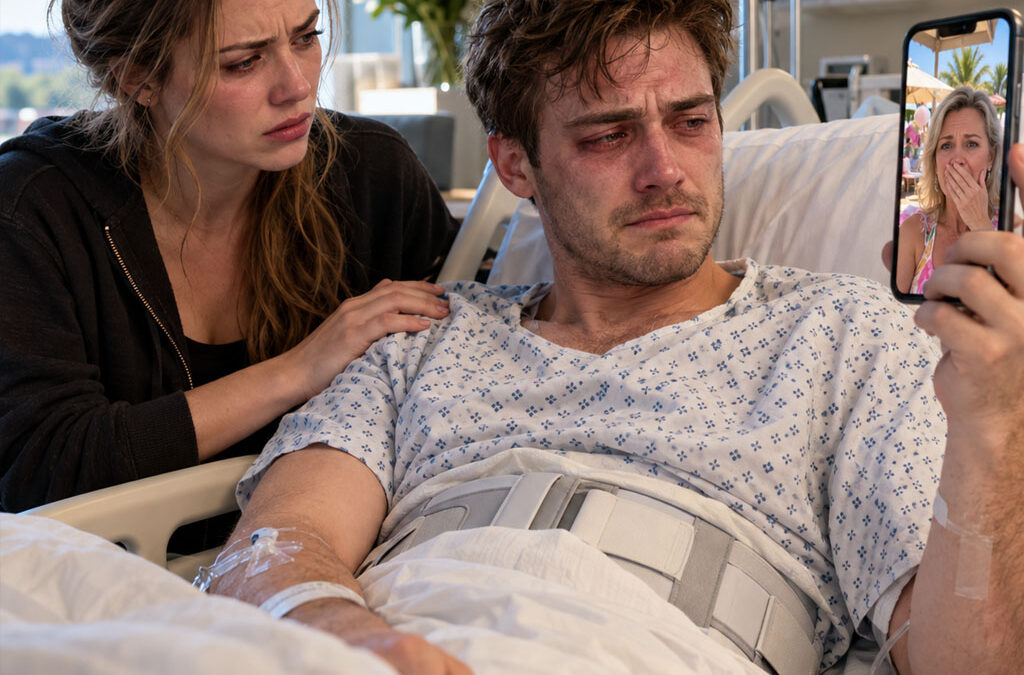
When I woke, Claire was beside me. Her eyes were red, and she was holding my hand carefully around the IV tubing.
“Everything went well,” she whispered. “The surgeon said the decompression looked good.”
I tried to speak, but my mouth felt packed with cotton. The first clear question I managed was, “Anybody come?”
Claire knew who I meant.
She shook her head.
I closed my eyes.
Knowing you’re going to be abandoned doesn’t make abandonment hurt less.
During the next two days, Claire’s family rotated through my room. Her mother brought photographs of their ridiculous golden retriever. Her father asked my surgeon intelligent questions and wrote down every answer. Daniel handled prescriptions and disability paperwork. Aunt Ruth returned the next morning with takeout tacos because, according to her, “hospital food is punishment enough without adding back surgery.”
My immediate family sent nothing.
That first evening, Lauren posted a photograph from Cabo. She and her friends stood beside an infinity pool in matching pink swimsuits, cocktails raised toward the sunset.
Her caption included the words Family first.
Claire saw me staring.
“Give me the phone.”
“I’m fine.”
“You’re furious.”
“I can be both.”
She took it anyway.
On my third day, I was discharged. I could barely walk ten feet without sweating. Claire had transformed our living room into a recovery station with pillows, medication charts, water bottles, and a walker positioned beside the couch.
That night Dad texted.
Heard everything went well. Glad you’re okay.
Two sentences after five hours of spinal surgery.
I didn’t answer.
Two days later, Mom called.
“I hope you can understand why none of us could be there,” she began.
I told her exactly what I understood.
She immediately accused me of being cruel.
“Lauren needed support,” she said.
“For what? Drinking near a pool?”
“It was her bachelorette weekend.”
“And this was my spine.”
“Why does everything have to become a competition with you?”
I nearly laughed. “That’s an interesting question coming from this family.”
She started crying. Whether the tears were real or strategic, I no longer cared.
I told her I wanted the nineteen thousand dollars repaid at five hundred a month.
“You are using money to manipulate us.”
“No. I’m asking you to repay a debt.”
“We’re your parents.”
“Then act like it.”
I ended the call.
Daniel drafted a formal demand letter the following week. We had no signed loan contract, but years of text messages contained repeated admissions from both my parents. We found promises to repay me after refinancing, excuses for missed payments they had never actually made, and one message from Dad saying, We haven’t forgotten what we owe you.
Daniel tapped that message on his screen. “A judge will like this.”
The letter proposed five hundred dollars a month for thirty-eight months.
Mom called it blackmail.
Dad called it unnecessary.
Lauren called it proof I had never loved the family.
Nobody called it inaccurate.
Meanwhile, I learned to walk again.
Three times a week, a physical therapist made me perform movements that looked absurdly simple until pain turned them into mountains. Claire never pitied me. She challenged me when I wanted to quit and backed off when she knew I genuinely needed rest.
Eight weeks after surgery, I stopped using the cane.
At twelve weeks, I drove.
At sixteen, I returned to work part-time.
My parents occasionally sent two hundred dollars, then skipped a month, then sent one hundred fifty and acted as though they deserved gratitude. I recorded every payment.
Four months after surgery, Claire and I were walking along a reservoir trail when I stopped beside the water.
My back still stiffened after long distances, but my right foot no longer dragged.
“Marry me,” I said.
Claire stared. “That’s your proposal?”
“My back works. You stayed when everything was awful. I don’t feel like waiting for a restaurant reservation.”
She laughed so hard she started crying.
“Do you even have a ring?”
I pulled it from my jacket.
She said yes.
We planned a small wedding for November of the following year. Twenty-eight guests. Claire’s family. Aunt Ruth. Friends who had proven themselves when life was inconvenient.
My parents weren’t invited.
Neither were Lauren or Ryan.
Around the same time, Lauren mailed invitations for her own wedding. Hers was scheduled a few weeks before ours and apparently cost enough to finance a small house. She texted that she hoped I would attend so we could “put everything behind us.”
I didn’t respond.
Six months after the demand letter, my parents had repaid only twenty-four hundred dollars.
Daniel asked, “Ready?”
“For what?”
“Court.”
I looked at the payment spreadsheet, then at the scar running down my back in the reflection of the dark computer screen.
“File it.”
The lawsuit finally got their attention.
Dad left three voicemails in one afternoon about embarrassment, family privacy, and how disappointed he was that his son would involve lawyers.
He never said, We’ll repay what we owe.
Lauren’s wedding came and went in September. I saw photographs online because relatives shared them. Mom posted dozens of pictures and wrote about her perfect daughter, her perfect day, and the importance of family.
A few weeks later, Claire and I stood beside a lake with mountains behind us and promised each other something much simpler: that showing up mattered.
Aunt Ruth gave a toast that made half the guests cry. Daniel was my best man. Claire’s father walked her down the aisle. Nobody fought. Nobody demanded attention. Nobody made love conditional.
Our honeymoon was a cabin six hours north where the cell service disappeared completely.
One morning, we hiked three miles.
Claire stopped on the trail and took a picture of me walking ahead of her.
“Do you know what I’m photographing?” she asked.
“Trees?”
“Your feet.”
I looked down.
Both were moving normally.
For several seconds neither of us spoke.
I had almost postponed that surgery.
The thought made me cold.
The civil hearing took place on December 10.
My parents arrived late.
The judge reviewed our evidence and asked Dad, “Do you dispute receiving nineteen thousand dollars from your son?”
Dad shifted in his chair. “No, Your Honor, but this was family helping family.”
“Do you dispute promising to repay it?”
He hesitated.
Daniel handed the judge copies of the messages.
The judge read silently.
Mom interrupted. “We’ve made payments.”
“How much?”
Mom looked at Dad.
Neither answered.
Daniel did.
“Twenty-four hundred dollars over three years.”
The judge lowered her glasses. “Why has the remainder not been paid?”
Dad began listing household expenses. Then, incredibly, he mentioned Lauren’s wedding.
The judge stopped him.
Judgment was entered in my favor for the remaining balance, interest, and court costs. My parents were ordered to pay six hundred dollars every month. If they repeatedly failed, we could pursue wage garnishment.
Outside the courtroom, Mom hurried toward me.
“Evan, please.”
I kept walking.
The first payment arrived late and short.
Four hundred dollars instead of six.
Daniel sent notice that garnishment would follow if they failed to correct it.
Dad called from another number.
“Son, four hundred is better than nothing.”
“The judge said six.”
“You know things are tight.”
“You had three years.”
“We’re trying.”
“No. Now you’re complying.”
The remaining two hundred arrived three days later.
February’s payment was on time.
I should have known the sudden cooperation meant pressure was building somewhere else.