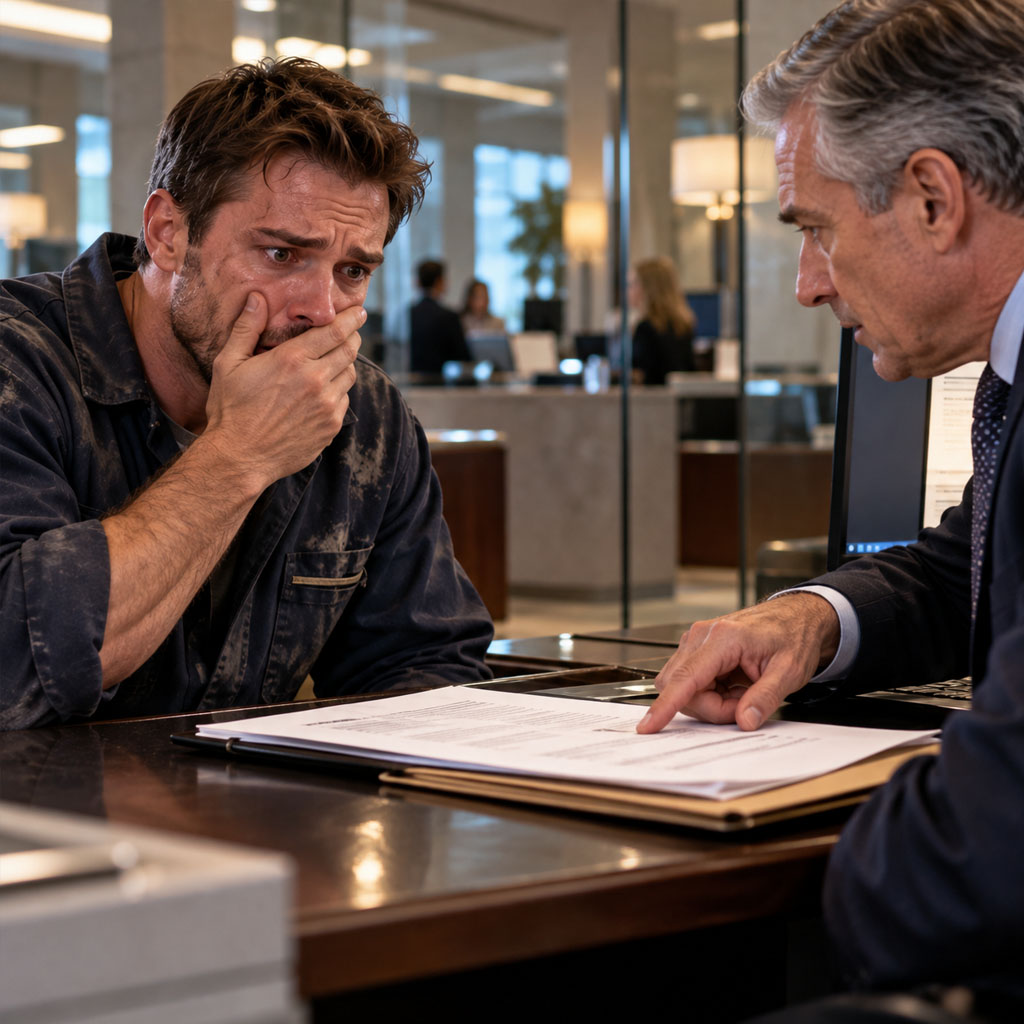
“Sir, someone is trying to withdraw $400,000 from your account,” the woman said. “Did you authorize that transaction?” I nearly dropped my phone because I had never opened an account at her bank. Then she mentioned the year it had been established, and I felt the blood drain from my face.
Chapter 2
I drove to Toledo instead of calling Caroline back. My wife had listened quietly when I explained what happened, then urged me not to confront anyone until I understood the situation. Megan had always been the practical one in our marriage, and that afternoon I needed her steady judgment more than ever.
Ruth Pruitt’s law office occupied the second floor of an old brick building near the courthouse. She was a silver-haired woman in her late sixties, dressed in a dark green cardigan with reading glasses hanging from a chain. When I introduced myself, her expression softened.
“Daniel,” she said, taking both my hands. “You look so much like your father.”
I hadn’t heard those words in years.
She led me into her office and motioned toward a chair.
“I’ve been hoping to speak with you for a long time.”
I sat down, still carrying the bank folder.
“Why did my mother keep this from me?”
Ruth looked toward a framed photograph on her desk before answering.
“Because what happened to your father frightened her more than you ever knew.”
My father, Thomas Reeves, had been an industrial electrician at Halverson Chemical outside Toledo. He was a quiet man who smelled of machine oil and Old Spice, and he loved teaching me how things worked. I remembered sitting beside him in the garage while he repaired an old lawn mower, patiently explaining the difference between a worn part and a dangerous one.
He died in December 1994 after an explosion at the chemical plant.
The company called it a tragic industrial accident.
But Ruth told me there was more to the story.
“Three weeks before the explosion, your father reported serious corrosion in a pressurized system,” she said. “He warned his supervisors that a failure could kill someone.”
She opened an old file.
“His warnings were ignored. Worse, the investigation uncovered evidence that inspection reports had been falsified.”
I looked down at the yellowed documents.
“My father knew it was dangerous?”
“He knew someone could get hurt. He tried to prevent it.”
Ruth explained that her father, Harold Pruitt, had represented my mother after the explosion. Once Halverson Chemical understood the evidence against it, the company negotiated a confidential settlement worth $4.6 million.
Half was placed in a trust for Caroline. The other half was placed in one for me.
Our mother’s decisions about when to release the money differed.
“Caroline received control of her trust when she turned thirty,” Ruth explained. “Your mother directed that yours remain invested until your fortieth birthday.”
I stared at her.
“Caroline knew about the settlement?”
“Yes.”
“And she never told me?”
Ruth lowered her eyes.
“Her circumstances became complicated.”
My sister had always lived more comfortably than I did. She worked in real estate, wore beautiful clothes, and lived in a large colonial house with her husband. Greg managed investments and liked talking about expensive restaurants and golf trips.
I’d always assumed they were simply successful.
Ruth explained that Caroline’s trust had been distributed years earlier. Greg persuaded her to invest heavily in a restaurant venture, which failed after several difficult years.
Much of the money disappeared.
“Your mother was deeply troubled by what happened,” Ruth said. “She believed Greg was exercising too much control over Caroline’s finances.”
I thought about the last months of Mom’s life.
Caroline and Greg had handled most of her appointments, bills, and correspondence. I’d visited on Sundays, bringing groceries and sitting beside her bed. Sometimes Mom looked as though she wanted to tell me something, but she’d glance toward the doorway and fall silent.
I’d assumed she was exhausted.
Ruth reached into a drawer.
“Your mother became concerned that some of her correspondence wasn’t reaching her. That’s why she arranged the special restriction at the bank.”
She placed a sealed envelope before me.
My name was written across the front in Mom’s careful handwriting.
“She gave this to me shortly before she died,” Ruth said. “She wanted you to have it personally.”
My hands trembled as I picked it up.
“Why didn’t she tell me herself?”
“She intended to. But her health declined faster than anyone expected.”
Ruth leaned forward.
“Daniel, before you speak with your sister or her husband, please let me contact the appropriate authorities. That document presented at the bank raises serious questions.”
I nodded.
But when I returned to my truck, I found six missed calls from Caroline.
I finally answered.
“Danny,” she said breathlessly. “Where have you been? Greg says there’s been some terrible misunderstanding at a bank.”
“What kind of misunderstanding?”
“I don’t know everything. Please come over. We need to talk.”
I looked at the envelope resting on the passenger seat.
Against Ruth’s advice, I drove to Upper Arlington.
Caroline opened the door looking pale and exhausted. Greg greeted me with his usual polished smile and invited me into the living room.
“Let’s clear up this confusion,” he said. “Your mother left a small trust, and we’re simply trying to handle the final paperwork.”
I sat on the sofa.
“A small trust?”
“Yes. Complicated estate matters.”
I looked directly at him.
“Is thirty-eight million dollars small?”
His smile vanished.
Caroline turned toward him.
“Thirty-eight million?”
For several seconds, nobody moved.
Greg cleared his throat.
“Danny, you’re misunderstanding the structure of those assets.”
Caroline shook her head.
“You told me his trust had been exhausted paying for Mom’s care.”
“Caroline, not now.”
“You said there was almost nothing left!”
Her voice cracked.
I realized she was hearing the amount for the first time.
Greg tried to dismiss the discrepancy, claiming the money was tied up in complicated investments. Then I placed a copy of the suspicious amendment on the coffee table.
“Mom died March ninth,” I said. “This document says she signed it April second.”
Greg’s expression hardened.
“Clerical error.”
“Then who signed it?”
He rose from his chair.
“Your mother wanted the family taken care of. Caroline and I sacrificed years looking after her.”
Caroline stood, too.
“Greg, answer him.”
“Sit down, Caroline.”
“No.”
Her voice was quiet but firm.
“Did you sign Mom’s name?”
Greg stared at her.
Then he looked toward the front door.
“I don’t have to sit here and be accused of crimes in my own home.”
“Then leave,” Caroline said.
He looked shocked.
“What?”
“I want you to leave.”
Greg snatched his keys from the table and stormed out. The front door slammed hard enough to rattle a picture frame.
Caroline sank onto the sofa.
“Danny, I swear I didn’t know.”
I wanted to believe her.
But I’d just discovered that my family had hidden the truth about my father’s death, my inheritance, and the money I’d struggled without for decades.
“I need some time,” I whispered.
I walked outside and sat in my truck beneath a streetlight.
Then I opened my mother’s envelope.
Chapter 3
Mom’s letter was four pages long, written in the careful handwriting I remembered from childhood birthday cards. Near the end, the lines tilted slightly, and several words were difficult to read. I could almost picture her sitting at the kitchen table, struggling to finish what she hadn’t been able to say aloud.
“My dearest Danny,” it began. “If you’re reading this, then I ran out of time. I am so sorry.”
I pressed my hand against my mouth.
She wrote about my father, about his courage in reporting dangerous conditions, and about the grief that followed his death. She explained that the settlement had never felt like a blessing to her. No amount of money could replace the husband she’d loved or give two children their father back.
She’d wanted Caroline and me to grow up understanding the value of work and kindness.
But she admitted she’d made mistakes.
She had kept the secret too long.
“You grew into a good man,” she wrote. “You built something with your own hands. I have been proud of you every single day.”
I stopped reading to wipe my eyes.
Then came the part about Caroline.
Mom explained that my sister had been fifteen when Dad died, old enough to understand the family’s financial fears. She remembered watching Mom cry over bills and hearing relatives wonder how we’d survive.
That fear never left her.
Greg had promised Caroline a life where money would never be a problem. Instead, he gradually took control of her financial decisions.
Mom had suspected for years that he was exploiting her.
“I believe your sister is frightened, Danny,” she wrote. “Not cruel. If she ever finds the courage to do what’s right, please give her a chance.”
The final paragraphs concerned the bank account.
Mom had feared Greg might try to gain access after her death. She arranged for the bank to contact me directly before allowing substantial withdrawals by anyone else.
“I wanted to build one last wall around you,” she wrote. “I couldn’t always protect you when you were little. But I could do this.”
I read the final words through tears.
“Do something good with your life, Danny. Something your father would recognize. Remember that money can buy comfort, but it cannot buy character. I love you, always. Mom.”
I lowered the letter into my lap.
For years, I’d thought my mother had left me almost nothing.
Now I understood she’d spent her final days worrying about how to protect me.
My phone rang.
It was Ruth.
“Daniel, I need you to listen to something,” she said. “Our office received a voicemail late last night. I didn’t hear it until this morning.”
She played the recording.
Caroline’s frightened voice filled my truck.
“Ms. Pruitt, this is Caroline Whitfield. I found some paperwork in Greg’s briefcase. It has my mother’s signature, but I don’t think she signed it. He’s planning to take it to the bank tomorrow. Please stop him. I’m afraid he’s going to hurt my brother.”
I closed my eyes.
Caroline had called before the bank intervened.
Before anyone confronted Greg.
Before she knew how much money was involved.
She’d already tried to protect me.
“Your sister made that call on her own,” Ruth said softly.
I looked toward Caroline’s house. The living room lights were still on.
I went back inside.
She sat exactly where I’d left her, staring at the floor.
I lowered myself onto the couch beside her.
For a long time, neither of us spoke.
Then Caroline leaned against my shoulder.
“I’m sorry, Danny,” she whispered. “I should have questioned him years ago.”
I put my arm around her.
We cried together, two middle-aged siblings grieving the parents we’d lost and the years we’d allowed fear and silence to come between us.
The following days brought discoveries neither of us was prepared for.
Ruth reported the suspicious documents to the authorities, and investigators examined the attempted withdrawal. They reviewed the disputed amendment, the notarial acknowledgment, and Caroline’s warning message.
The notary, Dennis Hoyt, eventually admitted that Greg had paid him to certify a document improperly.
The records also revealed that Greg had been quietly diverting money from Caroline’s accounts for years. He’d concealed losses, transferred funds without properly explaining them, and maintained financial arrangements she knew nothing about.
There was even a separate apartment in Cincinnati.
When Caroline learned about it, she sat at my kitchen table for nearly an hour without speaking.
Finally, she said, “I spent twenty years believing I was married to a successful man.”
Megan reached across the table and her hand.
“You believed someone you loved,” she said. “That doesn’t make his dishonesty your fault.”
Caroline shook her head.
“But I should have seen it.”
“Maybe,” Megan answered gently. “What matters now is what you do with the truth.”
Greg was arrested several days later. Prosecutors pursued charges arising from the forged amendment, the attempted withdrawal, and other misconduct revealed during the investigation.
At first, he denied everything.
But as the case developed, the evidence against him became overwhelming.
He eventually accepted a plea agreement.
Caroline testified about the documents she’d discovered and the financial decisions she’d allowed him to control. She described how he’d convinced her that my inheritance was gone and how she’d unknowingly repeated his false explanations after Mom died.
I sat behind her in the courtroom.
She never looked toward Greg.
When she finished testifying, she walked straight to me.
“Was I okay?” she whispered.
I hugged her.
“You told the truth. That’s what matters.”
Soon afterward, she filed for divorce.
The legal proceedings took months, and some of the financial damage could never be undone. Caroline sold the big colonial house and moved into a small two-bedroom home near a park.
For the first time in decades, she managed her own life.
One afternoon, she invited me over for coffee.
“I keep thinking about Mom,” she said. “All those years she worried about me, and I thought she was just being controlling.”
I looked at a photograph of our parents sitting on her mantel.
“She made mistakes, too.”
Caroline nodded.
“But she loved us.”
“She did.”
I reached into my jacket and handed her a copy of Mom’s letter.
She read it slowly.
When she reached the passage asking me not to hate her, she began to cry.
I sat beside her until she finished.
Neither of us said much afterward.
We didn’t need to.
Chapter 4
The trust distribution was completed the following January. By then, the legal questions concerning the attempted withdrawal had been resolved sufficiently for the funds to be released under the trust’s terms. I sat in Ruth Pruitt’s office signing documents with hands that had spent most of their adult life repairing engines.
When everything was finished, Ruth smiled.
“Your mother would be proud of you, Daniel.”
I thought about Mom’s final letter.
“I hope so.”
The money changed our circumstances immediately, but Megan and I agreed that it wouldn’t change the things we valued.
We paid off the shop’s debt first.
The morning I made the final payment, I stood outside Reeves Auto and Brake and looked at the building I’d nearly lost. The faded sign needed repainting, and the waiting room furniture had seen better days.
But for the first time since buying the business, I didn’t feel a knot in my stomach when I thought about the next month’s bills.
I called Luis into the office.
He’d been working beside me for almost fifteen years, through bad winters, equipment failures, and months when we barely earned enough to cover payroll.
“I’ve got something for you,” I said.
He looked worried.
“You’re not selling the place, are you?”
I laughed.
“Not a chance.”
I told him I wanted to give him a raise and a minority ownership stake in the business.
He stared at me.
“Danny, are you serious?”
“Couldn’t have kept the doors open without you.”
Luis looked down at his hands.
He was a broad-shouldered man who rarely showed emotion, but his eyes filled.
“Your dad would be proud,” he said quietly.
I swallowed hard.
“Thanks, buddy.”
At home, Megan finally reduced her hospital schedule. She still loved nursing, but she no longer had to take every extra shift that became available.
The morning she slept past eight o’clock, I found her sitting at the kitchen table in her bathrobe, looking out the window.
“What’s wrong?” I asked.
She smiled through tears.
“Nothing. I just realized I don’t have to rush anywhere.”
We established a college fund for Lily and began planning a modest family vacation. She wanted to visit the ocean, partly because she loved marine animals and partly because she believed every beach should have a restaurant that welcomed dogs.
I told her we’d look into it.
We didn’t buy a mansion or expensive cars.
I kept my old pickup truck, and Megan continued driving her dependable SUV. We repaired the roof, replaced the aging furnace, and painted Lily’s bedroom the sea-blue color she’d wanted for years.
Our life became more comfortable.
But it remained recognizably ours.
The biggest decision concerned my father’s legacy.
For decades, I’d thought he died because of an unavoidable industrial accident. Now I knew he’d tried to protect his coworkers and had been ignored.
I couldn’t change what happened.
But I could help prevent something similar from happening to another family.
With Ruth’s guidance, I established the Thomas Reeves Workplace Safety Fund. It supported workers who faced retaliation after reporting dangerous conditions and helped families seeking legal assistance following serious workplace injuries.
Our first major case involved a young pipefitter near Cleveland who lost his job after raising concerns about faulty equipment.
His attorney believed the dismissal was retaliation.
The fund helped him pursue his claim.
When the case was resolved in his favor, the young man wrote me a letter.
He said the assistance had allowed him to keep his family in their home while fighting for his rights.
I read it twice.
Then I drove to Toledo.
My father’s grave stood beneath an old maple tree in a quiet cemetery. I’d visited many times over the years, usually bringing flowers and telling him about birthdays, graduations, and the little moments he missed.
That afternoon, I sat beside the headstone for nearly an hour.
I told him about Megan and Lily.
I told him the shop was finally secure.
And I told him about the safety fund that carried his name.
“I hope we’re doing something good with what you left us, Dad,” I whispered.
The wind stirred the maple leaves.
For a moment, I imagined him in our old garage, wiping grease from his hands and telling me that doing the right thing mattered most when it was difficult.
I left the cemetery feeling closer to him than I had in years.
Caroline’s life was changing, too.
Her divorce became final, and she gradually rebuilt her confidence. She took a position with a smaller real estate firm and began enjoying ordinary things she’d once overlooked.
She tended a vegetable garden, volunteered at her church, and adopted a rescue dog named Charlie.
But money remained a painful subject between us.
One Sunday, I visited her new house and placed an envelope on the kitchen table.
Inside were arrangements to help replace a portion of what Greg had wrongfully taken from her, structured so she could regain financial stability without surrendering control of her life.
She pushed it back toward me.
“Danny, I can’t accept this.”
“Why not?”
“Because I’ve already received more than I deserved.”
I looked at her.
“Caroline, Mom wanted both of us to be okay.”
Her eyes filled.
“But it’s your money.”
“That’s why I get to decide what to do with it.”
She shook her head.
“You’ve got your own family to think about.”
“You’re my family, too.”
She began crying.
For a moment, I was afraid she’d refuse again.
Then she picked up the envelope.
“Only on one condition,” she said.
“What’s that?”
“You, Megan, and Lily come for Sunday dinner whenever you can. I don’t want us drifting apart again.”
I smiled.
“Deal.”
That was how our Sunday dinners began.
Caroline wasn’t a particularly good cook, but she was enthusiastic. Her pot roast was usually dry, and Lily developed a habit of politely asking whether there was extra gravy.
Megan brought desserts, I handled the occasional repair around the house, and Charlie followed Lily everywhere hoping she’d drop something edible.
Sometimes Caroline invited old friends. Sometimes we stayed late playing cards. Sometimes we talked about Mom and Dad, sharing memories we’d never discussed when we were younger.
Those evenings became the part of my week I looked forward to most.
One Sunday, Lily noticed Caroline wiping her eyes while we cleared the table.
“Aunt Caroline, why are you crying?”
My sister smiled.
“Because I’m happy, sweetheart.”
Lily frowned.
“People cry when they’re happy?”
“Sometimes,” Caroline said. “Especially when they’ve spent a long time being afraid.”
Lily considered that for a moment, then hugged her aunt.
I stood in the doorway watching them.
Years earlier, I’d thought wealth meant a house without a mortgage, a bank account that never ran dry, and freedom from financial worry.
Those things certainly made life easier.
But standing there, listening to my daughter laugh with the sister I’d almost lost, I understood that the most important part of our inheritance couldn’t be measured in dollars.
My father had left us an example of courage.
My mother had left us a reminder that love sometimes comes wrapped in imperfect decisions.
And Caroline had shown me that even after years of fear, a person could find the strength to tell the truth.
The following spring, Megan and I took Lily to the Atlantic coast. We stayed in a comfortable little beach cottage with peeling blue shutters and a wooden porch overlooking the dunes.
One evening, after Lily had fallen asleep, Megan and I sat outside listening to the waves.
“Do you ever think about what would have happened if the bank hadn’t called?” she asked.
I looked toward the dark water.
“All the time.”
Greg might have succeeded in taking money that was never his. Caroline might have remained trapped in a marriage built on lies. I might have continued working myself into exhaustion, believing my parents had left me nothing but memories.
But the bank had called.
And behind that call was my mother’s final effort to protect me.
“She really thought of everything she could,” Megan said.
I nodded.
“Except she never knew whether it would work.”
Megan reached for my hand.
“Maybe that’s what love is sometimes. Doing the best you can and hoping it reaches the people who need it.”
We sat quietly while the ocean rolled beneath the moonlight.
Back in Ohio, my father’s name now appeared on letters that helped working families defend their rights. My sister had found a peaceful life of her own. My daughter was growing up surrounded by love, without carrying the fear of poverty that had shaped Caroline’s childhood.
And I was still Daniel Reeves, the mechanic who preferred fixing things to talking about money.
I’d discovered that having millions didn’t make me more valuable than I’d been before. It simply gave me the opportunity to do more with the values my parents had tried to teach me.
Sometimes, on quiet mornings at the shop, I think about the woman at the bank who called while I was working beneath that Silverado.
A single conversation changed everything.
But the greatest surprise wasn’t the balance on the screen.
It was learning how much my mother had loved me, how bravely my father had lived, and how much courage my sister had found when it mattered most.
For months after Mom died, I believed she’d left me only a small check and a shoebox of memories.
In the end, she left me a chance to protect the people I loved, honor the father I’d lost, and help strangers who needed someone to stand beside them.
And whenever I think about that inheritance, I remember the final words of her letter.
“Do something good with your life, Danny.”
Every morning, I wake up determined to do exactly that.
THE END.