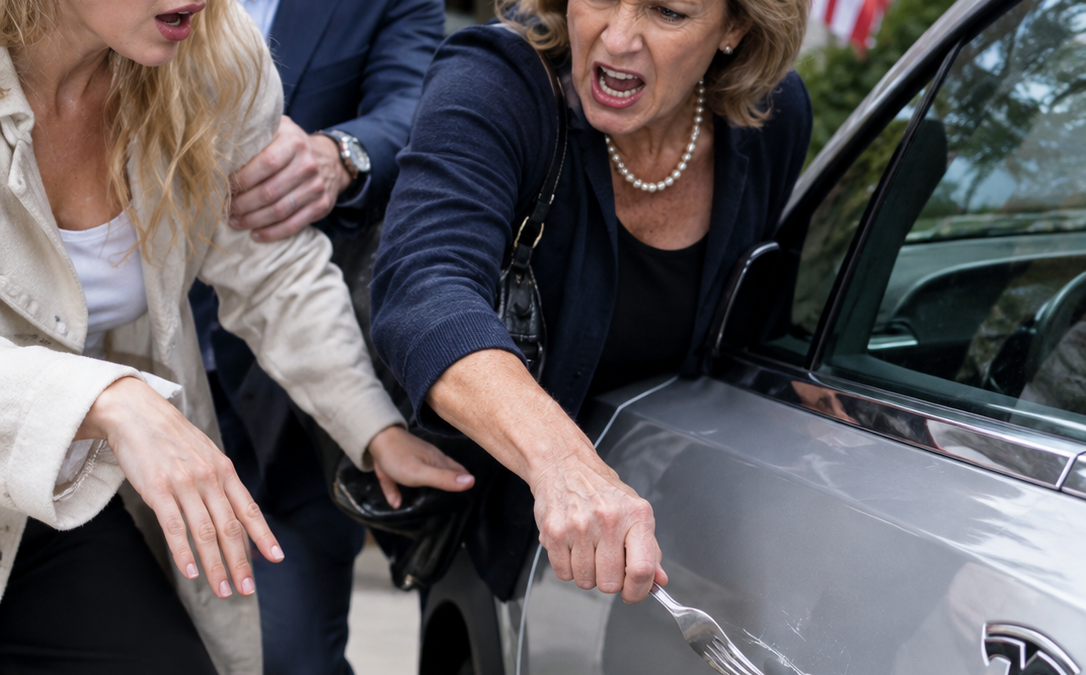
“GIVE ME THE KEYS OR WATCH WHAT HAPPENS!” my mother-in-law snapped before dragging a dinner fork across my brand-new Tesla. Two white gouges ripped through the silver paint. My husband grabbed my wrist and demanded I apologize while she laughed. Hours later, I found my forged signature on a $190,000 loan application. Then I saw who would get the money.
PART 1: THE PRICE OF SAYING NO
“GIVE ME THE DAMN KEYS, LAUREN!”
My mother-in-law stood in my driveway, gripping a dinner fork like she’d just won an argument. When I refused to let her drive my brand-new Tesla, she dragged the fork across the driver’s door.
The screech was loud enough to bring my neighbor onto his porch.
“There,” Carol said, admiring the damage. “Now you’ve got something worth crying about.”
My husband, Brian, stood three feet away.
He didn’t stop her. He didn’t even look surprised.
Instead, he grabbed my wrist and told me to quit embarrassing his mother.
Seven hours later, I found out why he’d been so desperate to keep Carol happy.
Someone had used my Social Security number, my salary information, and a forged signature to apply for a $190,000 loan.
And the person who submitted the application was sleeping in my bed.
My name is Lauren Mitchell. I’m thirty-three years old, and until that Thursday, I lived in what I thought was a reasonably happy marriage in Columbus, Ohio.
I’d been married to Brian for seven years.
He owned a small residential renovation company called Mitchell Home Improvements. I worked as an operations manager for a regional logistics company, handling contracts, payroll projections, and enough spreadsheets to make my accountant father proud.
Our marriage had a simple financial arrangement.
I earned the steady income. Brian chased the big contracts.
When his business did well, we celebrated. When it didn’t, I covered the difference.
Three years earlier, one of his commercial clients had delayed payment on a renovation project. Brian couldn’t pay his suppliers, and his business checking account was almost empty.
I transferred $18,400 from my personal savings.
He promised to replace it within six months.
That was thirty-six months ago.
Whenever I mentioned the money, he’d remind me how hard it was to run a small business.
“It’s not like I’m buying yachts, Lauren.”
No. He was buying expensive tools, leasing a new pickup truck, and taking potential clients to steak dinners.
Apparently, those were business necessities.
Then there was Carol.
Carol Mitchell was sixty-one, divorced, and convinced that having raised a son entitled her to lifetime access to his wife’s bank account.
She lived in a four-bedroom house outside Dublin, a Columbus suburb, although her mortgage payments suggested she couldn’t afford it.
Two years earlier, she’d called me crying because she was behind on her mortgage.
I paid $7,200 to help her catch up.
She hugged me that afternoon.
By Thanksgiving, she was complaining that I hadn’t brought homemade dinner rolls.
Brian’s standard response never changed.
“She’s my mother. Don’t make everything a competition.”
I’d explain that expecting basic respect wasn’t a competition.
He’d sigh, rub his forehead, and tell me I was being sensitive.
Eventually, I stopped bringing it up.
My younger sister, Jessica, was less willing to accept the arrangement.
One Saturday, after I’d canceled brunch for the third time to help Carol with paperwork, Jessica called me.
“Let me guess. Queen Carol needs another rescue mission.”
“Her insurance company messed up a claim.”
“Lauren, you spent last weekend helping Brian with invoices. The weekend before that, you drove his mother to Cincinnati because she didn’t like the specialist in Columbus.”
“She’s family.”
“So am I. Remember me?”
I didn’t have a decent answer.
Jessica was thirty, worked as a physical therapist, and had the kind of practical attitude I usually admired in other people.
She finally said something I kept remembering.
“You’re not married into a family, Lauren. You’re their emergency fund with a driver’s license.”
I laughed because I didn’t want to discuss it.
She didn’t laugh back.
That conversation happened in March.
By September, I’d decided to do something I hadn’t done in years.
Buy something expensive purely because I wanted it.
A silver Tesla Model 3.
I’d spent nearly four years putting aside money in a separate savings account, adding whatever remained after bills, emergencies, and Brian’s occasional requests for financial help.
I’d saved $24,000 for the down payment.
The remaining financing was affordable on my salary. My credit score was excellent, and the payments fit comfortably into my budget.
I researched insurance premiums, charging equipment, and maintenance costs.
I even had an electrician install a home charger in the garage before I bought the car.
Brian knew I was shopping.
He just didn’t think I’d actually do it.
“You’re really going to spend that kind of money on a car?” he asked one evening.
“I’m going to spend my money on a car.”
He looked up from his laptop.
“Must be nice.”
That should have bothered me more than it did.
Instead, I reminded him that I’d driven my old Honda Accord for eleven years.
I didn’t need permission to replace it.
On Thursday afternoon, I picked up the Tesla.
The delivery associate walked me through the controls, showed me the charging settings, and helped connect my phone.
When she handed over the key cards, I laughed.
Not because anything was particularly funny.
I was thirty-three years old, employed, financially responsible, and absurdly excited about owning something nice.
I drove through Columbus with the windows down, stopped at Starbucks for an iced latte, and took the longer route home.
When I pulled into our driveway, I sat there for several minutes looking at the clean silver hood.
For once, I hadn’t bought something to solve somebody else’s problem.
That feeling lasted approximately four hours.
Carol was coming over for dinner that evening.
She’d invited her longtime friend Denise, a woman who seemed incapable of offering an opinion unless Carol had supplied it first.
Brian had ordered takeout from a local Italian restaurant.
I’d set the dining table, opened a bottle of red wine, and put together a salad.
Carol arrived at six-thirty.
She noticed the Tesla before she even reached our front door.
“Well, isn’t this interesting?”
I came outside to greet her.
“Hey, Carol.”
She walked around the car without acknowledging me.
“Brand-new?”
“Yes.”
“How much did that set you back?”
“I’ve been saving for it.”
“That wasn’t my question.”
Denise peered through the passenger window.
“Oh, Carol, look at that screen. It’s gorgeous.”
Carol folded her arms.
“Some people sure know how to treat themselves.”
I ignored the comment.
Brian appeared in the doorway, holding a beer.
“Mom, dinner’s ready.”
Carol pointed at the Tesla.
“Did you approve this?”
I actually laughed.
“Approve it?”
She turned toward me.
“Marriage is supposed to be a partnership.”
“Good thing I discussed the purchase with my husband, then.”
Brian looked uncomfortable.
Carol gave him a sharp glance.
“Well, I certainly hope you aren’t neglecting your responsibilities while you’re playing rich girl.”
It took effort not to ask whether those responsibilities included her mortgage.
Instead, I went inside.
Dinner was tolerable for the first twenty minutes.
Denise discussed her upcoming Florida vacation. Brian talked about a kitchen remodeling contract he hoped to secure.
Carol complained about property taxes.
Then she asked whether the Tesla could drive itself.
“It has driver-assistance features,” I explained. “But you still have to supervise it.”
Carol nodded.
“I’d like to try it.”
“Maybe I can show you sometime.”
“No, I mean tonight.”
She finished her wine and pushed back her chair.
“Denise, grab your purse. We’re taking that little spaceship around the block.”
I looked at her.
“Sorry?”
“The Tesla. Give me the keys.”
I smiled, assuming she was joking.
“I’m not letting anyone else drive it yet.”
Carol held out her hand.
“Lauren.”
“Carol.”
“Keys.”
“No.”
Denise stared at her plate.
Brian continued cutting his chicken parmesan.
Carol tilted her head.
“I’m your husband’s mother.”
“I’m aware.”
“Then stop treating me like some stranger asking to borrow your jewelry.”
“It has nothing to do with who you are. I picked the car up today, and I’m not lending it out.”
Brian finally looked up.
“Lauren, seriously. It’s just a quick drive.”
“No, Brian.”
He gave me the expression I knew too well.
The one that meant I was about to spend the evening apologizing.
“Why do you always have to make things difficult?”
I set my glass down.
“I’m not making anything difficult. I said no.”
Carol’s chair scraped against the floor.
“Well. That tells me everything I need to know.”
She walked toward the kitchen.
I assumed she was getting her purse.
Then I noticed her pick up a dinner fork from the counter.
“Carol?” I said.
She kept walking.
The front door opened.
A second later, I heard the first scrape.
It was a long, ugly sound.
I ran outside.
Carol stood beside my Tesla, dragging the fork along the driver’s door.
A thin silver-white line appeared across the paint.
“STOP!”
She looked over her shoulder.
For one second, I thought she’d realize what she’d done.
Instead, she smiled.
“Oh, is this bothering you?”
Then she scraped the door again.
Harder.
The second mark ran almost parallel to the first.
Denise appeared behind me.
“Oh, my goodness.”
Carol tossed the fork onto the driveway.
“There. Maybe next time you’ll remember that family comes before your expensive toys.”
I pulled out my phone and started recording.
“What did you just do?”
Carol shrugged.
“It’s a scratch. Don’t have a breakdown.”
“That’s intentional property damage.”
“Oh, listen to her. Someone’s been watching too much television.”
Brian came down the front steps.
“What’s going on?”
I pointed at the door.
“Your mother just keyed my car with a fork.”
Carol rolled her eyes.
“Such a dramatic girl.”
Brian examined the damage.
Then he turned to me.
“Put the phone away.”
I stared at him.
“Excuse me?”
“Lauren, everybody’s watching. We’ll sort this out privately.”
Our neighbor, Mr. Harrison, was standing near his mailbox.
Carol spotted him and raised her voice.
“See? She’s always been obsessed with money.”
I took a step toward the driveway.
“Carol, you’re paying for that.”
She laughed.
“With what? You’re the one driving around in a luxury car.”
Brian reached for my wrist.
“Enough. You’re embarrassing Mom.”
I pulled free.
“Your mother deliberately damaged my car, and you’re worried about her being embarrassed?”
He lowered his voice.
“Don’t start.”
“I’m not starting anything. I’m finishing this conversation.”
I pointed to the front door.
“Carol, leave.”
For the first time that evening, she looked genuinely offended.
“You’re throwing me out?”
“Yes.”
“In front of my friend?”
“Denise can leave, too.”
Brian stepped between us.
“Lauren, apologize.”
I looked at him.
It took a moment to process what he’d said.
“Apologize for what?”
“For being disrespectful.”
I held up my phone.
“Your mother just vandalized a car I bought with my own money. I’m documenting it, and I’m asking her to leave. Which part requires an apology?”
He didn’t answer.
Carol did.
“You know what your problem is? You think earning a paycheck makes you better than everyone else.”
“No. I think earning a paycheck means I get to decide how I spend it.”
She stepped closer.
“Careful, sweetheart. Pride can cost you everything.”
I looked her directly in the face.
“So can property damage.”
That ended the conversation.
At least, I thought it did.
Carol and Denise collected their purses.
As they walked to Denise’s SUV, Carol called back, “Brian, you need to get your wife under control.”
He said nothing.
Not one word.
After their car disappeared down the street, I photographed the scratches from several angles.
I took close-up pictures and wide shots showing the entire driver’s door.
My Tesla had exterior cameras, but I wasn’t sure what footage had been captured. I opened the app to check the vehicle’s recording settings.
The incident had been recorded.
There was Carol, standing beside my car, lifting the fork and dragging it across the paint.
Twice.
I saved the footage immediately.
Brian watched from the porch.
“Are you seriously making this into a police matter?”
“Your mother committed a crime.”
“It was a stupid argument.”
“She damaged my property because I wouldn’t give her something.”
“She lost her temper.”
“Then she can lose some money fixing it.”
Brian sighed.
“I’ll talk to her tomorrow.”
“You should’ve talked to her when she picked up the fork.”
He took a step toward me.
“Can we please not ruin our marriage over a scratch?”
I looked at the lines across the paint.
Then at the man who’d watched them happen.
“The scratch isn’t what’s ruining anything.”
I went upstairs.
Our bedroom was at the end of the hallway, next to the office Brian used for his business paperwork.
I wanted to find my insurance documents and confirm the policy details.
The filing cabinet in our home office held our tax returns, vehicle records, and household paperwork.
Brian had been using the room earlier that afternoon.
His laptop sat open on the desk.
Beside it was a thick manila folder, partially covered by a stack of invoices.
My name was printed on the folder.
LAUREN MITCHELL — JOINT BORROWER.
I stopped.
I hadn’t applied for any joint loans.
I lifted the folder.
The first page was a loan application from a mortgage lender.
Applicant: Carol Mitchell.
Co-borrower: Lauren Mitchell.
Requested loan amount: $190,000.
Property securing the loan: Carol’s house.
I read the page twice.
Then I turned it over.
My employer was listed correctly.
So was my annual income.
The application included my home address, date of birth, Social Security number, and credit information.
All of it accurate.
I reached the signature page.
There was my name.
An electronic signature.
A date.
And a checkbox stating that I had authorized the lender to review my credit and financial records.
I hadn’t.
I’d never discussed refinancing Carol’s house.
Not once.
I kept turning pages.
The proposed financing would pay off her existing mortgage and provide additional funds for supposed home improvements.
One contractor estimate stood out.
FOUNDATION STABILIZATION AND STRUCTURAL REPAIRS.
Total: $48,000.
Contractor: Mitchell Home Improvements.
Brian’s company.
I sat down at the desk.
Carol had needed help with her mortgage for years, but her house didn’t have a foundation problem.
Two years earlier, I’d helped her arrange roof repairs and a general home inspection.
Only the previous month, she’d bragged that her house was in excellent condition compared with older properties in the neighborhood.
Yet Brian’s company had submitted a nearly fifty-thousand-dollar estimate for urgent structural work.
I looked at the payment schedule.
The proposed renovation funds were designated for work by his company.
No completed work was documented.
Then I found a printed email.
Carol had written to Brian:
Make sure Lauren doesn’t see the final figures before Friday. Once the money comes through, everything will be handled.
Brian’s reply was underneath.
She’ll be angry, but I’ll calm her down afterward. She always comes around.
I read that last sentence several times.
She always comes around.
There it was.
Seven years of marriage reduced to five words.
I took photographs of every page and scanned the documents into a private folder on my phone.
Then I forwarded copies to an email account Brian couldn’t access.
I heard footsteps behind me.
“What are you doing?”
Brian stood in the doorway.
His beer was gone.
I lifted the application.
“Did you submit a loan application using my identity?”
He looked at the folder.
Then at me.
“Where did you find that?”
“That’s your first question?”
“Lauren, it’s not what you think.”
“Then this should be easy. Did I authorize a $190,000 loan?”
He closed the door behind him.
“Mom needed refinancing.”
“I know what refinancing is. I asked whether I authorized it.”
“We were going to tell you.”
“When?”
He rubbed his face.
“Before anything became official.”
I held up the signature page.
“This looks pretty official.”
“It’s preliminary paperwork.”
“Then why does it say I consented to a credit check?”
He didn’t answer.
I placed the contractor estimate on the desk.
“Why is your company getting $48,000?”
“Because Mom needs repairs.”
“What repairs?”
“Foundation work.”
“Show me the inspection report.”
He shifted his weight.
“It’s complicated.”
“No. The question is incredibly simple. Where’s the structural engineer’s report?”
“Lauren—”
“Does it exist?”
He stared at the floor.
I waited.
Finally, he said, “The work isn’t as extensive as the estimate makes it look.”
I pulled out the desk chair and sat down.
“Explain that sentence.”
He took a breath.
“My business is behind.”
“How far?”
“Thirty-five thousand. Maybe thirty-eight, depending on the supplier.”
“And?”
“The refinancing could help us get caught up.”
I looked at the estimate.
“You submitted a fake renovation budget so you could use the money to pay your business debts.”
“We would still do work on her house.”
“Forty-eight thousand dollars’ worth?”
He said nothing.
“Brian, you put my name on an application I never signed. You used my income to make a loan possible. You were planning to send money to your own business under a repair estimate you just admitted was inflated.”
He sat on the edge of the other chair.
“You’re making it sound worse than it is.”
I stared at him.
“Try making it sound better.”
“Mom’s scared of losing the house. I’ve got people who need paying. I was trying to find a solution.”
“A solution to whose problem?”
He looked genuinely irritated.
“Ours, Lauren. My business is our future.”
“Funny. When I gave you $18,400, you called it a business emergency. When I asked about repayment, you said it was your business, not mine.”
He leaned forward.
“I didn’t know you’d keep score.”
“Apparently, neither did you.”
He reached toward my hand.
I moved it.
“Don’t.”
“Please. I can explain everything.”
“You just did.”
I stood and picked up the folder.
He blocked the doorway.
“What are you going to do with that?”
“Protect myself.”
“Don’t do anything you’ll regret.”
I almost laughed.
“Your mother said the same thing right before she scratched my car.”
His expression changed.
“Lauren, listen. We need this loan.”
“We?”
He glanced at the paperwork.
“Mom could lose the house.”
“And you could lose your business.”
“Exactly.”
“So you decided I should take the risk without knowing about it.”
He finally raised his voice.
“Because you would’ve said no!”
I looked at him.
“That’s the first honest thing you’ve said all night.”
I stepped past him.
He didn’t try to stop me.
I locked the bedroom door, opened my laptop, and began making calls.
The lender’s fraud-reporting number led to an automated menu and an online submission form.
I completed it.
I stated that I hadn’t applied for the loan, hadn’t authorized a credit inquiry, and hadn’t signed any borrower documents.
I uploaded copies of the application and requested an immediate hold pending identity verification.
Then I placed credit freezes with Equifax, Experian, and TransUnion.
I changed my financial passwords and checked the recent activity on my accounts.
At 12:17 a.m., I sent a detailed email to the loan broker listed on the paperwork.
I attached the disputed signature page and asked for written confirmation that no closing or disbursement could proceed on my authorization.
I also requested copies of any additional documents supposedly signed by me.
The broker’s after-hours email replied automatically.
My report had been received.
At 12:43 a.m., Carol called.
I put her on speaker and started taking notes.
“Brian says you’re refusing to help me.”
“Hello to you, too, Carol.”
“This is serious, Lauren.”
“I agree. Somebody submitted loan paperwork using my personal information.”
She made an impatient noise.
“Oh, for heaven’s sake. Brian was handling all that.”
“Were you aware my name was on the application?”
Silence.
“Carol?”
“He said you’d understand.”
“So you knew.”
“You have a wonderful salary. It’s not like helping family is going to bankrupt you.”
“That’s not an answer.”
“Why should my son struggle while you drive that ridiculous car around town?”
I opened the photograph of my scratched Tesla.
“Did you know he submitted an inflated $48,000 repair estimate?”
Another pause.
“Brian needs to keep his business running.”
“And you agreed to use my identity to help him do that?”
“You’re his wife.”
“That isn’t permission.”
Carol scoffed.
“Don’t lecture me about marriage. I’ve lived a lot longer than you.”
“Then you’ve had plenty of time to learn what the word ‘no’ means.”
Her voice sharpened.
“If you ruin this refinancing, don’t expect me to forget it.”
“I’ll manage.”
I ended the call.
At 1:17 a.m., another email arrived.
The lender’s fraud system confirmed that my report had been logged and the application flagged for review.
I forwarded the confirmation to Brian.
Then I packed several days of his clothes into a duffel bag and placed it outside the bedroom door.
He knocked ten minutes later.
“Lauren?”
I didn’t answer.
“We can fix this.”
I stared at the ceiling.
“Start by telling the truth to the lender.”
He didn’t respond.
Around five in the morning, I finally fell asleep.
At exactly 6:12 a.m., someone began pounding on the front door.
I checked my security-camera feed.
Carol stood on my porch wearing a wrinkled cardigan over her pajamas.
She was barefoot, holding her slippers in one hand and her phone in the other.
I opened the door but left the security chain attached.
“Lauren, please.”
Her voice cracked.
“The lender put the closing on hold. Brian says you reported fraud.”
“I did.”
“Call them back. Tell them there was a misunderstanding.”
“There wasn’t.”
She pressed her phone against the narrow opening.
“The deadline is next week. If this loan doesn’t close, I could lose my house.”
“Then you need to speak to your mortgage servicer.”
“You don’t understand!”
“I understand enough.”
She grabbed the doorframe.
“I’m begging you. Just tell them it was a mistake.”
I looked down at her bare feet.
Yesterday she’d laughed while damaging something I’d worked years to afford.
Now she wanted me to rescue her again.
“Carol, did Brian also invent the foundation repairs?”
She stopped talking.
Her hand slowly dropped from the doorframe.
I could hear a car driving past behind her.
Finally, she whispered, “How much did you find?”
“The application. The contractor estimate. Your emails.”
Carol looked toward the hallway behind me.
“Where’s Brian?”
“Why?”
“Get him.”
“Carol—”
“NOW.”
Brian appeared at the foot of the stairs, still wearing yesterday’s shirt.
Carol pointed at him.
“You told me she wouldn’t find the paperwork.”
He stared at her.
“Mom, stop talking.”
Then she said something neither of us expected.
“I’m not taking the blame for what you did with that second document.”
I went still.
“What second document?”
Brian’s face changed.
“Mom. Shut up.”
Carol turned back toward me.
“He said you already signed it. He told me you knew exactly what you were agreeing to.”
I looked at my husband.
“Brian?”
He wouldn’t answer.
Then my phone buzzed.
An email had arrived from the loan broker.
Subject: Additional Authorization Documents — Lauren Mitchell.
I opened the attachment.
And there, underneath a copy of my driver’s license, was a second authorization I had never signed.
This one did much more than approve a credit check.
It gave instructions for the money.
And beside the payment instructions was a bank account I recognized immediately.
END OF PART 1
PART 2: THE DOCUMENT THEY NEVER EXPECTED ME TO FIND
The account number at the bottom of the authorization made me grip my phone tighter.
I knew those digits.
Three years earlier, I’d transferred $18,400 into that account to keep Brian’s company from collapsing.
It was the operating account for Mitchell Home Improvements.
But this wasn’t simply another contractor estimate.
The document instructed the lender to allocate the entire $48,000 renovation amount to Brian’s company through the proposed renovation disbursement arrangement.
Attached was a signed certification stating that I had reviewed the renovation budget and approved the contractor’s involvement.
My electronic signature appeared at the bottom.
Again.
Brian had not just listed his company as a contractor.
He’d submitted paperwork claiming I had personally reviewed and approved the arrangement.
I scrolled to the next page.
A copy of my Ohio driver’s license had been uploaded as supporting identification.
The same license I’d reported missing for half a day two weeks earlier before finding it in the drawer where Brian kept our insurance cards.
I looked up.
“Where did you get the copy of my license?”
Brian stared at the phone.
“Lauren, we need to talk inside.”
“We can talk right here.”
Carol stood on the porch, clutching her slippers.
“What is she talking about?”
I turned the screen toward her.
“Brian submitted instructions to direct forty-eight thousand dollars to his business. Apparently, I approved it.”
Carol’s mouth opened.
“I didn’t sign that.”
“Neither did I.”
Brian finally spoke.
“It’s a standard authorization.”
“Great. Then explain why my signature is on it.”
He looked toward the street.
“Can we stop doing this where the neighbors can hear?”
I glanced at the security camera mounted above the porch.
“You were fine with an audience when your mother destroyed my car.”
“Lauren, please.”
“No. You’ve had seven years of me being reasonable. This morning, you answer the questions.”
He folded his arms.
“What do you want to know?”
“Did you electronically sign those documents using my name?”
He didn’t respond.
“Brian.”
“Yes.”
Carol made a small noise.
I kept looking at him.
“Did you upload my driver’s license?”
“Yes.”
“Did you tell the lender I had approved a loan when you knew I hadn’t?”
He rubbed the back of his neck.
“Yes, but I was planning to explain everything before closing.”
I laughed.
It surprised all three of us.
“You were planning to explain the fraud before taking the money?”
“Don’t call it fraud.”
“What would you prefer? Creative paperwork?”
Carol stepped between us.
“Enough. Brian, tell her why you did it.”
He looked at his mother.
“You know why.”
“I know what you told me.”
I crossed my arms.
“Then I’d love to hear both versions.”
Brian stared at the porch floor.
His voice dropped.
“The business owes suppliers around thirty-eight thousand dollars. Two vendors threatened collections. I couldn’t get another business loan.”
“Because your company’s finances are terrible?”
He didn’t answer.
Carol looked at me.
“He said if we refinanced the house, we’d both be okay.”
“And you agreed?”
“I needed to catch up on the mortgage.”
“So you agreed to claim you needed foundation repairs?”
She hesitated.
“Brian said the paperwork had to show improvements.”
I waited.
“And the money?”
She looked at her son.
“He told me he’d take care of the business debts first and put the rest toward the house.”
Brian shook his head.
“That’s not exactly what I said.”
Carol rounded on him.
“Don’t you dare.”
For the first time since I’d known her, Carol sounded angrier with Brian than with me.
“You told me Lauren would sign. You promised me there wouldn’t be a problem.”
I raised one hand.
“Stop.”
They both looked at me.
“I want to make sure I understand this.”
I pointed toward Carol.
“You knew the renovation estimate wasn’t accurate.”
She said nothing.
I pointed toward Brian.
“You knew I hadn’t agreed to the loan.”
He looked away.
“And the two of you went ahead anyway because you figured I’d eventually clean up the mess.”
Brian finally met my eyes.
“You’ve always helped us before.”
There it was again.
Not an apology.
An expectation.
I glanced at my watch.
6:26 a.m.
I hadn’t even made coffee.
“Here’s what’s happening,” I said.
“The fraud report stays in place. I won’t authorize this loan, and I won’t contact the lender to withdraw my complaint.”
Carol grabbed my sleeve.
“Please, Lauren. If the refinancing falls apart, I could lose the house.”
I removed her hand.
“Then call your mortgage company. Ask about repayment options. Sell the house if you have to.”
She stared at me.
“You’d really make me sell my home?”
“I’m not making you do anything.”
“You know what I mean.”
“No, Carol. For years, you made financial decisions assuming I’d pay for the consequences. I’m telling you that arrangement is over.”
She started crying.
I didn’t move.
“Lauren, I’m sixty-one years old.”
“I know.”
“Where am I supposed to go?”
“I don’t know. That’s a question you need to answer.”
Brian stepped forward.
“Could you at least wait before making a final decision?”
“About the loan?”
“About everything.”
I looked at him.
“Did you ask yourself that question before signing my name?”
He opened his mouth.
Nothing came out.
I stepped back into the house.
“Brian, your bag is upstairs. I want you out today.”
“Lauren—”
“Don’t make me say it twice.”
Carol reached for the door.
“And what about me?”
I looked at the scratched Tesla in the driveway.
“You can start by paying for what you did to my car.”
She wiped her face with the sleeve of her cardigan.
“I’ll pay for it. Just call the lender.”
“Those are separate issues.”
“You can’t be this heartless.”
“Carol, yesterday you damaged my car because I wouldn’t hand over the keys. Today you’re asking me to put my financial future on the line to save yours.”
She looked down.
I closed the door.
Neither of them knocked again.
At 8:47 a.m., I called my manager and asked for a personal day.
She approved it without asking for details.
Then I made coffee, opened my laptop, and organized everything.
The loan application.
The forged authorizations.
The contractor estimate.
The emails.
The lender’s acknowledgment.
The photographs and security footage of the Tesla damage.
I put copies in separate folders and backed them up.
At 9:06 a.m., the loan broker returned my message.
His name was Michael Torres.
He spoke carefully.
“Ms. Mitchell, we’ve received your report. The application is currently suspended pending investigation.”
“Has any money been released?”
“No. The loan has not closed, and no funds have been disbursed.”
I sat back in my chair.
That was the first good news I’d heard since buying my car.
He explained that the lender would review the identity-verification records and the authorization documents.
I told him I wanted every document submitted under my name preserved.
He confirmed that my complaint had been added to the file.
Before ending the call, I asked one more question.
“Mr. Torres, can you tell me how the application was submitted?”
He paused.
“I can confirm that it was submitted electronically through the loan application process. Our investigation will examine the supporting records.”
“Okay. Thank you.”
I didn’t need to know every technical detail that morning.
I needed the lender to know I hadn’t consented.
And I needed a record proving I’d said so.
Next, I checked my credit reports.
The loan inquiry had appeared on one report.
I filed a dispute and attached the information I’d already provided to the lender.
Then I called Jessica.
She answered on the second ring.
“Hey. Everything okay?”
“No.”
She stopped moving around.
I could hear a door close on her end.
“What happened?”
“Carol scratched my new car with a fork.”
There was a pause.
“She did what?”
“And Brian used my identity to apply for a hundred-and-ninety-thousand-dollar loan.”
Silence.
Then Jessica said, “I’m coming over.”
“You don’t have to.”
“That wasn’t a question.”
She arrived twenty-five minutes later with two Starbucks coffees and a breakfast sandwich I hadn’t asked for.
She saw the Tesla first.
“Oh, you’ve got to be kidding me.”
She bent down beside the driver’s door.
The scratches were even uglier in daylight.
Jessica stood up.
“Tell me you have video.”
“I do.”
“Good.”
Inside, she listened while I explained everything.
She didn’t interrupt until I mentioned that Brian had admitted submitting the documents.
“Have you called a lawyer?”
“Not yet.”
“Do that next.”
I picked at the wrapper around my sandwich.
“Jess, I think my marriage is over.”
She sat beside me.
“Yeah. I think it is.”
It wasn’t what I wanted to hear.
But she didn’t soften it, either.
“I’m sorry,” she added.
That was enough.
For years, whenever I described another disaster involving Brian or Carol, people had told me to be patient.
Jessica was the first person who didn’t suggest I give them another chance to explain.
That afternoon, I met with an attorney.
We discussed the loan application, the damage to my car, and the practical steps I could take to protect my finances while deciding what to do about the marriage.
She advised me to preserve the original documents and communications.
She also explained that a disputed application didn’t automatically make me responsible for a debt I’d never agreed to, but the unauthorized use of my identity needed to be investigated and formally documented.
We discussed separate accounts, existing liabilities, and how to avoid making decisions under pressure.
I left her office with a list of tasks.
None of them involved apologizing to Carol.
Later that day, I filed a police report concerning the intentional damage to my Tesla and provided information about the unauthorized financial application.
I handed over the video and copies of the relevant paperwork.
The officer asked whether I wanted to pursue the vehicle damage complaint.
“Yes.”
He nodded and continued taking notes.
For once, I didn’t explain that Carol had been having a difficult year.
I didn’t mention her mortgage problems.
I simply described what she’d done.
Brian called twelve times that afternoon.
I answered the thirteenth.
“Where are you?” he demanded.
“At home.”
“We need to discuss this.”
“I’m listening.”
He hesitated.
“Did you talk to an attorney?”
“Yes.”
“Unbelievable.”
I almost smiled.
“That you signed my name without asking, or that I called a lawyer afterward?”
“You know what I mean.”
“Actually, I don’t.”
His tone softened.
“Lauren, I love you.”
I looked at our wedding photograph hanging in the hallway.
“I loved you, too.”
“Loved?”
He sounded genuinely startled.
I took the photograph off the wall.
“Brian, you watched your mother deliberately damage my car. Then you demanded I apologize to her. And that was before I discovered you had submitted financial documents in my name.”
“I panicked.”
“You planned.”
He said nothing.
I continued.
“You collected my information. You submitted the application. You uploaded identification. You signed my name. That’s not panic.”
He took a breath.
“I thought if I could get everything sorted out, you’d forgive me.”
“That’s the problem. You counted on it.”
“Please don’t throw away seven years.”
“I’m not the one who did.”
I ended the call.
That night, Brian took a room at a hotel.
By Saturday, he’d rented a small furnished apartment across town.
He collected his clothes while Jessica sat at my kitchen island scrolling through her phone.
He avoided looking at her.
Before leaving, he stopped beside me.
“I never wanted to hurt you.”
Jessica looked up.
“Wow. That’s comforting. Imagine what would’ve happened if you had.”
Brian glared at her.
I opened the front door.
“Your mail can go to the new address. I’ll communicate about the rest through email.”
He stood there holding his overnight bag.
“That’s it?”
“For today.”
He looked around the house.
Then he walked out.
I shut the door.
Jessica waited until his truck had disappeared.
“I’m ordering pizza.”
I looked at her.
“It’s ten in the morning.”
“Then we’re having breakfast pizza.”
I laughed.
This time, it didn’t feel strange.
The following Monday, Carol left a voicemail.
“You’re destroying this family, Lauren. I hope you’re proud of yourself.”
I saved it.
On Tuesday, she called again.
This time, her voice was softer.
“I know things got out of hand. I shouldn’t have scratched your car.”
I waited for the rest.
“Maybe if you reconsider the loan, we can all put this behind us.”
There it was.
I didn’t answer.
On Wednesday, I received an estimate from the Tesla-approved repair facility.
The damage wasn’t something that could be polished away.
Both scratches had cut through the finish, and the driver’s door needed professional refinishing.
The estimate was $2,860.
I emailed it to Carol.
I included still photographs and a copy of the security footage.
My message was short.
Please arrange payment for the repair. This is separate from the loan investigation.
She responded within twenty minutes.
You’re really charging your own family?
I replied:
Yes.
No additional explanation.
That was new for me.
Carol spent the next several days telling relatives I’d abandoned her during a financial emergency.
Brian’s aunt Patricia called to ask whether I’d reconsider helping.
I asked her one question.
“Did Carol mention that Brian submitted a loan application with my forged signature?”
Patricia went quiet.
“No.”
“Then you don’t have the whole story.”
I offered to explain.
She said she’d call me back.
She never did.
Carol also threatened legal action because my fraud report had disrupted her refinancing.
Her threats stopped after she sought legal advice.
Meanwhile, Brian’s business problems became impossible to hide.
Two suppliers demanded payment.
He sold a trailer and several pieces of equipment to raise cash.
One of his larger remodeling jobs was delayed after a subcontractor refused to continue without payment.
For years, every financial emergency had ended with me moving money between accounts.
This time, I wasn’t involved.
I heard about the equipment sale from a mutual friend.
I didn’t call Brian.
I didn’t offer a payment plan.
I didn’t ask how much he needed.
I went to work, paid my own bills, and drove a rental car while the Tesla was being repaired.
It was surprisingly difficult to do nothing.
Whenever my phone rang, I still had the impulse to solve whichever problem appeared on the screen.
I’d spent years being the person everybody contacted when something went wrong.
Now I was learning that hearing about a problem didn’t make it mine.
Two weeks after the incident, Carol paid the full Tesla repair bill.
The payment came after my attorney sent a formal demand with the estimate and supporting documentation.
Carol didn’t include an apology.
I didn’t need one to repair the car.
The loan application remained stopped while the unauthorized authorization documents were reviewed.
No funds were released.
Carol eventually contacted her mortgage servicer and began exploring alternatives.
She decided to list her house for sale.
When I heard, I remembered the afternoon I’d given her $7,200 to keep that same house.
She’d hugged me so tightly that day.
Then, two months later, she’d criticized me for buying store-bought pumpkin pie.
I’d spent years hoping she’d appreciate what I’d done.
But gratitude hadn’t been the problem.
Carol believed my help was something she was entitled to receive.
The moment I refused, she treated me like an enemy.
Brian tried several times to repair our marriage.
He sent flowers to my office.
He left a handwritten letter in our mailbox.
He offered to attend counseling.
I didn’t dismiss counseling as useless.
I simply didn’t believe the problem was a lack of communication.
He knew I hadn’t agreed to the loan.
He knew forging my signature was wrong.
He had done it anyway.
One evening, he asked to meet at a coffee shop near my office.
I agreed to one conversation.
He was already seated when I arrived, wearing the blue button-down shirt I’d bought him for our fifth anniversary.
Two drinks sat on the table.
He’d ordered my usual iced vanilla latte.
“Thanks,” I said, sitting down.
He looked tired.
He’d lost weight since moving out.
For several minutes, we discussed practical things.
Insurance.
Mail.
The remaining balance on a shared credit card.
Then he placed his hands on the table.
“Lauren, I know I messed up.”
I waited.
“I thought I was protecting everyone.”
“From what?”
“Losing the business. Mom losing her home.”
“And who was protecting me?”
He looked down.
I took a sip of coffee.
“You know what bothers me most?”
He shook his head.
“It isn’t even the money.”
His eyes lifted.
“You used to ask me what I thought about everything. Which jobs you should accept. Whether we could afford a vacation. What color to paint the living room.”
I set my cup down.
“But when you decided to put my financial security at risk, you didn’t ask.”
“I knew you’d be upset.”
“No. You knew I’d say no.”
He pressed his lips together.
“You’re right.”
It was the first time he’d said that without immediately adding an excuse.
I appreciated it.
It didn’t change my decision.
He reached into his jacket and pulled out a small envelope.
Inside was a cashier’s check.
Eighteen thousand four hundred dollars.
I stared at it.
He spoke quietly.
“I sold some equipment. This is what I owed you from three years ago.”
I looked at the check.
Then at him.
“Why now?”
“Because you were right. I should’ve paid you back.”
I took the envelope.
“Thank you.”
He looked hopeful.
“Does that mean—”
“No.”
The hope disappeared.
“Brian, repaying a debt doesn’t erase what happened.”
“I know.”
“I don’t think you do.”
He leaned back in his chair.
“So there’s no chance?”
I considered the question.
For seven years, I’d imagined growing old with this man.
We’d talked about taking road trips when we retired.
We had favorite restaurants, shared jokes, and Christmas ornaments we’d collected on vacations.
There had been good years.
Real ones.
But loving those memories didn’t make the documents on his desk disappear.
“I don’t trust you,” I said.
He stared at his coffee.
“And I can’t build a marriage with someone who thinks my consent is an obstacle to work around.”
He nodded slowly.
I stood.
“I hope you get your business sorted out.”
“Lauren?”
I stopped.
“I’m sorry.”
I looked at him.
“I believe you’re sorry now.”
Then I left.
Three months after Carol scratched my Tesla, I filed for divorce.
The process wasn’t pleasant.
There were financial disclosures, attorney meetings, and arguments over household belongings.
Brian wanted to keep the house.
We eventually worked toward an arrangement through our attorneys rather than arguing in person.
The identity misuse matter continued through the appropriate reporting and investigative channels. I cooperated when documentation was requested.
I didn’t need to exaggerate what had happened.
The paperwork was bad enough.
Carol’s house was listed for sale.
She had options she hadn’t wanted to consider, including downsizing.
I didn’t pay her mortgage.
I didn’t help her pack.
When she sent a long email accusing me of destroying her relationship with Brian, I read it once and forwarded it to my attorney.
Then I deleted it from my inbox.
I didn’t reply.
The strangest part of those months was how ordinary my life became.
I worked.
I bought groceries.
I went to the gym.
I started attending Sunday dinners at Jessica’s house again.
I replaced the towels Brian had insisted were perfectly fine despite being worn almost transparent.
I bought a new set of dishes because I liked them.
Not because anybody needed them.
The first Sunday after filing for divorce, I drove my repaired Tesla to Jessica’s house.
The driver’s door looked perfect.
No scratches.
No evidence of Carol’s fork.
Jessica was waiting on the porch with her daughter, Emma.
Emma was eight and had apparently been making something for me all morning.
“AUNT LAUREN!”
She ran toward me holding a sheet of construction paper.
“Look!”
I crouched beside the car.
The drawing showed two women standing beside a silver rectangle with wheels.
One woman had long brown hair.
The other had bright yellow hair, even though Jessica was a brunette.
Above them, written in uneven purple letters, were four words.
AUNT LAUREN IS HAPPY.
I stared at the drawing.
Emma pointed at the silver rectangle.
“That’s your cool car.”
“I figured that part out.”
“And that’s you.”
“Who’s the yellow-haired person?”
“Mom. I ran out of brown.”
I laughed.
Emma grinned.
“Do you like it?”
“I love it.”
She hugged me, nearly crushing the paper between us.
Jessica watched from the porch.
When Emma ran inside to tell her father I’d arrived, Jessica came down the steps.
“You okay?”
I looked at the drawing again.
“Getting there.”
She nodded.
Then she glanced at the Tesla.
“Looks good.”
“It does.”
“Carol ever apologize properly?”
“No.”
Jessica shrugged.
“Wouldn’t hold my breath.”
We stood in the driveway for a moment.
The neighborhood smelled like cut grass and somebody’s backyard barbecue.
A delivery driver rolled past in an Amazon van.
Nothing dramatic happened.
Nobody demanded money.
Nobody needed rescuing.
And nobody told me I was selfish for buying something with my own paycheck.
Jessica slipped her arm around my shoulders.
“Come on. We’ve got burgers.”
I followed her inside.
That evening, when I got home, I placed Emma’s drawing on my refrigerator.
Then I made a cup of tea and checked my bank account.
My bills were paid.
My credit files were protected.
My car was repaired.
The unauthorized loan had never funded.
My marriage was ending, but I finally had control over my own decisions.
I looked around the kitchen.
For the first time in years, nobody else’s emergency was waiting for me at the dining table.
Carol had scratched my Tesla because she couldn’t tolerate being told no.
Brian had forged my signature because he believed I’d forgive him once he’d gotten what he wanted.
They’d both made the same calculation.
That keeping the peace mattered more to me than protecting myself.
They were wrong.
And if Carol ever asked me again whether losing her house was worth destroying our family, I knew exactly what I’d say.
“You didn’t lose my help because you needed money, Carol. You lost it because you thought you could take it without asking.”
I placed my car keys beside Emma’s drawing.
The Tesla had cost me years of savings.
The scratches had cost $2,860 to repair.
Leaving my marriage would cost me time, legal fees, and a future I’d once planned with someone I loved.
None of those things was cheap.
But I could afford them.
What I couldn’t afford anymore was another seven years of letting people use my love as permission to take whatever they wanted.
The next morning, I got into my silver Tesla, put on my favorite playlist, and drove to work.
My phone rang as I pulled out of the driveway.
Brian.
I let it go to voicemail.
Then I turned up the music.
For once, I had somewhere to go that had absolutely nothing to do with fixing his problems.
And that was exactly where I wanted to be.