“Your boyfriend doesn’t call you Fevan when you’re not around,” his cousin whispered. “He calls you Fern. And I think you deserve to know why.”
Chapter 2
I stood there holding the frame, suddenly remembering every private conversation Wesley and I had shared in that apartment.
Marlene knew about our arguments. She knew when I cried. She even knew about conversations we’d had with the bedroom door open and our voices barely above whispers.
I returned the frame to the shelf, trying not to disturb its position. Then I went into the bathroom, locked the door, and called my friend Nora.
Nora worked with me at a medical billing office downtown. She was fifty-eight, divorced, practical, and the kind of woman who never confused kindness with weakness. When I explained what I’d found, she didn’t dismiss me.
“We’re going to handle this carefully,” she said. “You shouldn’t confront anybody until you know what that thing is.”
The following afternoon, we met her friend Omar, who owned a security installation business. He examined photographs I’d taken of the frame and then inspected the device itself.
His expression changed almost immediately.
“There’s a concealed camera and microphone in here,” he said. “This isn’t a standard digital frame.”
He showed us a narrow seam in the casing. Hidden behind it was a small electronic assembly designed to capture video and sound.
“Someone went to considerable trouble to disguise this,” he added.
I sat down because my knees no longer felt dependable.
Omar explained that the equipment could potentially record activity inside our home. He urged me to preserve the device and arrange for a qualified forensic examination rather than trying to investigate its electronics myself.
Nora drove me straight to a law office.
Attorney Simone Carter listened while I described Marlene’s strange comments, the missing messages, and the camera. She studied the photographs without interrupting.
“What you’ve described raises serious privacy and surveillance concerns,” she said. “We need to establish who installed this equipment, what it recorded, and whether anyone had permission.”
For the first time, someone was treating my fear as something that could be examined rather than something I should apologize for.
That evening, I began writing down everything I remembered.
I included the anniversary dinner, Marlene’s visits, her comments about our private conversations, and the day she installed the frame. I also remembered the decorative lamp she’d brought us months earlier.
The lamp sat near the apartment entrance. It was unusually heavy, and when Omar later examined it, he found a concealed audio-recording component inside the base.
Two devices.
Two gifts from Wesley’s mother.
I couldn’t remember ever feeling so foolish or so angry.
The forensic specialist Simone recommended needed several days to examine the equipment. Meanwhile, I asked our building manager to preserve available security footage showing Marlene’s visits.
Our neighbor, Mr. Collins, provided another disturbing detail.
“That older woman who comes around?” he asked one afternoon near the mailboxes. “I’ve seen her sitting in the parking garage late at night. Sometimes she’s there an hour or more.”
He described Marlene’s silver sedan and the blue scarf she wore almost everywhere.
I thanked him, then went upstairs and sat on the edge of my bed.
I was beginning to understand that someone had treated my home as a place she had a right to enter, observe, and control.
The forensic report arrived the following Friday.
Both devices had recorded activity, and the picture frame had been connected to an account associated with Marlene. The available records indicated that video had been captured over several months.
I read the report twice before calling Wesley.
“We need to talk tonight,” I told him.
He came home carrying takeout from our favorite restaurant, smiling until he saw my face.
I laid the photographs, timeline, and forensic report across the kitchen table. Then I explained everything, beginning with Talia’s warning.
Wesley didn’t interrupt.
When I finished, he stared at the report for a long time.
“Mom bought that frame,” he said quietly. “She insisted we keep it plugged in.”
“Did you know what was inside it?”
He looked genuinely horrified. “God, Fevan. No.”
I believed him. But believing he hadn’t known about the camera didn’t erase what happened next.
“Please let me speak to her first,” he said. “Before lawyers or police. She’s been through things you don’t understand.”
I stared at him.
“Your mother recorded me inside my own home, Wesley. And you’re worried about what this might do to her?”
“She’s my mother.”
“And I’m the woman you say you want to marry.”
He buried his face in his hands.
We argued for nearly two hours. He kept insisting that Marlene wasn’t dangerous, only deeply troubled. I kept asking why her pain seemed more important than my right to feel safe.
Eventually, he agreed that she would no longer be allowed into our apartment, that the locks would be changed, and that Simone would continue handling the evidence.
The following evening, Wesley met his mother at a coffee shop.
He returned looking exhausted.
“She denied everything,” he told me. “Then she cried. She said she was trying to protect me from getting hurt.”
“Did she apologize?”
He shook his head.
“She said you’re turning me against my family.”
I wasn’t surprised. What he said next, however, made my skin go cold.
“She kept calling you Fern,” he whispered. “I corrected her every time, but she wouldn’t stop.”
I sat very still.
“Wesley, who is Fern?”
He looked toward the hallway, then back at me. His eyes filled with tears.
“There’s something about my family I should’ve told you a long time ago.”
He called his father.
An hour later, Warren arrived at our apartment carrying an old photograph.
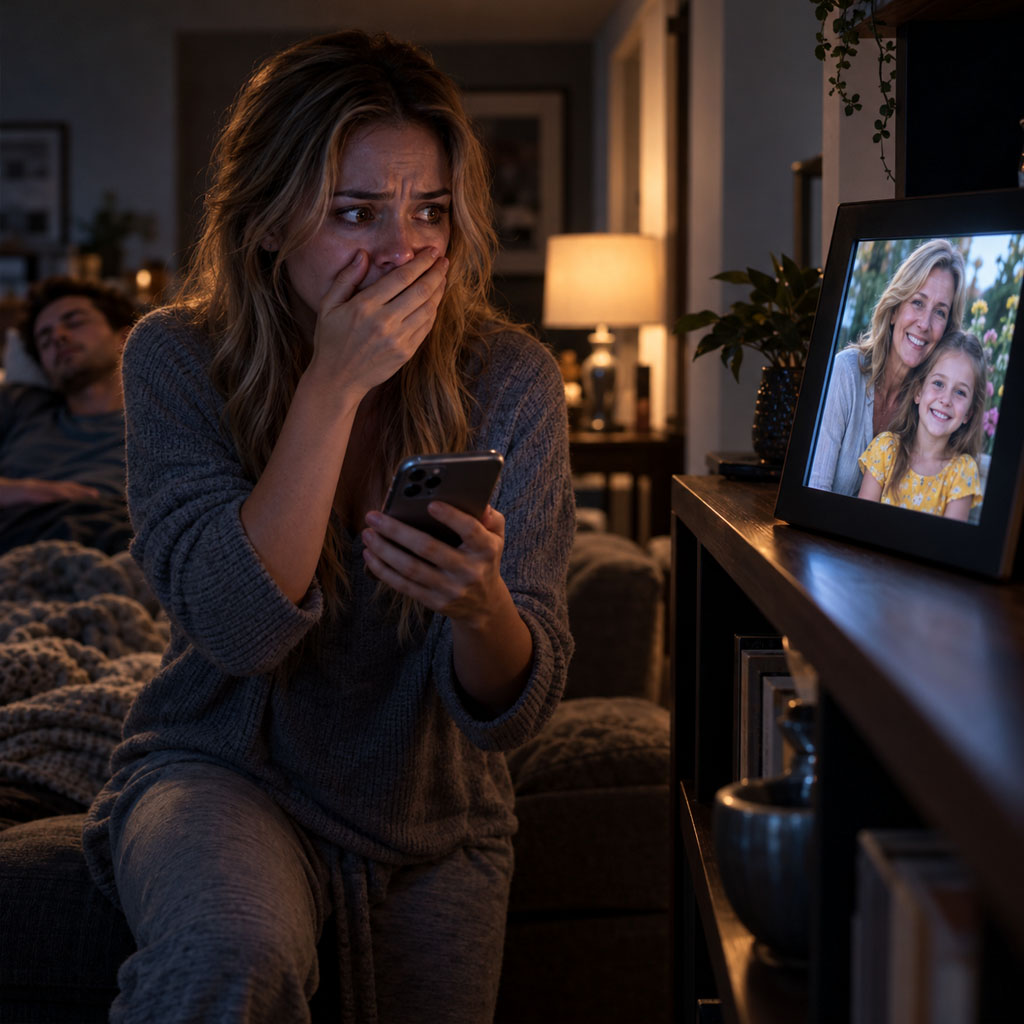
It showed Wesley at about fifteen, standing beside a little girl in a bright yellow dress.
Warren placed it on the table.
“This,” he said, “was our daughter.”
Chapter 3
Warren’s voice was barely audible as he told me about the little girl in the photograph.
She was Wesley’s younger sister, lively and stubborn, with an enormous laugh and a love of everything yellow. She’d died from an aggressive illness shortly after her ninth birthday.
Marlene had never recovered.
“She kept her room exactly as it was,” Warren said. “For years, she wouldn’t let anybody move a thing.”
I looked at Wesley. He was staring at the floor.
“Her nickname was Fern,” Warren continued. “But that wasn’t her full name.”
Something inside me tightened.
“Her name was Fevan.”
I couldn’t speak.
Warren explained that Marlene’s grandmother had come from Eritrea, just as my mother’s family had. The grandmother had chosen the name Fevan for Marlene’s daughter, honoring a woman from an earlier generation.
But the family had quickly shortened it.
“People said Fern was easier,” Warren admitted. “Eventually, everybody called her that.”
I thought of Aunt Ruth correcting my name when I was a child. I thought of teachers who never tried to pronounce it properly, and of Wesley promising that he loved my name exactly as it was.
Then I thought of Marlene.
“She knew,” I whispered. “From the moment Wesley introduced me, she knew my name was the same as her daughter’s.”
Warren nodded.
He explained that Marlene had developed troubling attachments before. She’d become controlling toward a niece, then toward two women Wesley had dated. Both relationships had ended amid arguments about Marlene’s interference.
The family had always explained it away as grief.
“But this time,” Warren said, looking at the forensic report, “she crossed a line none of us can pretend not to see.”
He reached across the table.
“I’m sorry, Fevan. We should have confronted this years ago.”
I wanted to feel compassion for Marlene, and part of me did. I couldn’t imagine losing a child. But compassion didn’t change what she’d done to me.
She hadn’t welcomed me as Wesley’s girlfriend. She’d welcomed the possibility of turning me into someone she’d lost.
Her unusual affection, her constant presence, even her excitement about a future granddaughter suddenly made terrible sense.
She had mistaken a coincidence for permission.
That night, I packed a suitcase and went to stay with Nora.
Wesley didn’t try to stop me. He carried my bags to the car and kissed my forehead.
“I’m sorry,” he said. “I should’ve protected our home.”
“You should’ve respected me when I told you something was wrong,” I answered.
He nodded without defending himself.
At Nora’s house, I slept for nearly ten hours. There were no unfamiliar electronics on the shelves, no unexpected visitors, and no one asking why I’d closed a door.
I hadn’t realized how exhausted fear could make a person.
Simone sent Marlene a formal letter directing her to stop contacting me and stay away from our home and workplace. It also demanded that she preserve the recordings and other relevant evidence, rather than destroy anything that might be needed for an investigation.
Marlene reacted exactly as I’d feared.
Within hours, relatives were calling Wesley. One aunt accused me of humiliating a grieving mother. A cousin insisted that a family disagreement should never involve an attorney.
Then Warren intervened.
He told the family about the hidden recording devices, the forensic findings, and the earlier incidents they’d ignored.
“This isn’t about somebody calling somebody the wrong name,” he told them. “It’s about what happens when we keep excusing behavior that hurts other people.”
The calls gradually stopped.
Several days later, Warren asked whether I would attend a family meeting. I discussed it with Simone, who helped me decide what boundaries I needed and how to leave if the conversation became hostile.
I agreed to one meeting.
Marlene sat in her usual armchair when I entered. Her face looked tired, and her hands were clasped so tightly that her knuckles had turned white.
I placed copies of the evidence on the coffee table.
“The frame recorded activity inside our apartment,” I said. “The lamp captured sound. Neither Wesley nor I agreed to that.”
Marlene began crying.
“I only wanted to know my son was happy.”
Warren spoke gently. “Marlene, that isn’t an explanation.”
She turned toward me.
“You don’t understand what it means to lose someone, Fern.”
The room went silent.
“My name is Fevan,” I said.
She looked away.
I continued, keeping my voice steady.
“I know your daughter was named Fevan. I’m sorry she died. But I am not your daughter, and I cannot bring her back.”
Tears streamed down her face. For a moment, I thought she might finally acknowledge what she’d done.
Instead, she whispered, “I was only trying to love you.”
“Love doesn’t require someone to surrender their privacy or their identity,” I answered.
Wesley moved beside me.
“Mom, you have to stop,” he said. “You can’t keep doing this to people.”
Marlene looked at him as though he’d struck her. Then she turned toward Warren, perhaps expecting him to defend her.
He didn’t.
“We should’ve helped you face this years ago,” he said. “But we won’t let it continue.”
Marlene never apologized that evening. She admitted she’d become too involved, but she still wouldn’t plainly acknowledge the recordings.
We left with an agreement that she would have no direct contact with me, would stay away from our apartment, and would seek professional help for her unresolved grief.
The following morning, Simone accompanied me to make a police report. The evidence was documented, and I was told what further legal steps might be available.
I chose to consider those options carefully rather than make an immediate decision about pursuing charges.
That decision belonged to me.
For so much of my life, I’d allowed other people to decide what was easier, what was acceptable, and how much discomfort I should endure.
I wasn’t going to do that anymore.
Chapter 4
Wesley began therapy the following week.
He told me later that he’d spent much of his adolescence trying to keep his mother from falling apart after his sister died. Whenever she cried, he comforted her. Whenever she became unreasonable, he found a reason to excuse her.
“I thought being a good son meant keeping her happy,” he admitted one evening. “I didn’t realize I was asking you to pay for that.”
It was the first apology that made me believe he understood.
We made changes to the apartment. The locks were replaced, our digital accounts were secured, and anything Marlene had brought into our home was examined or removed.
The shelf where the picture frame once stood remained empty.
For a while, I considered moving out permanently. Every corner reminded me of the months I’d spent being observed without knowing it.
But slowly, the place began feeling like ours again.
Nora helped me rearrange the living room, moving the couch beneath the window and replacing the old curtains with soft cream-colored ones. I bought a small fern from a garden center, then almost laughed at the irony.
I returned it to the shelf and chose a flowering plant instead.
There were still difficult days.
Sometimes a car slowing outside our building made my heart race. Sometimes I found myself replaying conversations, wondering what Marlene had heard.
But the quiet gradually became comforting rather than frightening.
Warren called about a month later to say Marlene had begun seeing a grief counselor regularly. He made it clear that she wasn’t asking me to contact her.
I was relieved to hear it.
I hoped she could finally mourn her daughter without expecting another woman to become her. Whatever happened to our relationship, that little girl deserved to be remembered as herself.
Then, one Sunday afternoon, our doorbell camera sent an alert.
Marlene stood outside our apartment, holding a covered casserole dish.
She didn’t ring the bell.
For nearly two minutes, she stood there looking toward the camera. Then she placed the dish on the floor and walked away.
Wesley watched the recording beside me.
His first instinct was to call her.
I put a hand on his arm.
“Remember what we agreed.”
He closed his eyes, then nodded.
We preserved the recording and notified Simone, who helped us report the unwanted visit. The building manager removed the dish the following morning.
Wesley didn’t call his mother.
That choice mattered more to me than another dozen apologies.
Over the months that followed, we worked carefully at rebuilding trust. Wesley learned to set boundaries without asking me to manage his mother’s feelings. I learned that loving someone didn’t mean overlooking the things that frightened or hurt me.
We were not magically healed.
But we were moving forward honestly.
One Saturday morning, I drove to visit Aunt Ruth.
She was seventy-four now, with silver hair and the same practical expression she’d worn when she collected me from the airport so many years earlier.
We sat at her kitchen table, drinking tea from mismatched cups.
“Aunt Ruth,” I said, “do you remember when you told me to use an American name at school?”
She sighed.
“I remember.”
“Why did you think I needed to hide who I was?”
Her hands rested on the table.
“I was afraid for you,” she admitted. “You were a little girl who’d already lost so much. I thought if people could pronounce your name, they’d be kinder.”
“They weren’t always kinder.”
“I know.”
I told her about Marlene, about the cameras, and about discovering another family had taken my beautiful name and shortened it into something convenient.
Aunt Ruth listened without interrupting.
“When Mama named me Fevan,” I said, “she wasn’t making my life difficult. She was giving me something that belonged to me.”
My aunt began crying quietly.
“Your mother loved that name,” she whispered. “She practiced saying it while she was pregnant. She used to tell me it sounded like music.”
I hadn’t known that.
For a moment, I could almost picture my mother sitting beside a window, speaking my name before she’d ever held me.
Aunt Ruth reached across the table.
“I’m sorry I made you feel you needed to change it.”
We sat together for a long time.
Then she said, slowly and carefully, “Fevan.”
She pronounced it perfectly.
A few weeks later, a small package arrived at my apartment.
Inside was a delicate gold necklace with my name written in the beautiful script of my family’s homeland. Aunt Ruth had ordered it from a jeweler who specialized in traditional lettering.
A handwritten note accompanied it.
“Your mother gave you this name with love. I should have taught you to wear it with pride.”
I put the necklace around my neck and stood before the bathroom mirror.
The gold letters rested just below my collarbone.
For the first time in years, I looked at my reflection without thinking about how I might make myself easier for other people to accept.
Wesley appeared in the doorway.
“That’s beautiful,” he said.
I touched the necklace.
“It’s my name.”
He smiled softly. “I know.”
We stood together for a moment, neither of us needing to say anything else.
Several months later, Wesley asked me to marry him.
He didn’t arrange a crowd or make a grand public speech. We were sitting on the back porch after dinner, watching the sunlight fade behind the trees, when he took my hand.
“I know we still have things to work through,” he said. “And I know trust isn’t something I can ask you to give me all at once.”
He paused.
“But I’d like to spend the rest of my life earning it.”
I looked at the man beside me, remembering both the harm he’d failed to prevent and the effort he’d made to change.
“Yes,” I whispered.
Then I added, “But we’re taking our time.”
He laughed through his tears. “As much time as you need.”
We didn’t announce a wedding date immediately. We continued working on our relationship, building a future that belonged to us rather than to anyone else’s expectations.
Marlene remained outside my life. Wesley maintained limited contact with her, but he never again permitted her to interfere in our relationship.
And I stopped believing that forgiveness was something I owed people simply because they’d suffered.
One crisp autumn morning, I walked into a coffee shop near my office.
The young woman behind the counter smiled as she handed me my receipt.
“Can I have a name for your order?”
It was such an ordinary question.
For years, I’d answered it with Faith or Faye because those names were easier. I’d accepted misspellings and awkward smiles, convincing myself that correcting someone wasn’t worth the trouble.
But that morning, sunlight poured through the windows, and my mother’s necklace rested warm against my skin.
“Fevan,” I said clearly.
The woman repeated it carefully.
“Fevan?”
“That’s right.”
She wrote it on the cup.
When my order was ready, she called my name across the shop, exactly as my mother had intended it to be spoken.
I walked to the counter and took the coffee with both hands.
There it was, written in black marker. Nothing shortened. Nothing changed. Nothing borrowed from someone else’s memories.
I carried the cup outside into the bright October morning.
I thought of the little girl in the yellow dress, whose life had ended far too soon. I thought of the mother who couldn’t release her grief, and of the family that had finally learned that love without boundaries could become something terribly destructive.
I hoped Marlene would someday find peace.
But her healing was no longer my responsibility.
For most of my life, I’d believed belonging meant becoming whatever made other people comfortable. I’d been afraid that insisting on my own name would make me difficult to love.
Now I understood that the people who truly loved me would never require me to disappear.
My mother had given me a name before I ever entered this world. Through everything that followed, it had remained mine.
And at last, I knew how to carry it.
With pride, without apology, and without fear.
THE END.