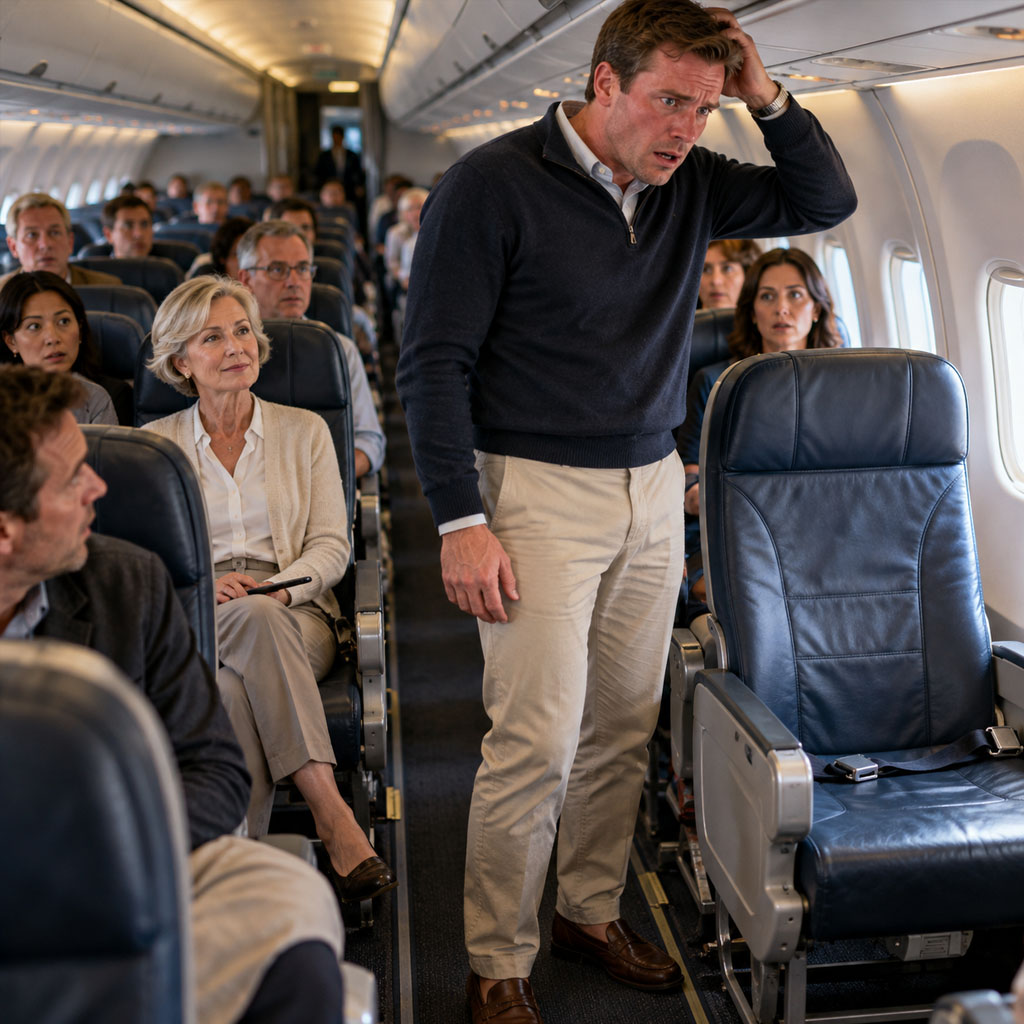
The man beside me had spent nearly four hours pushing his legs into my airplane seat, but when he returned from the restroom and discovered I was gone, his expression changed so dramatically that passengers stopped talking to watch. He stood frozen in the aisle, staring at my empty seat as though someone had stolen something that belonged to him. What he didn’t know was that I had spent those four hours preparing for precisely that moment.
Chapter 2
Denise came to my row almost immediately. She crouched beside my seat, and I noticed the little gold pin on her uniform marking nineteen years of service. There was something reassuring about her calm expression.
“How can I help you?”
“I need another seat,” I said. “And I owe you an apology because I wasn’t truthful earlier.”
She waited without interrupting.
I showed her the photographs and explained what had happened. Then I described Josh’s story about the woman on the Denver flight. Denise studied the images before glancing at the older gentleman across the aisle.
“Did you see these things happen, sir?”
He nodded.
“My name is Henry Ashworth. I taught high school civics for thirty-eight years, and I witnessed the entire thing.”
His expression grew troubled.
“I should have spoken up sooner. I used to tell my students that doing nothing isn’t always the same as doing what’s right.”
Denise thanked him and stepped into the forward galley. She spoke quietly with another crew member before returning.
“There’s an empty aisle seat two rows behind you,” she said. “You’re welcome to move there.”
Relief washed over me.
I gathered my handbag, sweater, and paperback. My legs trembled when I stood, and the ache in my hip made every step unpleasant.
But when I lowered myself into seat 33D, I nearly cried with relief.
For the first time since boarding, both of my knees fit comfortably in front of me.
Denise leaned closer.
“I’ve informed the captain about your complaint. We’ll document what happened.”
“Thank you,” I whispered.
A few minutes later, the restroom door opened.
Josh returned to row thirty-one, stopped, and stared at the empty window seat.
He looked around until he spotted me.
“What did you do?” he demanded loudly.
Several passengers turned.
“I moved,” I answered.
“You complained about me behind my back?”
“I asked you repeatedly to respect my space. You refused.”
His face reddened.
“She told the flight attendant everything was fine!” he announced to the surrounding passengers. “She’s making trouble!”
I felt the familiar urge to apologize. It rose inside me as naturally as breathing, but this time I didn’t obey it.
“You’re right about one thing,” I said. “I did tell her everything was fine. I was embarrassed, and I didn’t want an argument.”
Josh folded his arms.
“See? Nothing happened.”
I lifted my phone.
“Then I suppose you won’t mind the photographs.”
His smile disappeared.
Denise stepped into the aisle and explained that the captain had been informed and that Josh was expected to remain in his assigned seat without bothering anyone.
He opened his mouth to argue, but Henry spoke before he could.
“I watched her ask you to move several times, young man. You knew exactly what you were doing.”
Josh glared at him.
“Mind your own business.”
Henry’s expression didn’t change.
“When someone is being mistreated in front of me, it becomes my business.”
For a moment, nobody spoke.
Then Josh returned to his seat and sat with his knees carefully together.
The confrontation lasted less than five minutes. Yet once it was over, my hands began shaking so badly that I couldn’t hold my paperback.
Denise brought me water.
“You handled that well,” she said.
“I don’t feel as though I did.”
“Standing up for yourself can be uncomfortable, especially when you’re not used to it.”
I looked toward the window across the aisle.
“I spent my career listening to people tell the truth under difficult circumstances. You’d think I would have learned how to do it myself.”
Denise smiled gently.
“Sometimes knowing something and doing it are two different things.”
The plane landed at Boston Logan Airport shortly after three that afternoon. Most passengers remained seated while an airline supervisor came aboard to speak with Josh. An airport police officer was waiting near the gate.
I gave a statement describing what happened. Henry offered to provide one as well.
The officer explained that rude behavior by itself wasn’t necessarily a criminal matter. Nevertheless, he could document the incident, and the airline could decide whether Josh had violated its passenger conduct policies.
That seemed reasonable to me.
I wasn’t interested in seeing Josh arrested. I wanted the airline to understand that what happened wasn’t simply a disagreement over legroom.
Before leaving, the supervisor asked whether I would accept a customer-service follow-up. I agreed, expecting perhaps an apology and an assurance that my complaint would be reviewed.
An hour later, my daughter opened her front door.
“Mama!”
Claire was wearing slippers and an oversized sweatshirt. Her hair was tied in a crooked ponytail, and her eyes filled with tears as she hugged me.
Then my son-in-law, Ben, carefully placed my granddaughter in my arms.
June was impossibly small.
Her tiny mouth moved in her sleep, and one little hand curled around my finger.
For several minutes, I forgot the airport, the airplane, and the man in the expensive sweater.
I thought only of Thomas.
He should have been standing beside me, making silly faces at the baby and insisting that she had his nose.
I kissed June’s forehead.
“Your grandpa would have loved you so much.”
Claire wrapped an arm around my shoulders.
“He already did, Mama. He was talking about her before we even knew she was a girl.”
That evening, after everyone had settled down, an email arrived from the airline.
It offered me a seven-hundred-fifty-dollar travel voucher as compensation for my unpleasant experience. Attached was a customer satisfaction release that would close the complaint once signed.
I read the document carefully.
The release treated the matter as resolved and required me to waive further claims connected to the incident.
I remembered Josh’s story about the Denver passenger.
A voucher.
A form.
A complaint that disappeared.
Before I could decide what to do, another email arrived.
This one came from an attorney representing Joshua Pruitt.
The letter denied my description of events and warned against making damaging public accusations. It threatened possible legal action if I circulated the photographs or statements about Josh.
I sat very still.
The old Maggie wanted to sign the airline’s form, accept the voucher, and forget everything.
I was visiting my granddaughter for the first time. I wanted quiet mornings, family dinners, and the peaceful happiness I’d been missing since Thomas died.
I didn’t want lawyers or arguments.
But the longer I stared at the release, the more uncomfortable I became.
I thought of the woman on the Denver flight. Had she accepted the money because she’d been satisfied, or because she was simply too exhausted to continue?
And how many other passengers had quietly surrendered their space because confronting a stranger seemed harder than enduring him?
At eleven that night, I opened my laptop and began typing.
Chapter 3
For thirty-three years, I’d worked in the Pierce County courthouse, recording testimony from people who sometimes seemed determined to avoid the truth. I knew the difference between a complaint written in anger and a careful account supported by facts. So I wrote down everything I remembered, from boarding the plane to the moment Josh returned from the restroom.
I included the photographs and the names of the airline employees who had spoken with me. I described Henry’s observations and noted Josh’s account of the earlier incident. I made no assumptions about his intentions beyond what his words and actions supported.
By two in the morning, I had a complete statement.
Then I called an old colleague, Gerald Weinstein, an attorney I’d known throughout much of my career. Jerry had represented families in difficult cases for decades, and I trusted his judgment.
He listened as I explained the airline’s offer and the threatening letter.
“Maggie, don’t sign anything you don’t understand,” he said. “Let someone review those terms first.”
“I’m frightened they’re going to sue me.”
“Anyone can threaten a lawsuit. That doesn’t mean the claims have merit, but you should take the letter seriously and respond appropriately.”
He asked me to send him the documents.
The following morning, Henry emailed his statement. He described watching Josh repeatedly crowd my seat and hearing my requests for more room.
At the bottom, he’d written one sentence that brought tears to my eyes.
“I regret waiting so long to speak.”
Denise also confirmed that she’d filed an incident report and forwarded the information to the airline’s passenger conduct department.
I sent my statement to the department’s supervisor, Colleen Hartwell, explaining that I would not accept the voucher or sign the release while the incident remained under review.
Colleen called me later that day.
She had a calm voice and spoke with the precision of someone accustomed to dealing with difficult situations.
“Mrs. Halloran, I’ve reviewed your statement and the crew’s report. I understand why you’re concerned.”
I thanked her.
“May I ask you something?” I said. “Did that incident on the Denver flight actually happen?”
She paused.
“I can’t discuss another passenger’s private complaint without appropriate authorization. But I can tell you that we’re reviewing the information you’ve provided.”
I understood.
I’d spent enough years in courtrooms to respect the importance of proper procedures.
Colleen explained that repeated substantiated conduct violations could lead to restrictions on a passenger’s future travel. She couldn’t promise an outcome, but she assured me the matter would receive a formal review rather than being automatically closed.
I hung up feeling relieved, though not entirely satisfied.
Two days later, Colleen contacted me again.
She said another passenger involved in a similar incident had agreed to speak with me.
Her name was Renata Vasquez.
Renata was fifty-eight, a hospice nurse from Denver, and she sounded like a woman who had spent many years comforting frightened families.
“I heard you had trouble with Joshua Pruitt,” she said.
“Yes. He made the flight miserable.”
Renata sighed.
“He did the same thing to me last spring.”
We spoke for nearly forty minutes.
She described having her armrest taken over and her legroom crowded. When she’d asked Josh to move, he’d made remarks about her size and acted as though she had no right to complain.
Afterward, the airline offered her a two-hundred-fifty-dollar voucher and a release.
“I signed it,” she admitted. “I’d worked a long shift before that trip, and I was exhausted. I just wanted the whole thing to end.”
“You had every right to feel that way.”
“I know. But I’ve thought about it ever since.”
Her voice softened.
“I was embarrassed that I let him make me feel so small.”
I looked down at the wedding ring I still wore.
“Renata, I spent almost four hours doing the same thing.”
She laughed quietly.
“Then I suppose we’re both learning.”
Before we ended the call, she told me she’d agreed to provide the airline with a new statement if the review process allowed it.
I thanked her.
“You’ve already done something important,” she said. “You reminded me that speaking up isn’t always making trouble.”
Over the following days, I tried to put the matter aside and enjoy my family.
Claire needed help with laundry, grocery shopping, and the thousand little chores that accompany a newborn. Ben returned to work, leaving the three of us to spend long afternoons together.
I rocked June while Claire slept. I folded tiny sleepers and sorted blankets, amazed that something so small could require so much attention.
In the evenings, Claire and I sat at the kitchen table drinking tea.
One night, she asked what had frightened me most about the flight.
I considered the question.
“Not Josh,” I finally said. “At least, not entirely.”
Claire looked surprised.
“Then what?”
“The thought that everyone would think I was making a fuss. I was afraid of being the difficult woman.”
My daughter reached across the table and took my hand.
“Mom, you’ve spent your whole life making sure everyone else is comfortable.”
I smiled sadly.
“Your father used to say that.”
“He was right.”
She squeezed my fingers.
“You deserve to be comfortable, too.”
I looked toward the living room, where June slept peacefully in her bassinet.
When Claire was a little girl, I had taught her to be kind, speak honestly, and treat other people with respect. Yet somewhere along the way, I’d forgotten to teach myself that respect was something I deserved as well.
A week later, Jerry called.
He had responded to the attorney’s letter, explaining that my account concerned events I personally experienced and had documented. He advised me to avoid public arguments while the airline completed its review.
Several days afterward, the attorney withdrew his demand.
I felt relieved, but I knew the larger question remained unresolved.
Had the airline taken the incident seriously, or would Josh simply continue behaving the same way on future flights?
The answer arrived eleven days after I submitted my statement.
Colleen called while I was feeding June in Claire’s rocking chair.
“Mrs. Halloran,” she began, “the passenger conduct review has been completed.”
I held my breath.
She explained that the airline had substantiated the complaints from both flights. After reviewing the reports and the passenger’s conduct history, it had decided to suspend Joshua Pruitt’s travel privileges indefinitely, subject to its internal review procedures.
I closed my eyes.
For a moment, I couldn’t speak.
“Are you still there?” Colleen asked.
“Yes,” I whispered. “I’m here.”
She continued.
“I wanted you to know that your complaint was taken seriously. And I appreciate the care you took in explaining what happened.”
When we ended the call, I sat quietly with June asleep against my chest.
I didn’t feel triumphant.
I felt something deeper and calmer.
For years, I’d assumed that staying silent was the kindest way to handle conflict. Now I understood that sometimes silence allows unfairness to continue long after the original moment has passed.
I hadn’t needed to humiliate Josh or make him suffer.
I’d only needed to tell the truth and let the people responsible make an informed decision.
Chapter 4
By the time my visit to Boston ended, June had grown noticeably heavier in my arms. Claire was beginning to find her rhythm as a new mother, and Ben had learned how to change a diaper without looking as though he were disarming a bomb. Their little home was noisy, cluttered, and wonderfully alive.
On my last evening, Claire found me sitting alone by the window.
“Are you ready to go home, Mom?”
I looked at the photograph of Thomas she’d placed on the side table. He was smiling beneath a ridiculous fishing hat, holding the trout he’d caught during our last vacation together.
“I think I am,” I said.
She sat beside me.
“Does it feel strange going back to the house?”
“Every day.”
I took her hand.
“But I think I’m finally ready to start living in it again, instead of just remembering what it used to be.”
Claire leaned her head against my shoulder.
“Dad would be proud of you.”
I swallowed hard.
“I hope so.”
She smiled.
“He’d probably be telling everyone about the time his five-foot-two wife stood up to a bully on an airplane.”
I laughed, and for once the sound didn’t turn into tears.
When I returned to Tacoma, my house was exactly as I’d left it. Thomas’s gardening gloves still hung beside the back door, and his favorite coffee mug sat on the kitchen shelf. But the silence felt different.
It was no longer something I had to endure.
It was space I could decide how to fill.
I began meeting friends for lunch again. I volunteered twice a week at the local library, helping adults improve their reading and writing skills. On Saturdays, I visited the farmers market and sometimes bought flowers simply because I liked having them on the table.
I also stayed in touch with Henry.
He sent me a Christmas card with a photograph of his grandchildren standing beside a snow-covered pine tree. Inside, he’d written that our conversation had reminded him of something he’d tried to teach his students for nearly four decades.
“Courage isn’t always loud. Sometimes it’s simply being willing to say what you saw.”
I placed the card on my mantel.
Renata and I developed an unexpected friendship as well.
We talked about our children, retirement plans, favorite books, and the peculiar ways life changes after fifty. She told me stories about her work as a hospice nurse, while I shared memories of the more unusual cases I’d encountered as a court reporter.
Neither of us wanted our friendship to revolve around the man from the airplane.
One afternoon in March, I flew to Denver to visit her.
She met me at the airport wearing a bright green scarf and carrying a thermos of coffee. We recognized each other immediately, although we’d only spoken over the phone.
We hugged like old friends.
Over lunch, Renata admitted that she’d been nervous about meeting me.
“Why?” I asked.
“Because I thought you’d be one of those fearless women who always knows exactly what to say.”
I laughed.
“Renata, I once apologized to a department store mannequin because I bumped into it.”
She laughed so hard that the waiter turned around.
Then her expression softened.
“I guess bravery doesn’t mean never being afraid.”
“No,” I said. “I think it means deciding that fear doesn’t get the final vote.”
We spent the afternoon walking through a botanical garden and talking about everything except Joshua Pruitt.
When it came time for me to return home, Renata hugged me tightly.
“I’m glad you didn’t sign that form, Maggie.”
“So am I.”
“But I’m even happier you called me.”
I held her hand.
“Me, too.”
On my flight home, I chose an aisle seat.
Thomas had always preferred the aisle because he liked being able to stretch his legs without disturbing anyone. Choosing that seat felt like a small tribute to him, but also like a quiet declaration that I was no longer afraid to travel alone.
A pleasant-looking man in his seventies sat beside me. He wore a plaid shirt and carried a folded newspaper with a half-finished crossword puzzle.
As he settled in, his knee drifted slightly into my space.
For a moment, an old familiar discomfort tightened my stomach.
Then I remembered the long flight to Boston, Henry’s steady voice, Denise’s kindness, and the tiny granddaughter who had reminded me that life still held wonderful surprises.
I turned toward the gentleman.
“Excuse me,” I said pleasantly. “Would you mind moving your leg over just a little?”
He glanced down.
“Oh, goodness. I’m sorry.”
He immediately adjusted his position.
“These airline seats seem to get smaller every year, don’t they?”
“They certainly do,” I replied with a smile.
And that was that.
No argument.
No embarrassment.
No terrible consequence for asking a reasonable question.
As the plane climbed above the clouds, I looked out the window and thought about all the years I’d spent believing that kindness required me to be agreeable.
Thomas had been right about one thing.
I’d always been stronger than I knew.
But strength wasn’t what I’d imagined when I was younger. It wasn’t about winning arguments, embarrassing people, or forcing the world to behave according to my wishes.
It was about knowing that my comfort, my voice, and my dignity mattered just as much as anyone else’s.
I thought about June growing up in a world that wouldn’t always be fair. There would be people who underestimated her, interrupted her, or expected her to make herself smaller for their convenience.
I hoped she would be kind. I hoped she would be patient and generous, just as her grandfather had been.
But more than anything, I hoped she would understand something it had taken her grandmother sixty-one years to learn.
Being polite doesn’t mean surrendering your boundaries. Being older doesn’t mean becoming invisible, and keeping the peace doesn’t require accepting disrespect.
Sometimes the most important thing a person can say is also the simplest.
“Excuse me. I need a little room.”
And sometimes, when you finally say it without apologizing, you discover that the world has room for you after all.
I settled back in my seat, opened my paperback, and smiled.
For the first time in a very long while, I wasn’t waiting for someone else to make me comfortable.
I had finally learned how to do that for myself.
THE END.