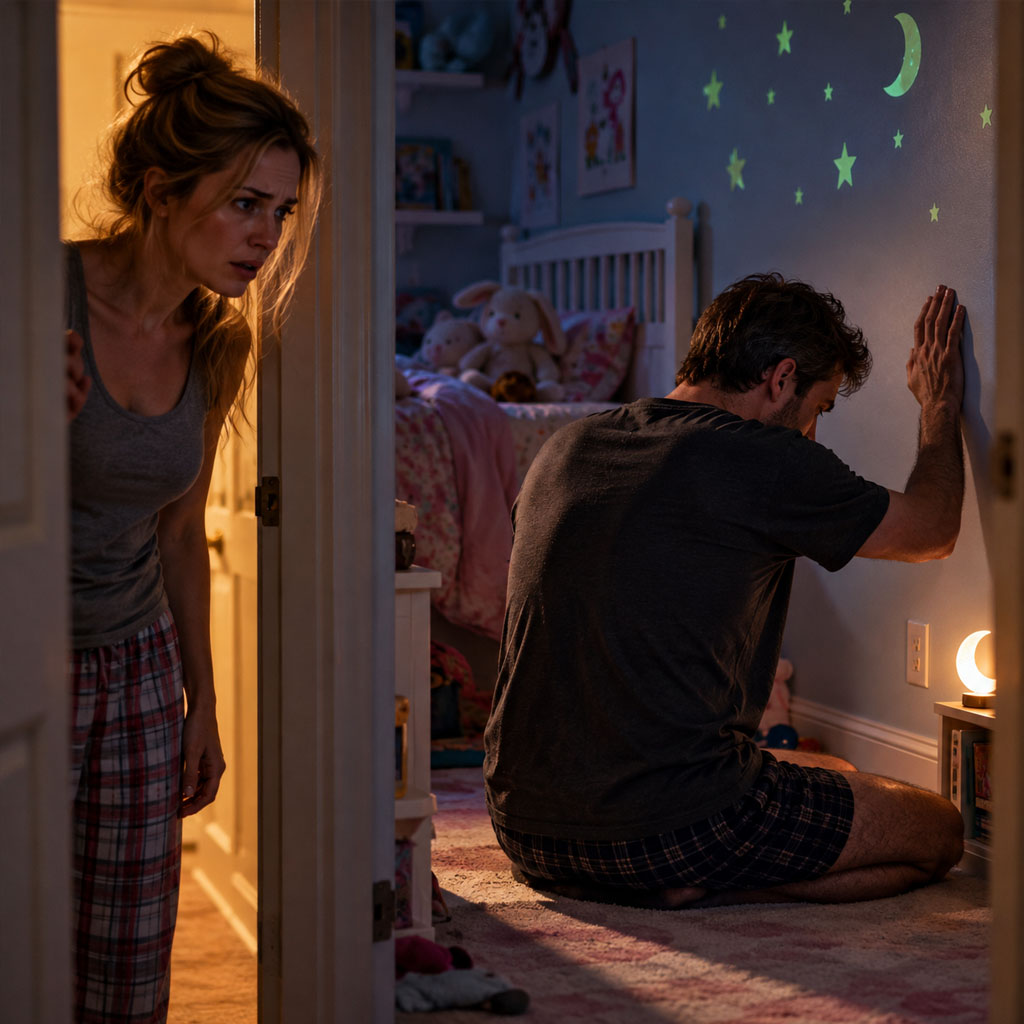
“Mommy, Uncle Raymond is in my bedroom again. He keeps touching the wall, and I don’t think he knows I’m watching him.”
Chapter 2
That evening, I waited until Emma was asleep before asking Daniel about the tester.
He was sitting at the kitchen table, staring into a cup of coffee he’d forgotten to drink. The moment I placed the yellow tool in front of him, his shoulders stiffened.
“Where did you find that?” he asked.
“In Emma’s room.”
He picked it up and ran his thumb over the initials. “It was Ray’s.”
“I know. Why was it upstairs?”
He stared at the tool for a long time.
“I took it out of the garage a few nights ago,” he admitted. “I thought maybe I could check the outlet.”
“Why didn’t you tell me?”
“Because I didn’t know what I was checking for.”
I wanted to ask more, but he stood, put the tester on the counter, and said he had to leave for his overnight shift at the paper mill. We’d been married long enough for me to recognize when Daniel was holding something back. That night, his silence frightened me more than Emma’s story.
Over the next several days, I began noticing things I’d previously ignored.
The upstairs hallway light flickered whenever the clothes dryer ran. An occasional clicking sound came from behind Emma’s bedroom wall, particularly late at night. And twice, when I went to wake her for school, I found her sleeping backward, with her head at the foot of the bed.
“Why are you sleeping that way, honey?” I asked.
“The other end gets too hot,” she answered.
“Your pillow?”
“No. The wall by my pillow.”
I touched the plaster near her bed. During the day, it felt normal, slightly cool beneath my fingers. Still, I moved her bed a short distance away and told her she could sleep in our room whenever she wanted.
That Thursday, I went into the garage to get a snow shovel. Raymond’s box of tools sat on its usual shelf, but the flaps were open. Daniel had clearly been looking through it, despite having avoided the box since his brother’s funeral.
I remembered how close the two men had been.
Raymond was six years older than Daniel and had practically raised him during the years their father struggled with alcohol. He taught Daniel to fish, helped him buy his first truck, and stood beside him at our wedding.
When Raymond became ill, Daniel spent nearly every spare evening at the hospital. After his brother died, he returned to work almost immediately and rarely spoke about the loss.
I’d always believed he was coping in his own quiet way.
Now I wondered whether he’d simply buried his grief where nobody could see it.
That night, I lay awake listening to the house.
Shortly before three, Daniel eased out of bed. I kept my eyes closed and heard him walk slowly down the hallway.
After several minutes, I followed.
He was sitting beside Emma’s bed again, his hand pressed against the wall.
This time, he didn’t startle when he saw me.
I sat on the floor beside him.
“Tell me what’s happening,” I whispered.
For a long while, he said nothing.
Then he spoke so quietly I could barely hear him.
“Monday night, I woke up because I heard two knocks. They came from this room. I thought Emma was playing around, so I came to check.”
He swallowed.
“She was asleep. Then I heard the knocks again, right here.”
He pointed toward the outlet.
“I remembered Ray doing that. I don’t know why, but I put my hand on the wall like he used to.”
“Did you see anyone?”
“No. But Emma woke up, looked straight past me, and said, ‘Good night, Uncle Ray.’”
His voice broke.
“Karen, I thought I was losing my mind. I’ve been dreaming about my brother for months. Sometimes I still hear his voice when I’m half asleep.”
I placed my hand on his shoulder.
“Why didn’t you tell me?”
“Because you already have enough to worry about. And because I didn’t want you thinking I was coming apart.”
We sat quietly as the furnace started downstairs.
Then I remembered something.
“Daniel, what does the wall feel like?”
He frowned.
“Warm.”
I pressed my palm beside his.
The plaster wasn’t merely warm. A circular patch above the outlet felt noticeably hotter than the surrounding wall.
I moved my hand a few inches sideways. The temperature changed immediately.
“That’s not normal,” I whispered.
Daniel pulled his hand away.
A faint smell drifted toward us, something like overheated plastic mixed with a sharp chemical odor. I leaned closer to the outlet without touching it.
Then we heard it.
Two small, dry snapping sounds came from inside the wall.
Daniel stared at me.
“That was it,” he whispered. “That’s the sound I’ve been hearing.”
I looked at our daughter, sleeping peacefully beneath her pink blanket. Her cheek rested only a short distance from the wall.
Suddenly, everything Raymond had taught us years earlier came rushing back.
The knocking. The warmth. The warning about old wiring.
I stood so quickly that my knees struck the bed frame.
“Daniel, get Emma. We’re leaving the house.”
He didn’t argue.
I wrapped our daughter in her blanket and carried her downstairs while Daniel hurried to the basement and switched off the main electrical breaker. The furnace stopped, and the entire house fell silent.
Outside, freezing wind swept across the driveway. I settled Emma into the back seat of our SUV while Daniel retrieved our coats and phones.
“What’s happening, Mommy?” she asked sleepily.
“Something in the house needs fixing, sweetheart. We’re going somewhere safe while the firefighters check it.”
I called 911 and explained that an interior wall was unusually hot and that we’d heard electrical snapping sounds.
The dispatcher instructed us to remain outside.
Within minutes, a fire engine turned into our driveway, its red lights flashing across the snow.
Three firefighters entered the house carrying equipment. One of them, a woman named Lieutenant Harris, spoke with us first and carefully listened to my description.
“Unusual heat and that kind of smell can indicate a serious electrical problem,” she said. “You did the right thing getting everyone out.”
Then she disappeared through our front door.
Daniel and I sat in the car, watching flashlight beams move behind Emma’s bedroom curtains.
Neither of us spoke for a long time.
Finally, Daniel whispered, “Ray told us to replace that wiring.”
I looked toward the upstairs window.
“Eleven years ago.”
He covered his face with both hands.
“I should’ve listened.”
I wanted to reassure him, but I couldn’t.
Because while our daughter slept in the back seat, firefighters were opening the wall where her pillow had rested only hours earlier.
And I had no idea what they were about to find.
Chapter 3
Lieutenant Harris returned nearly forty minutes later, carrying a thermal imaging camera.
Her expression was serious, but she spoke calmly as she approached our vehicle.
“We found the problem,” she said. “And I’m very glad you called when you did.”
She showed us an image of Emma’s bedroom wall. Most of it appeared in cool shades of blue and purple, but near the outlet was a bright area of yellow and white.
“There’s an electrical connection inside that wall that’s been overheating,” she explained. “The temperature was dangerously high when we checked it, even after the power had been disconnected.”
My mouth went dry.
“Was it close to catching fire?”
She chose her words carefully.
“The wiring insulation is badly damaged, and the surrounding wood has started to char. That means the situation was serious. I can’t tell you exactly when ignition might have occurred, but this was a significant fire hazard.”
Daniel gripped the steering wheel.
The firefighters had opened part of the wall and discovered an improperly installed electrical junction box. Newer wiring had been connected to old cloth-covered wiring, and one connection had worked loose.
Over time, the unstable connection had generated heat and intermittent electrical arcing.
The small snapping sounds were not mysterious knocks.
They were signs of a dangerous electrical failure.
I turned toward Emma.
She was asleep with her stuffed rabbit tucked beneath her chin, unaware of how close we’d come to losing everything.
“Her bed was right against that wall,” I whispered.
Lieutenant Harris nodded.
“Have a licensed electrician repair the damaged wiring and inspect the surrounding circuits before you use that part of the house again.”
We spent the rest of the night at a roadside motel.
Emma thought the unexpected trip was wonderful. She jumped between the beds, asked for pancakes, and wanted to know whether the firefighters had found Uncle Raymond.
Daniel glanced at me.
“They found something wrong with the wall,” I told her gently. “Something we couldn’t see.”
Emma nodded as though that answered everything.
“Good,” she said. “He was trying really hard.”
I didn’t ask what she meant.
The following morning, an electrician named Frank Miller arrived at our house. He’d spent thirty years working on older homes and took one look at the damaged junction box before shaking his head.
“This connection never should’ve been buried like this,” he said. “Whoever worked on it didn’t do the job properly.”
Daniel searched through the folder where we kept receipts and repair records.
Eventually, he found a faded work order dated three years earlier.
I remembered it immediately.
Just weeks after Raymond’s funeral, the ceiling light in Emma’s room had stopped working. Daniel was exhausted, I was struggling to keep the household running, and we’d hired a handyman whose advertisement I’d found at the hardware store.
He’d spent one afternoon repairing the light and accepted payment before leaving.
I’d never thought about the work again.
Frank studied the paperwork, then examined the damaged wiring.
“This connection is consistent with that repair,” he said. “The whole affected section needs replacing. We’ll inspect the rest while we’re here.”
The repairs took several days.
Frank and his crew removed the damaged wiring, installed new circuits, and arranged for the required inspection. When they finished, every outlet and fixture on that side of the house had been checked.
Emma’s bedroom wall was repaired and repainted pale yellow, just as she’d requested.
We should have felt relieved.
And we did.
But something continued troubling me.
On our second night at the motel, Emma was taking a bath while I sat nearby folding towels. She floated her plastic ducks across the water, humming a song she’d learned at school.
Then, without looking up, she said something that made my hands stop moving.
“Mommy, why did Uncle Raymond wear his wedding ring around his neck?”
I stared at her.
“What did you say?”
“When he came to my room, his ring was hanging on a string.” She lifted one of her ducks and swung it gently. “It moved like this whenever he bent down.”
For a moment, I couldn’t speak.
Raymond had worked around electrical equipment most of his adult life. During those years, he’d often kept his wedding band on a braided cord beneath his shirt rather than wearing it on his finger.
Linda used to tease him about it.
She’d once joked that the cord was probably his most faithful companion after her.
But Raymond stopped wearing the ring that way during his illness. Emma had been only four when he died, and I couldn’t remember her ever seeing it around his neck.
“Who told you about that, sweetheart?” I asked.
She looked puzzled.
“Nobody. I saw it.”
I tried to smile.
“Maybe you remember a picture.”
She shrugged and returned to her ducks.
Later that evening, I called Linda.
She’d moved to Green Bay after Raymond’s death to be closer to her sister. We still spoke on holidays, but I hadn’t told her anything about Emma’s strange experiences.
“Linda, do you remember Ray wearing his wedding ring on a cord?”
She laughed softly.
“Of course. He wore it that way for years. Why?”
“Emma mentioned it today.”
The line went quiet.
“Emma?”
“Yes.”
“Well, that’s strange. I don’t think I’ve ever talked to her about that.”
I told her what had happened, beginning with Emma’s nighttime visits and ending with the electrical problem.
Linda listened in silence.
When I finished, she began crying.
“That sounds exactly like Raymond,” she whispered. “He never could leave a dangerous wire alone.”
I didn’t know what to say.
“I’m not claiming anything supernatural happened,” I finally told her.
“I know, Karen.”
“But Emma described things I don’t understand.”
Linda took a slow breath.
“Maybe there’s an explanation. Maybe she heard us talking years ago and remembered more than we realized.”
“That’s what I’ve been telling myself.”
There was another pause.
“Whatever happened,” Linda said, “I’m grateful she’s safe.”
After we returned home, I searched through our old family photographs.
I found one picture from a fishing trip taken before Emma was born. Raymond stood knee-deep in a lake, holding an enormous bass, his shirt hanging open.
A dark cord was visible around his neck.
In another photograph from our wedding reception, the same cord appeared beneath his loosened collar.
Both pictures had been stored in boxes in the attic for years.
Perhaps Emma had seen them somewhere else. Perhaps Daniel had mentioned the ring during one of his bedtime stories about his brother.
Children remember odd details, often long after adults forget saying them.
Those explanations were reasonable.
I believed they could be true.
But they didn’t completely settle the question.
And for the first time in my life, I was willing to admit that I didn’t have an answer for everything.
Chapter 4
Once the repairs were complete, life slowly returned to normal.
The hallway lights no longer flickered. The strange smell disappeared, and Emma’s bedroom remained cool even when the furnace ran throughout the night.
Frank had shown us the damaged junction box before disposing of it.
One side was almost completely black, and the insulation around several wires had melted together. Looking at it made me feel sick, especially knowing how close it had been to our daughter’s bed.
Daniel kept a photograph of it on his phone.
Not because he wanted to frighten himself, but because he said he’d never ignore a warning about our home again.
He also made an appointment with a grief counselor.
I’d suggested counseling before, but he’d always insisted he was managing fine. This time, he told me he was tired of carrying his brother’s death alone.
“I think I stopped talking about him because it hurt too much,” Daniel admitted one evening. “But not talking about him didn’t make me miss him any less.”
We were sitting at the kitchen table after Emma had gone to bed.
I reached for his hand.
“You don’t have to pretend you’re okay all the time.”
He looked at me with tears in his eyes.
“Sometimes I still feel like that kid who followed Ray everywhere. He always knew what to do. Even when Dad was drinking and everything at home was falling apart, Ray knew how to make things right.”
I squeezed his fingers.
“He’d be proud of you for taking care of Emma.”
Daniel shook his head.
“He warned us about those wires. And we forgot.”
“We didn’t forget him,” I said. “We put things off, the way families sometimes do. That was a mistake, but we fixed it before anyone was hurt.”
He remained quiet for a moment.
Then he smiled sadly.
“Ray would’ve found that problem in five minutes. He’d have knocked on the wall, complained about the wiring, and asked what we were making for lunch.”
I laughed through my tears.
“Probably two sandwiches and a slice of pie.”
“Three sandwiches,” Daniel corrected. “You remember how that man could eat.”
For the first time since Raymond’s funeral, we talked about him without letting sadness swallow every memory.
We remembered the Thanksgiving he’d burned the turkey because he was repairing Linda’s kitchen light. We remembered his terrible jokes, his love of country music, and the way he always carried peppermint candies in his shirt pocket for Emma.
Daniel told stories I’d forgotten.
And as he spoke, something seemed to loosen in him.
A week later, while I was braiding Emma’s hair before school, she looked at me in the bathroom mirror.
“Mommy, do you think Uncle Raymond will come back?”
I paused with the purple hair ribbon between my fingers.
“Why do you ask?”
She shrugged.
“Because I haven’t seen him since the firefighters came.”
“Does that make you sad?”
“A little. But I think he’s finished.”
“Finished with what?”
“Checking the wall.”
She said it with such certainty that I felt a small chill despite the warm morning.
Then she smiled.
“Can I wear my sparkly shoes today?”
I laughed and tied her braid.
“Only if you promise not to jump in the puddles.”
She promised, although we both knew how little chance that promise had of surviving recess.
That afternoon, I drove Emma to school and spent the rest of my day at work reviewing damaged road signs from the latest snowstorm.
Everything was ordinary again.
Trucks needed repairs. Paperwork piled up. Someone complained about a missing stop sign on County Road B.
I found myself grateful for every dull, predictable minute.
Still, I occasionally thought about the three nights Emma said she’d seen Raymond.
I wondered whether she’d been dreaming, whether shadows had played tricks on her eyes, or whether she’d confused her father with someone she barely remembered.
I knew there were explanations that didn’t involve a ghost.
Daniel’s grief had made him unusually sensitive to sounds in the house. Emma might have recognized his silhouette and connected it with stories about Raymond. The dangerous wiring had produced real noises, and her memories could easily have filled in the rest.
Yet the ring on the cord remained difficult to explain.
So did the fact that Emma had begun sleeping with her head away from the overheated wall before either Daniel or I recognized the danger.
Maybe she’d simply felt the warmth and moved away.
Maybe her sleeping mind had transformed familiar family stories into a vivid dream.
Or maybe there were things about love and memory that I couldn’t fit into a neat explanation.
I decided I didn’t need to choose one.
One Sunday afternoon in late April, the snow had finally melted from our backyard. Daniel and I sat on the porch with mugs of coffee while Emma rode her bicycle up and down the driveway.
She’d recently learned to ride without training wheels and was determined to demonstrate her new skill every few minutes.
“Mommy! Daddy! Watch this!”
We waved as she pedaled past.
Daniel smiled, then looked toward the upstairs window.
“What do you think we should tell her about Ray?” he asked.
I thought for a moment.
“We tell her what we know about the wiring. We tell her the house had a dangerous problem and that trained professionals repaired it. She deserves to understand why we had to leave that night.”
“And the rest?”
I watched Emma turn her bicycle carefully near the mailbox.
“We don’t have to tell her she’s wrong about what she remembers,” I said. “And we don’t have to tell her it was definitely Ray. We can listen when she wants to talk.”
Daniel considered that.
“You really think that’s enough?”
“I think it’s the truth. We don’t know exactly what she experienced.”
He looked down at his coffee.
“I hope it was him,” he admitted. “I know that sounds foolish, but I hope my brother was there somehow.”
I reached for his hand.
“There’s nothing foolish about missing someone.”
Daniel nodded.
“Ray loved that little girl. He was crazy about her from the day she was born.”
“I remember.”
“He used to tell me he’d teach her everything about fixing things when she got older.”
I smiled.
“Well, he’d certainly approve of us finally fixing the electrical system.”
Daniel laughed softly.
“He’d probably ask why it took us eleven years.”
We sat in comfortable silence for a while, watching our daughter ride through the sunshine.
Then Emma abandoned her bicycle and came running toward us.
“Mommy, I remembered something!”
I opened my arms as she climbed onto my lap.
“What is it, sweetheart?”
“Uncle Raymond smiled at me the last night.”
Daniel looked over.
“He did?”
She nodded enthusiastically.
“He touched the wall, then looked at me and smiled. I think he was happy because you and Daddy finally heard the knocking.”
I brushed the hair away from her forehead.
“That’s a nice thing to remember.”
She leaned against me for a moment.
“Mommy, do people stop loving you when they die?”
The question caught me unprepared.
Across from us, Daniel lowered his coffee mug.
I held Emma a little closer.
“No, sweetheart. I don’t believe love disappears just because somebody dies. We still love Uncle Raymond, don’t we?”
She nodded.
“Very much.”
“And we always will.”
She seemed satisfied.
“Then maybe he still loves us, too.”
I kissed the top of her head.
“Maybe he does, baby.”
She slid off my lap and ran back toward her bicycle, leaving Daniel and me looking at each other.
Neither of us spoke.
There was nothing we needed to add.
That evening, after Emma went to bed, I stood in her doorway and looked around the room.
The yellow walls were freshly painted. Her glow-in-the-dark stars formed a crooked constellation above the headboard, and her stuffed rabbit sat proudly on the pillow.
Everything was quiet.
I walked over and rested my palm against the wall near the new outlet.
It felt cool and ordinary.
Exactly as it should.
I thought about Raymond standing in that room eleven years earlier, warning us that the wiring needed attention. His voice was still so clear in my memory that I could almost hear his familiar laugh.
“Hot wall, bad wall, Karen. Remember that.”
I smiled.
“I remember now, Ray,” I whispered.
Whether his presence had been real or only a story woven from grief, memory, and a child’s imagination, I couldn’t say.
What I knew was that Emma had noticed something we hadn’t understood, and because we listened, we discovered a danger before it became a tragedy.
That lesson would stay with me for the rest of my life.
The next morning, I found Daniel in the garage with Raymond’s old toolbox open beside him.
He was cleaning the tools, wiping away years of dust and carefully arranging each wrench and screwdriver.
“What are you doing?” I asked.
He looked up and smiled.
“Thought I’d restore some of these. Maybe someday Emma and I can build something together.”
I sat beside him and picked up the yellow tester.
Raymond’s initials were still scratched into its handle.
Daniel reached over and touched them gently.
“He taught me how to fix my first bicycle,” he said. “Maybe it’s time I passed some of that along.”
Outside, Emma rang her bicycle bell and shouted for us to watch her new trick.
Daniel laughed, stood up, and offered me his hand.
We walked out into the sunshine together.
Our daughter was waiting at the end of the driveway, grinning from ear to ear, certain that the world was wonderful and full of possibilities.
I watched her climb onto her bicycle, healthy and happy beneath the clear Wisconsin sky.
And I understood something I’d never understood before.
Sometimes the people we love leave us with warnings. Sometimes they leave us with memories, skills, or little habits that seem unimportant until the day we need them most.
We may never know whether someone we lost is somehow still watching over us.
But we can honor them by listening, by caring for one another, and by taking seriously the small things that tell us something isn’t right.
As Emma pedaled toward us, Daniel slipped his arm around my shoulders.
For one quiet moment, I felt an overwhelming gratitude for our daughter, our home, and the life we’d nearly lost without realizing it.
And somewhere in my heart, I thanked a stubborn old electrician who had taught us, long ago, that even walls can have something important to say.
THE END.