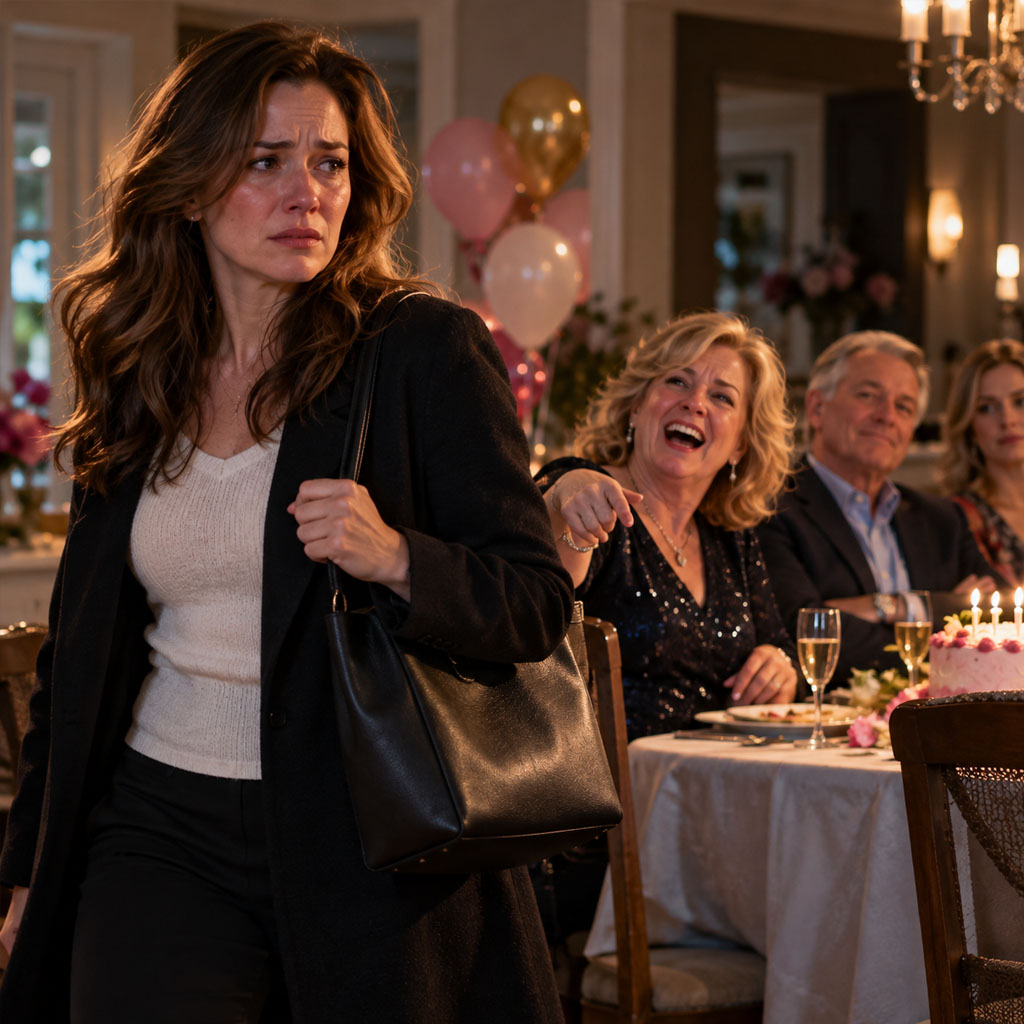
My mother broke my nine-year-old daughter’s heart in front of twenty relatives, then laughed as though the sound of her crying was part of the birthday entertainment.
Chapter 2
The following morning, I accepted a position at a respected law firm in downtown Columbus. The offer had been sitting unanswered in my inbox for almost three weeks. It came with a substantial raise, flexible hours, and the opportunity to work from home twice a week.
I had hesitated because my parents kept talking about retirement. I had even considered using part of my higher salary to help them pay off their house.
Now I transferred that month’s $300 into a savings account for Rose.
For the first time in years, the money felt like it belonged exactly where it should.
My parents didn’t take my decision seriously until they received a $600 bill from an attorney who helped them secure an extension on their business license. My father forwarded the invoice with an angry message.
“Six hundred dollars for something you could have done in ten minutes. Unbelievable.”
I didn’t reply.
Amanda called that evening while I was folding laundry.
“Mom’s really upset,” she said. “I think everybody’s making this bigger than it needs to be.”
“Did she apologize to Rose?”
“She said she was sorry Rose got upset.”
“That’s not the same thing.”
Amanda sighed. “Monica, they’re getting older. The business is stressful enough without you suddenly refusing to help.”
“Then maybe you should help them.”
“You know I can’t do legal work. I’m a second-grade teacher, and I’ve got three kids.”
“I have a child, too.”
“That’s not what I meant.”
I sat on the edge of my bed. “Amanda, you watched our mother humiliate Rose. You didn’t say a single word.”
“I didn’t know what to say.”
“You could have said it wasn’t right.”
My sister fell silent.
For the next several weeks, my parents alternated between angry messages and pretending nothing had happened. My father sent documents with question marks attached. My mother sent photographs of dinners she had cooked, followed by complaints that families weren’t supposed to treat each other like strangers.
I continued working, taking Rose to school, and discovering how peaceful evenings could be when I wasn’t constantly rescuing someone else’s business.
Then, eleven days after starting my new job in January, my father appeared in the firm’s lobby.
He was holding a thick folder.
“One of our drivers had an accident,” he said when I came downstairs. “Nobody was badly hurt, but the insurance company is making trouble. I need you to look at these papers.”
“I’m sorry about the accident. You need to call your attorney.”
“That fellow wants a retainer before he’ll even open the file.”
“That’s how legal representation works.”
My father’s face reddened. “Are you seriously going to let your parents lose everything because a little girl cried at a birthday party?”
A receptionist looked up from her desk.
I lowered my voice. “Rose cried because her grandmother told her she didn’t deserve to belong to this family.”
“Your mother never said that!”
“She said she wished Amanda’s children were her only grandchildren.”
He opened his mouth, then closed it.
“Don’t come to my workplace again,” I told him.
He left with the folder tucked beneath his arm.
The company survived the insurance matter. My parents hired an attorney, the claim was resolved, and business continued.
What changed was that every professional service now came with an invoice.
By February, my mother called from an unfamiliar number.
“Before you hang up, I want to see Rose,” she said.
“She doesn’t want to visit right now.”
“She’s nine. She doesn’t get to make that decision.”
“She’s old enough to know when someone has hurt her.”
My mother began crying. “You’re keeping my own granddaughter away from me.”
“Mom, you told her you wished your other grandchildren were the only ones you had.”
“It was a joke!”
“Then explain why nobody laughed except you.”
She had no answer.
Eventually, she muttered, “You’ve always been difficult, Monica.”
“And you’ve always expected me to accept things I shouldn’t.”
I ended the call.
But while I was learning to stand up for myself, Rose was struggling in ways I hadn’t anticipated.
She stopped singing.
Before the birthday party, my daughter had sung constantly, in the shower, while brushing her teeth, even while making peanut butter sandwiches. Now our house was unnaturally quiet.
Her teacher contacted me because Rose had withdrawn from a spring music program she had eagerly discussed for months.
That night, I sat beside her on the living room couch.
“Honey, did something happen at school?”
She shook her head.
“Does this have anything to do with Grandma’s birthday?”
Her eyes filled with tears.
“Grandma laughed because I sounded terrible,” she whispered. “She didn’t laugh at Amanda’s kids.”
I pulled her close.
“You didn’t sound terrible. You were nervous, sweetheart.”
“But they’re better than me.”
“No. They’re different from you.”
She studied my face.
“Do you think Grandma loves them more?”
I could have offered a comforting lie. Instead, I chose words that wouldn’t make my daughter doubt her own experience.
“Grandma has treated Aunt Amanda’s family differently for a long time. That isn’t fair, and it isn’t because there’s anything wrong with you.”
“Is it because of you, Mommy?”
The question pierced me.
“Maybe some of it started with how she treated me,” I admitted. “But none of that belongs on your shoulders.”
Rose rested her head against my arm.
I sat holding her long after she fell asleep.
For the first time, I understood that I hadn’t really outgrown my childhood hunger for my parents’ approval. I had simply disguised it as responsibility.
I was still trying to become the daughter they would finally choose.
A few weeks later, my mother sent me a photograph of an invoice from their new attorney.
The total was $4,800.
“Look what this crook is charging us,” she wrote. “Can you believe it?”
I enlarged the photograph.
Beneath the amount was a description of the legal work: preparation of business succession documents and ownership transfer to Amanda Reynolds.
I stared at those words until they blurred.
Then I called my father.
“Dad, what are you transferring to Amanda?”
His cheerful greeting disappeared.
“Where did you hear that?”
“Mom sent me the invoice. Are you giving Amanda the company?”
“It’s not finalized.”
“All of it?”
He sighed. “Eventually, yes.”
I sat down slowly.
Fifteen years of unpaid legal work. Thousands of dollars in mortgage assistance. Countless evenings away from my own daughter.
And the business I had helped protect was being handed to my sister.
“Why?” I asked.
“Because Amanda has three children to provide for. You have a good career, Monica. You’re financially secure.”
“I have a daughter, too.”
“Nobody’s saying otherwise.”
“Does Amanda even want to run a trucking company?”
“She can hire somebody to manage it.”
I felt something colder than anger settle in my chest.
“You expected me to spend years keeping that company running so you could give it to Amanda?”
“We don’t owe you an inheritance.”
“I never asked for one.”
“Then why are you upset?”
“Because you expected everything from me while planning everything for her.”
My father scoffed. “You’re being dramatic.”
“No, Dad. I’m finally finished being useful.”
Chapter 3
That night, I sat at my kitchen table reviewing years of old bank statements. My mortgage contributions alone totaled more than $30,000. The legal services I had provided would have cost my parents many thousands more.
I had never kept track of the hours because I believed I was helping my family. Seeing the numbers together made me realize how thoroughly I had confused sacrifice with love.
Rose wandered into the kitchen wearing her pink pajamas.
“Mommy, why are you looking at all those papers?”
“I’m learning an expensive lesson.”
“Is it about math?”
I smiled sadly. “Something like that.”
She climbed into my lap.
“Math makes me tired,” she announced.
“Me too, sweetheart.”
The next afternoon, Amanda called.
“Did you know Mom and Dad were leaving you the company?” I asked.
She hesitated.
“They’ve mentioned it before.”
“For how long?”
“A few years.”
“And you never thought to tell me?”
“I didn’t think it was a big deal. You’re a lawyer, Monica. You don’t need their business.”
I closed my eyes.
“That’s what Dad said.”
“Well, maybe he has a point.”
“The point isn’t whether I need it. It’s that I helped build something they planned to give away without even acknowledging my contribution.”
Amanda remained quiet.
Finally, she said, “You’re right about the birthday.”
I wasn’t expecting that.
“What?”
“I should have said something when Mom laughed at Rose. I knew it was cruel, but I just sat there. I’m sorry.”
Her voice sounded genuinely ashamed.
“Rose needed someone to stand up for her,” I said.
“I know.”
For a moment, we were silent.
Then Amanda surprised me again.
“Monica, I don’t want the company.”
I frowned. “What are you talking about?”
“I don’t want to own a trucking business. I love teaching. I love my life. Dad keeps insisting I can hire someone to manage everything, but I don’t want that responsibility.”
“Then tell him.”
“It’s not that easy.”
“Why?”
She gave a bitter little laugh.
“Because being the favorite doesn’t mean Mom and Dad listen to me. It means they’ve already decided what I’m supposed to want.”
Her words made me pause.
I had always seen Amanda as the child who received everything I was denied. It hadn’t occurred to me that being placed on a pedestal might also come with expectations she couldn’t escape.
“Then make them listen,” I said.
“I’m going to try.”
That weekend, Amanda told our parents she would not accept the company.
My father called Sunday evening, furious.
“Are you satisfied now?”
I was preparing spaghetti while Rose worked on a puzzle at the kitchen table.
“About what?”
“Your sister suddenly doesn’t want the business. You’ve turned her against us.”
“I told Amanda to make her own decision.”
“She was perfectly happy until you started filling her head with nonsense.”
“Dad, listen to yourself. Amanda is forty-five years old. She can decide whether she wants to own a company.”
“Then what are we supposed to do with it?”
“You can sell it. You can hire management. You can keep working. Those are your decisions.”
“You’ve turned this family upside down!”
I set down the wooden spoon.
“No, Dad. I stopped holding everything up.”
For once, he didn’t have an immediate answer.
Spring arrived, bringing warmer afternoons and a little more laughter into our house.
My parents hired an accountant to straighten out years of business records. They paid their attorney to handle contracts and regulatory matters. They hired someone to evaluate the company for a possible sale.
My father complained endlessly about the costs.
Then relatives began calling.
My Aunt Denise was particularly offended.
“Your poor mother says you’ve abandoned them over a harmless birthday joke,” she declared.
I repeated my mother’s exact words.
There was a silence on the other end.
“Well,” Aunt Denise finally said, “Patricia has always had a sharp tongue.”
“Yes,” I replied. “And now she has an attorney who sends invoices.”
Aunt Denise changed the subject.
By April, my parents decided to sell the company. The first offer came in lower than they had hoped, and my father forwarded the documents to me without explanation.
I wrote back, “Please discuss the offer with your attorney.”
His response surprised me.
“I wasn’t asking for legal advice. I wanted your opinion as my daughter.”
For several minutes, I studied those words.
Then I typed, “As your daughter, I hope you make the choice that gives you and Mom a comfortable retirement.”
He didn’t respond.
It was the first time I had spoken to him without trying to solve something.
Meanwhile, Rose began quietly singing again.
One afternoon, I heard her voice coming from the bathroom while she showered. It was barely louder than a whisper, but I recognized the tune immediately.
I stood in the hallway with tears rolling down my cheeks.
I didn’t interrupt her.
A week later, she brought home a registration form for her school’s spring music night.
“I might do it,” she said casually, placing the paper on the counter.
“That sounds wonderful.”
“It’s a group song. Five kids.”
“Would you enjoy that?”
She shrugged.
“Maybe. I’m still scared.”
“Being scared doesn’t mean you can’t do something.”
She considered that carefully.
Three days later, she signed the form herself.
Around the same time, a pale blue envelope arrived addressed to Rose in my mother’s handwriting.
I showed it to my daughter.
“Grandma sent you a letter. Would you like me to read it first?”
Rose nodded.
Inside was a handwritten apology.
My mother admitted that her words at the birthday party had been cruel. She wrote that Rose had done nothing wrong and that a grandmother should make her grandchildren feel safe and loved, not judged against one another.
She did not call it a joke. She didn’t ask Rose to stop being sensitive.
She simply wrote that she was sorry.
At the bottom, my mother added, “You don’t have to forgive me, sweetheart. I just want you to know that I was wrong.”
I read the letter twice.
Then I gave it to Rose.
She studied it carefully before folding it along its original creases.
“Do I have to write back?” she asked.
“No.”
“Do I have to visit her?”
“Not unless you’re comfortable.”
She put the letter into her desk drawer.
“Maybe someday.”
I told my mother that Rose had received the letter and wasn’t ready for a visit.
“All right,” my mother replied.
For once, she didn’t argue.
Chapter 4
My parents sold the company in early May. They received less than they had originally wanted, but enough to retire comfortably if they managed their money carefully.
The closing took place without my involvement.
A few days later, my father called while I was parked outside Rose’s elementary school.
“Well, you got what you wanted,” he said.
“What did I want?”
“The company is gone. Everything changed after you stopped helping us.”
I watched children streaming out through the school doors.
“Dad, the company didn’t disappear because I stopped helping. You decided to sell it.”
“We had to pay lawyers, accountants, consultants. Do you have any idea what all that cost?”
“Yes. I know what professional services cost.”
He said nothing.
“The work was always valuable, Dad. You just didn’t notice because I never charged you.”
His breathing grew heavy.
“We’re your parents.”
“I know. And I was your daughter, not an employee you could call whenever you needed something fixed.”
After a long silence, he said, “Maybe we should have handled the company differently.”
“That’s not the part that hurts the most.”
“What, then?”
“Rose.”
My father’s voice softened.
“Monica—”
“You watched Mom humiliate her. You nodded when she said those things. My daughter spent weeks believing she wasn’t good enough to be loved by her own grandparents.”
“I didn’t intend that.”
“But you let it happen.”
For several moments, I thought he might hang up.
Then he said quietly, “I’m sorry.”
There was no defense, no explanation, and no attempt to make me feel guilty.
“I should have spoken up,” he continued. “Your mother was wrong, and I was wrong for sitting there.”
I closed my eyes.
“Thank you for saying that.”
It was the closest my father had ever come to acknowledging the emotional cost of our family.
But an apology didn’t erase fifteen years of being taken for granted. It didn’t mean I was ready to reopen every door I had finally found the courage to close.
I could accept his regret without surrendering the peace Rose and I had worked so hard to build.
Two weeks later, the school held its spring music night.
The auditorium was packed with parents, grandparents, and excited children. Bright paper flowers decorated the walls, and the stage lights cast a warm glow over the little performers waiting behind the curtain.
Amanda came with her oldest daughter.
I hadn’t invited my parents. Rose had decided she wasn’t ready to see them at her performance, and I respected that decision.
Before the program began, Amanda approached us in the hallway.
She knelt in front of Rose.
“I owe you an apology,” she said. “At Grandma’s birthday party, I should have spoken up when she said those awful things.”
Rose looked at her aunt cautiously.
“I was scared,” she whispered.
“I know, sweetheart. And I’m sorry I didn’t help you.”
Rose nodded.
Then her cousin stepped forward and offered her a tiny bracelet made from blue and silver beads.
“I made it for you,” she said. “For good luck.”
Rose smiled and slipped it over her wrist.
A few minutes later, the children were called backstage.
I watched my daughter walk toward the curtain, her little shoulders stiff with nerves.
When her group appeared, Rose stood near the center of the stage.
Her hands were clasped tightly in front of her.
The music began.
For one terrible second, she looked as though she might freeze again.
Then she found me in the audience.
I smiled.
She took a breath and started singing.
Her voice trembled at first, but as the song continued, she grew steadier. By the final verse, she was looking straight ahead, singing with the other children.
There was no extraordinary solo, no thunderous standing ovation, no miraculous transformation into a fearless performer.
There was simply a nine-year-old girl finding the courage to use her voice again.
And it was beautiful.
When the song ended, I applauded until my palms hurt.
Rose ran toward me afterward, her cheeks flushed with excitement.
“Mommy! Did you hear me?”
“Every word, sweetheart.”
“Even the high part?”
“Especially the high part.”
She threw her arms around my waist.
Then she looked around the auditorium.
“Grandma didn’t come?”
“No, honey.”
Rose thought about that.
“That’s okay.”
She took my hand.
“Can we get ice cream?”
I laughed through my tears.
“Absolutely.”
Amanda joined us with her daughter, and the four of us went to a little ice cream shop near the school. Rose talked excitedly about the performance, explaining how she had almost forgotten one line but remembered it just in time.
Amanda listened without interrupting.
For the first time in years, spending time with my sister didn’t feel like competing for something neither of us should have had to earn.
Our relationship didn’t suddenly become perfect. We still had years of misunderstandings between us, and there were things neither of us knew how to discuss.
But we were learning.
Over the summer, my parents sold their large house and moved into a smaller condominium near a quiet park. My mother started volunteering at a community garden, and my father joined a local fishing club.
They were doing fine.
I was relieved, not because I wanted to resume responsibility for their lives, but because I had never wished them harm.
I had only wanted the freedom to live my own life without carrying theirs.
Rose eventually asked to see her grandmother.
We met at a neighborhood café, just the three of us.
My mother looked nervous when Rose approached the table. She didn’t rush forward or demand a hug.
Instead, she smiled gently.
“Hello, Rose. I’m glad you came.”
Rose sat beside me.
“Hi, Grandma.”
They talked about school, books, and Rose’s new interest in drawing birds. My mother listened carefully and praised a sketch of a robin without mentioning Amanda’s children.
Before we left, Rose surprised me by giving her grandmother a brief hug.
It wasn’t a promise that everything was forgiven.
It was simply a small beginning, offered on Rose’s terms.
In September, my father called one Saturday afternoon.
For the first time, he wasn’t asking about a contract, a business problem, or an unexpected expense.
He asked how my new job was going.
I told him I liked the work and enjoyed having more time with Rose.
He listened.
Then he cleared his throat.
“Amanda showed us the video of Rose singing at school.”
I waited.
“She did a wonderful job,” he said. “She looked nervous at first, but she kept going.”
“Yes, she did.”
Another silence followed.
Then he said, “I wish I’d clapped for her at your mother’s birthday.”
My throat tightened.
“I wish you had, too, Dad.”
There wasn’t much more to say.
But for once, he had understood what mattered.
When I ended the call, Rose was sitting at the kitchen table, finishing her homework.
“Was that Grandpa?” she asked.
“Yes.”
“Did he need lawyer stuff?”
I laughed.
“No, honey. He just called to talk.”
She looked puzzled for a moment.
Then she shrugged.
“That’s nice.”
And perhaps, someday, it would become ordinary.
The $300 I once sent my parents every month still goes into Rose’s savings account. With my higher salary, I’ve also begun putting money aside for her education and the opportunities she may want when she’s older.
But the biggest change hasn’t been financial.
It’s the quiet confidence that has returned to our home.
Rose sings while making breakfast again. Sometimes she sings off-key, sometimes she forgets the words, and sometimes she makes up ridiculous lyrics that leave us both laughing.
I never correct her.
Every time I hear her voice floating through the house, I remember that painful afternoon when she believed she wasn’t worthy of her grandmother’s love.
I also remember the little girl I once was, desperately trying to become good enough for parents who had already decided what role I should play.
It took me forty-one years to understand something my daughter deserved to know at nine.
Love isn’t a reward for being talented, successful, obedient, or useful. It isn’t something a child should have to earn through perfect behavior or a daughter should have to purchase through years of sacrifice.
Real love leaves room for mistakes. It protects the vulnerable, celebrates imperfect efforts, and never makes one person feel smaller so another can shine.
My mother once wished Amanda’s children were her only grandchildren.
I cannot change the words she spoke that afternoon, and I cannot erase the hurt they caused.
But I can make certain Rose never grows up believing those words define her.
And I can finally stop believing the same thing about myself.
THE END