The moment my sister grabbed the tubing connected to my heart medication, I realized she wasn’t there to visit me. She was there to make sure I never left that hospital alive. And the most terrifying part wasn’t the hatred in her eyes. It was how calmly she smiled while I struggled to breathe.
Chapter 2
I stared at the fundraising page for nearly an hour, watching strangers leave messages wishing me strength and praying for my recovery.
A retired schoolteacher in Ohio had donated two hundred dollars. A widower in Wisconsin wrote that he’d lost his wife to heart disease and hoped his contribution would help another family avoid that sorrow. Reading those messages hurt more than discovering the money was missing.
These were good people being deceived in my name.
I called Marilyn.
“She’s collecting donations for treatments I’m not receiving,” I told her. “And almost none of the money is reaching the hospital.”
“Have you confronted her?”
“Not yet.”
“Good. Don’t. Save everything you can, and let’s get you an attorney.”
For the next several days, I carefully preserved the public campaign statements, donation totals, and discrepancies between Fallon’s claims and my medical expenses.
Then Fallon arrived in a brand-new black Range Rover.
She parked outside my building, stepped onto the sidewalk in designer sunglasses, and carried a thirty-dollar container of organic soup into my apartment.
“You’re welcome,” she announced, setting it on the counter. “Healthy food isn’t cheap.”
I looked toward the window.
“Is that your new car?”
She smiled.
“I needed dependable transportation in case you have an emergency. My followers completely understand.”
“You bought that with the donations?”
“I leased it through my business. Stop making everything sound criminal.”
Before I could respond, someone knocked.
Marilyn stood outside holding a small briefcase.
She looked from Fallon to me, then noticed the oxygen tubing.
“How are you holding up?” she asked quietly.
“Better now.”
Fallon crossed her arms.
“Sloan’s supposed to be resting. I’m handling everything.”
“That’s interesting,” Marilyn replied. “Because Sloan asked me here to discuss a financial matter.”
Fallon’s smile tightened.
“Fine. I’ve got errands anyway.”
She left angrily, forgetting her tote bag on the kitchen counter.
Marilyn noticed a folder protruding from it.
I wanted desperately to look inside, but Marilyn stopped me.
“We need evidence that can stand up to scrutiny,” she said. “Your attorney can help obtain proper financial records. Don’t give Fallon a reason to claim we’re the ones acting improperly.”
Instead, we concentrated on what was already available: Fallon’s public business filings, fundraising statements, and a series of expense claims she’d posted to reassure donors.
One document caught my attention.
Fallon Wellness LLC.
The company had been registered in Delaware shortly before the fundraiser began.
Fallon was its sole owner.
Using publicly available information and documents provided voluntarily by people who had worked with her, we began reconstructing the business.
One public update included an invoice claiming thirty-five thousand dollars had been spent developing the fundraising website.
I recognized the designer’s name immediately.
Tegan Brooks had completed freelance projects for my company.
I called her.
“Tegan, it’s Sloan Bennett. Did you build my sister’s fundraising website?”
“Yes,” she replied. “And Sloan, I’m so sorry you’re sick. Fallon made it sound terrible.”
“Do you remember what you charged?”
“Twenty-five hundred dollars. I discounted the work because I thought it was helping you.”
I closed my eyes.
“Would you be willing to send my attorney a copy of your original invoice?”
“Of course. Is something wrong?”
“Very.”
Marilyn and I compared the invoice Fallon’s business had publicly reported with the genuine invoice Tegan supplied.
The difference was thirty-two thousand five hundred dollars.
Marilyn studied the documents for a long moment.
“This is beyond a dishonest fundraiser,” she said. “We need to let investigators determine where that money went.”
That evening, I contacted Daniel Hayes, an attorney I’d worked with on a corporate fraud case.
He reviewed the records and called me shortly afterward.
“Sloan, there are substantial concerns here,” he said. “Misrepresentation, potentially falsified invoices, and possible misuse of charitable donations. We need a formal investigation.”
“Can the remaining money be protected?”
“We can immediately notify the fundraising platform and request preservation of the records. We’ll also refer the evidence to the appropriate authorities.”
For the first time since leaving the hospital, I felt something other than fear.
I felt relief.
Then another message appeared on my computer.
It concerned an application for a charitable organization using identifying documents associated with me.
I hadn’t authorized any such application.
When Daniel helped me examine the information, we discovered that the application included details from old records I had left in my mother’s fireproof safe.
The safe was in the basement of my childhood home.
Mom had the only key.
I called her immediately.
“Did you give Fallon my documents?”
“What documents, sweetheart?”
“My birth certificate and old tax paperwork.”
She became quiet.
Finally, she said, “Fallon needed them for the fundraising organization. She said everything would be handled properly.”
I gripped the phone.
“You had no right.”
“She’s trying to help you!”
“She’s using my identity without permission.”
Mom’s voice sharpened.
“Must you always make everything difficult? She’s your sister.”
“And I’m your daughter.”
There was a long silence.
I waited for her to acknowledge what she’d done. I waited for even a small apology.
Instead, she said, “Don’t ruin Fallon’s future over paperwork.”
I hung up.
For years I’d believed Mom loved us both, only differently. Now I understood that protecting Fallon had become more important to her than protecting me.
Daniel arranged for the suspected misuse of my identity to be reported and advised me on safeguarding my finances. The fundraising platform began reviewing the campaign, and the matter was referred to federal investigators because of the interstate transactions and suspected financial fraud.
Within days, Fallon’s fundraiser was suspended.
Her accounts associated with the campaign were restricted pending further review.
Sponsors began asking questions.
Then my phone rang.
Fallon.
I declined the call.
She rang again. And again.
Finally, a message arrived.
“You have no idea what you’ve done. You’ve destroyed everything I’ve worked for.”
I set down the phone and tried to breathe slowly.
But my heart began racing.
The pressure behind my breastbone intensified until I could barely remain upright.
I reached for the medical alert button beside my chair.
By the time the ambulance arrived, I had lost consciousness.
When I awoke in intensive care two days later, Dr. Warren looked deeply concerned.
“Your heart experienced a dangerous rhythm disturbance,” she explained. “We’re adjusting your treatment, and you need to stay here under close observation.”
Marilyn visited that afternoon.
She brought clean pajamas, my favorite hand cream, and a small vase of yellow daisies.
“Daniel’s handling everything,” she assured me. “Your only job is getting better.”
I squeezed her hand.
“Did Fallon contact you?”
“Several times. I told her everything goes through the attorney.”
Late that evening, after Marilyn left, I heard footsteps outside my room.
The door opened.
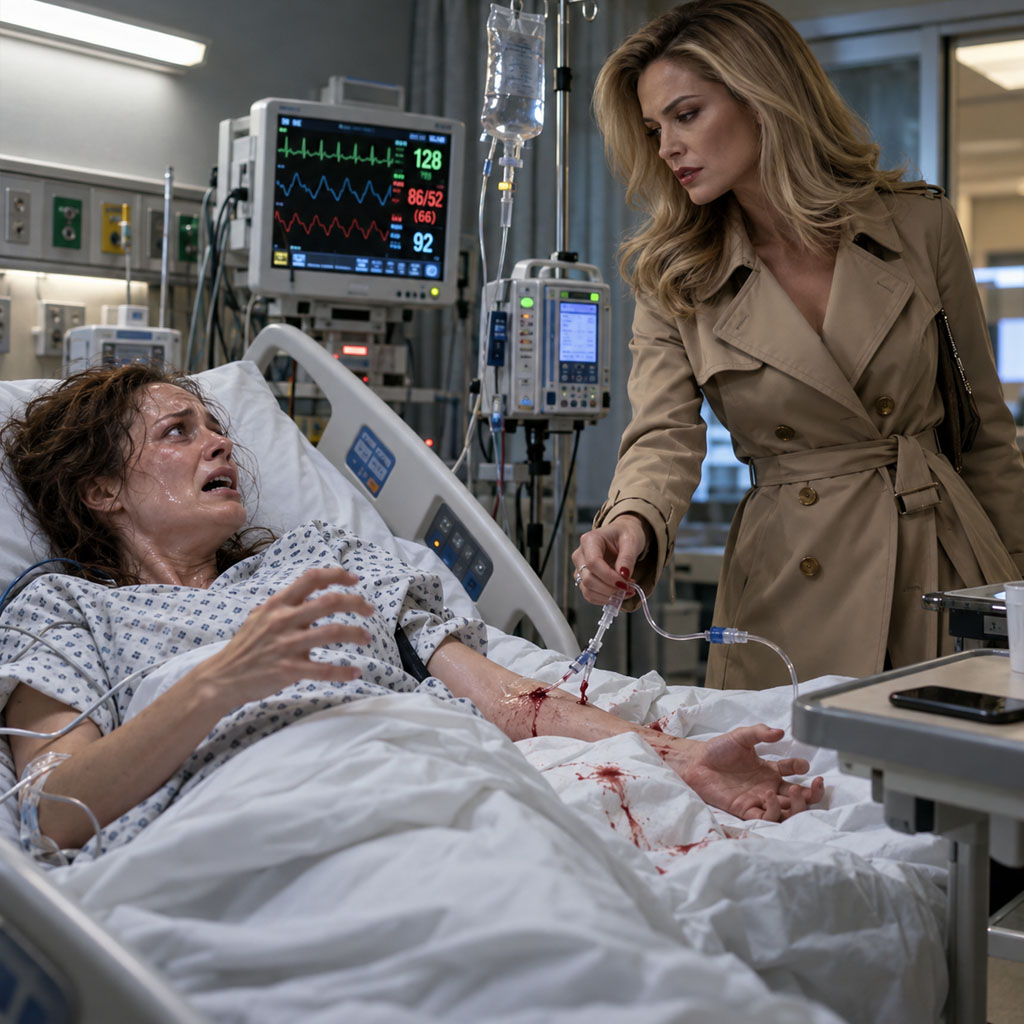
Fallon walked in wearing her expensive beige trench coat.
She wasn’t smiling.
She tossed a stack of documents onto my bedside table.
“They froze my money,” she whispered furiously. “My sponsors are threatening lawsuits. You’re going to fix this.”
I stared at the papers.
It was an authorization allowing Fallon to continue using my name and medical situation in sponsored content.
“Sign it,” she demanded.
I shook my head.
Her face hardened.
“You ungrateful little liar. I’ve spent months making people care about you.”
I reached toward my phone and quietly started a voice recording.
Then I looked directly at her.
“I know about your company,” I whispered. “I know about the false invoices. Daniel has the evidence.”
Fallon’s eyes widened.
For several seconds, she said nothing.
Then she leaned closer.
“You think you can destroy me and just lie here pretending to be sick?”
My heart monitor began beeping faster.
“Fallon, leave.”
She looked at the lines connected to my arm.
And suddenly, she reached for them.
Chapter 3
The pump alarm was the last clear sound I remembered before everything went black.
Somewhere beyond the darkness, I heard people shouting. There were hurried footsteps, the rustle of medical gowns, and someone calling my name.
“Sloan? Sloan, stay with us.”
I couldn’t answer.
When I finally opened my eyes, pale morning light filtered through the hospital blinds. My arm had been bandaged, fresh IV access had been established, and the heart monitor beside me was beating in a slow, steady rhythm.
Marilyn was sitting near the window.
Two unfamiliar people stood beside my bed.
They wore dark suits rather than hospital uniforms.
One stepped forward.
“Ms. Bennett, I’m Special Agent James Carter with the FBI. This is Agent Elena Martinez.”
I blinked.
The FBI?
Agent Carter spoke gently.
“We’re investigating the financial allegations involving your sister’s fundraising activities. Last night, hospital security contacted local police after a serious incident involving your treatment equipment.”
Marilyn moved closer.
“You’re safe, Sloan,” she said. “The doctors stabilized you.”
Agent Martinez opened a notebook.
“Your sister claims there was an argument and that the medical tubing became disconnected while she was trying to protect herself.”
I stared at her.
“Protect herself?”
“She alleges that you became confused and physically agitated because of your medication.”
I wanted to laugh. Instead, tears filled my eyes.
Even after nearly killing me, Fallon had found a way to make herself the victim.
Agent Carter continued.
“Hospital staff documented the condition of the equipment and your medical response. We’re reviewing the available security footage and speaking with witnesses.”
I turned toward Marilyn.
“My phone,” I whispered.
She immediately understood.
“It’s here.”
“I recorded her.”
The agents exchanged glances.
“Recorded what?” Agent Martinez asked.
“When she came into the room. Before she touched anything.”
Marilyn retrieved my phone and placed it within reach.
With my permission, the agents listened to the recording.
Fallon’s voice filled the room.
“You’ve ruined everything. My sponsors are backing out.”
Then came her demand that I sign the authorization.
The recording captured my refusal, her angry accusations, and the moment she discovered I knew about Fallon Wellness LLC.
“You think you can destroy me and just lie here pretending to be sick?”
There was a sharp disturbance, followed by the pump alarm.
Then Fallon’s final words.
“You’re just faking it.”
Agent Carter stopped the recording.
Nobody spoke for several seconds.
Finally, Agent Martinez looked toward the door.
“We’ll need to preserve this properly and have the recording examined,” she said. “It may be important evidence.”
I nodded, exhausted.
“Where’s Fallon?”
“She’s been interviewed by local detectives. Her explanation doesn’t agree with what we’ve established so far.”
Marilyn took my hand.
“You don’t have to deal with her anymore.”
For once, I believed her.
Over the following weeks, my hospital room became a place of genuine recovery rather than family conflict. Staff restricted unauthorized visitors, and Daniel coordinated with investigators so that I could rest.
Through my attorney, I learned that the financial investigation had grown considerably.
Records obtained through proper legal procedures showed that Fallon had directed donations into her company’s account. Investigators traced spending that included luxury purchases, vehicle lease payments, personal expenses, and payments she had labeled as caregiver compensation.
The fundraiser had collected approximately ninety-two thousand dollars.
Only six hundred dollars had reached my hospital account.
Investigators also found discrepancies in expense records, including Tegan’s altered invoice.
What disturbed me most wasn’t simply the amount.
It was the way Fallon had described my suffering as a business opportunity.
In messages reviewed by investigators, she had discussed expanding her content into a sponsored documentary series about caring for a critically ill sister. She had been negotiating a proposed six-figure partnership while I struggled to walk across my living room.
And Mom had helped.
When questioned about my documents, she admitted allowing Fallon access to the safe. She claimed she believed the paperwork was needed to support a legitimate family fundraiser.
Whether she understood the full extent of Fallon’s financial misconduct was something investigators would have to determine.
I stopped trying to explain my mother’s choices.
For twenty years, I had explained them away.
She was lonely. She was worried. She was doing her best. She didn’t mean to hurt me.
But intentions didn’t erase the damage.
One afternoon, Daniel visited with an update.
“Fallon’s been formally charged in connection with the alleged financial scheme,” he said. “The hospital incident is also under investigation. The recordings, medical records, and witness statements are being reviewed.”
“Will she go to prison?”
“That’s for the courts to decide.”
I looked out the window.
Below us, the Chicago streets were crowded with ordinary people hurrying through their ordinary lives.
“I don’t want revenge, Daniel.”
“I know.”
“I just want her to stop.”
He closed his folder.
“Then we’re working toward the same thing.”
A month later, doctors finally allowed me to leave the hospital under a carefully supervised recovery plan.
Marilyn helped me settle into my apartment. She arranged groceries, made sure I understood my medication schedule, and promised to drive me to follow-up appointments.
Unlike Fallon, she never took pictures of me.
She never announced her generosity.
She simply showed up.
As I sat in my favorite chair that evening, I realized how long I’d confused being useful with being loved.
Marilyn didn’t need anything from me.
She wanted me alive.
That difference brought me to tears.
Chapter 4
The legal proceedings lasted eight months.
During that time, I attended cardiac rehabilitation, worked with my doctors, and gradually regained enough strength to take short walks.
Some days were encouraging. Other days, climbing a flight of stairs felt like finishing a marathon.
But I was improving.
The prosecution’s case rested on financial records, witness testimony, electronically preserved communications, and the evidence connected to the hospital incident.
Fallon’s attorneys initially argued that she had made careless bookkeeping mistakes while overwhelmed by her sister’s illness.
That explanation became harder to maintain as additional records emerged.
The falsified invoices showed deliberate changes. The business expenses showed personal purchases unrelated to my care. The hospital evidence contradicted her claim that I’d caused the dangerous disconnection myself.
Eventually, Fallon accepted a plea agreement.
She admitted responsibility for the fraudulent diversion of donated funds, falsified supporting documents, and her reckless conduct during the hospital confrontation.
At sentencing, I sat beside Marilyn in the courtroom.
Fallon wore a plain gray blouse. Without her carefully styled hair, expensive makeup, and bright camera-ready smile, she looked like someone I barely recognized.
Our mother sat several rows behind her.
I hadn’t spoken to either of them in months.
The judge reviewed the seriousness of the offenses, the financial harm to donors, and the danger created by Fallon’s actions at the hospital.
Fallon received a five-year prison sentence, followed by supervised release and an order requiring restitution. Additional restrictions applied to her handling of fundraising activities.
I felt no triumph when the sentence was announced.
Mostly, I felt tired.
Then Fallon turned toward me.
For one brief moment, our eyes met.
I wondered whether she might finally understand what she’d done.
Instead, she mouthed three words.
“You ruined everything.”
I looked away.
There was nothing left to say.
Outside the courthouse, reporters gathered near the entrance. Marilyn guided me toward our waiting car while Daniel addressed the legal questions.
I didn’t give an interview.
I didn’t want my face on another screen or my illness turned into another spectacle.
I’d already spent too much of my life allowing other people to tell my story.
Mom faced consequences of her own.
She cooperated with investigators and acknowledged giving Fallon access to documents she had no authority to use. Civil settlements required her to contribute toward compensating those harmed by the false claims.
Her savings diminished, and the comfortable image she’d maintained within our extended family collapsed.
For a while, relatives called me.
Uncle Brooks, who once accused me of being heartless for refusing to fund Fallon’s wellness retreat, left a message saying the punishment seemed harsh.
Another cousin suggested that I should help Mom repair the family home.
I didn’t return those calls.
My energy was too valuable to spend defending decisions I’d made to protect myself.
Three days after Fallon’s sentencing, my building’s front desk called.
“Ms. Bennett, your mother is downstairs. She says she’d like to speak with you.”
I stood quietly in my living room.
For a moment, I considered refusing.
Then I asked the concierge to send her up.
When I opened the door, Mom looked older than I remembered. Her hair had gone almost completely gray, and the lines around her mouth seemed deeper.
She glanced at my face, then at the oxygen machine that was no longer beside my chair.
“You’re looking better,” she said.
“I am.”
Her eyes filled with tears.
“Sloan, I don’t know what I’m going to do. The house needs repairs, and I’ve used almost everything I saved. People at church barely speak to me anymore.”
I waited.
She twisted the strap of her purse.
“I know mistakes were made.”
“Mom, Fallon stole money donated for my medical care. She endangered my life.”
Her shoulders sagged.
“I never thought she’d go that far.”
“You gave her my documents after I told you I didn’t trust her.”
“I was trying to keep the family together.”
I shook my head.
“No. You were trying to keep Fallon happy.”
Mom began crying.
“She’s still your sister.”
“And I’m still your daughter.”
The words hung between us.
For a moment, I saw something resembling shame cross her face.
Then she looked past me into my apartment.
“I was hoping you might help me with the roof.”
There it was again.
The same request. The same expectation.
For twenty years, our conversations had always circled back to what I could provide.
I rested my hand against the doorframe.
“I hope you find a way to repair your home, Mom. But I won’t be paying for it.”
She stared at me.
“You’d really turn your own mother away?”
“I’m not turning you away because you’re my mother. I’m refusing because I can’t keep sacrificing my life to solve problems I didn’t create.”
She lowered her eyes.
“Will you ever forgive us?”
I considered the question.
“Maybe someday,” I said. “But forgiveness doesn’t mean giving you access to my life again.”
Mom stood silently for a while.
Then she turned and walked toward the elevator.
I closed the door gently.
There was no satisfaction in it, no sudden burst of happiness. I felt the sadness of losing the family I’d always wished I had.
But beneath that sadness was peace.
By the following summer, my heart function had improved significantly. I no longer needed supplemental oxygen, although I still followed a careful medication and exercise plan.
My company welcomed me back on a part-time remote schedule. Marilyn continued visiting on weekends, sometimes bringing dinner, sometimes arriving with nothing more than a good book and an afternoon to spare.
One Saturday, we sat together on my balcony overlooking the city.
The sun was setting behind the buildings, turning the windows gold.
“You know,” Marilyn said, “you’ve spent your whole career identifying risks for other people.”
I smiled.
“And somehow missed the biggest one in my own life.”
“You didn’t miss it forever.”
I looked toward Lake Michigan, where the fading light stretched across the water.
For years, I’d thought strength meant enduring whatever my family demanded. I believed a good daughter never said no, a good sister always helped, and love was something you proved by giving until you had nothing left.
Nearly losing my life had taught me otherwise.
Real love doesn’t require someone to surrender their safety, dignity, or future. It doesn’t turn another person’s suffering into an opportunity for profit. And it certainly doesn’t punish someone for refusing to be exploited.
Fallon’s choices had brought her to prison.
Mom’s choices had brought her to a lonely house she could no longer afford to maintain.
Their consequences were not mine to repair.
I had spent my childhood trying to earn fairness, my adulthood trying to purchase peace, and my illness fighting for the simple right to survive.
Now I had something I’d never truly possessed before.
A life that belonged to me.
I took a slow breath of warm summer air and listened to the sounds of the city below.
My heart wasn’t perfect. Perhaps it never would be.
But it was beating.
And for the first time in many years, I wasn’t living to meet somebody else’s expectations.
I was living because my own life mattered.
That was enough.
THE END.