The Korean billionaire came back for a reunion, then his best friend’s sister opened the door with a seven-year-old who had his gray eyes
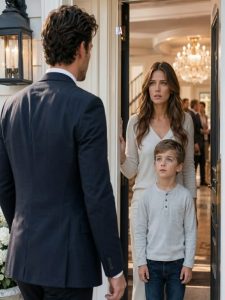
“The reunion events run through next weekend.”
“That isn’t what I asked.”
“Good.”
The word cut sharper than she intended. She saw it land, saw his face tighten almost imperceptibly, and hated that she still knew how to read him.
“No.”
“I haven’t asked anything.”
“You’re about to.”
He looked toward the hallway, where Noah had vanished upstairs twenty minutes earlier.
Leah shut off the faucet. “Don’t.”
“I need to know.”
“You don’t need anything from me.”
His jaw flexed.
She lowered her voice. “Not tonight. Not in Brian’s kitchen. Not while my son is asleep upstairs after meeting you for the first time.”
Jisoo absorbed that. The ownership. The protection. The warning.
“You’re right,” he said.
That almost made her angrier.
The old Jisoo would have argued. He would have charmed, deflected, softened the air with humor. This version simply accepted the line she drew and stepped back from it.
She did not know what to do with that.
The next morning, Jisoo opened the guest room door and found Noah sitting cross-legged in the hallway with a model airplane kit in his lap.
Brian’s voice floated from downstairs. “I warned you! Once he likes you, privacy is over!”
Noah looked up. “Uncle Brian says you build things.”
“I run a company that builds things.”
“That’s different.”“It is.”
“Can you build this?”
Jisoo had eighty-three unread emails, a call with Seoul in thirty minutes, and a headache forming behind his eyes.
He sat down on the floor.
They built the airplane for two hours.
Noah read every instruction twice. Jisoo, who had made billion-dollar decisions in less time than Noah spent aligning one wing, found himself waiting. Not impatiently. Not politely. Actually waiting.
When a small plastic piece snapped, Jisoo expected frustration.
Noah only said, “We fix it.”
He reached for the glue.
Jisoo stared at his small hands. Steady. Serious. Familiar in ways that made Jisoo’s chest hurt.
Over the next week, the house changed around him.
Or maybe he changed inside it.
On Wednesday, Jisoo walked Noah home from school because he saw him outside the gate struggling with his backpack straps.
“Mr. Kim!” Noah called.
“Jisoo is fine.”
“My mom says children shouldn’t call adults by first names unless they are family.”
Jisoo nearly stopped walking.
Noah continued, unaware. “But Uncle Brian says rules are flexible if the adult is annoying.”
“That sounds like Brian.”
They walked home talking about black holes, Jupiter, cafeteria pizza, and whether spaghetti counted as an invention or a miracle. Noah believed the universe might be conscious. Jisoo told him that was a bold theory.
Noah looked pleased. “I have many.”
Leah saw them from the kitchen window.
Noah was waving both hands, explaining something enormous. Jisoo walked beside him in his tailored coat, listening with his full attention.
That was new.
The Jisoo she remembered had filled rooms. This one made space.
She stepped away before they saw her watching.
Ava Mitchell arrived at the alumni garden party that Saturday.
Leah recognized her immediately.
Seven years had sharpened Ava, not changed her. She was still beautiful in a cool, composed way, with dark blond hair, a lawyer’s posture, and the kind of calm that made people confess too much.
Leah was setting cups on an outdoor table when Ava approached.
“You’re Leah Brooks,” Ava said.
Leah held her gaze. “And you’re Ava.”
Ava’s expression shifted. She understood at once that Leah knew exactly who she was.
“I’m not here to make anything harder,” Ava said.
“People usually say that right before they do.”
Ava looked across the yard.
Jisoo was crouched beside Noah near the fence, helping him adjust the wings on another paper airplane. Noah said something, and Jisoo smiled.
Ava’s eyes narrowed slightly.
“He doesn’t know, does he?” she asked.
Leah said nothing.
Ava looked back at her. “I knew Jisoo in college. I knew him after college too. He was charming, selfish, brilliant, and terrified of anything real. I’m not defending him.”
“Then why are you talking to me?”
“Because I have never seen him look at anyone like that.”
Leah’s fingers tightened around the stack of cups.
Ava’s voice softened. “Not even himself.”
That night, Jisoo did not sleep.
He sat in Brian’s guest room with old photos open on his phone. Him at seven, standing beside his father in Seoul. Gray eyes. Left dimple. Serious expression. Then Noah that afternoon, holding a paper airplane like a trophy.
There was no coincidence large enough to hide inside.
The next morning, he found Leah in the backyard hanging laundry.
“Noah is mine,” he said.
It came out too bluntly. Too raw.
Leah clipped a small striped shirt to the line.
“No,” she said.
The word struck him.
She turned then, calm and pale. “Noah is mine. He may be your biological son. But he is mine. Every fever, every nightmare, every parent-teacher conference, every grocery bill, every birthday candle, every time he asked why other kids had dads and he didn’t—I answered. I stayed. So choose your words carefully.”
Jisoo bowed his head slightly.
“You’re right.”
Her mouth twisted. “There it is again.”
“What?”
“You being reasonable. It’s infuriating.”
“I’m trying not to make this worse.”
“You already made it worse seven years ago.”
He looked at her then. No defense. No performance.
“I know.”
She laughed once, without humor. “Do you?”
“I know I left.”
“You didn’t just leave.” Her voice lowered. “I came to tell you. I heard you through the door.”
His face changed.
Leah saw the memory hit him.
“Ava asked if there was something between us,” she said. “You told her I was Brian’s kid sister. You said nothing happened that mattered.”
Jisoo closed his eyes.
“I was pregnant,” Leah said. “I stood outside your door with your child inside me and listened to you erase me.”
He opened his eyes again, and there was no color in his face.
“Leah…”
“No. Don’t apologize yet. Not until you understand what you’re apologizing for.”
He stood very still.
She picked up another shirt from the basket. Her hands trembled once before she steadied them.
“If I had told you,” she said, “would you have stayed?”
The question hung in the cold air.
Jisoo wanted to lie.
He wanted to reach back through time and drag a better answer out of the man he had been. He wanted to say yes with enough force to make it true.
But Leah was watching him.
And she deserved at least one clean truth from him.
“No,” he said, voice rough. “Not then.”
Her eyes shone, but no tears fell.
“I know.”
The quiet after that was worse than shouting.
“I would have given money,” he said. “I would have called it responsibility. I would have convinced myself distance was kinder. I would have failed you and called it maturity.”
Leah looked away.
“That was my answer too,” she said. “So I made my decision alone.”
She picked up the laundry basket and walked inside.
Jisoo remained in the yard, staring at a pair of Noah’s socks clipped to the line. Navy blue with tiny yellow stars.
For the first time in his adult life, accountability did not feel like an argument he could win.
It felt like standing in the wreckage of a house he had burned down and finally smelling the smoke.
Brian found out two nights later.
He discovered Noah’s birth certificate while searching Leah’s filing cabinet for insurance papers. The father’s line was blank. That alone might not have told him everything.
But grief has instincts.
When Leah came home from work, Brian was sitting at the kitchen table with the document in front of him.
“Who?” he asked.
Leah closed the door behind her.
“Brian—”
“Who is Noah’s father?”
She sat across from him.
And told him.
Brian did not move for a long time.
His face passed through shock, anger, betrayal, then something much worse: heartbreak.
“He was here,” Brian said. “All those years ago. He was in our kitchen. I trusted him.”
“I know.”
“You were pregnant, and you didn’t tell me?”
“I was scared.”
“You should have had help.”
“I had you.”
“That’s not the same.” His voice broke. “Leah, that is not the same.”
She reached for his hand. “I needed one choice in my life that wasn’t made by someone trying to protect me.”
Brian looked down.
From the hallway, Jisoo heard every word.
He had come down for water and stopped when he heard his name. He should have walked away. Instead, he stood in the dark and listened to the cost of his absence spoken in the voices of the two people who had once trusted him most.
When it ended, he went back upstairs, sat on the edge of the guest bed, and understood something simple.
Leah had not kept Noah from him because she was cruel.
She had kept Noah safe from the man Jisoo had actually been.
And she had been right.
Part 3
The next morning, Jisoo was in the kitchen at six-fifteen making coffee.
Brian came downstairs twenty minutes later looking like he had not slept. He stopped in the doorway when Jisoo handed him a mug.
For a moment, neither man spoke.
Then Jisoo said, “I’m not going to hire lawyers.”
Brian’s eyes hardened.
“I’m not going to demand rights,” Jisoo continued. “I’m not going to offer money like it fixes anything. I’m not going to make Leah’s life harder because I can’t handle my own guilt.”
Brian sat down slowly.
“What are you going to do?”
“Whatever she allows,” Jisoo said. “If that means nothing, then nothing. If that means I get to know him slowly, I will do it slowly. If that means leaving, I’ll leave.”
Brian looked at him over the coffee.
“You hurt her again, and I don’t care how rich your family is. I will become the most expensive problem you’ve ever had.”
Jisoo nodded. “Fair.”
“Noah has routines. Don’t disrupt them.”
“I won’t.”
“He doesn’t need a billionaire. He needs someone who shows up when he says he will.”
Jisoo’s grip tightened around his mug.
“I can do that.”
Brian stared at him for a long time.
“Then do it.”
It was not forgiveness.
It was a door cracked open.
Jisoo began with small things.
He fixed the porch railing without mentioning it. Replaced the kitchen hinge. Packed Noah’s backpack correctly on Tuesdays, when Leah worked the early shift and always forgot the library folder. He made dinner, not fancy food, just food that waited. Pasta. Rice bowls. Soup when the weather turned.
Leah hated how difficult it was to resent a man who quietly washed dishes.
She knew how to reject flowers. She knew how to distrust expensive gifts. She had no defense against someone who remembered that Noah hated apple slices if they were brown, or that Brian needed his shoulder brace after physical therapy, or that she drank chamomile tea only when she was pretending not to panic.
Noah adopted him with the fearless certainty of a child.
They built model airplanes. They walked to school. Jisoo taught him Korean words, which Noah mispronounced with great confidence.
One afternoon, Noah stopped mid-sidewalk and studied Jisoo’s face.
“People think we look alike.”
Jisoo’s chest tightened. “Do they?”
“We have the same eyes.” Noah pointed. “And the same dimple. Mine is better.”
“That seems likely.”
“Is that weird?”
Jisoo knelt so they were eye level.
“No,” he said. “It’s not weird.”
Noah accepted this and immediately began talking about Jupiter’s moons.
Jisoo listened to every word.
Then the photograph appeared.
A lifestyle blogger spotted them outside the Boston Museum of Science on a Sunday afternoon. The photo was grainy but clear enough: Jisoo and Noah walking side by side, gray eyes turned toward each other, matching dimples visible in profile.
The caption spread fast.
Korea’s most eligible billionaire seen in Boston with mystery child who looks exactly like him.
By evening, Korean gossip sites had picked it up. By morning, photographers were outside Leah’s workplace.
She drove home furious.
Jisoo was already at Brian’s kitchen table with his phone in front of him. Brian paced behind him. Noah was upstairs, thankfully unaware, drawing rockets.
“There are cameras outside my job,” Leah said.
Jisoo stood. “I know.”
“Don’t.”
He stopped.
“Don’t tell me you know. Tell me what you’re doing.”
“I’m making a statement.”
Leah laughed in disbelief. “A statement?”
“I’ll take responsibility for my past. I won’t name you. I won’t confirm anything about Noah. I’ll say the people involved deserve privacy and that I will not discuss a child publicly under any circumstances.”
“Your investors will panic.”
“Yes.”
“Your father will lose his mind.”
“Probably.”
“Your company stock will drop.”
“Almost certainly.”
She stared at him. “And you’re still doing it?”
Jisoo looked toward the stairs.
“Noah’s life is not a headline,” he said. “He doesn’t get to choose whether the world looks at him. I do get to choose what I give them instead.”
The kitchen went silent.
For once, Leah had no answer.
The statement went out that night. Jisoo sat for one controlled interview with a journalist he trusted. He did not spin. He did not charm. He said he had hurt people when he was younger. He said he was trying to make things right. He said a child’s privacy mattered more than public curiosity.
The stock dropped four percent the next morning.
Three board members called before lunch. His father’s assistant called six times. Jisoo handled all of it from Brian’s kitchen table and did not mention the cost once.
By Tuesday, the photographers disappeared.
By Thursday, Noah had a cough.
At first, Leah called it a cold. Then the fever climbed. By Saturday morning, she was in the emergency room listening to a doctor say the word pneumonia in a calm voice that frightened her more than panic would have.
She called Brian.
She did not call Jisoo.
Brian did.
Jisoo arrived at the hospital at ten-thirty that night, coat thrown over a sweater, hair windblown, face stripped of every boardroom mask.
Leah was standing in the corridor with a coffee she had not touched.
“You didn’t need to come,” she said.
“I know.”
Her eyes flashed.
He caught himself. “Sorry. I wanted to be here.”
That was harder to fight.
For three days, he stayed.
He read to Noah about black holes and Korean palaces and Jupiter’s storms. He slept in a chair angled toward the bed. He brought Leah coffee without asking how she took it. He did not crowd her. Did not perform worry. Did not act like his fear mattered more than hers.
On the second night, Leah went home to shower after Brian promised to stay nearby. Jisoo sat beside Noah under the dim hospital light, reading from a library book about space exploration.
Around two in the morning, Noah stirred.
“Jisoo?”
“I’m here.”
“Are you staying?”
“Yes.”
Noah’s small hand moved on the blanket.
Jisoo placed his hand over it gently.
“Mom gets scared when I’m sick,” Noah whispered.
“She loves you.”
“I know. She stirs her tea too long when she’s scared.”
Jisoo looked at him.
This child noticed everything.
Just like Leah.
Noah’s eyes fluttered closed. “I’m glad you’re here.”
Jisoo’s throat tightened. “Me too, buddy.”
A long silence followed.
Then Noah whispered, “I wish you were my dad.”
The room went still.
Jisoo lowered his head.
There were sentences a man could spend seven years arriving too late to say.
He squeezed Noah’s hand carefully.
“I would be honored,” he said, voice breaking. “More than anything.”
Noah was already drifting back to sleep.
When Leah returned at dawn, she found them both asleep: Noah small beneath the blankets, Jisoo folded painfully into the chair, still turned toward him as if even sleep could not make him stop watching over the boy.
She stood in the doorway and cried silently.
Not because everything was fixed.
Because something had finally begun.
Noah came home five days later, weak but cheerful, holding Leah’s hand on one side and Jisoo’s on the other. Brian made soup. Noah described the hospital pudding cups as “a major medical breakthrough.” Everyone laughed, and Leah watched Jisoo laugh without looking away.
Weeks became months.
Jisoo did not return to Seoul the way everyone expected. He rented a modest apartment twelve minutes from Brian’s house. He shifted operations, delegated decisions, and took calls at strange hours. He went to school meetings. He cut fruit for class parties. He learned that Noah liked scrambled eggs but not runny eggs, hated the sound of balloons rubbing together, and was afraid of deep water but too proud to say so.
He learned Leah sang quietly while washing dishes.
He learned to make noise before entering the kitchen so she would not stop.
One evening, Leah came to his apartment to return a jacket she had washed and folded. She meant to stay five minutes.
She stayed an hour.
There were model airplanes on the windowsill. Noah’s books on the table. Her favorite tea in the cabinet.
“You went to three stores for this tea,” she said.
“Brian told me the brand.”
“Brian talks too much.”
“He does.”
She held the mug between her hands. “What are you really doing here, Jisoo?”
He took his time answering.
“Learning ordinary life,” he said. “School runs. Laundry. Parent meetings. The right kind of crackers for Noah’s lunch. How to be useful without making a speech about it.”
Her eyes lifted.
“And you?” she asked.
His voice softened. “Learning you again, if you let me.”
Leah looked at him for a long time.
“I’m not promising forgiveness.”
“I’m not asking for it.”
“I’m watching.”
“I know.”
This time, she did not tell him to stop saying it.
Spring came to Boston slowly, then all at once.
On a Sunday in April, cherry blossoms bloomed along the walking path behind Brian’s house. Noah had been bribed with the right to choose dinner if he stayed inside with Brian for one hour while the adults talked.
He chose spaghetti.
Brian accepted.
Leah and Jisoo walked beneath the pink-white branches, close enough for their hands to brush.
“I don’t want to keep living as the man I was at twenty-three,” Jisoo said.
Leah listened.
“I don’t want to pretend he didn’t exist either. He hurt you. He abandoned you. He made you carry something alone that should never have been yours alone to carry.” He stopped walking. “But I’m asking if we can stop letting the worst version of me decide the rest of our lives.”
Leah turned to him.
The wind moved through the blossoms, scattering petals across his dark hair and shoulders.
She thought of the boy who had charmed everyone and stayed for no one.
Then she thought of the man who had slept in a hospital chair, protected her son from headlines, learned Tuesday dinners, found her tea, and loved Noah not like a discovery, but like a promise.
“I waited a long time for you to become this person,” she said.
His eyes filled.
“I love you, Leah.”
“I know.”
A surprised laugh escaped him.
She stepped closer. “I hated you for leaving.”
“I know.”
“I hated myself for missing you.”
His face tightened.
“And I am still angry sometimes,” she said. “But I don’t want anger to raise our son. I don’t want the past to be the only thing we honor.”
“Our son,” he repeated, barely above a whisper.
Leah nodded.
Then Jisoo reached for her hand, slowly enough that she could pull away.
She did not.
He kissed her beneath the cherry blossoms like a man coming home carefully to a house he had once burned, knowing every step across the threshold had to be earned.
Behind the garden fence, Noah crouched beside Brian with both hands over his mouth.
“I knew it,” Noah whispered.
Brian wiped one eye and pretended it was allergies.
“So did I, kid.”
One year later, Jisoo Kim was not on a stage in Seoul accepting an award. He was at a community center in Boston washing dishes beside Leah after a fundraiser Brian had somehow turned into a neighborhood event.
Noah ran in wearing a paper crown from the craft table.
“Dad,” he called, “Uncle Brian says the spaghetti is emotionally important, but structurally overcooked.”
Jisoo froze.
Leah looked at him.
Noah did not seem to realize what he had said. He only held up two paper airplanes and asked which one looked more aerodynamic.
Jisoo crouched in front of him.
“The blue one,” he said, voice unsteady.
Noah nodded. “Correct.”
Then he ran off again.
Leah slipped her hand into Jisoo’s.
Outside, Boston moved on around them. Cars passed. Wind pushed through budding trees. Somewhere in the kitchen, Brian shouted at someone not to insult his pasta.
Jisoo looked at Leah, then toward the room where their son was laughing.
For most of his life, he had believed legacy meant buildings, companies, wealth, and names carved high enough for the world to see.
Now he knew better.
Legacy was a boy with gray eyes calling him Dad without ceremony.
It was a woman who had survived him, then chosen him only after he learned how to stay.
It was showing up the next morning, and the morning after that, until love stopped being a promise and became proof.