The note on my refrigerator said my nine-year-old son wasn’t family, and the woman who wrote it was already sailing toward Bermuda with money she’d stolen from me. Downstairs, my little boy was washing his school uniform at midnight because nobody had stayed behind to take care of him. When he looked up and asked whether he’d done something wrong, I knew my mother had finally crossed a line I could never forgive.
Chapter 2
Sunday morning, Danny found me sitting on the bedroom floor surrounded by envelopes. Some were decorated with birthday stickers, others with Christmas stamps, and several contained photographs. Every one had been carefully addressed to my son.
Danny stood in the doorway holding his favorite stuffed dog.
“Are those for me?”
I nodded.
“Yes, honey. They’re from Grandma Joan and Grandpa Frank.”
His expression changed.
“I thought they didn’t like me.”
I swallowed hard.
“Why would you think that?”
“Grandma Diane said they had their own family. She said they didn’t need another kid around.”
I closed my eyes.
For five years, I’d believed my mother when she told me Michael’s parents wanted to take Danny away. I’d blocked their numbers during the worst months of my grief, trusting her to handle everything while I tried to survive.
Now I was beginning to see how thoroughly she’d controlled what I heard and what I believed.
I handed Danny an envelope with a drawing of a blue crab on the front.
He opened it carefully.
“Dear Danny,” he read aloud. “Pop-Pop and Nana miss you every day. We still have your little blue fishing net waiting by the pier. Whenever you’re ready, we’ll be right here.”
He looked up.
“Mom, do they really still have my net?”
I remembered Michael’s father standing on a wooden dock, showing our three-year-old how to lower a crab net into the water. Danny had laughed so hard that afternoon he’d gotten hiccups.
“I think they do,” I said.
“Then why didn’t we go see them?”
There was no answer that wouldn’t hurt.
“Because I believed something that wasn’t true,” I finally told him. “And I’m very sorry.”
I found Frank Brennan’s number in my phone and removed the block.
He answered on the second ring.
“Brennan.”
“Frank, it’s Tess.”
Silence.
Then his voice softened.
“Is Danny all right?”
“He’s safe. I found your letters.”
I heard him breathe out slowly.
“Joan’s going to want to hear this.”
I explained what had happened, including the cruise, the note, and the money.
Frank had retired from the Maryland Transportation Authority Police after nearly thirty years. He wasn’t a man who wasted words.
“Stay home,” he said. “I’ll be there in twenty minutes.”
He arrived in fifteen.
I watched him climb my front steps wearing an old navy windbreaker, his gray hair neatly combed and his expression difficult to read.
When I opened the door, he didn’t rush inside.
“May I come in?”
Those four words nearly broke me.
Mom had been living in my house for five years and had never once asked permission to enter a room, use a card, or make a decision about Danny.
Frank sat at my kitchen table while I showed him the letters.
“I thought you wanted custody,” I admitted.
His face tightened.
“Your mother told us you’d fallen apart after Mikey died. She said seeing us would make things worse.”
“She told me you thought I was an unfit mother.”
Frank stared at the table.
“I never said that. Not once.”
“Then why didn’t you come?”
“We did. Three times. Diane told us you weren’t ready and asked us to send letters to her address. She said she’d give them to Danny when things settled down.”
My eyes filled.
“She never gave us anything.”
Frank reached across the table and covered my hand with his.
“We figured you needed time. We weren’t going to make you choose sides while you were grieving.”
I couldn’t speak.
For years, I’d imagined these people had abandoned us. All the while, they had been waiting twelve miles away.
A small voice came from the hallway.
“Pop-Pop?”
Frank turned.
Danny stood in his pajamas, clutching the letter with the blue crab.
The old man’s face changed completely.
“Well, look at you,” he whispered.
Danny approached cautiously.
“Are you the grandpa who taught me about crabs?”
Frank lowered himself into a chair so they were eye level.
“That’s me.”
“Do you still have the blue net?”
“Sure do. The handle’s a little scratched, but it’ll still catch a crab.”
Danny considered that.
“Can we go fishing sometime?”
Frank’s eyes glistened.
“Whenever your mama says it’s all right.”
For the first time that weekend, my son smiled.
After Danny went upstairs, Frank and I examined the financial records.
What we discovered was worse than I expected.
My mother had used my credit card for years, disguising personal purchases as household expenses. There were beach rentals in Ocean City, expensive dental appointments, restaurant bills, and gifts for my older sister, Shannon.
The cruise alone represented thousands of dollars in charges I had never authorized.
I’d trusted Mom to buy groceries and pay household expenses during my workweeks. She had used that access to support a lifestyle she couldn’t afford.
“Why didn’t I notice?” I whispered.
Frank shook his head.
“Because you were working, raising a child, and trusting your mother. You should’ve checked, sure. But the person who took advantage of that trust knew exactly how busy you were.”
He pointed toward the cruise paperwork.
“First thing tomorrow, talk to your bank. Then make a report about Danny being left alone.”
I hesitated.
“She’s still my mother.”
Frank looked toward the stairs.
“And he’s still your son.”
That settled it.
Monday morning, I went to the bank and reported the unauthorized purchases. The bank representative canceled the card, documented my concerns, and began reviewing the disputed transactions.
Later that day, Frank accompanied me to the police station.
I brought photographs of the note, the cruise paperwork, and the financial records. I explained my work schedule and the arrangement under which Mom had agreed to care for Danny.
Detective Laura Mitchell listened without interrupting.
When I finished, she asked, “Your mother knew you weren’t scheduled to return until Sunday?”
“Yes.”
“And she left Saturday without arranging another responsible adult?”
“That’s right.”
“Did she tell anyone the child was alone?”
“I don’t know.”
The detective made several notes.
“We’ll need to establish what happened. We’ll also review the card activity and speak with anyone who may have relevant information.”
I expected anger, disbelief, or judgment.
Instead, she treated me like a mother trying to protect her child.
That afternoon, Mom called from the ship.
“Teresa, honey, there’s a problem with the card. The cruise line says it isn’t working.”
I stood in my kitchen while Danny colored at the table.
“I canceled it.”
Silence.
“What do you mean, canceled?”
“I mean I reported the charges and closed the card.”
Her voice sharpened.
“You went through my things?”
“They’re my financial records, Mom.”
“You have absolutely no respect for privacy.”
I almost laughed.
“You left my nine-year-old alone overnight.”
“Oh, for heaven’s sake. He’s nine, not three. Bev was checking on him.”
Our neighbor Bev lived next door.
“Did you ask her?”
Another silence.
“Don’t start making trouble over nothing, Teresa. I’ll be home Thursday, and we’ll discuss this like adults.”
“No,” I said. “We won’t be handling it the way we always do.”
“What is that supposed to mean?”
“It means I’ve spoken to the bank and the police.”
Her voice dropped.
“You’d better be careful. People might start asking why you’re away from your own child for seven days at a time.”
The threat was unmistakable.
For years, she’d used my fear of losing Danny to control me.
But this time, I wasn’t alone.
Chapter 3
Tuesday morning, my sister called before breakfast.
“Have you lost your mind?” Shannon demanded.
I held the phone away from my ear.
“Good morning to you, too.”
“Mom says you accused her of stealing and called the police because Danny stayed home for a few hours.”
“She left him alone overnight.”
“She said Bev was watching him.”
“Ask Bev.”
Shannon sighed impatiently.
“You know how Mom is. She gets dramatic, but she means well. You’re going to embarrass the whole family over a misunderstanding.”
I looked at Danny sitting at the table, carefully spelling words for his homework.
“Shannon, did you know Mom was using my card to pay for your vacations?”
“What?”
“The beach rentals. The restaurants. This cruise.”
There was a pause.
“She told us you wanted to help.”
“I wasn’t even invited.”
Shannon didn’t answer.
I ended the call before she could explain away another five years.
That afternoon, Bev knocked on my door.
She was sixty-two, worked part-time at a grocery store, and had lived next door since before Michael and I bought the house.
She held out her phone.
“Tess, your mother sent me something.”
The message read, “Just tell them you checked on Danny Saturday. You would’ve done it if I’d asked.”
Bev’s cheeks were flushed.
“She never asked me, honey. I didn’t know he was alone. I heard your dryer running late and thought you were home.”
I stared at the message.
“Would you be willing to tell the detective?”
“Of course. I should’ve checked that night. I’ve been thinking about it ever since.”
I squeezed her hand.
“You didn’t know. Mom did.”
Bev gave her statement later that afternoon.
The detective also arranged for a county child welfare worker to visit our home. I was nervous, even though I’d done nothing wrong. Mom’s warnings had lived inside my head so long that I still heard them whenever someone in authority asked about my son.
The worker spent a short time observing our home, asking about Danny’s routine, and discussing safe childcare arrangements.
Frank was helping Danny with multiplication at the kitchen table.
The woman smiled when Danny proudly showed her his school project.
Before leaving, she said, “It looks like you’ve taken steps to make sure your son has dependable care. We’ll document the situation and let you know if anything else is needed.”
After the door closed, I sat down and cried.
Frank quietly made another pot of coffee.
That evening, his wife Joan arrived carrying a homemade lasagna.
She stood in the doorway wearing a brown cardigan, her silver hair pinned neatly behind her ears.
“Am I welcome?” she asked.
I wrapped my arms around her.
“More than you know.”
Joan held me for a long time.
Then she stepped back and looked toward the kitchen.
“Where’s my grandson?”
Danny appeared from behind the hallway wall.
She opened her arms.
He ran into them.
Watching them together, I felt a strange combination of happiness and grief. They belonged to each other so naturally, yet they had been kept apart for five precious years.
Later, Joan told me about the Christmas gifts she’d sent.
“There was a box when Danny turned seven,” she said. “I made him a blanket and put together a photo album of Michael. Your mother said she’d give it to him.”
I remembered a dusty cardboard box in the basement marked “Christmas Decorations.”
We found it beneath the shelf Michael had built when I was pregnant.
The shelf was one of the last things he’d made for our home. He’d measured its height carefully so I wouldn’t have to bend while carrying our baby.
“You’re doing enough work already,” he’d joked.
Inside the box was a purple blanket with a little bird stitched into one corner.
Beneath it lay a photo album.
Danny sat on the basement floor and turned the pages slowly.
There was Michael holding him as a newborn, Michael pushing his stroller through the park, and Michael asleep on the couch with a toddler curled against his chest.
“That’s Daddy,” Danny whispered.
Joan nodded.
“He loved you more than anything.”
Then she reached into her purse.
“There’s something else.”
She handed him a birthday envelope.
Inside was a small, folded letter.
The handwriting was unmistakably Michael’s.
“To Danny, for when you’re older.”
My son looked at me.
“Can I read it?”
I nodded, unable to speak.
Michael had written the letter on Danny’s first birthday. Joan explained that he’d given her a copy to keep safe, just in case life ever prevented him from saying the words himself.
She had sent it when Danny turned seven, hoping it would reach him.
Danny unfolded the paper.
“Dear buddy,” he began softly.
He read quietly for a while, moving his lips over the words.
Then he looked up.
“Daddy says I’m the best surprise that ever happened to him.”
My tears finally spilled.
“That’s exactly what you were.”
He continued reading.
Michael had written about teaching him to ride a bicycle, going fishing with Grandpa Frank, and cheering at his baseball games.
Near the end, he’d added something that made my heart ache.
“Never let anybody make you feel like you don’t belong. You’re my son, and your mom’s son, and you’ll always have people who love you.”
Danny pressed the letter against his chest.
“Can I keep this in my room?”
“Of course,” I whispered. “It belongs to you.”
That night, after everyone had gone home, I sat alone beneath the shelf Michael built and thought about everything Mom had taken.
She had stolen money, yes.
But money could be accounted for.
What couldn’t be repaid were birthdays without grandparents, Christmas mornings without their gifts, and five years of believing that people who loved us had abandoned us.
Wednesday afternoon, another message arrived from Mom.
“I’ll repay everything. Just tell the police it was a misunderstanding. Don’t humiliate me in front of Shannon’s children.”
I stared at the screen.
Not once had she asked how Danny was doing.
Not once had she apologized to him.
She was frightened of being embarrassed, but not ashamed of what she’d done.
I didn’t answer.
Instead, I called the nursing home near our neighborhood about a daytime position I’d been considering for months.
The salary would be smaller, but I’d be home every evening.
For years, I’d believed that earning more money was the best way to protect Danny.
Now I understood that being present mattered just as much.
Frank and Joan offered to help with school pickup.
“We’re only fifteen minutes away,” Joan said. “And Frank’s been looking for an excuse to make somebody listen to his fishing stories.”
Frank smiled.
“I’ve got plenty.”
For the first time since Michael died, I could imagine a future that didn’t depend on my mother.
Thursday morning, I woke before dawn.
Danny was staying with Joan while I went downtown.
I folded Mom’s note and slipped it into my purse.
Five days earlier, she’d boarded a cruise ship convinced that I would quietly clean up her mess.
She had no idea what would be waiting when she stepped onto the pier.
Chapter 4
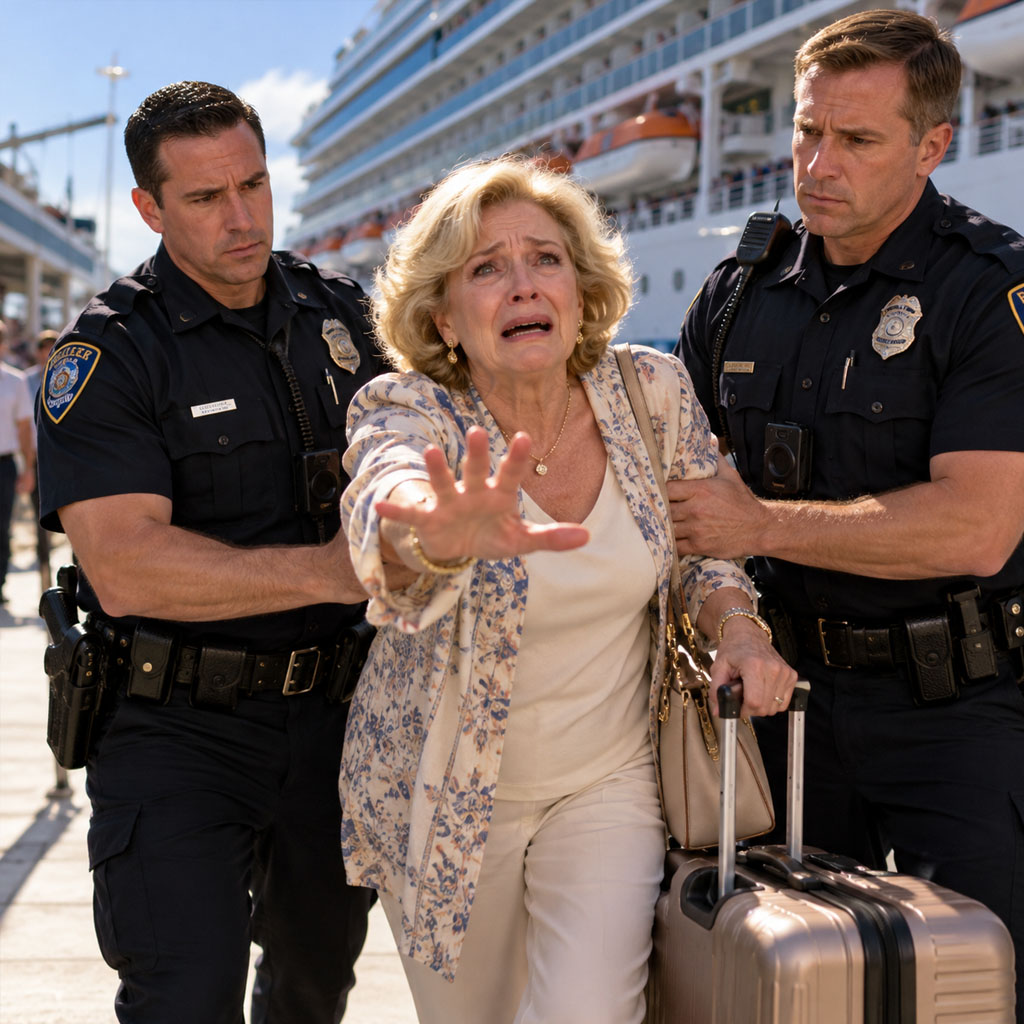
The Port of Baltimore was already busy when Frank and I arrived. Families stood near the terminal entrance holding welcome-home signs, while luggage carts rattled across the pavement. Beyond the building, the enormous white cruise ship towered over everything.
I spotted Detective Mitchell near the passenger exit.
Two uniformed officers stood beside her.
She approached us calmly.
“Mrs. Brennan, we’ve reviewed the information you’ve provided, along with additional records. We’d like you to remain here while we speak with your mother.”
I nodded.
“All right.”
Frank rested a hand briefly on my shoulder.
“You don’t have to say anything you don’t want to.”
I watched passengers begin emerging through the terminal doors.
An elderly couple came through laughing, their arms linked. A little girl ran toward a woman holding a sign that said “Welcome Home, Nana!”
I wondered what Danny might have been doing if Mom had simply included him in the trip.
Then I saw Walt.
Mom’s boyfriend was pushing two suitcases, looking uncomfortable.
Behind him came Shannon’s husband, Rob, followed by their two children.
Shannon appeared next.
She saw me standing with Frank and stopped walking.
Then my mother emerged, accompanied by the two officers.
Her face was flushed, and her lips were pressed into a tight line.
For a moment, she didn’t recognize me.
Then she did.
“Teresa!”
Her voice carried across the terminal.
“What is this nonsense?”
Detective Mitchell stepped forward.
“Mrs. Diane Noak, we’d like to speak with you about the unauthorized financial transactions and the circumstances surrounding your grandson being left without supervision.”
Mom straightened her shoulders.
“I’ve already explained that there was a misunderstanding.”
“Then we’d appreciate your cooperation in clarifying it.”
Mom looked directly at me.
“Tell them, Teresa. Tell them I thought you were coming home Saturday.”
I remained silent.
The detective continued.
“We have the cruise booking records and the bank’s documentation concerning charges made to your daughter’s account.”
Mom’s expression changed.
“She gave me permission to use that card for groceries.”
“Those records include cruise payments and other expenses outside that arrangement. We’d like to discuss those transactions with you.”
Walt stared at his shoes.
Rob slowly lowered the luggage cart handle.
Shannon looked from the detective to Mom.
“Mom, you said Tess insisted on paying for the trip.”
Mom turned sharply.
“Shannon, not now.”
“But you told us she wanted it to be a gift.”
“That’s enough!”
The sudden sharpness of her voice made several nearby passengers turn.
Detective Mitchell remained composed.
“We also have a statement from your daughter’s neighbor confirming she was not asked to supervise Danny. We need to address that information as well.”
Mom looked at me with unmistakable anger.
“You dragged Bev into this?”
“Bev told the truth,” I answered.
Mom’s expression shifted again, and she began crying.
“After everything I’ve done for you, this is how you repay me?”
I had heard those words so many times that I could almost predict what would come next.
“I gave up my retirement to help you raise that boy. I kept your house running while you went off to work. I deserved a little appreciation.”
Shannon stepped forward.
“You used Tess’s money for our vacations?”
Mom didn’t answer.
“Three summers?” Shannon whispered. “Those beach rentals were hers?”
“I was going to pay it back.”
“When?”
“Don’t interrogate me in public!”
Walt touched Mom’s arm.
“Diane, maybe we should just go with the officers.”
She pulled away.
“No! My own daughter is trying to destroy me!”
The detective explained that Mom was being taken into custody in connection with the financial investigation and that the other concerns would be handled through the appropriate process.
I felt no triumph watching the officers stand beside her.
Mostly, I felt tired.
Mom looked at me one last time.
“Teresa, please. Don’t let them do this in front of the children.”
I thought about Danny standing on that stool in the basement, trying to wash his only clean school shirt.
I thought about the note on my refrigerator.
And I thought about Michael’s letter, hidden in a box while our son grew up believing he wasn’t wanted.
“Mom,” I said quietly, “you left a nine-year-old alone because you didn’t consider him part of your family. You used my money without permission and hid letters from people who loved him.”
She opened her mouth.
I continued.
“You don’t get to call that a misunderstanding.”
Tears ran down her face.
“He’s my grandson.”
“He was your grandson when you wrote that note.”
She looked away.
I reached into my purse and handed the original note to Detective Mitchell.
The detective placed it with the other materials.
Then Mom looked past me and noticed Frank.
Her face drained of color.
“Frank?”
He stood beside me, his hands in his coat pockets.
“Hello, Diane.”
She stared at him.
For five years, she’d kept us apart by convincing each side that the other wanted nothing to do with them.
Now he stood beside me without anger, without threats, and without the slightest intention of leaving.
“Those letters weren’t yours to keep,” he told her.
Mom had no answer.
The officers escorted her toward a waiting vehicle.
Shannon watched in silence.
Rob took their children farther down the walkway.
Walt picked up the suitcases.
And I turned away.
For the first time in my adult life, I didn’t feel responsible for fixing whatever happened next.
Frank opened the passenger door of his truck.
I climbed inside.
The moment the door closed, my hands began shaking.
Frank didn’t say anything.
He simply started the engine and waited until I could breathe normally.
After a while, I whispered, “I didn’t want it to end this way.”
“I know.”
“She’s still my mother.”
Frank nodded.
“And Danny is still your boy. You protected him.”
I watched the harbor disappear behind us.
That was when I finally began to cry.
Chapter 5
By the following week, Mom was staying with her sister in Glen Burnie while the legal proceedings continued. She no longer had a key to my house, and I had removed her name from Danny’s school pickup authorization.
Shannon came by one evening to return the old key.
She stood on my porch looking embarrassed.
“Mom told me you were paying for the cruise,” she admitted. “I never questioned it.”
“I know.”
“She said you didn’t want Danny to go because traveling would interfere with his routine.”
I stared at her.
“She told Danny he wasn’t invited because he was a mistake.”
Shannon’s eyes filled.
“I didn’t know.”
“You could’ve asked.”
She nodded.
“You’re right.”
For a moment, we stood in the doorway without speaking.
Then Shannon looked past me toward the kitchen, where Danny was finishing his homework.
“I owe him an apology.”
“Yes,” I said. “You do.”
She didn’t ask to come inside.
That was something new.
We began rebuilding our relationship slowly, through occasional calls and short visits. I wasn’t ready to pretend everything was normal, but I was willing to see whether she could become someone Danny might trust again.
The financial investigation continued through the fall. Eventually, Mom accepted responsibility for unauthorized charges and entered a court-approved repayment arrangement. The outcome included supervision and financial restitution, rather than the kind of dramatic punishment some people might have expected.
I didn’t attend every hearing.
Olivia, the attorney helping me with the financial matters, kept me informed.
The bank credited back the charges it determined were unauthorized, and Mom was required to repay additional amounts over time.
It would take years.
I didn’t feel pleased about that.
But I no longer felt guilty.
Meanwhile, our lives changed in quieter, more important ways.
I accepted the daytime position at a nursing home fifteen minutes from our house. The paycheck was smaller, and I had to adjust our budget, but I came home every afternoon before dinner.
Danny no longer had to count the nights until my next week off.
On Tuesdays, Frank picked him up from school and helped with homework. On Thursdays, Joan brought homemade soup or a casserole, always enough for leftovers.
Their presence filled spaces I hadn’t realized were empty.
One afternoon, I came home to find Danny sitting at the kitchen table with Frank.
They were working on fractions.
“I don’t understand why the bottom number doesn’t change,” Danny complained.
Frank studied the worksheet with exaggerated seriousness.
“Well, buddy, I spent thirty years dealing with traffic accidents, and I can tell you this much. Fractions are considerably more dangerous.”
Danny burst out laughing.
I stood in the doorway listening.
It was such an ordinary sound.
For years, my house had been full of Mom’s instructions, complaints, and reminders about everything I supposedly owed her.
Now it was full of laughter.
One Sunday in November, Joan invited us to dinner at their home in Essex.
The weather was cold, but the sun was bright, and the water behind their house sparkled beneath a pale blue sky.
Danny could hardly sit still through lunch.
“Can we go to the pier now, Pop-Pop?”
Frank looked at his plate.
“After you finish those potatoes.”
“I already ate most of them.”
“Most isn’t all.”
Joan winked at me.
“He’s been practicing that speech all morning.”
After lunch, Frank brought out the little blue crab net.
The handle was scratched, just as he’d promised, but the netting was still strong.
Danny held it with both hands.
“Do you remember how?” Frank asked.
Danny nodded enthusiastically.
“You put it down slowly. Then you wait.”
“And when you feel something?”
“You don’t yank it!”
“Exactly.”
I watched them from a lawn chair beside Joan.
The two of them leaned over the railing, their heads close together, talking about crabs and tides.
Joan sighed.
“Michael used to stand right there with Frank.”
I looked at her.
“Does it hurt?”
“Sometimes,” she admitted. “But seeing Danny there makes it hurt a little differently.”
I understood.
Grief doesn’t disappear when happiness returns.
It simply learns to share the room.
Later that afternoon, Joan brought out a cardboard box from her hall closet.
Inside was Michael’s old baseball glove.
The leather had darkened with age, and one finger was slightly bent.
“His father gave him this when he was twelve,” Joan explained. “I think Danny should have it.”
Danny slipped his small hand inside.
The glove swallowed his fingers.
“It’s huge!”
Frank smiled.
“You’ll grow into it.”
Danny held the glove against his chest.
“Was Daddy good at baseball?”
“Pretty good,” Frank said. “Terrible at remembering where he left his shoes, though.”
Danny laughed.
I laughed, too.
It felt wonderful to hear stories about Michael that weren’t connected to the day we lost him.
On the drive home, Danny asked whether we could visit again the following weekend.
“Of course,” I said.
“Even if I don’t catch a crab?”
“Especially then.”
He thought for a moment.
“Mom, do you think Grandma Diane really meant what she wrote?”
I tightened my hands on the steering wheel.
There it was.
The question I’d been waiting for.
I pulled into a quiet parking lot near the river and turned toward him.
“Sweetheart, I can’t tell you exactly what Grandma was thinking. But I know what she wrote was cruel, and it wasn’t true.”
He looked down at the glove in his lap.
“She always said I was a lot of trouble.”
“Being a child isn’t trouble. Children need attention, patience, and love. That’s what adults are supposed to give them.”
“Did she love me?”
I took a breath.
“Maybe in the way she knew how. But love isn’t just something people say. It’s something they show by how they treat you.”
Danny nodded slowly.
“Pop-Pop says Daddy loved me before I could even talk.”
“He did.”
“And you?”
I reached over and brushed his hair away from his forehead.
“I loved you before I ever saw your face.”
He smiled.
“Okay.”
Then he settled back in his seat, satisfied.
Children have a remarkable ability to accept the truth when adults finally stop hiding it.
By Christmas, our house felt different.
We decorated the tree together, and Danny insisted on hanging an ornament with Michael’s photograph near the top.
Joan made pierogi for Christmas Eve dinner, and Frank arrived with a ridiculous Santa hat that blinked red whenever he moved his head.
Shannon visited with her children and brought Danny a new baseball.
There were still awkward moments.
There were conversations we avoided and others we knew we’d eventually have to face.
But nobody called my son a mistake.
Nobody treated him as an inconvenience.
And nobody demanded that I purchase peace by remaining silent.
Mom sent one letter in January.
She said she was sorry things had gotten out of hand and promised that once her financial situation improved, she’d make everything right.
I read it twice.
Then I put it away.
An apology that couldn’t acknowledge what she’d done to Danny wasn’t something I could build a relationship upon.
I didn’t hate her.
I simply understood that keeping my son safe mattered more than protecting my mother’s feelings.
One Saturday afternoon, while I folded laundry in the basement, Danny came downstairs carrying a strip of masking tape and a black marker.
“What are you doing?” I asked.
“Making something.”
He printed his name in large, careful letters.
DANNY BRENNAN.
Then he went upstairs and placed the tape beneath the mail slot on our front door.
“So Nana and Pop-Pop know where to send my letters,” he explained.
I stood beside him and smiled.
“They already know where you live, honey.”
“I know. But I want everybody to know.”
He stepped back and admired his work.
For years, his name had been written on envelopes hidden beneath my mother’s bed.
Now it was displayed proudly on our front door.
That evening, after Danny went to sleep, I stood alone in the kitchen.
The dryer hummed downstairs.
A pot of Joan’s homemade soup rested on the stove.
Michael’s photograph stood beside Danny’s newest school picture.
I thought about the night I’d come home early and found my boy washing his uniform at midnight.
I remembered the terrible note, the stolen credit card, the shoebox of letters, and the two officers waiting at the pier.
There had been a time when I would have done anything to avoid embarrassing my mother.
But silence had never protected my family.
It had only protected the person hurting us.
I walked upstairs, opened Danny’s bedroom door, and watched him sleeping beneath the purple blanket Joan had made years earlier.
Michael’s letter rested safely in the drawer beside his bed.
The old baseball glove sat on his dresser.
My son had a mother who came home every evening, grandparents who adored him, and a house where he no longer had to wonder whether he belonged.
I gently pulled the blanket over his shoulder.
Then I whispered the words I wished I’d said loudly enough for everyone to hear years ago.
“You were never my mistake, sweetheart. You were always my greatest blessing.”
He stirred slightly but didn’t wake.
I turned off the lamp and closed the door.
Downstairs, the dryer finished its cycle.
For once, I didn’t rush to empty it.
The laundry could wait until morning.
My son was safe, the house was peaceful, and there was nothing left I needed to prove.
I’d spent years believing that a good daughter endured whatever her mother demanded.
Now I knew something different.
A good mother protects her child, even when doing so means standing against the person who raised her.
And sometimes the family that saves you isn’t the family that insists you owe them everything.
It’s the family that shows up, keeps its promises, and makes sure a little boy never has to ask whether he’s wanted again.
THE END.