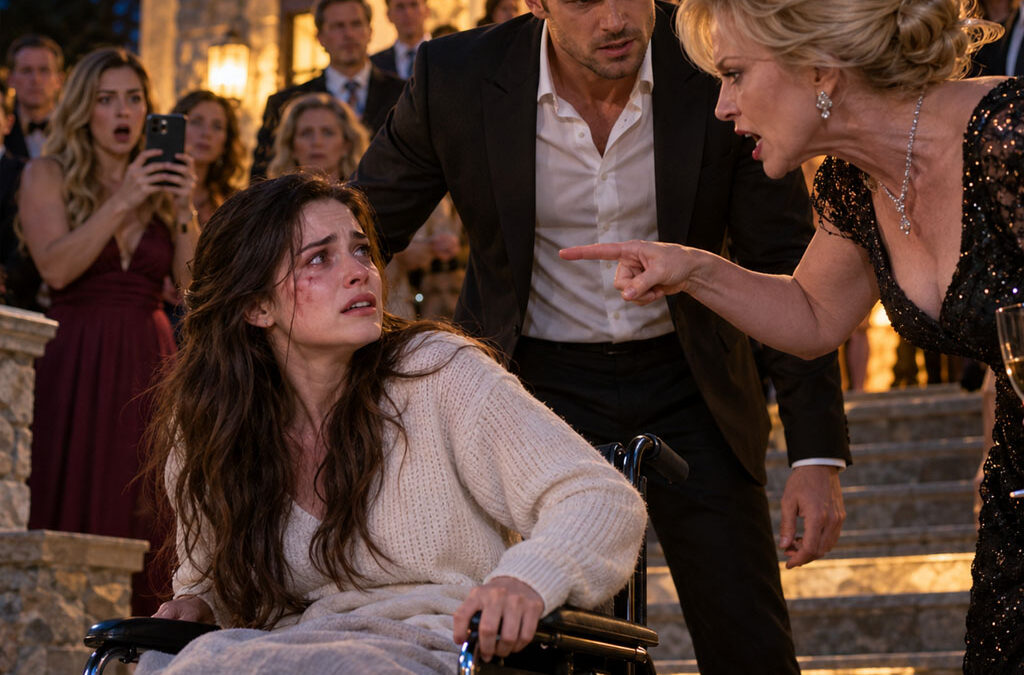
The last thing I remembered before my mother-in-law shoved me down fourteen marble stairs was her perfume.
Chapter 2
By eight the next morning, Tessa’s video had millions of views.
The clip showed Cordelia’s toast, Flynn opening the state notice, and me sitting in my wheelchair while everyone realized the five-million-dollar property came with an eight-figure problem.
Cordelia responded before sunrise.
She posted a statement saying I had fallen after drinking while emotionally unstable.
She said I was abusing pain medication.
She said I had maliciously deceived her son.
Then she claimed I had threatened her by saying, “Be careful on the stairs.”
Women from her church shared it.
Country club friends defended her.
Parents from my school began commenting.
Cordelia understands addiction better than most people.
Sloan needs help, not encouragement.
I hadn’t consumed alcohol in almost a year.
Flynn knew that.
We had been trying to start a family.
On Monday morning, Phoebe called.
“Flynn hired Grant Whitaker.”
Everyone in our county knew Whitaker. His face appeared on billboards beside highways, always wearing a white cowboy hat despite practicing law in suburban Maryland.
“He filed to rescind the transfer.”
“On what grounds?”
“Fraud and incapacity.”
I laughed once.
It hurt my ribs.
“He told everyone I was mentally incompetent so he could take the house. Now he’s telling a judge I was mentally incompetent so he can give it back.”
“Pretty much.”
“If the transfer is reversed?”
“The house returns to you.”
“And the repair obligation?”
“Returns with it.”
My stomach tightened.
By then, fines were accumulating daily.
Phoebe continued.
“He’s going to lose.”
“How do you know?”
“Because your grandfather expected people to behave exactly like this.”
She reminded me of the medical capacity examination.
The medication record showed I had gone nearly eleven hours without narcotic pain relief before signing.
The notary’s log stated I was alert and understood the deed.
Most importantly, page six explicitly disclosed the dam.
Flynn had initialed it.
“Not reading a contract isn’t fraud,” Phoebe said. “It’s bad judgment.”
For the first time in days, I breathed.
Then a sheriff’s deputy arrived at my friend’s house.
Cordelia had reported me for threatening her.
The deputy looked uncomfortable as he stood on the porch.
“She says the remark about the stairs made her fear for her safety.”
I stared at him.
Then at my cast.
Then at the wheelchair.
Something suddenly became obvious.
I had never reported Cordelia.
The paramedics had documented a fall.
Flynn said I slipped.
Cordelia said I slipped.
The hospital wrote accidental fall because I had been unconscious when I arrived.
On paper, she had never pushed me.
But on paper, I had threatened her.
“There is something I need to tell you,” I said.
Two days later, Detective Renee Okafor sat across from me at the sheriff’s office.
She had short silver hair, reading glasses on a chain, and sixteen years of experience investigating crimes against persons.
I told her everything.
She listened without interrupting.
When I finished, she removed her glasses.
“I believe that you believe what you’re telling me.”
My throat tightened.
“That isn’t the same as believing me.”
“No.”
“She pushed me.”
“Then I need evidence.”
She explained what a defense lawyer would say.
I had delayed reporting.
I was in a divorce.
I had just transferred valuable property to my husband knowing it carried massive liability.
Millions of strangers had watched me make a remark about stairs.
“They’ll say this is retaliation.”
I looked down.
“There were bruises on my back.”
That changed something.
The hospital trauma nurse had photographed my injuries.
Image fourteen showed four long purple marks beside my right shoulder blade.
My surgeon reviewed it.
His report said the pattern was consistent with a forceful open-handed push from behind and inconsistent with a simple fall.
Detective Okafor called.
“It helps.”
“But?”
“Flynn can say somebody tried to catch you.”
I closed my eyes.
“I need something that isn’t a word,” she said.
Cordelia struck again before I found it.
My principal called.
A parent had complained about the viral video and police report.
I was placed on paid administrative leave.
Flynn canceled my phone service.
Then my debit card stopped working.
Our joint account had been frozen for “suspected fraud.”
Within forty-eight hours I had lost access to my money, my phone number, and my classroom.
That night, sitting in Marin’s guest room, I remembered Grandpa.
Write down every single thing.
So I did.
Dinner.
The wine Flynn drank.
Cordelia’s perfume.
The argument.
The stairs.
His shoes passing beside my hand after I fell.
Then I remembered something.
A vibration against my wrist.
My Apple Watch.
Marin had brought my belongings home from the hospital.
We found it inside a plastic bag with my torn blouse.
The battery was dead.
I charged it.
Then I synced the health data.
Hard fall detected — 10:13 p.m.
No response.
Emergency SOS initiated — 10:14 p.m.
Call duration: 3 minutes, 41 seconds.
I stared at the screen.
“I didn’t call 911.”
Marin understood first.
“Your watch did.”
If the line stayed open, the dispatcher might have heard everything.
Okafor answered immediately.
County emergency communications stored recordings for thirty days.
We were on day twenty-six.
She submitted a preservation request.
For three days, I believed the recording was safe.
Then she called.
“The request went to an obsolete mailbox. They changed systems and never updated the website.”
I stopped breathing.
“The recording?”
“Scheduled for automatic deletion at two tomorrow morning.”
“Stop it.”
“I need a warrant or court order.”
“Get one.”
“My lieutenant refused.”
The case looked too much like divorce retaliation.
Okafor lowered her voice.
“There is one option. The on-call judge tonight is Harriet Voss. If you come in, give me a sworn statement, and I write an affidavit, I can bring it to her personally.”
“What happens if she says no?”
“The recording disappears.”
That afternoon, Grant Whitaker emailed me a settlement offer.
Flynn would withdraw the motion.
He would restore access to my belongings.
He would stop claiming I lacked mental capacity.
In exchange, I had to sign one statement.
My fall had been accidental.
No one touched me.
And I would withdraw my police report.
The offer expired at midnight.
They knew.
Somehow they knew I was looking for evidence.
Marin found me staring at the document.
“If you sign, it’s over.”
“I know.”
“You keep the house?”
“Yes.”
“And the dam.”
“Yes.”
“You don’t sign?”
“Maybe the recording proves nothing. Maybe Flynn wins the hearing. Maybe I get eleven million dollars of liability back.”
Marin crouched beside the wheelchair.
“What did Walter teach you?”
I looked at the clock.
“Write everything down.”
“No.”
I looked at her.
“He taught you not to lie because you’re scared.”
I deleted the settlement.
“Get the car.”
At 5:31 p.m., Detective Okafor started the recorder.
She questioned me for more than two hours.
At 9:15, she left carrying an affidavit.
At 11:14, my phone rang.
“She signed.”
Judge Voss had signed the preservation order.
At 1:12 a.m., forty-eight minutes before deletion, Okafor returned.
Her coat was wet from rain.
She held out headphones.
“You don’t have to hear this.”
“I do.”
She pressed play.
A dispatcher’s voice came first.
This is an automated emergency call from an Apple Watch reporting a hard fall. Can anyone hear me?
Then Flynn.
She’s not moving.
Then Cordelia.
Calm.
Almost bored.
She’s breathing. Get the folder, Flynn.
“Mom—”
“Get the folder. Leave her. She’ll sign a lot faster from a hospital bed than she ever did from that chair at my table.”
My entire body went cold.
Then the dispatcher called out again.
Cordelia heard her.
“What is that?”
Flynn answered.
“Her watch. It’s calling 911.”
Footsteps approached.
Then Cordelia’s voice transformed.
“Oh, thank goodness. Yes, this is her mother-in-law. She’s fallen down the stairs. I’m afraid she’s been drinking. Please hurry.”
I removed the headphones.
For nearly a minute, I couldn’t speak.
Okafor sat beside me.