My sister volunteered me for a modeling job while I was standing in her kitchen holding a stubborn jar of pasta sauce, and the woman behind the camera looked at me with such sudden concentration that I forgot what I had been saying.
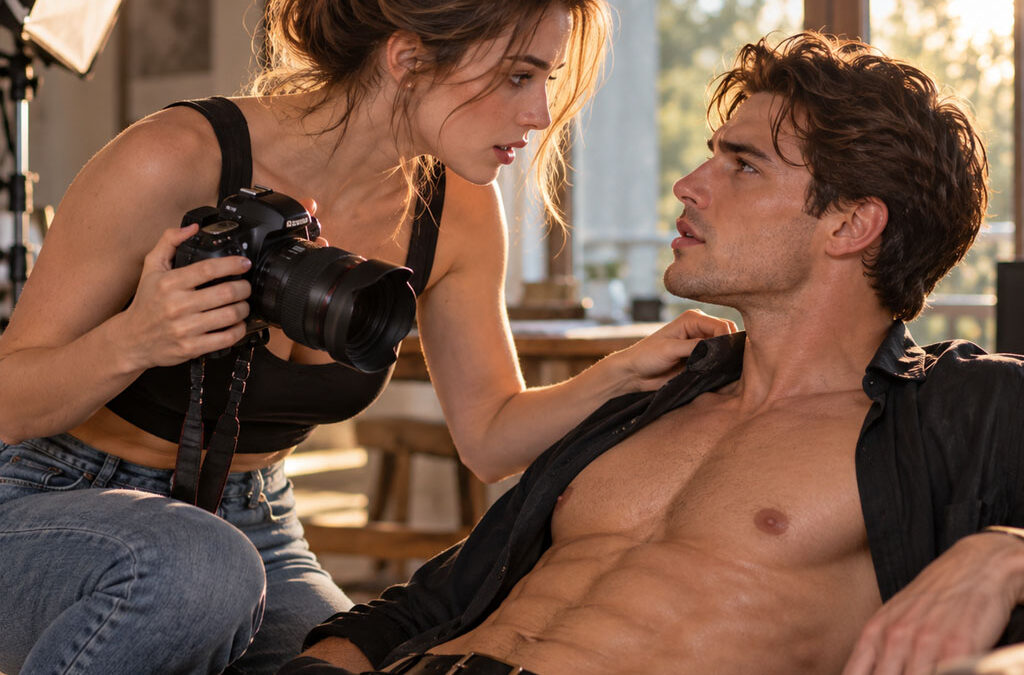
Chapter 2
Nora sent me the schedule at 11:43 that night.
Three shoot dates.
Two alternate locations.
Four wardrobe notes.
And one final instruction.
Do not shave or do anything weird to your hair. Continuity matters.
I replied:
I was planning a mohawk.
Her answer came immediately.
I will break into your house with clippers.
The first full shoot was in a rented studio downtown.
It was less glamorous than I expected.
White walls.
Paper backdrops.
Light stands.
Cables everywhere.
I walked in and immediately began mentally calculating how many orthopedic injuries were waiting to happen.
Nora looked up from adjusting a stand.
“Don’t.”
“Don’t what?”
“Make your physical therapist face.”
“Someone is going to trip.”
“No one is going to trip.”
She tripped over a cable ten minutes later.
I caught her elbow.
She steadied herself and said, “We never speak of this.”
“Agreed.”
She handed me a garment bag.
The first hour was easy.
Nora had learned that I photographed better in motion, so she kept giving me things to do.
Walk.
Turn.
Adjust a cuff.
Sit.
Look up when she called my name.
I liked that.
In rehabilitation work, patients often moved more naturally when they had a reason to reach a position instead of being ordered into it.
I said as much while Nora checked her camera settings.
She looked at me.
“Exactly.”
“What?”
“If I tell somebody to look confident, they give me confidence face. If I give them something real to do, sometimes confidence happens by itself.”
“So you’re manipulating me.”
“Directing.”
“Same thing.”
“Manipulating costs extra.”
The problem started when she told me she needed to get into the frame.
I hadn’t realized her project involved paired styling.
She mounted the camera on a tripod and connected a remote.
“We’re checking balance,” she said. “Nothing dramatic.”
That should have warned me.
At first, we stood several feet apart.
Nora checked the monitor.
“No.”
“What?”
“We look like strangers waiting for an elevator.”
“We basically are two people waiting for instructions.”
She moved closer.
Still frowned.
Then closer again.
“Relax your hand.”
“It is relaxed.”
“Theo, your fingers look like you’re signing a mortgage.”
I laughed.
The camera clicked three times.
“There,” Nora said.
We checked the images together.
She was right.
With her beside me, the photographs changed.
Alone, I looked fine.
With Nora, there was tension.
Not bad tension.
Context.
She was expressive where I was restrained. She moved quickly. I held still. She looked ready to say something; I looked like I already knew what it was.
Nora stared at the monitor.
“That’s useful.”
“You talk about me like I’m a tripod.”
“Tripods complain less.”
“Tripods can’t drive you home.”
She smiled.
“See? Useful.”
After that, teasing became part of the process.
She told me to look interested.
I asked her to define interested.
She told me normal people didn’t require a legal definition.
At one point, she stepped directly in front of me to adjust the collar of my jacket.
Her fingers touched the fabric near my throat.
Then paused.
Only for half a second.
But we both noticed.
Nora stepped back.
“Don’t move.”
Her voice had changed.
I didn’t.
She took the picture.
Later, after the formal setups were finished, we sat on the studio floor eating takeout from cardboard containers.
Nora showed me that photograph.
I wasn’t smiling.
My face wasn’t dramatic.
But something in my expression had softened.
“What were you thinking about?” she asked.
“You told me not to move.”
Nora stared at me.
“That is the most Theo answer possible.”
“What does that mean?”
“You answer precisely enough to avoid technically refusing.”
“Eat your noodles.”
She smiled.
But after a while, we stopped joking.
She told me why the project mattered.
She didn’t want a portfolio full of expensive-looking pictures that meant nothing. She wanted viewers to feel as if the people inside each photograph had lives beyond the edges of the frame.
“What happened five minutes before,” she said. “What happens five minutes after. Who they’re hiding something from. Why they’re looking at each other.”
I listened.
For years, I had thought Nora’s work was mostly about beauty.
Clothes.
Light.
Angles.
I hadn’t understood how much thought lived beneath it.
“You take this more seriously than I realized,” I said.
She considered that.
“Fair.”
“You aren’t offended?”
“No. I make it look easy on purpose.”
That was the first conversation where I stopped thinking of her as Olivia’s glamorous friend.
After that, the project developed a rhythm.
Nora sent increasingly ridiculous wardrobe instructions.
I arrived after clinic.
She forgot to eat.
I began bringing food for two.
She carried too much equipment.
I carried half without asking.
None of it felt important.
That was probably why it became important.
Two weeks in, Nora’s instructor reviewed the photographs.
His name was Daniel Kesler, and according to Nora, he liked the paired images more than anything else.
“He says it looks like there’s a relationship happening between frames.”
She said the word relationship too carefully.
I leaned against my kitchen counter.
“A relationship.”
“A visual relationship, Mercer. Don’t panic.”
“I remain completely calm.”
“He wants more continuity.”
“What does that mean?”
“The next sequence needs to feel more familiar.”
“How familiar?”
She went quiet.
Then said, “Enough that the camera believes us.”
The next shoot took place in an apartment-style studio with a couch, kitchen counter, and tall windows.
Nora explained the concept.
“Two people who’ve known each other long enough that being close feels automatic.”
“That seems hard to manufacture.”
“Then don’t manufacture it.”
We tried.
It looked terrible.
We sat at opposite ends of the couch.
Nora checked the monitor.
“We look divorced.”
“That is technically a relationship.”
“Not the one I’m trying to make.”
She sat closer.
Then closer.
Finally her shoulder rested lightly against my side.
She handed me the remote.
“Put your arm behind me.”
I stretched it across the back of the couch.
“Now what?”
“Look at me like you know me.”
That should have been easy.
I did know her.
I knew she took her coffee with too much cinnamon.
I knew she rearranged camera equipment when nervous.
I knew she stopped joking when a photograph mattered.
I knew she forgot meals but never batteries.
I knew the small line that appeared between her eyebrows when she was trying to solve something.
And once I started thinking about those details, I stopped acting.
Nora saw it.
Her expression changed too.
The camera clicked.
Neither of us moved.
The silence suddenly felt crowded.
She looked down first.
“Okay.”
Her voice had gone professional.
“That might be enough.”
We checked the frame.
It wasn’t dramatic.
Two people on a couch.
My arm behind her.
Her face turned toward mine.
But it looked intimate in a way styling could not explain.
“You’re using that?”
“Probably.”
“It looks personal.”
Nora met my eyes.
“That is the point.”
“Is it?”
She looked away.
The rest of that shoot was worse.
Or better.
Depending on what you were measuring.
The strongest photographs kept happening between instructions.
Nora fixing a necklace while I watched her reflection.
Me handing her a coffee mug and stealing it back.
Her laughing while I reached for it.
My hand finding her waist automatically when she nearly backed into a light stand.
Every accidental moment looked more convincing than anything we posed.
Olivia saw the photographs that night.
She swiped through the tablet.
Then reached the couch image.
Her eyebrows rose.
“Wow.”
Nora grabbed for the screen.
“It’s the project.”
Olivia held it away.
“I didn’t say anything.”
“Your face did.”
My sister looked at me.
Then Nora.
“You two look very convincing.”
I told her to finish her cereal.
She smiled.
That comment stayed with me.
Apparently, it stayed with Nora too.
Because after that, she became more careful in front of Olivia and less careful when we were alone.
We spent an hour shopping for one jacket.
Stayed on a rooftop after a location scout until sunset.
Texted each other about dinner after supposedly discussing lighting.
The shoots stopped being the part of the week I looked forward to most.
The hours around them became better.
Then Daniel reviewed the project again.