“Wait until morning,” Marcus said without looking up from his laptop, while my fever climbed past 103 and the pain in my left calf pulsed so hard it felt like a second heart had been buried under my skin.
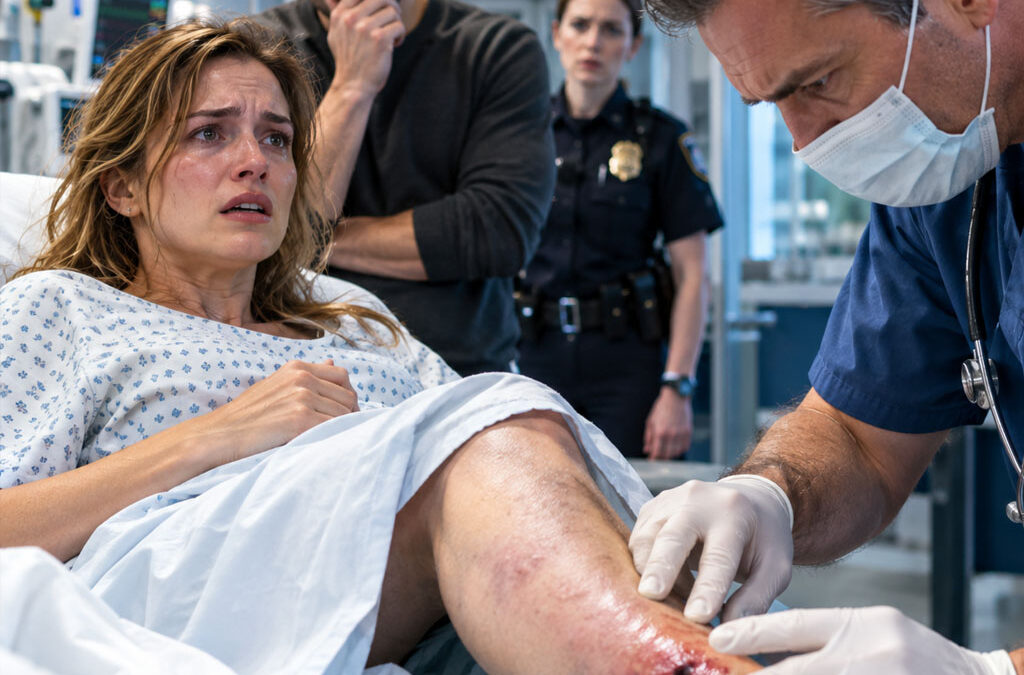
Chapter 2
Dr. Whitfield returned late that morning carrying a tablet.
He showed me a scan of my leg.
“The puncture went through the gastrocnemius and stopped very close to the posterior tibial vessels.”
“How close?”
“Less than an inch.”
I stared at the image.
“If it had gone farther?”
“You could have bled severely in your sleep.”
“And someone with medical training would know that.”
He hesitated.
“Yes.”
Deborah had spent three decades in operating rooms.
Dr. Whitfield continued.
“There’s something else. The puncture is deeper than what we normally see from a simple injection.”
“You think it was intentional.”
“I think somebody put a needle into your calf. Intent is for police.”
By afternoon, the toxicologist arrived.
Dr. Priya Nandan had the blunt efficiency of someone who preferred facts to comfort.
“The compound is related to a veterinary neuromuscular blocker,” she said. “Highly diluted.”
My mouth went dry.
“Lethal?”
“In the right dose.”
“But I got several small doses.”
“That’s what we believe.”
Detective Cho stood near the window.
“What would repeated low doses do?”
Dr. Nandan answered.
“Weakness. Respiratory symptoms. Fever-like presentation. Muscle damage depending on injection technique. Progressive decline.”
“Could it resemble infection?”
“Yes.”
“Sepsis?”
“In a poorly investigated death, possibly.”
The room went quiet.
“How would somebody get it?” Cho asked.
“Research facilities. Some veterinary settings. Diversion isn’t common, but it happens.”
I closed my eyes.
Deborah’s younger brother, Paul, owned three veterinary clinics.
I had been to one of them.
Marcus had toured the back rooms with him during a Fourth of July barbecue.
I told Cho.
Only that.
Not the policy.
Not yet.
That evening Marcus asked to see me.
My friend Patrice, a nurse on the surgical floor, leaned through the doorway.
“You can say no.”
“I know.”
“You sure?”
“No.”
But I let him in.
He looked terrible.
Same shirt as the day before. Red eyes. Unshaven jaw.
He rushed toward the bed.
“Naomi, thank God.”
I watched him carefully.
“I told you I needed the hospital.”
His face twitched.
“I know.”
“You told me to wait.”
“I didn’t understand what was happening.”
“You didn’t ask.”
He lowered his head.
“I’m sorry.”
Then came the sentence that changed everything.
“I can’t believe Mom would do this.”
He said it too quickly.
Police had not told me Deborah was definitely responsible.
They had only detained her.
Marcus was supposed to be confused.
Instead, he was already assigning guilt.
I said nothing.
He pulled a chair closer.
“She was trying to help you.”
“Was she?”
“I mean, I thought she was.”
His hands were perfectly still.
People imagine lies look dramatic.
They usually don’t.
A good liar controls the obvious parts.
I had spent years reading bodies.
Marcus was performing distress.
That didn’t prove anything.
But it changed the weight of every word.
The following morning, Patrice told me a lawyer named Gregory Fenn had visited.
“Your mother-in-law’s attorney.”
I nodded.
“He met with Marcus too.”
My attention sharpened.
“For how long?”
“Maybe forty minutes.”
One attorney meeting privately with both the accused woman and the accused woman’s son.
Not impossible.
But dangerous.
Especially if their stories needed to match.
That afternoon, I called my sister, Renee.
“I need you to go to Dad’s cabin.”
“Naomi, you’re in the hospital. What are you talking about?”
“In the bedroom closet there’s a loose floorboard. Under it is an external drive.”
She went silent.
“What’s on it?”
“I’ll explain later.”
“Does Marcus know?”
“He knows I stored old records there. He doesn’t know what records.”
“Okay.”
“Renee, listen to me. Don’t tell Mom. Don’t tell your husband. Don’t tell anybody where you’re going.”
Four hours later she called.
I heard panic before she spoke.
“Naomi.”
“What?”
“Somebody’s been here.”
My grip tightened around the phone.
“The side door was forced.”
“And the closet?”
“The floorboards are torn up.”
I stopped breathing.
“The drive?”
“Gone.”
My heart monitor began beeping faster.
Patrice looked into the room from the hallway.
I turned away.
Only a handful of people knew about my father’s cabin.
Renee.
My father’s old fishing partner.
And Marcus.
Months earlier, during a Sunday drive, I had casually mentioned storing old government files there.
I had thought nothing of it.
Now the timing became clear.
Marcus knew evidence existed.
Someone had broken into the cabin while I was too sick to protect it.
They weren’t simply waiting for me to die.
They were cleaning up.
The next morning I asked for Detective Cho.
When she arrived, I closed the door.
“No Marcus. No family. No hospital staff unless medically necessary.”
Her expression changed.
“All right.”
Then I told her everything.
The unexplained withdrawals.
The international transfer.
The insurance policy.
“My signature is forged.”
“How much?”
“Two million.”
Cho stopped writing.
“How long ago was the policy issued?”
“Six months.”
She leaned back.
“You’ve known this for six months?”
“I found the documents six months ago.”
“Why didn’t you report it?”
“Because I didn’t know whether Marcus created it or whether someone was using his information. So I started documenting.”
Cho looked frustrated.
“You could have been killed.”
“I almost was.”
Her face softened.
“Fair point.”
I told her about the cabin.
The missing drive.
Then I told her about my former DoD work.
“You investigated fraud?”
“Medical and insurance fraud connected to military systems.”
Cho stared at me.
“You held all this back because you were evaluating us.”
“Yes.”
“That’s extremely annoying.”
“I know.”
To my surprise, she laughed.
Then she called a forensic accountant.
His name was Walter Epps.
By that evening, subpoenas had uncovered something I had never found.
The sixty-thousand-dollar transfer did not originate from Marcus.
It came from a business account tied to Paul’s veterinary group.
Paul’s clinics were in serious financial trouble.
Two were behind on leases.
One faced a former employee’s lawsuit alleging controlled-substance diversion.
The state licensing board had already opened an investigation.
The family needed money.
And dead, I was worth two million dollars.
The next day, my attorney arrived.
Samuel Reyes specialized in civil litigation and white-collar cases.
He was calm enough to make a hurricane feel administrative.
“We’re going to challenge the policy immediately,” he said. “But first, we need to protect you.”
“From Marcus.”
“Yes.”
I looked toward the hospital door.
“He’s still legally my husband.”
“And until you revoke permissions, he may still have access to medical information. If you became incapacitated, he could potentially have input in certain decisions.”
Every muscle in my body tightened.
“I want him removed from everything.”
“I’m already preparing it.”
“And a protective order.”
“That too.”
Then he warned me the order might take time unless prosecutors charged Marcus quickly.
Deborah’s bail hearing was less than twenty-four hours away.
If she made bail and Marcus remained uncharged, they could both return home.
They could destroy whatever evidence remained.
That night I lay awake counting possibilities.
At 2:47 a.m., Patrice came in.
“You need sleep.”
“I need a favor.”
She stopped.
“What kind?”
“I need to know whether anyone outside this hospital tried to access my chart.”
“Naomi—”
“I’m not asking you to break the law. Ask compliance to check the access log. Tell them police are investigating possible poisoning.”
Twenty minutes later she returned pale.
“Someone tried.”
“When?”
“Two days ago.”
“Who?”
“The login credentials belonged to a nurse who works part-time at an urgent care clinic connected to your husband’s family.”
There it was.
This was bigger than Deborah slipping poison into my leg.
Someone was monitoring whether I would survive.
At six in the morning I called Cho.
“They’re still trying to see my records.”
“I know,” she said.
I sat up.
“You know?”
“We got notice from hospital compliance.”
“I need you to move faster.”
“We are.”
“Deborah’s hearing is today.”
“I know.”
“If Marcus isn’t charged—”
“Naomi.”
Her voice changed.
“We executed a warrant at Paul’s largest veterinary clinic two hours ago.”
I went silent.
“What did you find?”
“A controlled-substance ledger that doesn’t match the official inventory.”
“That’s enough for diversion.”
“Yes.”
“What else?”
Cho took a breath.
“An external hard drive in a locked cabinet.”
My eyes closed.
“What kind?”
“Black casing. Scratched corner. Silver tape on the back.”
My drive.
They had stolen the one thing meant to protect them.