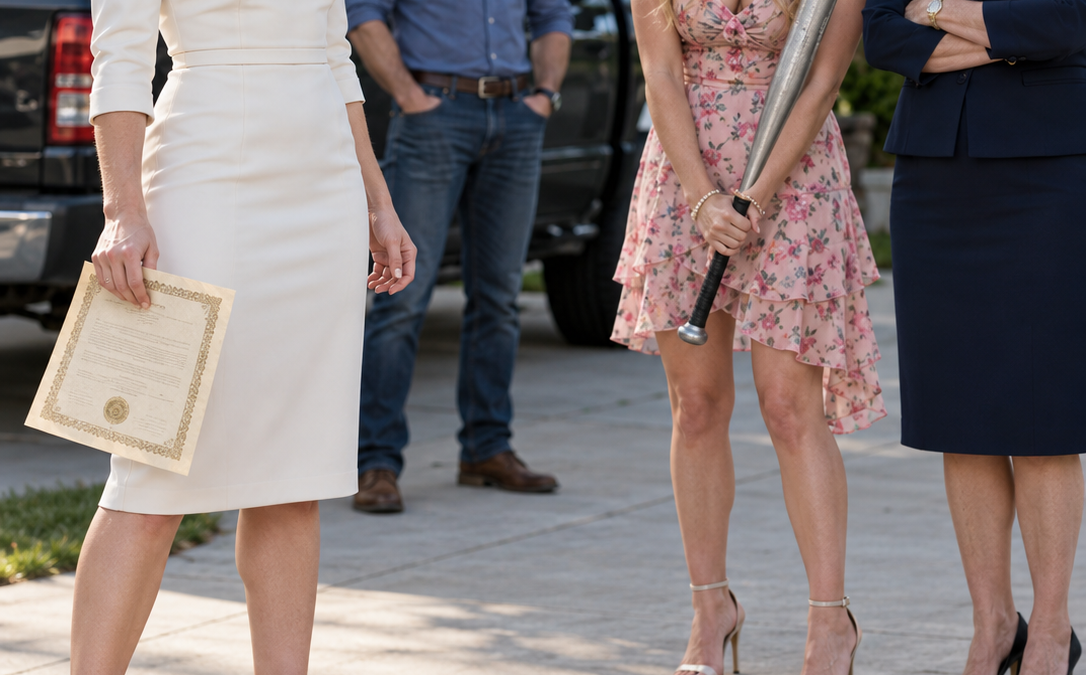
“That should teach your daughter!” Fallon sneered, swinging a baseball bat into the $5,000 violin on my driveway. My six-year-old screamed as splintered wood scattered across her shoes. Mom folded her arms. “You provoked her, Merritt.” I didn’t shout. I reached into the torn red case and unfolded the certificate Fallon hadn’t bothered to read. Then she saw the name.
PART 1 — THE $5,000 GIFT MY SISTER DESTROYED WITHOUT KNOWING THE TRUTH
“That should teach your daughter a lesson!” my sister Fallon snapped, lowering the aluminum baseball bat beside the shattered violin on my driveway.
My six-year-old daughter, Joy, was crying behind me. Pieces of expensive wood lay scattered across the concrete, and my mother stood beside Fallon with her arms crossed.
“You shouldn’t have bought it, Merritt,” Mom said. “You know how sensitive your sister is about money.”
I looked at the broken violin, then at the two women who had spent my entire life making excuses for each other.
Neither had the slightest idea what Fallon had just destroyed.
My husband, Hayes, was standing near his truck, staring at the bat. He looked ready to throw both women off our property.
I raised one hand to stop him.
Then I reached into the torn violin case and pulled out a folded certificate.
“Before you say another word,” I told Fallon, “there’s something you should know about that violin.”
She laughed.
And that was the last time I heard my sister laugh that morning.
But to understand what happened next, you need to know why I had purchased a $5,000 violin in the first place.
Because two weeks earlier, my sister had accused my daughter of destroying an eighty-dollar instrument.
And what I discovered afterward changed everything.
My name is Merritt. I’m thirty-four, married to a mechanical engineer named Hayes, and we live with our daughter in a comfortable suburb outside Columbus, Ohio.
I work as a senior aviation insurance underwriter.
Most people hear my job title and immediately lose interest, which is fine with me. I spend my days reviewing expensive risks, investigating mechanical failures, and deciding whether companies have adequately protected themselves against disasters.
A bad day at my office can involve a claim worth several million dollars.
A normal day involves contracts, technical reports, conference calls, and enough black coffee to keep Starbucks shareholders happy.
I’m good at my job because I pay attention to details.
Unfortunately, for most of my life, I ignored the biggest warning sign in front of me.
My own family.
My younger sister, Fallon, was thirty-two and had never met a financial responsibility she couldn’t transfer to somebody else.
She called herself a freelance event planner.
That sounded impressive until you discovered that most of her business involved posting pictures from other people’s weddings, ordering expensive outfits, and occasionally organizing birthday parties for friends.
She drove a silver SUV, wore designer sunglasses, and posted Instagram photos from restaurants where a single lunch cost more than my family’s weekly groceries.
Meanwhile, I was paying her electricity bill.
And her internet.
And part of her rent whenever another client supposedly paid late.
Our mother considered this arrangement perfectly reasonable.
“Merritt, you have a good career,” she would say. “Fallon is still finding herself.”
Apparently, finding yourself required unlimited financial assistance and a premium credit card.
It had been that way since childhood.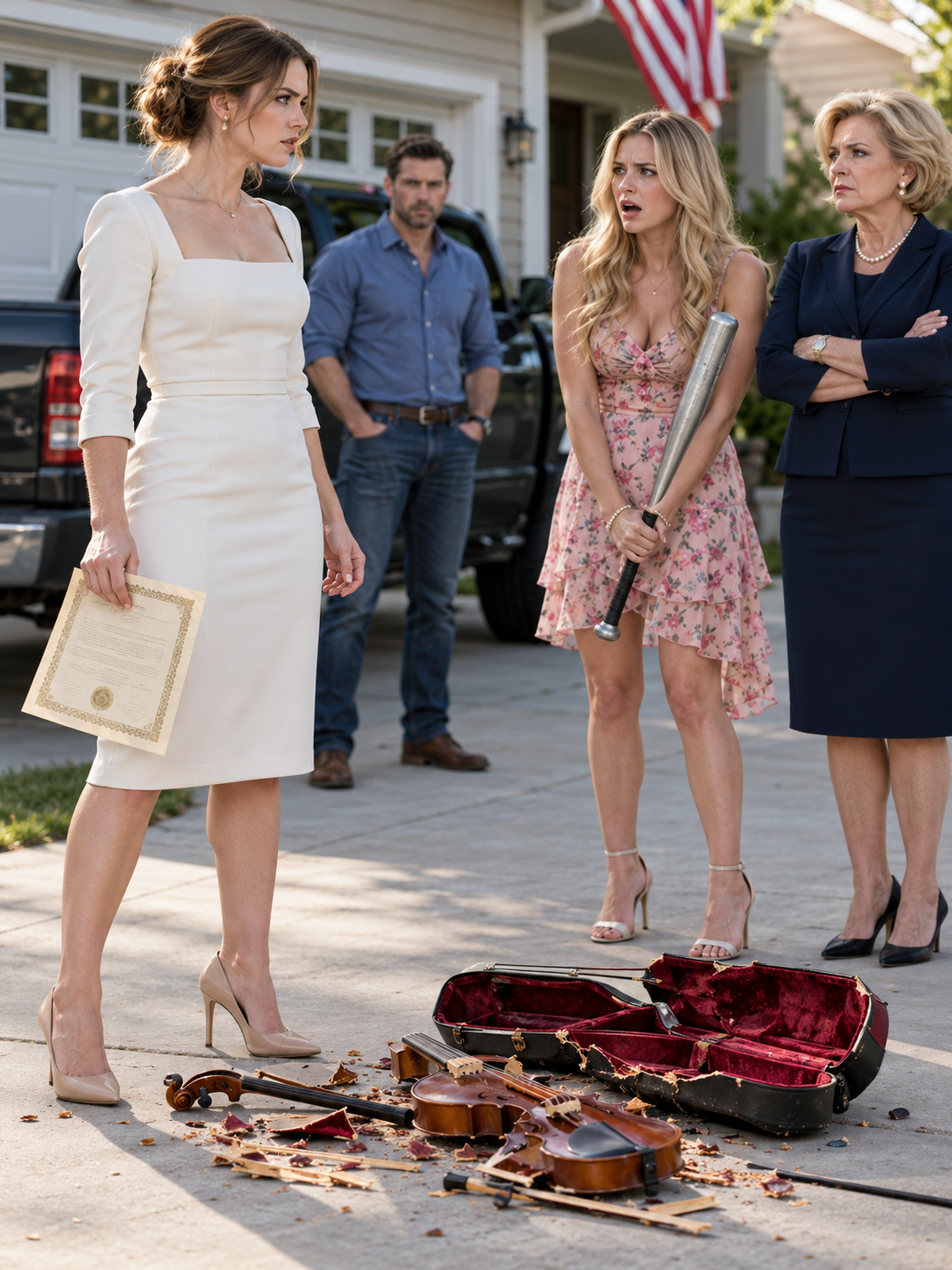
When I was seventeen, I worked weekend shifts at a diner to afford an emerald-green velvet dress for my high school winter formal.
Four months of carrying coffee, wiping tables, and coming home smelling like french fries had finally paid for something I wanted.
Two days before the dance, I found that dress on my bedroom floor.
The bodice had been cut apart.
The straps were severed, and the skirt had long, uneven slashes running through the velvet.
Fallon was fourteen at the time.
I found her across the hallway, painting her nails while listening to music.
“Did you do this?” I demanded, holding up the dress.
She barely glanced at it.
“It was too flashy.”
“What?”
“You were making me feel bad about my dress. You always have to show off.”
I stared at her.
“You cut up something I worked four months to buy because you didn’t like it?”
Fallon shrugged.
“Maybe next time don’t rub your money in everybody’s face.”
Mom appeared in the doorway before I could answer.
I thought she would finally punish Fallon.
Instead, she looked at my ruined dress and said, “You know your sister is sensitive, Merritt. Why would you leave that hanging where she could see it?”
I actually laughed because I thought she was joking.
She wasn’t.
“You’re older,” Mom continued. “You need to think about how your choices affect other people.”
I wore a borrowed dress to the dance.
Fallon never apologized.
That incident should have taught me everything I needed to know about my family.
Instead, I spent another seventeen years hoping things would improve.
When I started college, I worked two jobs and took out student loans.
When Fallon announced she was going to become a professional cellist, Mom took out a second mortgage to buy her an instrument worth thousands.
Fallon quit three months later.
“The strings hurt my fingers,” she complained.
The cello sat untouched in her bedroom while I struggled to pay for professional certification exams.
Mom refused to contribute a dollar.
“We’ve already spent so much on Fallon’s musical development.”
Musical development.
Three months of lessons and an abandoned cello apparently qualified as a major family investment.
The only person who recognized how ridiculous it was happened to be my mother’s older brother, Uncle Theo.
He rarely attended family gatherings.
One rainy afternoon during my final year of college, he asked me to meet him at a coffee shop near campus.
He bought two coffees, sat across from me, and pushed a white envelope over the table.
Inside was enough money to cover my remaining certification exams.
“Take it,” he said.
“Uncle Theo, I can’t—”
“Sure you can. Your mother isn’t going to help you.”
I looked down at the envelope.
He leaned forward.
“Pass those exams. Get yourself a good job. And when you start making real money, don’t let those two turn you into their personal bank.”
I promised him I wouldn’t.
I kept the first two promises.
The third one took me another decade.
After graduation, I landed a position at a respected insurance firm. I worked my way into senior underwriting, married Hayes, and purchased our home.
For the first time, I had real financial security.
I foolishly believed Mom would finally respect me.
Instead, she started calling whenever Fallon needed something.
Three hundred dollars for an overdue phone bill.
Eight hundred for emergency car repairs.
Fifteen hundred because Fallon had booked a vacation before remembering her rent was due.
Every payment came with the same explanation.
“She’s your sister, Merritt.”
By the time the violin incident happened, I had personally covered approximately eighteen thousand dollars of Fallon’s expenses.
The largest ongoing expense was her daughter Romy’s private academy.
Romy was six, the same age as Joy.
Unlike her mother, she was a sweet little girl who rarely complained and genuinely loved music.
Fallon had enrolled her in an expensive private academy with a music program, insisting that public school would destroy her daughter’s creativity.
Then the tuition bills arrived.
Predictably, Fallon couldn’t pay.
Mom showed up at my house one evening and announced that withdrawing Romy would ruin her future.
So I agreed to cover two thousand dollars a month.
Every month, the payment disappeared from my checking account.
Meanwhile, Fallon continued enjoying expensive brunches and posting pictures of shopping bags.
Hayes hated the arrangement.
“You’re paying for a lifestyle she’s pretending she can afford,” he told me one evening.
“Romy shouldn’t suffer because her mother can’t budget.”
“Then help Romy directly. Stop financing Fallon.”
I knew he was right.
But I kept paying because I didn’t want another family war.
Then came the barbecue.
And that was when everything changed.
Two Saturdays before the driveway disaster, Hayes and I invited the family over for burgers.
It was a beautiful afternoon.
The grill was smoking, college football was playing on the television inside, and the girls were enjoying themselves on the backyard patio.
Romy had brought her beginner violin.
Fallon had ordered it online for around eighty dollars.
The instrument was poorly made, but Romy loved practicing, and she had learned enough notes to play the beginning of a familiar children’s song.
I was flipping burgers when I heard a sharp crack.
Then Romy screamed.
I turned to see her holding one hand against her chest.
The violin was lying in the grass.
A wooden tuning peg had snapped loose, and something had struck her hand.
Before anyone could examine the instrument, Fallon charged across the patio.
She grabbed Joy by the arm.
“What did you do?”
Joy looked frightened.
“Nothing! I was just watching!”
“You broke Romy’s violin!”
“I didn’t touch it!”
Fallon struck the back of Joy’s hand.
It happened so quickly I barely registered the movement before Joy began crying.
I dropped the spatula.
“GET YOUR HANDS OFF MY DAUGHTER!”
I pulled Fallon away and positioned myself between them.
For once, my sister stopped talking.
I pointed toward the backyard gate.
“You ever touch my child again, and you will never set foot inside this house.”
Mom hurried over.
“Merritt! Stop overreacting!”
I looked at her.
“Did you just see what Fallon did?”
“Joy needs to learn not to touch other people’s things.”
“She didn’t touch anything!”
“Then why is Romy’s violin broken?”
Hayes walked over, picked up the instrument, and examined the damaged peg.
He rotated the broken piece between his fingers.
“Because this thing was falling apart before anybody touched it.”
Fallon scoffed.
“Oh, wonderful. Now you’re a violin expert?”
“I’m a mechanical engineer. I know failed materials when I see them.”
He showed us the damaged wood.
The peg had fractured near an area that looked dark and deteriorated. He also pointed out a poorly bonded joint in the pegbox.
“This isn’t evidence that Joy broke anything,” Hayes said. “The string tension could have caused the peg to fail during ordinary tuning.”
Fallon snatched the violin away.
“How convenient.”
Then she turned to me.
“You owe Romy a replacement. And don’t buy another cheap one.”
I stared at her.
“You just hit my daughter.”
“She needs to respect other people’s property.”
“You’re leaving. Now.”
Fallon grabbed Romy’s hand and marched toward the gate.
Mom followed, shaking her head.
“I cannot believe how selfish you’ve become, Merritt.”
That evening, Hayes photographed the broken peg and the damaged instrument.
Joy had finally settled down after we explained that she hadn’t caused the accident.
I sat at the kitchen island with my laptop.
The damaged violin was beside me.
Something about the fractured wood bothered me.
If that small piece had struck Romy somewhere other than her hand, the consequences might have been much worse.
So I searched for the manufacturer.
I found the distributor’s website, its parent company, and the contact information for its legal department.
Then I wrote a formal complaint.
Not an angry social media post.
Not a dramatic message demanding an apology.
A documented report identifying the product, explaining the failure, describing the potential injury risk, and including Hayes’s photographs.
I requested a review of the manufacturing defect and appropriate compensation.
I also made it clear that I was prepared to obtain independent expert analysis and seek legal advice if the company dismissed the issue.
By nine the following morning, I had an email from the distributor’s legal department.
Ten minutes later, my office phone rang.
A company representative introduced himself and offered a replacement violin and a fifty-dollar gift card.
I looked at the photographs on my computer.
“Let me make sure I understand your proposal,” I said. “A tuning peg failed during ordinary use, a child was struck by the broken component, and you’d like to replace it with another instrument from the same product line?”
He cleared his throat.
“We take safety concerns very seriously.”
“Then you should understand why that offer isn’t acceptable.”
I explained what I did for a living.
I described the material failure, the need for proper testing, and why a product intended for beginners deserved more scrutiny.
The conversation became considerably more productive.
Over the next several days, the distributor reviewed the evidence and negotiated a private resolution.
Eventually, it agreed to fund a five-thousand-dollar credit toward an instrument from an approved independent craftsman.
The agreement addressed the defective product and included confidentiality terms concerning the settlement.
The company wasn’t admitting broad liability, and I wasn’t pretending one broken violin proved a nationwide manufacturing problem.
But the result was far more generous than the original replacement offer.
And I knew exactly what to do with it.
I drove to a small workshop outside Columbus owned by a master violin maker named Orson.
He was in his late sixties, with silver hair, worn hands, and a workshop full of beautiful instruments.
I explained the defective violin.
Then I explained Fallon.
And finally, I told him about Romy.
Orson listened without interrupting.
When I finished, he asked one question.
“Who is the new instrument for?”
I answered immediately.
“Romy.”
He studied me.
“Your sister’s daughter?”
“Yes.”
“The same sister who struck your little girl?”
“Yes.”
He set down the piece of maple he’d been examining.
“That’s an interesting decision.”
“I know.”
“May I ask why?”
I looked toward the unfinished violins hanging along his workshop wall.
“Because Romy actually loves music. She shouldn’t lose something important to her because her mother behaves like an idiot.”
Orson nodded.
“And because,” I added, “I’m tired of being told I’m a selfish monster every time I refuse to give Fallon something.”
I wasn’t trying to buy my sister’s affection anymore.
I wanted to give Romy something that belonged entirely to her.
Something Fallon couldn’t claim I had purchased for my own daughter just to embarrass her.
Maybe, when confronted with undeniable generosity, my sister would finally understand how wrong she’d been.
Or maybe she wouldn’t.
Either way, I would know I had made one final good-faith effort.
Orson agreed to make a custom violin.
We selected aged spruce for the top and beautifully figured maple for the back.
He showed me samples of amber varnish and explained how the instrument would be fitted for a young musician.
The finished violin would be valuable enough to last for years, with appropriate adjustments as Romy grew.
Then I asked for one additional detail.
“A certificate of authenticity,” I said. “With her full name.”
Orson reached for his ledger.
“What would you like it to say?”
I dictated the wording carefully.
Custom crafted exclusively for Romy. Commissioned by her aunt Merritt as a replacement following a defective instrument failure.
Orson wrote everything down.
Then he asked about the case.
I selected a durable hard-shell model lined with deep burgundy suede.
Joy had helped me choose the color from a catalog because she adored red.
She knew the violin was going to be a surprise for her cousin.
And she was almost as excited about presenting the gift as I was.
The violin took several weeks to finish.
During that time, Fallon continued behaving exactly as she always had.
She criticized my clothes at family dinners.
She complained about my job.
She accused me of being stingy because I refused to pay for an expensive weekend getaway.
And I continued paying Romy’s tuition.
Hayes watched the entire thing with increasing frustration.
“One day, Merritt, you’re going to have to decide when enough is enough.”
I told him I knew.
What I didn’t know was how soon that day would arrive.
The finished violin was scheduled for delivery on a Saturday morning.
Orson drove it to our house himself in his old station wagon.
Joy ran outside when she saw him pull up.
“Is it here?”
Orson smiled.
“It certainly is.”
He lifted the case from his trunk and carefully helped her hold it.
Joy admired the red lining when he opened it briefly to check the instrument.
“Romy’s going to love this,” she said.
I smiled.
“I think so, sweetheart.”
I had planned to invite Fallon, Romy, and Mom over for dinner that evening.
I wanted to give Romy the violin at the table, with Hayes beside me and enough time to explain everything.
But before Orson could drive away, a silver SUV turned sharply onto our street.
Fallon pulled into our driveway.
Mom was sitting beside her.
Neither had called to say they were coming.
Fallon climbed out, holding a large iced coffee.
Then she noticed the violin case.
Her expression changed immediately.
“What’s that?”
Joy looked up proudly.
“A new violin!”
Fallon stared at the expensive-looking case.
Then she turned toward me.
“You’re kidding.”
I started to speak.
“Fallon—”
“You bought your daughter a professional violin?”
Mom climbed out of the passenger seat.
“What?”
Fallon pointed toward Joy.
“Look at that! Merritt bought her kid some ridiculously expensive instrument while Romy doesn’t even have one!”
Mom’s face hardened.
“Merritt, honestly. You know how much your sister has been struggling.”
I held up both hands.
“Would you please listen for thirty seconds?”
Fallon marched toward me.
“Is this funny to you?”
“What?”
“Watching me struggle while you throw money around like it’s nothing?”
“Fallon, the violin isn’t—”
“You think you’re better than everybody!”
Joy stepped closer to me.
“Mommy?”
I put a reassuring hand on her shoulder.
“Go stand by the porch, sweetheart.”
Fallon was already turning toward her SUV.
She opened the rear hatch.
At first, I thought she was getting her purse.
Then I heard metal scraping against plastic.
She pulled out an aluminum softball bat.
“Fallon,” I said sharply. “Put that down.”
She ignored me.
Mom stood beside the car, watching.
Fallon marched directly toward Joy.
My daughter was still holding the violin case.
Before I could take it from her, Fallon snatched it away.
“YOU WANT TO SHOW OFF?”
She threw the case onto the driveway.
“THEN WATCH THIS!”
The bat came down.
The first blow split the outer shell.
“Fallon! STOP!”
She swung again.
This time, I heard wood breaking beneath the damaged case.
Joy screamed.
I pulled her behind me as Fallon delivered one final blow.
Then everything stopped.
The red case lay torn open.
The custom violin was destroyed.
And my sister stood over it, breathing hard, looking pleased with herself.
“That should teach her,” Fallon said.
Mom nodded.
“You shouldn’t have provoked your sister, Merritt.
A truck pulled up behind them.
Hayes had returned from the hardware store.
He jumped out, saw the wreckage, and started toward us.
I raised my hand.
“Hayes. Take Joy.”
He looked at the bat.
“Merritt—”
“Please.”
He moved beside our daughter.
I crouched beside the ruined case.
The strings were broken. The body was split, and pieces of carefully shaped wood were scattered across the driveway.
But the padded document pocket inside the lid had survived.
I slipped my fingers inside.
The certificate was still there.
I stood and unfolded it.
Fallon gave me a mocking smile.
“What? Going to show us the receipt?”
I looked her straight in the face.
“No, Fallon.”
I turned the certificate toward her.
“I’m going to show you whose violin you just destroyed.”
PART 2 — THE CERTIFICATE THAT EXPOSED MY SISTER’S LIES AND DESTROYED HER PERFECT LIFE
Fallon stared at the certificate in my hand.
“What are you talking about?”
I held the document where she could see it.
“Read the name.”
She didn’t move.
“Fallon. Read it.”
Mom stepped forward.
“Merritt, stop being theatrical.”
I ignored her.
My sister finally leaned closer, her eyes moving over the elegant handwriting beneath Orson’s signature.
Her expression changed.
First confusion.
Then disbelief.
Then something I had never seen on Fallon’s face before.
Actual fear.
“No,” she whispered.
I nodded toward the wreckage.
“Yes.”
She looked down at the violin.
Then back at the certificate.
“No. That’s not possible.”
“It was commissioned for Romy. Your daughter. The one who’s been begging you for a better violin.”
Fallon blinked several times.
I continued before she could interrupt.
“Remember that eighty-dollar violin that broke at our barbecue? The one you blamed Joy for?”
She said nothing.
“I contacted the distributor. I sent them photographs proving the instrument had a serious defect. After reviewing the complaint, they agreed to fund a replacement.”
Mom’s mouth opened slightly.
I pointed toward the ruined case.
“Five thousand dollars. That’s what they authorized. I used the entire amount to have Orson build Romy a professional instrument.”
Fallon stepped backward.
“You’re lying.”
“There’s the certificate. The purchase documentation is in my email. Orson delivered it himself this morning.”
“But Joy was holding it!”
I stared at her.
“She liked the red case.”
“Then why didn’t you say something?”
“I tried.”
“You should have told me!”
I gave a short laugh.
“Between you screaming at my daughter and getting a baseball bat out of your car, when exactly was I supposed to schedule that conversation?”
Fallon pointed toward the broken violin.
“You set me up!”
That got Hayes’s attention.
He took one step forward.
“Careful, Fallon.”
She turned toward him.
“This was deliberate! She knew how upset I was about Romy’s violin!”
Hayes looked at the destruction on the driveway.
“So you decided to smash another one?”
“I didn’t know!”
“That’s usually why adults ask questions before grabbing a weapon.”
Mom hurried between us.
“Everybody needs to calm down.”
I looked at her.
“That’s interesting, Mom. You were perfectly calm while Fallon was smashing a violin in front of a six-year-old.”
“She was emotional.”
“She was swinging a baseball bat.”
“It was a terrible misunderstanding!”
“No. A misunderstanding is putting diesel in a gasoline engine. This was an adult destroying someone else’s property because she couldn’t stand the idea of her niece getting something nice.”
Fallon’s lips tightened.
“I said I didn’t know it was for Romy.”
“And that’s supposed to make it better?”
Neither answered.
I looked at Fallon.
“If that violin had belonged to Joy, would you be sorry?”
She opened her mouth.
Nothing came out.
I nodded.
“That’s what I thought.”
Hayes had taken Joy inside. Through the front window, I could see him sitting beside her on the couch.
She was holding her favorite stuffed rabbit.
My mother glanced toward the house.
“Your daughter will get over it.”
I turned back.
“Get off my property.”
Mom looked offended.
“Merritt!”
“Both of you.”
Fallon crossed her arms.
“What about Romy’s violin?”
I looked down at the scattered wood.
“Ask the person holding the bat.”
She stared at me.
“You’re not seriously going to make me pay for that.”
“No. I’m not wasting another afternoon chasing you for money you don’t have.”
Mom stepped closer.
“Good. At least you’re being reasonable.”
I took out my phone.
“But I am finished paying your bills.”
Fallon’s expression changed immediately.
“What?”
I opened my banking app.
“You heard me.”
I found the recurring tuition transfer.
Two thousand dollars.
Every month.
I canceled the next payment.
Fallon moved toward me.
“Wait! Romy’s tuition is due next week!”
“Then you’d better call the school.”
“You can’t do that!”
“It’s my checking account. Watch me.”
I pulled up the utility payments associated with her apartment.
Electricity.
Water.
Internet.
Canceled.
Then I opened my credit card account and removed Fallon as an authorized user.
Her eyes widened.
“Merritt, that’s my emergency card!”
“It’s my card. With your name on it.”
“You’re being vindictive!”
“No. I’m updating my budget.”
Mom grabbed my sleeve.
“You can’t abandon family over a piece of wood!”
I looked at her hand until she let go.
“I’m not ending this because of a violin.”
I pointed toward our front door.
“I’m ending it because my daughter is afraid of her aunt, and her grandmother thinks that’s acceptable.”
Fallon shook her head.
“You’re punishing Romy!”
“Romy can attend public school. She can still take violin lessons. What she can’t do is keep living off my paycheck while you attack my child.”
Mom’s face hardened.
“We raised you better than this.”
I looked at the woman who had defended Fallon when she cut up my prom dress, excused every insult, and treated my career like a family-owned ATM.
“No, Mom. You raised me to tolerate this.”
Hayes stepped onto the porch.
“Both of you need to leave.”
Fallon looked around the driveway.
For one brief second, I thought she might apologize.
Instead, she pointed at the certificate.
“This is going to make Romy hate you.”
I folded the paper.
“No, Fallon. Romy won’t even know about it unless you tell her.
Fallon grabbed her bat and stormed toward the SUV.
Mom followed, but stopped beside me.
“One day you’ll regret turning your back on your own blood.”
I looked through the window at Joy.
“No,” I said. “I regret waiting this long.”
They drove away.
And for the first time in years, I didn’t feel obligated to call either of them afterward.
I went inside.
Joy looked up from the couch.
“Mommy, is Aunt Fallon coming back?”
I sat beside her.
“No, sweetheart.”
“Was the violin broken because I held it?”
That question hurt more than the five-thousand-dollar loss.
“No. You did nothing wrong.”
She picked at the ear of her stuffed rabbit.
“But it was for Romy.”
“I know.”
“Will she be sad?”
I put my arm around her.
“Probably. And that’s sad. But none of this was your responsibility.”
Hayes sat beside us.
“We’re going to make sure you feel safe here,” he told her.
She leaned against him.
Later, after Joy went to bed, Hayes and I went outside to clean up the driveway.
He placed the larger violin fragments in a box so we could document the damage.
I photographed the case, the broken instrument, and the pieces scattered across the concrete.
Then I placed Orson’s certificate in a folder with the purchase documents.
Hayes watched me work.
“You’re documenting everything?”
“Yes.”
“You think she’s going to cause trouble?”
I looked at the empty driveway.
“It’s Fallon.”
He nodded.
“Good point.”
Neither of us knew how quickly that prediction would come true.
The following morning, my phone started vibrating before I’d finished my coffee.
The first message was from a cousin I hadn’t spoken to in months.
Merritt, I know things are tense, but cutting Fallon off financially because of a family disagreement seems incredibly cruel.
I stared at it.
Family disagreement?
Before I could respond, another text arrived.
Then another.
I opened Facebook.
Fallon had posted a lengthy statement about what she called the most humiliating experience of her life.
According to her, she’d brought Romy to my house hoping to repair our relationship after the barbecue.
That was interesting.
Romy hadn’t even been in the SUV.
Fallon claimed I had deliberately bought an expensive violin for Joy to mock her financial problems.
She wrote that she had tried to move the instrument out of sight because it was upsetting.
Then, according to her version, she accidentally dropped the case.
Accidentally.
Not a word about the baseball bat.
Not a word about the repeated blows.
Not a word about the certificate proving the violin belonged to Romy.
She finished by claiming I’d screamed at our elderly mother and cruelly canceled the financial assistance my entire family depended upon.
The comments were exactly what you’d expect.
One aunt called me selfish.
A cousin wrote that money had changed me.
A woman I’d met once at a Thanksgiving dinner suggested I needed therapy.
Then I saw Mom’s comment.
Praying my daughters can find peace. It’s heartbreaking when success makes someone forget the meaning of family.
I read it twice.
Then I handed Hayes my phone.
He scrolled silently.
“Wow.”
“That’s your professional assessment?”
“I’m trying to think of something polite.”
“Don’t bother.”
He reached for his laptop.
“You still have the garage camera footage?”
I looked at him.
Then toward the driveway.
The camera.
Of course.
We’d installed a new home security system earlier that year after several packages disappeared from our front porch.
The camera above the garage recorded high-resolution video with audio.
And it pointed directly at the spot where Fallon had smashed the violin.
I opened the security app.
Saturday.
9:58 a.m.
There she was.
The silver SUV.
Mom climbing out.
Fallon pointing at Joy.
I advanced the recording.
Then came the bat.
The footage showed everything.
Fallon opening her trunk.
Grabbing the weapon.
Taking the case from Joy.
Smashing it against the concrete.
My mother watching.
Then came the part I wanted the whole family to hear.
Fallon’s voice was perfectly clear.
“That should teach her.”
Mom’s response followed.
“You shouldn’t have provoked your sister.”
Hayes leaned back in his chair.
“Well, that settles it.”
I watched the recording again.
There was no convenient camera angle.
No missing context.
No complicated explanation required.
My sister had just told dozens of people that she’d accidentally dropped a violin.
I had video of her hitting it with a baseball bat.
I saved the original footage.
Then I exported a short, continuous section covering the destruction and the moment I read the certificate.
Hayes looked at me.
“What are you going to do?”
“Correct the record.”
“On Facebook?”
“No.”
I opened our extended family group chat.
There were thirty-eight members.
For years, that chat had been used to organize Christmas dinners, birthday parties, and Thanksgiving plans.
Today, it was full of messages about how disappointed everyone was in me.
I attached the video.
Then I wrote one sentence.
For the record, that violin was custom-made for Romy, and Fallon deliberately destroyed it. Here’s what actually happened.
I pressed send.
Then I turned off notifications.
Hayes watched me.
“That’s it?”
“That’s it.”
“You’re not going to argue with them?”
“They can argue with the camera.”
But I wasn’t finished.
I opened my email.
The first message went to the director of Romy’s private academy, which also operated her music program.
Her name was Ms. Kestrel.
I explained that I would no longer fund Romy’s tuition and asked the school to direct future billing questions to her parents.
I also reported the violent incident because Fallon regularly visited the campus.
I included the relevant footage and asked the director to handle the information discreetly.
The second email went to Fallon’s husband.
He worked in logistics and traveled frequently.
I barely knew him because Fallon preferred keeping us separated.
Whenever we did talk, he seemed exhausted.
I’d occasionally wondered whether he knew how much money I was providing to his family.
I attached the original recording.
Then I typed:
I thought you should see what happened yesterday. I know Romy wasn’t present, but I believe you should understand what occurred. Please make sure she’s safe.
I sent it.
And I closed the laptop.
Twelve minutes later, my phone began ringing.
I ignored the first call.
And the second.
On the third, Hayes looked at the screen.
“Your mother.”
I shook my head.
“Not interested.”
Then the group chat notifications started pouring in.
Aunt Denise wrote:
Oh my God. Fallon told us it was an accident.
Another cousin replied:
That was absolutely not an accident.
Someone else wrote:
Why was she swinging a bat near Joy?
Then came the apologies.
Suddenly, the people who’d been calling me heartless were admitting that they’d been misled.
My mother posted a message asking everyone to stop sharing the footage.
Fallon left the group.
Then she called me fourteen times.
I didn’t answer.
An hour later, Ms. Kestrel contacted me.
She had reviewed the footage and expressed concern about Fallon’s behavior.
The academy was contacting Romy’s parents regarding future arrangements and would not permit Fallon to enter campus while the safety matter was being assessed.
With my sponsorship withdrawn, Romy’s enrollment was also at risk unless her parents made other payment arrangements.
I felt terrible for Romy.
She had done nothing wrong.
But I wasn’t going to continue underwriting her mother’s behavior just because Fallon knew exactly how to use her daughter to make me feel guilty.
I asked Ms. Kestrel to make sure Romy’s father understood the options available.
Then another call arrived.
This one was from Fallon’s husband.
I answered.
“Hello?”
He didn’t speak immediately.
I could hear traffic outside.
Finally, he said, “Merritt, is that video real?”
“Yes.”
“It’s not edited?”
“The original recording is attached to my email. You can see the full sequence.”
He was quiet.
Then he exhaled.
“She told me something completely different.”
“What did she say?”
“That you threw a violin at her car. That you screamed at your mother and threatened her.”
I closed my eyes briefly.
“None of that happened.”
“I can see that.”
His voice sounded strained.
He told me Fallon had repeatedly lied about why she needed money and what happened during family arguments.
She had even told him I insisted on paying Romy’s tuition because I enjoyed controlling the family.
I nearly laughed.
I had been accused of many things, but apparently my monthly two-thousand-dollar donation was now a sinister power play.
Then his tone changed.
“Did she really hit Joy at the barbecue?”
“Yes.”
He was silent again.
“I didn’t know that.”
“I assumed Fallon told you.”
“She didn’t.”
I heard a car door closing.
“I’ve been trying to keep this marriage together for Romy,” he said. “But I’m starting to wonder what else she’s been hiding.”
I didn’t tell him to divorce Fallon.
I didn’t tell him what kind of father he should be.
I simply said, “You need to make decisions based on what’s actually happening, not just what Fallon tells you.”
He thanked me.
Then he said something I wasn’t expecting.
“I’m going to call an attorney.”
The line disconnected.
I sat at my kitchen table for several minutes.
For years, Fallon had controlled every family argument by getting to everyone first.
She told her version.
Mom confirmed it.
And I was expected to defend myself against a story they’d already agreed was true.
This time, the video had reached people before Fallon could invent another explanation.
And she couldn’t negotiate with a security camera.
The consequences started arriving almost immediately.
Within three weeks, Fallon’s husband had consulted an attorney and begun divorce proceedings.
He also requested temporary parenting arrangements that would keep Romy primarily with him while the court evaluated the family’s circumstances.
The video became part of the evidence supporting his concerns about Fallon’s conduct.
It wasn’t the only issue in their marriage.
According to him, there had been years of financial deception, volatile arguments, and problems he’d been trying to ignore.
But the recording made those problems impossible to dismiss.
Fallon called me repeatedly.
When I finally listened to one voicemail, she was screaming.
“You ruined my marriage! I hope you’re happy!”
I deleted it.
The next voicemail was from Mom.
“Your sister is losing everything, Merritt. You need to fix this.”
I deleted that one too.
Without my financial support, Fallon’s carefully maintained lifestyle began falling apart.
Her credit card access was gone.
The utility payments became her responsibility.
The tuition bills went directly to her and her husband.
And when her next rent payment came due, she discovered that posting photographs from expensive restaurants wasn’t a reliable source of income.
Her husband had already separated his finances and arranged somewhere else to stay with Romy.
Fallon fell behind on rent.
A notice followed.
Before long, she was packing her belongings and moving back into her childhood bedroom at Mom’s house.
The same bedroom where she’d once sat painting her nails while I stared at my destroyed prom dress.
Mom initially insisted Fallon just needed time to recover.
But time didn’t pay the bills.
And without my contributions, Mom discovered how expensive it was to support a thirty-two-year-old woman who expected somebody else to solve every problem.
She started selling jewelry.
Then she complained to relatives that nobody cared about family anymore.
The relatives had seen the video.
Most declined to get involved.
Fallon’s social media activity slowed dramatically.
The woman who once posted expensive meals and designer handbags began sharing inspirational quotes about betrayal.
I blocked her.
Not because I was afraid of what she might say.
Because I no longer wanted to spend ten minutes of every morning finding out.
Meanwhile, my house became quieter.
The phone stopped ringing during dinner.
My weekends were no longer interrupted by manufactured financial emergencies.
Hayes and I could make plans without wondering whether Mom would arrive demanding a rescue payment.
And Joy slowly stopped asking whether Aunt Fallon was coming over.
One afternoon, she watched Hayes replace a loose hinge on our backyard gate.
“Daddy?”
“Yes, sweetheart?”
“Can people still come here if they get mad?”
He set down his screwdriver.
“Being angry doesn’t mean somebody is dangerous. But people who hurt others or break things aren’t allowed to come here and do it again.”
Joy considered that.
“Even family?”
“Even family.”
She nodded and went back to her coloring book.
I stood inside the kitchen listening.
For years, I’d told myself I was protecting my family by keeping everyone happy.
I was wrong.
I’d been teaching Fallon that she could do whatever she wanted and still receive a check at the end of the month.
That was over.
One Tuesday evening, almost a month after the driveway incident, an email from Mom appeared in my inbox.
The subject line read:
Please think about your family.
I opened it.
It was long.
Mom explained that Fallon was struggling emotionally.
Her husband was pursuing divorce.
Romy was staying primarily with her father under a temporary arrangement while the adults worked through the legal process.
Money was tight.
The heating bill was overdue.
Mom had been forced to sell a necklace she’d owned for twenty years.
Then came the part I’d been expecting.
Merritt, you’ve made your point. Fallon has suffered enough. We are still family, and family is supposed to help each other.
She asked me to forgive them.
She asked me to reopen the door.
And near the bottom, she asked whether I could send a few hundred dollars until things improved.
I read the email twice.
I searched for any mention of Joy.
Nothing.
No acknowledgment that Fallon had frightened my daughter.
No apology for hitting her at the barbecue.
No acknowledgment of the destroyed violin.
Not even a sentence expressing regret about what happened on our driveway.
Just another request for money.
I thought about answering.
I even opened a blank reply.
Then I remembered Uncle Theo sitting across from me in that little coffee shop.
Don’t let them bleed you dry.
It had taken me seventeen years to understand that advice.
I closed the reply.
Moved Mom’s email to the trash.
And blocked the address.
Then I walked into the living room.
Hayes was sitting on the floor with Joy, helping her build a complicated castle out of colorful plastic blocks.
Joy looked up.
“Mommy! Come see!”
I sat beside them.
She handed me a tiny red piece.
“This is the door.”
I smiled.
“That’s a very nice door.”
She pressed it into my palm.
“You can put it wherever you want.”
I looked at the little red block.
And for some reason, I thought about the destroyed violin case.
The expensive burgundy suede.
The smashed maple.
The beautiful instrument Romy never got to play.
For a while, that was the part of the story that bothered me most.
Romy was innocent.
She had lost something because her mother couldn’t control herself.
But I couldn’t repair my niece’s entire childhood by continuing to finance Fallon’s life.
A few days later, Romy’s father contacted me.
He wanted to thank me for being honest.
He had arranged beginner violin lessons near his new apartment.
Romy was practicing on a borrowed student instrument until he could afford a better one.
He told me she still loved music.
Then he asked whether I’d like to speak with her sometime.
I said yes.
Not because I was ready to reconcile with Fallon.
Because Romy had never been the problem.
A few weeks later, her father brought her to a park near our neighborhood.
Joy ran toward her cousin the moment she saw her.
The two girls spent the next hour racing around the playground while Hayes and I talked with Romy’s father.
He looked tired, but relieved.
He said the divorce proceedings were difficult and the custody situation wasn’t settled.
He wasn’t pretending everything would be easy.
But he was trying to provide Romy with something she hadn’t consistently had at home.
Stability.
Before they left, Romy walked over to me.
“Aunt Merritt?”
I crouched beside her.
“Yes?”
“Daddy said you tried to get me a violin.”
I looked toward her father.
He nodded.
“He explained a little.”
I turned back to Romy.
“I did, sweetheart.”
“Was it the pretty red one?”
“Yes.”
She looked down at her sneakers.
“I’m sorry it broke.”
I put my hand gently on her shoulder.
“You have absolutely nothing to apologize for.”
She thought about that for a moment.
Then she smiled.
“I’m learning a new song.”
“I’d love to hear it someday.”
“Okay!”
She ran back toward Joy.
And just like that, the conversation was over.
No accusations.
No guilt.
No demand that I fix something.
Just a little girl who wanted someone to listen to her play music.
As I watched the cousins say goodbye, Hayes slipped his hand into mine.
“You okay?” he asked.
I nodded.
“Yeah.”
He looked toward the parking lot.
“Any regrets?”
I thought about the money.
The years of manipulation.
The destroyed dress.
The broken violin.
My mother’s face when she blamed Joy for what Fallon had done.
Then I looked at my daughter, laughing with her cousin.
“Only that I didn’t protect our peace sooner.”
That night, after Joy went to bed, I went into my home office.
The certificate from Orson was still in my desk drawer.
I unfolded it one last time.
The paper was creased, but the writing was intact.
Custom crafted exclusively for Romy.
I hadn’t bought that violin to humiliate my sister.
I hadn’t bought it to prove I was richer or smarter or more successful.
I’d bought it because a little girl loved music and deserved an instrument that wouldn’t fall apart in her hands.
Fallon had taken a beautiful gift and destroyed it because she couldn’t imagine I might have done something kind without wanting something in return.
And my mother had stood there and defended her.
For years, I’d asked myself what I could do to make them finally treat me with respect.
I’d tried working harder.
Giving more.
Staying quiet.
Apologizing when I’d done nothing wrong.
None of it worked.
Because the problem was never how much I gave.
The problem was that they believed they were entitled to everything I had.
I folded the certificate and placed it back in the drawer.
I couldn’t undo Fallon’s actions.
I couldn’t force Mom to admit she’d been wrong.
And I couldn’t guarantee what would happen in Romy’s family.
But I could decide what happened in mine.
The next morning, Joy came downstairs wearing her favorite red sweater.
She climbed onto the kitchen stool while Hayes made pancakes.
“Mommy?”
“Yes?”
“Can Romy come play again?”
I smiled.
“Of course.”
“And can we go hear her violin someday?”
I glanced at Hayes.
He smiled back.
“I think she’d like that.”
Joy nodded enthusiastically.
Then she reached for a pancake.
Outside, the driveway was clean.
The broken wood was gone.
Fallon’s SUV wasn’t parked at the curb.
And nobody was standing at our front door demanding that I apologize for something I hadn’t done.
For the first time in my adult life, I wasn’t waiting for the next family emergency.
I was simply having breakfast with my husband and daughter.
It wasn’t dramatic.
Nobody was shouting.
Nothing expensive was being destroyed.
And after thirty-four years of confusing obligation with love, I finally understood something.
Being related to someone doesn’t give them unlimited permission to hurt you. And forgiving someone doesn’t mean handing them the keys to your life again.
My sister had destroyed a five-thousand-dollar violin because she thought it belonged to my daughter.
What she actually destroyed was the last excuse I had for allowing her to hurt my family.
And that was one thing I would never pay to replace.