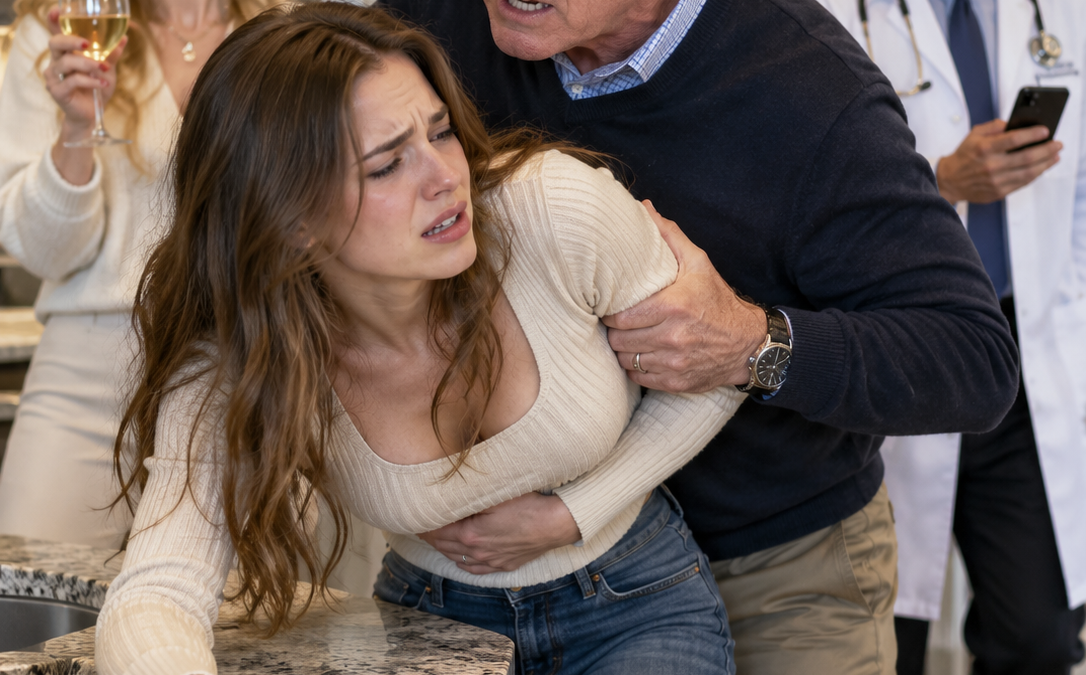
“SHUT UP AND GET BACK TO WORK!” Dad roared, shoving me into the granite counter as I struggled to breathe. Pain tore through my ribs. Samantha clapped, her Chardonnay sloshing onto the floor. “Give her an Oscar,” she laughed. Then Dr. Howard appeared in the doorway, saw my face, and reached for his phone. The X-rays would tell another story.
PART 1: MY FATHER CALLED ME A LIAR WHILE I WAS BLEEDING INSIDE
“SHUT UP AND GET BACK TO WORK!”
My father’s voice carried from the kitchen into the dining room, where twelve guests were celebrating Margaret’s eighty-second birthday.
I had one hand gripping the granite countertop and the other pressed against my left ribs. Every breath hurt. The dessert plates were still stacked beside the sink.
“Dad, I can’t—”
“Can’t what? Wash dishes? You’ve been finding excuses all night.”
My older sister, Samantha, leaned against the doorway in her expensive cream-colored sweater, holding a glass of Chardonnay.
“Oh, look. She’s dying again.”
She laughed.
I tried to straighten, but something beneath my ribs pulled so sharply that I bent forward instead.
Dad stepped closer.
“Stand up when I’m talking to you.”
“Please. Something’s wrong.”
He grabbed my shoulder and shoved me upright.
My side struck the counter.
The pain was immediate. I gasped, staggered backward, and caught the edge of the sink before my knees gave out.
Samantha actually clapped.
“Wow. That deserves an Oscar.”
Then someone spoke from behind her.
“Richard, take your hands off your daughter.”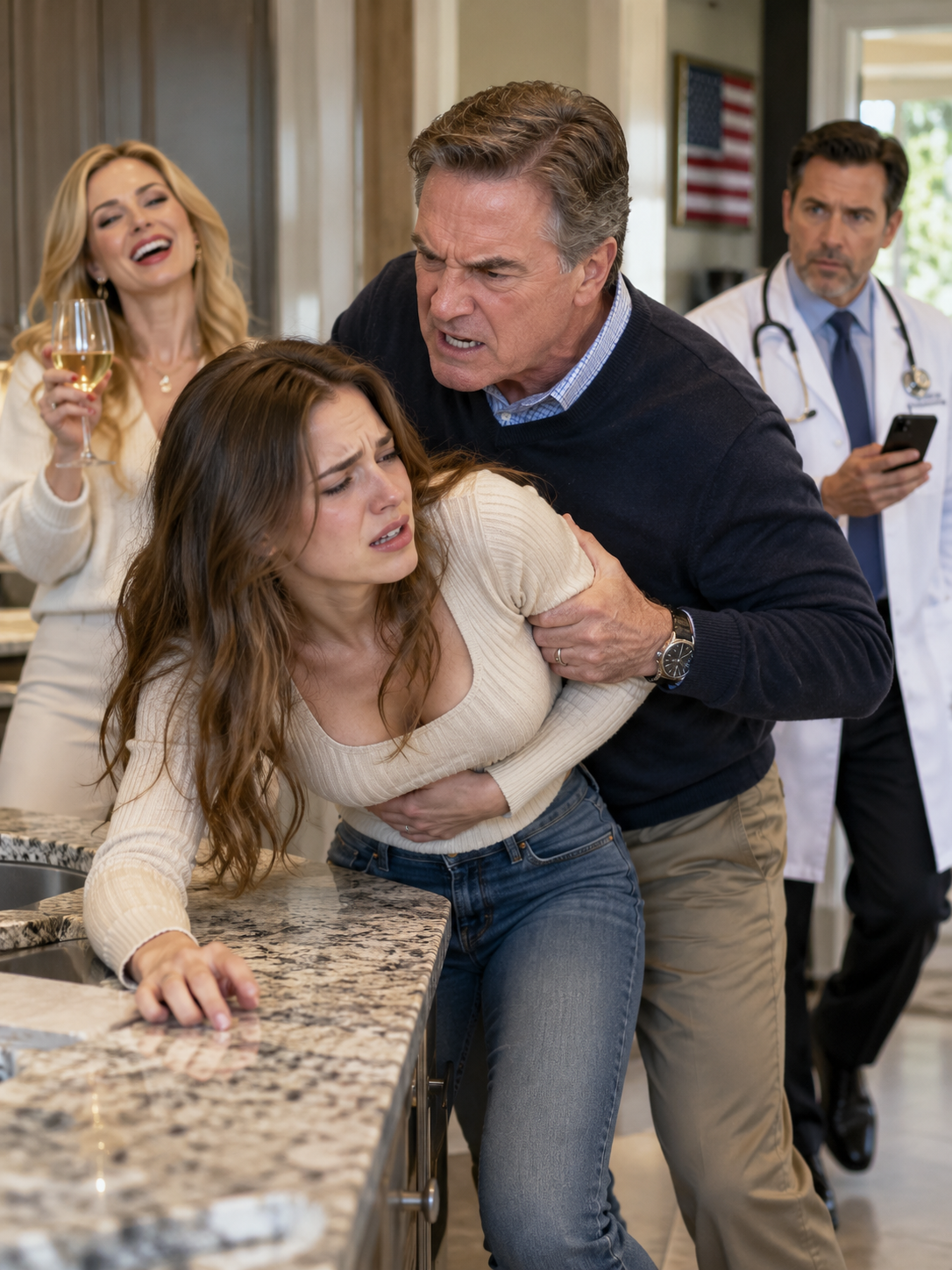
Dr. Howard stood in the kitchen doorway, still wearing his winter coat.
He looked at my face, then at the hand pressed against my ribs.
His expression changed.
“Everybody move. Now.”
Dad turned toward him.
“She’s fine, Howard. She’s been pulling this nonsense since she was a kid.”
Dr. Howard ignored him.
He came straight toward me, watching how little my chest moved when I breathed.
“How long have you been having trouble breathing?”
I tried to answer.
Nothing came out.
And when he reached for his phone, Dad said something I would never forget.
“Don’t you dare call an ambulance in my house.”
To understand why my father thought he could make that decision, you need to understand the house I grew up in.
My name isn’t important to what happened. The name that matters is Richard Marshall.
In our small Midwestern town, everyone knew him.
He owned a successful residential construction business, drove a spotless Ford F-150, attended the Chamber of Commerce breakfasts, and donated money whenever the local high school needed new equipment.
People called him dependable.
His employees called him demanding.
My sister called him the best father in the world.
I called him Dad because, growing up, I didn’t have much choice.
My mother, Sarah, died when I was seven.
Before that, I remembered Saturday pancakes, library trips, and somebody checking my forehead when I said I didn’t feel well.
After her funeral, everything changed.
Dad didn’t talk about grief. He talked about responsibility.
Samantha was older, outgoing, and smart enough to understand exactly what earned his approval.
She agreed with everything he said.
I asked questions.
That was my first mistake.
When I was nine, I fell out of the oak tree behind our house and landed on my wrist.
It swelled badly enough that I couldn’t close my fingers.
Dad looked at it and told me to stop whining.
“You can still use your other hand. Dinner dishes aren’t going to wash themselves.”
I washed them one-handed.
Three hours later, an urgent care doctor showed him the X-ray.
My wrist was fractured.
Dad studied the image, then shrugged.
“Well, how was I supposed to know?”
He never apologized.
Samantha spent the next week calling me Princess Cast.
That became the family routine.
If Samantha had a headache, Dad brought her medication and told everyone to be quiet.
If I had a fever, he asked whether I was trying to avoid chores.
When Samantha needed money for dance lessons, he paid without asking.
When I needed new sneakers because mine had holes, he told me to appreciate what I already owned.
And whenever I complained, Samantha delivered the same line.
“You’re so dramatic.”
By sixteen, I knew better than to tell either of them when I was sick.
That winter, I caught a flu that kept me in bed for three days.
My temperature was over 102 degrees. I couldn’t keep breakfast down.
Dad walked into my room carrying a snow shovel.
“Driveway. Now.”
I stared at him.
“Dad, I’m sick.”
“You’re sixteen, not six. Get dressed.”
Samantha watched through the living room window while I pushed snow across the driveway.
She held a mug of hot chocolate and waved.
Halfway through the job, I had to sit against a snowbank because I couldn’t stay upright.
Dad opened the front door.
“Are we working or taking a vacation?”
That was when I stopped expecting sympathy.
The only person who ever challenged him was my mother’s younger sister, Karen.
Aunt Karen lived three states away, but she called regularly.
She asked about school. She remembered my birthday. She listened when I answered questions.
Once, after hearing Dad yelling in the background, she said, “You know you don’t have to spend the rest of your life there, right?”
I was fourteen.
I couldn’t imagine anywhere else.
“You graduate, you get an education, and you make your own decisions,” she told me. “That’s the plan.”
I held onto that plan for years.
And eventually, I left.
College was the first place where people didn’t automatically assume I was lying.
When I told my roommate I had a migraine, she turned off the lights.
When I got sick before an exam, my professor explained the makeup policy instead of accusing me of avoiding responsibility.
Those things probably sound ordinary.
To me, they were astonishing.
I graduated, found an entry-level office position in the city, rented a small apartment, and started building a life.
For four years, I rarely visited home.
Dad complained that I had forgotten where I came from.
Samantha posted pictures of family dinners with captions about loyalty.
I stopped responding to most of them.
Then the company I worked for eliminated my department.
My severance barely covered two months of rent.
I sent out applications, worked temporary shifts when I could get them, and watched my savings disappear.
By the time my lease ended, I couldn’t afford another security deposit.
Aunt Karen offered to let me stay with her.
I should have accepted.
Instead, I convinced myself I could handle a few months at my father’s house.
He had an apartment above his detached garage.
It was empty.
And surely, I thought, things would be different now that I was an adult.
That was my second mistake.
Dad greeted me in the driveway with a handshake instead of a hug.
“You’re welcome to stay until you’re back on your feet,” he said.
Then he handed me a sheet of paper.
It was a chore schedule.
Monday: laundry and kitchen.
Tuesday: garage cleaning.
Wednesday: windows and bathrooms.
Thursday: yard maintenance.
Friday: whatever he needed.
I looked at him.
“Is this a joke?”
“Free housing isn’t free.”
I should have carried my suitcase back to the rental car.
Instead, I thanked him.
Within a week, I was waking up at five in the morning.
Dad expected breakfast ready before he left for work.
Samantha, who lived in a townhouse across town, started showing up nearly every day.
Usually with a Starbucks cup in one hand and her car keys in the other.
“Since you’re not working,” she’d say, “can you help Dad with a few things?”
A few things meant cleaning out the attic, hauling storage boxes, washing windows, or carrying supplies into the basement.
When I reminded her I needed time to apply for jobs, she laughed.
“Right. Your extremely demanding unemployment schedule.”
Dad controlled the keys to the old pickup truck.
Without it, the nearest grocery store was a long walk.
Every request to borrow it came with conditions.
“Get the fence cleaned first.”
“Finish the garage.”
“Don’t waste gas driving around for nothing.”
I started applying for jobs late at night.
My laptop sat on a folding table in the garage apartment, beside a space heater that barely kept the room comfortable.
Some nights, I submitted applications until two in the morning.
At five, Dad knocked on the door.
“Up. I’ve got things for you to do.”
I was an adult with a college degree, and somehow I had become his unpaid housekeeper.
Then came Margaret’s birthday dinner.
Margaret was turning eighty-two, and Dad wanted the celebration at our house.
Not because he enjoyed hosting.
Because he enjoyed having people tell him what a generous family man he was.
Two weeks before the event, he called me into the kitchen.
A yellow legal pad sat beside his coffee.
“You’re handling dinner.”
I glanced at the list.
Roast beef. Glazed ham. Mashed potatoes. Green beans. Fresh rolls. Two desserts.
There were twelve guests.
“All of this?”
“You’re living here rent-free. Consider it your contribution.”
Samantha looked up from her phone.
“I’ll supervise.”
“How generous,” I said.
She smiled.
“Somebody has to make sure it’s done right.”
For the next ten days, I cleaned, shopped, cooked, and prepared.
Dad checked the baseboards.
Samantha criticized the table settings.
I spent an entire afternoon polishing serving dishes that nobody had used in years.
Three days before the party, I carried a heavy box of china up from the basement.
Halfway up the stairs, something pulled beneath my left ribs.
I stopped.
The pain faded after a minute, so I kept going.
By the following morning, taking a deep breath hurt.
I assumed I had strained a muscle.
I took ibuprofen, adjusted how I lifted things, and tried not to think about it.
But the discomfort kept getting worse.
Whenever I bent sideways, a sharp pain traveled across my ribs.
When I raised my arm to reach the top cabinet, I had to stop halfway.
Samantha noticed.
Of course she noticed.
“What’s wrong with you now?”
“I think I hurt something carrying those dishes.”
She looked toward Dad.
“She’s setting up her excuse early this time.”
Dad didn’t even raise his head from the newspaper.
“Then stop lifting things the wrong way.”
By the morning of the party, I hadn’t slept properly in two nights.
The pain woke me whenever I rolled onto my left side.
I considered going to urgent care.
Then I looked at the clock.
Five thirty.
There were two roasts to prepare, vegetables to chop, desserts to finish, and twelve place settings to arrange.
I told myself I would go after dinner.
At noon, I nearly dropped a roasting pan.
At two, I had to brace myself against the refrigerator to catch my breath.
At four, I realized I couldn’t inhale fully.
That was when I knew something was seriously wrong.
“Dad,” I said when he came downstairs, “I think I need a doctor.”
He checked his watch.
“Guests arrive in an hour.”
“I know, but—”
“Then quit wasting time.”
Samantha appeared behind him in a new black dress.
“Unbelievable. She waits until everything needs doing.”
She looked me over.
“Try not to collapse before dessert. It’ll ruin the pictures.”
I went back to the stove.
By six thirty, our house looked perfect.
The dining table was set with Margaret’s best china.
Candles burned beside a centerpiece Samantha had chosen but I had paid for from the grocery money.
Dad stood by the fireplace telling stories about his construction projects.
His friends laughed.
Samantha accepted compliments about dinner.
“Oh, we’ve been working on this for days,” she said.
I was in the kitchen trying to figure out how to carry the gravy without making my side worse.
Margaret arrived wearing a lavender coat, walking carefully with her cane.
She stopped beside me.
“Honey, you look exhausted.”
“I’m okay.”
She studied my face.
“Are you sure?”
Before I could answer, Samantha swept into the room.
“Margaret! Come see your birthday cake.”
She guided her away.
I stayed at the sink.
Dinner began.
I served the roast, refilled glasses, cleared plates, and carried dishes back to the kitchen.
Every movement hurt.
At one point, I slipped into the pantry and leaned against the wall, counting my breaths.
I could hear Dad from the dining room.
“My girls have really stepped up for this party.”
Samantha laughed.
“Well, one of us has.”
A few guests chuckled.
I closed my eyes, waited for the dizziness to pass, and returned to work.
The worst moment came during dessert.
I was carrying a platter of cake slices when pain shot through my left side.
My knees buckled.
I caught myself against a dining chair, sending a fork clattering to the floor.
Conversation stopped.
Samantha turned.
“Oh, here we go.”
I tried to take a breath.
It felt as though something was preventing my lung from expanding.
“Dad,” I managed, “I need help.”
He waved toward the kitchen.
“Put the dessert down and pull yourself together.”
I made it through the doorway before my vision blurred.
The platter landed hard on the counter.
I gripped the sink.
Samantha followed me.
“You know everyone’s going to remember this, right?”
I didn’t answer.
She stepped closer.
“You couldn’t stand Dad getting attention for one night?”
“Please leave me alone.”
She tilted her head.
“Or what? You’ll faint?”
Dad came in behind her.
“What’s taking so long?”
I turned slightly toward him.
“I can’t breathe right.”
“You’re breathing enough to complain.”
“I need to sit down.”
“You need to finish cleaning up.”
He reached toward the dishes.
Then he looked at how I was standing.
“Straighten up. You look ridiculous.”
“I can’t.”
That was when he grabbed my shoulder.
He shoved me upright, hard enough that I stumbled sideways into the counter.
My left ribs hit the granite edge.
Something gave.
I heard myself cry out.
The pain was different now, sharper and deeper than anything I’d felt earlier.
I folded forward, both hands pressed against my side.
Samantha burst out laughing.
“She’s really committed to this.”
Dad looked annoyed.
“Enough. Get up.”
I couldn’t.
My knees were shaking.
My breathing came in tiny, uneven pulls.
And through the noise in my ears, I heard Dr. Howard.
“Richard, what the hell are you doing?”
He had arrived late after finishing work and had been removing his coat when he heard the commotion.
He pushed past Samantha.
“Move.”
Dad crossed his arms.
“She bumped herself. Don’t make a production out of it.”
Dr. Howard crouched beside me.
“Look at me. Where does it hurt?”
I pointed beneath my left ribs.
“Can you take a deep breath?”
I tried.
The pain stopped me.
He checked my pulse, studied my breathing, and pulled out his phone.
“I need an ambulance at this address,” he said.
Dad stepped forward.
“Howard, put that phone away.”
Dr. Howard kept speaking to the dispatcher.
“Adult female. Significant left-sided chest pain following an impact. Difficulty breathing. Possible rib injury.”
Samantha’s smile finally disappeared.
Dad raised his voice.
“You’re not turning my house into a circus!”
Dr. Howard looked straight at him.
“Richard, your daughter may have a serious chest injury. You’re worried about your dinner party?”
No one answered.
He gave the dispatcher the address.
Then he pulled out a chair and helped me sit.
“Stay still. Don’t try to stand.”
I looked toward Dad.
For some ridiculous reason, I still expected him to tell me whether I was allowed to rest.
Dr. Howard noticed.
“You don’t need his permission.”
Those six words stayed with me.
The ambulance arrived nine minutes later.
Two paramedics came through the front door carrying medical equipment.
One checked my oxygen saturation.
The other asked me what had happened.
I glanced toward Dad.
“She slipped,” he announced.
Dr. Howard turned.
“That’s not the whole story.”
The paramedic looked at me.
“Ma’am, I need you to tell me.”
I swallowed.
“My father shoved me. I hit the counter.”
Dad’s expression changed.
Not to concern.
To anger.
“That’s a hell of a thing to say about your own father.”
The paramedic didn’t look at him.
“Can you tell me whether you’ve had pain before tonight?”
I explained about the heavy dishes and the pain that had been getting worse for days.
He nodded, asking more questions while his partner prepared oxygen.
They helped me onto a stretcher.
By then, several guests had gathered near the hallway.
Margaret stood beside the dining table, gripping her cane.
She looked from me to Dad.
“Richard,” she said, “what have you done?”
He didn’t answer.
The ambulance doors closed.
I lay under a thin blanket while a paramedic monitored my breathing.
The oxygen helped, but every movement still sent pain through my side.
At the emergency department, a nurse took my blood pressure and helped remove my sweater.
A dark bruise had begun forming along my left ribs.
Dr. Simmons, the emergency physician, examined me carefully.
“How did this happen?”
I told her about the lifting.
Then the shove.
Then the counter.
She didn’t interrupt.
“We’re going to get imaging,” she said. “I want to make sure your lung hasn’t been injured.”
They ordered X-rays and a CT scan.
I lay on a narrow table while the machine moved around me.
Afterward, I was taken back to a treatment bay.
A nurse adjusted my oxygen and asked whether anyone could come stay with me.
“Aunt Karen,” I whispered.
Dr. Howard had already called her.
She lived three states away.
I had no idea how quickly she could get there.
While I waited, I stared at the monitor beside my bed.
For years, I’d listened to my father tell me that I exaggerated every illness.
I knew he’d say it again.
He would tell everyone I’d tripped.
Samantha would back him.
And by morning, the story would become another example of how difficult I was.
Then Dr. Simmons returned.
She pulled a chair beside my bed.
“I have your results.”
I watched her set the tablet on her lap.
“You have two fractured ribs on the left side. There’s also a small amount of blood collecting in the space around your lung. It’s called a hemothorax.”
I stared at her.
“Blood?”
“Yes. Right now, it’s small, and you’re stable. But this needs hospital monitoring. We’re admitting you.”
I couldn’t think of anything to say.
Two fractured ribs.
Blood around my lung.
And my father had told me to wash dishes.
Dr. Simmons waited while I processed it.
Then she asked a question nobody in my family had ever asked me.
“Do you feel safe going home?”
I looked down at the bruising visible beneath the edge of my hospital gown.
For twenty years, I’d been trained to give one answer.
This time, I wasn’t sure I could say it.
And before I opened my mouth, I heard a familiar voice outside the curtain.
“Where is she? I’m her aunt.”
Karen had arrived.
A nurse pulled the curtain aside.
Karen took one look at the oxygen tubing, the bruises, and the monitor beside my bed.
Then she turned toward Dr. Simmons.
“Tell me exactly how badly she’s hurt.”
The doctor explained.
Karen listened without interrupting.
When she finished, my aunt pulled a chair next to me.
She took my hand.
“Sweetheart, I need you to answer one question.”
I looked at her.
“Did Richard do this to you?”
And for the first time, I understood that my answer might destroy the version of our family everyone in town believed.
PART 2: MY FATHER SAID I WAS DESTROYING OUR FAMILY. THE JUDGE DISAGREED.
“Yes,” I told Aunt Karen. “He shoved me.”
She didn’t gasp.
She didn’t demand another explanation.
She simply pulled her chair closer.
“Tell me everything.”
I started with the birthday dinner.
The pain I’d been hiding.
The heavy dishes.
Samantha’s jokes.
Dad refusing to let me rest.
By the time I reached the shove, my voice had become unsteady.
“I hit the counter. And Samantha just laughed.”
Karen looked down at my hands.
They were still shaking.
“Why didn’t you call me?”
“I thought I could handle it.”
She took a tissue from the box beside my bed and placed it within reach.
“Handling something doesn’t mean you have to let someone keep hurting you.”
Dr. Simmons returned a few minutes later.
Karen asked about the fractures, the bleeding, and the treatment.
The doctor explained that the bleeding appeared stable but needed monitoring, and that the precise timing of the rib injuries wasn’t yet clear.
“What we know,” she said, “is that she has significant injuries, and another impact could have made them worse.”
Karen nodded.
Then she asked whether the hospital could document my account of the shove.
Dr. Simmons explained that my medical record would include the history I’d provided and the examination findings.
She also offered to have a hospital social worker speak with me privately.
I agreed.
By midnight, I had answered more questions about my safety than anyone in my family had asked in twenty years.
When Karen finally stood to leave for her motel, I caught her sleeve.
“I’m scared he’ll find out what I said.”
She looked at me.
“He probably will.”
I stared at her.
She didn’t soften the answer.
“But he’s not making your decisions anymore.”
The next morning, she returned carrying coffee, her laptop, and a folder.
She placed the folder on my bedside table.
“Dr. Howard called.”
I looked up.
“Is he angry?”
“At Richard? Absolutely.”
She opened her phone and showed me a message.
Dr. Howard had agreed to give investigators a statement about what he saw when he entered the kitchen, my condition, and Dad’s attempt to stop the ambulance call.
He hadn’t witnessed every second of the shove.
He wasn’t pretending otherwise.
But he had seen the aftermath.
And he was willing to put his name on the record.
“He says your father spent most of the ambulance call complaining about the guests,” Karen told me.
I turned toward the window.
Somehow, that detail hurt almost as much as my ribs.
Karen sat beside me.
“We should talk to the police.”
My first instinct was to refuse.
Not because I thought Dad was innocent.
Because I could already hear what he would say.
Ungrateful.
Liar.
Embarrassment.
The daughter who couldn’t appreciate everything he’d done.
“What if nobody believes me?”
Karen opened her folder.
“Then we give them facts.”
She laid out a notebook.
“We know who was at dinner. We know who called 911. We have medical records, photographs, and people who saw how you were breathing.”
She paused.
“And you have the right to report what happened.”
I looked at the folder.
For years, Dad had controlled every argument by speaking louder.
Now someone was telling me I didn’t have to win an argument.
I could simply tell the truth.
“Okay,” I said.
That afternoon, a police officer came to my hospital room.
Karen stayed, but the officer made sure I understood that I could speak privately.
He asked me to describe the incident without interruption.
I told him everything.
When I reached the part where Dad shoved me, the officer asked me to explain exactly where his hands were and how I struck the counter.
Then he asked about the earlier pain.
I explained that too.
I didn’t exaggerate.
I didn’t pretend I’d been perfectly healthy before the party.
I wanted every detail recorded correctly.
The officer photographed the visible bruising with my permission and noted the names of everyone present.
Then he asked whether there had been previous incidents.
I almost said no.
Instead, I remembered the fractured wrist.
The snowstorm.
The years of being ordered to work through illness.
“Yes,” I said. “There have been other things.”
He put down his pen.
“Start wherever you’re comfortable.”
That conversation lasted more than an hour.
After he left, I lay back against the pillows, completely exhausted.
Karen closed the door.
“You did well.”
“I feel sick.”
“Then we’ll tell the nurse.”
I almost laughed.
Even now, that simple response seemed unfamiliar.
Three days later, I was discharged.
My oxygen levels had improved, and repeat evaluation showed no concerning progression of the bleeding.
Dr. Simmons gave me instructions about pain medication, follow-up imaging, breathing exercises, and activity restrictions.
“No heavy lifting,” she said.
Karen glanced at me.
“Did you hear that?”
I nodded.
“Nothing heavier than a coffee mug.”
“Let’s not test the coffee mug yet.”
She helped me into her rental car.
I expected her to drive toward my father’s house.
Instead, she turned onto the highway.
“Where are we going?”
“Somewhere he doesn’t have a key.”
Karen had rented a small furnished place nearby so I could recover and attend my follow-up appointments without dealing with a long trip.
It had a bedroom, a living room, and a kitchen with mismatched mugs.
She showed me where she’d put my medication and the extra pillows.
Then she handed me a key.
“Your place while you’re healing.”
I stared at it.
“Karen, I can’t afford—”
“We’ll deal with that later.”
I looked around.
No chore schedule.
No list on the refrigerator.
No one waiting to inspect the floors.
For the first time since losing my job, I had a door I could close without worrying about who might open it.
That evening, Dad called.
I watched his name flash across my phone.
Karen was making soup in the kitchen.
“Are you going to answer?” she asked.
“No.”
“Good.”
He left a voicemail.
I listened to it once.
His voice sounded exactly as it always had when I disappointed him.
“You’ve really outdone yourself. An ambulance, a hospital, and now the police? All because you couldn’t handle being told to finish a job?”
He paused.
“You’d better think very carefully about what you’re doing to this family.”
Then Samantha’s voice came through.
“Tell her to grow up. She’s embarrassing everyone.”
The message ended.
I sat looking at my phone.
Karen came over.
“What did he say?”
I played it for her.
She listened without speaking.
Then she held out her hand.
“Let’s save that.”
We preserved the voicemail and sent a copy to the officer handling the case.
For once, Dad’s own words weren’t something I had to keep secret.
Over the next week, Karen and I documented what I remembered.
We made a timeline.
We listed witnesses.
I requested my hospital records, and the officer obtained relevant emergency-response information through the investigation.
Dr. Howard provided his account.
The police contacted people who had attended the dinner.
Some remembered Samantha laughing.
Some remembered me gripping the dining chair.
Margaret told investigators that she’d asked if I was sick because I looked unwell before dessert.
Not everyone had seen what happened in the kitchen.
But several people had noticed how badly I was struggling before the ambulance arrived.
And for the first time, those observations mattered.
Then the local newspaper reported that Richard Marshall was under investigation following an alleged assault involving his adult daughter.
Dad had spent years building a reputation as the man who could fix anything.
Now his name appeared in a headline about hurting his own family.
My phone started filling with messages.
A neighbor sent a short note.
I was there that night. I’m sorry I didn’t say anything.
An old classmate wrote that she remembered seeing me wearing a wrist cast while Samantha joked about it.
Another woman told me she’d heard Richard screaming at me in the driveway years earlier.
I didn’t know how to respond to most of them.
But I kept the messages.
Then Samantha posted on Facebook.
It’s amazing how far some people will go for attention. Family loyalty means nothing anymore.
I stared at the screen.
Underneath, one of her friends commented:
Is this about your sister? Because the article says she was hospitalized.
Samantha deleted the post.
For someone who had spent years mocking me in front of other people, she suddenly seemed very uncomfortable having an audience.
Three evenings later, the police officer called.
Investigators had gathered enough evidence for the prosecutor to pursue charges against Dad.
The officer also explained that protective-order arrangements were being addressed through the court.
When the temporary order was issued, Karen printed a copy and placed it on the table.
I read the restrictions carefully.
Dad was not allowed to contact me.
He could no longer show up at the place where I was staying.
The possibility of seeing his truck outside no longer felt like something I had to handle by myself.
Karen watched me read.
“What are you thinking?”
I ran my finger along the edge of the paper.
“That he can’t just walk in here and start yelling.”
She nodded.
“No. He can’t.”
My father had controlled our home for most of my life.
Now a court had put limits on his access to mine.
Recovery was slow.
Some mornings, sitting up hurt.
I had follow-up appointments, medication schedules, and breathing exercises that felt irritatingly simple until I tried them.
But nobody accused me of faking.
Nobody stood over me demanding that I move faster.
Karen helped me collect a few essential belongings through arrangements that avoided direct contact with Dad.
I left the rest behind.
The furniture could be replaced.
My old clothes could wait.
I wasn’t going back into that garage apartment.
Once I was well enough, I resumed applying for jobs.
I found a temporary administrative position that allowed me to start with lighter duties.
It wasn’t glamorous.
The pay wasn’t spectacular.
But when my supervisor asked how I was doing, I answered without calculating whether honesty would get me punished.
Meanwhile, Dad hired an attorney.
His defense was predictable.
He hadn’t shoved me.
Or if he had touched me, he’d only been trying to help me stand.
I’d already been injured before dinner.
I was angry about chores.
I was twisting an ordinary family disagreement into an assault.
Samantha backed him.
She claimed I’d always exaggerated injuries.
She told people I had deliberately humiliated Dad in front of his guests.
For a while, her version traveled around town faster than the actual facts.
A few people stopped speaking to me.
One distant relative sent a message telling me to settle things privately.
I deleted it.
Another asked whether I understood how expensive a criminal defense could be for Dad.
I answered that my medical bills weren’t imaginary either.
Then I blocked the number.
The case eventually went to trial.
By then, my ribs had healed enough that I could walk into the courthouse without stopping every few minutes.
Karen went through security beside me.
She carried a folder full of documents and a pack of tissues.
“Are you ready?” she asked.
“No.”
“Neither would I be.”
We walked in anyway.
Dad sat at the defense table wearing a navy suit.
I’d seen him wear that suit to church fundraisers, business dinners, and important meetings.
He looked exactly like the respectable contractor everyone knew.
Samantha sat behind him.
She wore a pearl necklace and held her phone in both hands.
When she saw me, she leaned toward Dad and whispered something.
He turned.
Our eyes met.
For a second, I was standing in his kitchen again.
Waiting to be told what I’d done wrong.
Then my attorney from the victim-support process touched my shoulder and directed me toward the waiting area.
I sat down.
And Dad’s expression stopped mattering.
The prosecution presented medical evidence, photographs, emergency-response records, and witness testimony.
Dr. Howard described arriving at the kitchen and finding me struggling to breathe.
He testified about my condition and Dad’s response when he said an ambulance was necessary.
He didn’t claim to have seen the shove itself.
He didn’t have to invent anything.
The emergency physician explained the rib fractures and hemothorax.
The defense emphasized that I’d experienced pain before the collision.
She acknowledged that the imaging couldn’t establish the exact instant each fracture occurred.
But she also explained the significance of the chest injury and why the impact and breathing difficulties required immediate treatment.
Then I testified.
The prosecutor asked about dinner.
I described cooking while in pain.
The warnings I’d ignored.
The moment I told Dad I couldn’t stand straight.
His hand on my shoulder.
The impact against the counter.
Samantha laughing.
I spoke slowly enough that every word could be recorded.
Dad’s attorney asked whether I was angry because Dad expected me to do chores.
“Yes,” I said.
He seemed pleased.
“So this was really about housework?”
“No. I was angry about the chores. I reported him because he shoved me.”
He asked whether I’d exaggerated injuries as a child.
I looked straight at him.
“When I was nine, my father said I was exaggerating a wrist injury. The X-ray showed a fracture.”
The attorney glanced at his notes.
I continued.
“When I said I couldn’t breathe during dinner, he said I was exaggerating again. The hospital found two fractured ribs and blood around my lung.”
The courtroom stayed quiet.
“I don’t know why my father kept assuming I was lying. You’d have to ask him.”
The attorney changed the subject.
Later, the prosecution played the voicemail Dad had left after my hospitalization.
His voice filled the courtroom.
He accused me of humiliating the family.
Then Samantha joined in, telling me to grow up.
The recording couldn’t prove everything that happened in the kitchen.
But it showed how they responded after learning I had been seriously injured.
I watched Dad’s attorney make notes while the message played.
Dad stared at the table.
For once, he couldn’t interrupt.
Karen testified about my condition when she arrived at the hospital and about the steps we’d taken afterward.
Margaret described seeing me struggling during dinner.
The medical photographs were displayed.
There was the bruise along my left side.
The records.
The timeline.
The emergency call.
The people who had seen me barely able to stand.
Dad’s attorney argued that he had never intended to hurt me.
That the family had a complicated relationship.
That I was interpreting his actions unfairly.
When Dad testified, he explained that he’d been trying to make me stand properly.
He said I had stumbled.
The prosecutor asked why, if he believed I was seriously hurt, he had objected to the ambulance.
Dad shifted in his chair.
“I didn’t think it was necessary.”
“And when a physician told you otherwise?”
“I thought she was overreacting.”
The prosecutor waited.
“Even after watching her struggle to breathe?”
Dad looked toward the judge.
“I’ve known my daughter her whole life.”
There it was.
The explanation behind every incident.
He knew me.
Therefore he thought he could decide what I was feeling.
And nobody else’s judgment mattered.
The case concluded after the remaining testimony and arguments.
The court found Dad guilty of the assault charge.
At sentencing, the judge considered the evidence, the extent of my injuries, and the circumstances.
Dad received jail time, financial penalties, and restitution obligations connected to my medical expenses.
Counseling was also included in the court’s orders.
A longer protective order kept restrictions in place for five years.
When the judge finished speaking, Dad looked toward me.
He seemed to expect something.
An apology.
A plea.
Maybe the familiar expression of a daughter afraid she’d disappointed him.
I gave him nothing.
Samantha sat motionless behind the defense table.
Her phone rested in her lap.
I remembered her laughing while I struggled to breathe in the kitchen.
Now there was nothing funny to say.
Outside the courthouse, a reporter approached.
“Do you have a comment about your father’s conviction?”
I looked at Karen.
Then I turned back.
“Yes.”
The reporter lifted her microphone.
“I told my father I was hurt. He told me I was lying. The hospital proved I was injured, and the court heard what happened.”
I paused.
“I hope the next person who says they’re in pain gets listened to the first time.”
That was all.
I didn’t need a dramatic speech.
I had spent twenty years explaining myself to people who refused to believe me.
I wasn’t spending another afternoon doing it.
The consequences didn’t stop at the courthouse.
The local paper published the verdict.
People who once praised Dad’s discipline started asking uncomfortable questions.
His business partners became reluctant to associate their names with his company.
Contracts disappeared.
Within months, the construction business he’d spent years building closed.
Samantha’s situation changed too.
She stopped posting pictures of perfect family dinners.
Some friends distanced themselves after the voicemail became part of the public court record.
She took time away from work.
A few relatives still defended her.
Others told her she should have called for help that night instead of laughing.
I never contacted her.
The protective order gave me distance from Dad.
My own decisions gave me distance from Samantha.
For the first time, I didn’t feel obligated to repair relationships I’d spent my life trying to survive.
Karen eventually returned home.
Before leaving, she stood in the doorway of my new apartment.
I’d found a modest place near my job.
It had one bedroom, a tiny balcony, and a dishwasher that made an alarming noise during the rinse cycle.
I loved it.
Karen looked around at the boxes.
“Not bad.”
“The dishwasher sounds like a lawn mower.”
“Then make the landlord fix it.”
I laughed.
She hugged me carefully.
“Call if you need anything.”
“I will.”
She pulled back.
“And call when you don’t need anything, too.”
I promised.
Over the following months, I continued working and rebuilding my savings.
I attended follow-up appointments.
I learned how to manage the memories that returned when someone raised their voice.
Sometimes I still caught myself apologizing when I’d done nothing wrong.
Sometimes I waited for criticism after finishing a simple task.
Those habits didn’t disappear because a judge signed an order.
But I noticed them now.
And I could choose what to do next.
One afternoon, I stopped at a downtown café after work.
The owner recognized me.
She came over carrying a fresh cup of coffee.
“This one’s on me.”
I reached for my wallet.
“You don’t have to do that.”
“I know.”
She set the cup down.
Then she said, “I’m proud of you.”
I looked at the coffee.
“Thank you.”
She nodded and returned to the counter.
For the rest of that afternoon, I kept thinking about those three words.
No lecture.
No conditions.
No requirement that I prove I deserved them.
Just a small kindness from someone who remembered me as a kid.
In the weeks that followed, other people approached me.
A woman at the grocery store told me she’d grown up with a father like Richard.
A former teacher apologized for not recognizing what had been happening at home.
A neighbor asked whether I knew where people could find support when they were afraid to report abuse.
I didn’t have all the answers.
So I started finding them.
I contacted a local victim-support organization.
I asked about resources, legal assistance, counseling, and community education.
Eventually, with their help, I organized a public event at the old town hall.
It wasn’t a celebration of Dad’s conviction.
It wasn’t an excuse to embarrass Samantha.
I wanted people to know where they could turn when someone in their family hurt them.
The event included information from local support services and an opportunity for adults to share their experiences if they wanted to.
Karen came back for it.
She arrived early, carrying bottled water and helping arrange chairs.
“You nervous?” she asked.
“Very.”
“Good. Means you care.”
At seven that evening, the room was nearly full.
Neighbors sat beside teachers, local business owners, and people I’d never met.
I wore a navy dress and flat shoes.
My ribs had healed.
I could stand comfortably for the first time in months.
Karen introduced me.
I walked to the microphone.
And I told my story.
Not the version Dad used to tell his friends.
Not Samantha’s Facebook version.
Mine.
I described growing up in a house where pain was treated as disobedience.
I described returning after losing my job.
The chores.
The birthday dinner.
The injury.
The shove.
The doctor who called 911 when Dad ordered him not to.
Then I talked about what happened afterward.
The hospital.
Karen.
The police report.
The protective order.
The trial.
And the years I’d spent believing that nobody would listen.
“When I was a little girl,” I told the room, “I thought being a good daughter meant never causing trouble.”
I looked toward Karen.
“Now I know that telling the truth about someone’s behavior isn’t causing trouble. The behavior is the problem.”
A few people nodded.
I continued.
“My father told me that reporting him would destroy our family.”
I paused.
“But he made his choices long before I made that phone call.”
After I finished, a representative from the victim-support organization explained how people could seek confidential help.
Then several attendees volunteered to speak.
One described years of being threatened by a relative.
Another talked about leaving an abusive marriage.
A third said she’d never told anyone how frightening her childhood home had been.
No one was forced to share.
No one was questioned about whether their pain was real.
We listened.
At the end of the evening, Margaret approached me with her cane.
She had attended the birthday dinner.
She had watched me struggle.
And she’d seen the ambulance take me away.
She stopped in front of me.
“I should have spoken up sooner,” she said.
I didn’t know what to say.
She looked down at her hands.
“I knew something was wrong. I let Richard convince me it wasn’t my place.”
I held her gaze.
“Thank you for saying that.”
She nodded.
“I’m glad you’re doing better.”
For once, I didn’t tell anyone I was fine just to make the conversation easier.
“I am,” I said. “I’m doing much better.”
The following morning, pictures from the event appeared in the local paper.
One showed me standing at the microphone.
Karen sat in the front row, smiling.
The article described the resources provided and the community’s response.
For years, my father’s name had been associated with his business, donations, and reputation.
Mine had barely existed outside his version of our family.
Now I was building a life he couldn’t control.
That afternoon, I went home, changed into jeans, and opened my laptop.
An email waited in my inbox.
The temporary position I’d taken during my recovery had turned into an offer for permanent employment.
Full benefits.
A salary I could live on.
A future I could plan without borrowing my father’s truck or asking permission to leave the house.
I read it twice.
Then I called Karen.
“You’re not going to believe this.”
She listened while I told her.
When I finished, she laughed.
“Actually, I believe it.”
I accepted the offer.
That evening, I made dinner in my own kitchen.
Nothing complicated.
Grilled chicken, vegetables, and a baked potato.
I placed the dishes in the sink afterward.
Then I looked at them.
For a second, I remembered Dad shouting across the kitchen.
Get back to work.
I remembered Samantha laughing.
The granite countertop.
The ambulance.
The doctor telling me my ribs were broken.
I picked up a sponge.
Then I stopped.
The dishes could wait until morning.
I turned off the kitchen light, carried my tea to the balcony, and sat down.
My phone rang.
It was Karen.
“Just checking in,” she said. “How was your day?”
I looked through the balcony railing at the quiet street below.
“Pretty good.”
“Anything exciting?”
I smiled.
“Not really.”
And that was the wonderful part.
Nobody had screamed at me.
Nobody had called me a liar.
Nobody had told me that resting made me worthless.
I’d gone to work, come home, cooked dinner, and decided when I wanted to wash the dishes.
Ordinary things.
Things I’d once thought I had to earn.
Karen asked whether I was coming to visit next month.
“Already looking at flights,” I told her.
“Good. I’ll pick you up at the airport.”
We talked for another ten minutes.
Then I hung up.
Across the street, porch lights came on one by one.
I finished my tea and went inside.
The dishes were still in the sink.
I left them there.
Because this was my home.
My time.
My life.
And nobody was coming through the door to tell me otherwise.