“That man is emotionally unstable, Your Honor. My daughter lived in fear of him, and I refuse to let my granddaughter suffer the same fate.”
Chapter 2
Rebecca wasted no time.
She challenged the temporary protective order, requested the therapist’s records through the court, and arranged for my visits with Emily to continue under supervision while the allegations were investigated.
I hated the visitation center.
It had beige walls, plastic chairs, and cheerful paintings that couldn’t disguise the sadness in the room. Every Wednesday, I was allowed sixty minutes with my own daughter while a stranger watched us.
During our second visit, Emily barely touched the coloring book I’d brought.
“Mommy says you’re sick,” she whispered.
My heart tightened.
“Why would she say that?”
“Grandma says you get angry and don’t remember things. Grandpa Richard says you’ve always had problems.”
I swallowed the hurt. “Do you remember me ever hurting you or Mommy?”
Emily shook her head.
“Then remember what you know for yourself, sweetheart. You don’t have to decide which grown-up is right.”
She leaned against me, and for a moment, I could pretend we were back home.
Just before the visit ended, she whispered something else.
“I don’t like Travis, Daddy.”
“Why not?”
“He yells a lot. Sometimes he grabs my arm when I don’t listen.”
Before I could ask anything more, the supervisor announced our time was over.
I told Rebecca immediately.
She urged me not to question Emily further and requested that a neutral child welfare professional assess her safety. Our investigator, meanwhile, documented Travis’s public behavior and uncovered previous complaints involving his temper.
Then we learned that my father had recently received fifty thousand dollars from a limited liability company connected to Lauren.
The payment was described as an investment in a real estate project.
The supposed development had no permits, no property, and no business activity.
When Rebecca showed me the bank documents, I could barely speak.
“My own father?”
“We can’t establish his motive from a payment alone,” she cautioned. “But combined with his testimony, the timing raises serious questions.”
It felt as though everything I’d believed about my family was collapsing.
My mother had died of cancer ten years earlier. She had been warm, outspoken, and fiercely protective of me. My father had always criticized those qualities, calling her emotional whenever she challenged him.
After her funeral, we had drifted apart.
Yet I never imagined he would turn against his granddaughter’s father for money.
The situation grew worse when the investigator documented Travis shouting outside Patricia’s house late at night. Another afternoon, photographs showed Emily with bruises on her forearm after Travis had been seen pulling her away from a playground.
The concern was reported through the proper channels. A child welfare assessment followed, and Rebecca secured permission to present the investigator’s documented observations at the custody hearing.
Meanwhile, Lauren continued telling friends that I had become dangerous. Anonymous messages reached several of my clients, suggesting my company was in financial trouble and that I couldn’t be trusted.
Miguel found me sitting alone in my office one evening.
“You look exhausted, Danny.”
“I’ve lost my marriage, my daughter, and my father. Sometimes I don’t recognize my own life.”
He sat across from me.
“You haven’t lost Emily. She’s waiting for you to keep showing up.”
Those words helped me endure the next three weeks.
On the morning of the hearing, I put on my navy suit and drove to the courthouse with Rebecca. I had slept perhaps two hours.
Lauren arrived with Patricia and their attorney, Martin Wells. My father entered separately, wearing the distinguished expression he had perfected during decades in court.
He didn’t acknowledge me.
The hearing began exactly as Rebecca predicted.
Lauren described me as controlling and emotionally unpredictable. Patricia testified that I frightened my wife and that Emily needed protection from my supposed outbursts.
Then my father took the stand.
“I’ve observed troubling behavior in Daniel since childhood,” he said solemnly. “He has difficulty accepting situations beyond his control.”
I stared at the man who had taught me to ride a bicycle, attended my graduation, and held Emily when she was born.
He continued speaking as though I were a stranger.
When the psychologist was called, things became even darker.
Dr. Vivian Morris described Emily as anxious and fearful. She said the child had produced drawings during therapy that revealed deep emotional distress.
Martin Wells presented one of those drawings to Judge Whitcomb.
“Doctor,” he said confidently, “please explain what this illustration tells us about the child’s fear of her father.”
Dr. Morris studied the page.
The judge leaned forward.
And then the psychologist read aloud the words written across the top in Emily’s unmistakable handwriting.
“When Mommy’s boyfriend gets mad.”
The courtroom became completely silent.
Chapter 3
Martin Wells blinked several times.
“Doctor, are you certain that’s what the drawing says?”
Dr. Morris looked uncomfortable.
“Yes. Emily said Travis frightens her when he shouts.”
The judge held up the drawing.
A large man with enormous arms stood beside a frightened little girl. Across the top, Emily had written the title herself.
Judge Whitcomb slowly removed her glasses.
“Mr. Wells, you presented this illustration as evidence against Mr. Carter. Yet it appears to identify someone else entirely.”
Wells shuffled his papers.
“Your Honor, I believe there has been some misunderstanding.”
“Then I suggest we clear it up.”
Rebecca rose.
“Your Honor, the respondent has additional evidence directly relevant to this drawing, the child’s safety, and the credibility of several witnesses.”
The judge granted a brief recess while the exhibits were reviewed.
When we returned, Rebecca presented the investigator’s photographs, recorded observations, and documented incidents involving Travis. She also established through questioning that Dr. Morris had known Lauren for nearly twenty years and had not disclosed that friendship when presenting her professional conclusions.
Under further questioning, the psychologist acknowledged that she had not personally witnessed me threatening Emily.
Then Rebecca introduced the financial records concerning my father.
The courtroom changed.
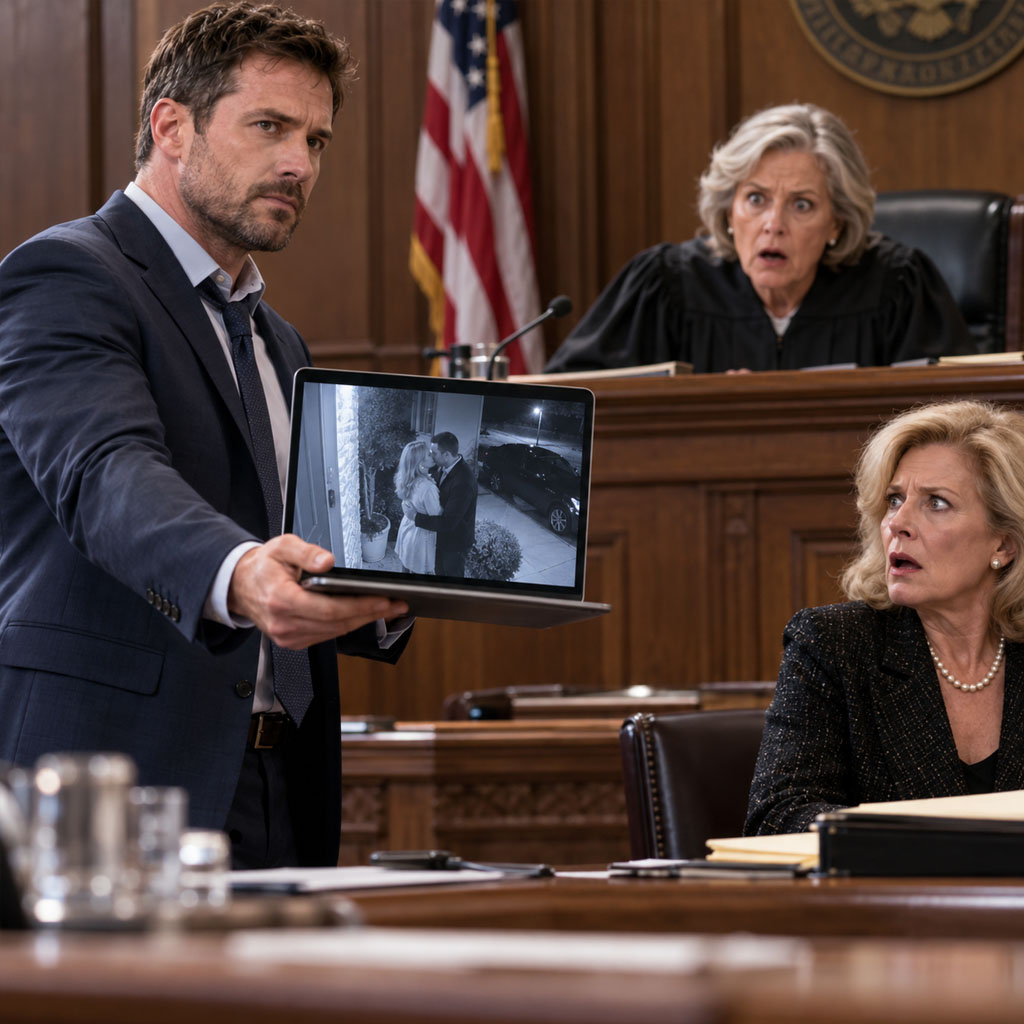
Judge Whitcomb’s face, which had been stern throughout the morning, registered unmistakable disbelief as she examined the dates and amounts.
“Mr. Carter received fifty thousand dollars from an entity associated with Mrs. Carter shortly before giving testimony against his son?”
“That is what the records show, Your Honor,” Rebecca answered.
My father’s attorney rose to object to any implication of wrongdoing. Judge Whitcomb acknowledged that the payment alone did not prove bribery, but permitted questions about the transaction’s purpose and credibility.
My father returned to the witness stand.
“What real estate project did you invest in?” Rebecca asked.
He adjusted his glasses.
“A residential development.”
“Where was it located?”
“I don’t recall the precise address.”
“Did you receive a contract?”
“I believe so.”
“Can you produce it?”
His mouth opened, then closed.
Rebecca waited.
“Mr. Carter, did you agree to support Lauren’s custody position in exchange for that money?”
“Absolutely not.”
“Then why was the payment described in correspondence as compensation for your assistance with the family matter?”
Rebecca handed him an email that had been obtained during discovery.
He stared at it.
For the first time in my life, I saw my father unable to find words.
Judge Whitcomb’s expression hardened.
The judge ordered the relevant materials preserved for further investigation. She also directed that Emily’s immediate safety be evaluated and that the contested psychological report not be treated as an independent assessment.
After hearing additional testimony, she granted me temporary primary physical custody pending further proceedings, with Lauren’s contact supervised until the safety concerns were resolved.
“This court will not allow a child to become an instrument of retaliation between adults,” Judge Whitcomb said. “The child’s welfare comes before anyone’s pride, anger, or financial interest.”
Lauren began crying.
Patricia stood abruptly.
“This is outrageous! That man manipulated the entire proceeding!”
The judge turned toward her.
“Mrs. Monroe, you have testified under oath. I suggest you consider the seriousness of that responsibility.”
Patricia sat down.
I expected to feel victorious.
Instead, I felt hollow.
That afternoon, I drove home with Emily asleep in the passenger seat, her stuffed rabbit tucked beneath her chin. I kept glancing toward her, hardly believing she was beside me.
When we reached the house, she woke and looked around.
“Are we staying here tonight, Daddy?”
“Yes, sweetheart.”
“And tomorrow?”
“Tomorrow too.”
She reached for my hand.
“Can we make pancakes?”
I laughed for the first time in weeks.
“With extra chocolate chips.”
The months that followed were difficult but steadier.
The investigation into the false testimony led to serious consequences. Lauren eventually accepted a plea agreement concerning her role in submitting misleading evidence. Dr. Morris faced professional disciplinary proceedings, and my father’s financial dealings became the subject of further investigation.
Travis’s behavior toward Emily was documented in the child welfare findings. He left town after his relationship with Lauren collapsed.
Through the final custody proceedings, I retained primary custody. Lauren was allowed a carefully structured path toward supervised contact with Emily.
I wanted to hate everyone involved.
For a while, I did.
But Emily needed a father who was present more than she needed one who was consumed by revenge.
I hired a trusted caregiver named Teresa to help when work kept me late. Emily began seeing Dr. Naomi Bennett, a child psychologist with no connection to either side of the dispute.
Slowly, her nightmares faded.
We moved into a smaller house near a lake, where she could ride her bicycle, play with our golden retriever, and learn to horseback ride.
One evening, while brushing the dog on our back porch, Emily looked up at me.
“Daddy, is Mommy a bad person?”
I thought carefully before answering.
“Your mother made some very bad decisions. But people are more complicated than one terrible thing they’ve done.”
“Can people change?”
“Some do. What matters is whether their actions change, not just their words.”
Emily nodded thoughtfully.
Then she asked, “Do you still love her?”
I watched the evening sunlight settle across the water.
“Not the way I used to, sweetheart. But I want her to become someone who can be good for you.”
I believed that was the end of our troubles.
Then, six months later, Lauren called with a warning that frightened me more than anything she’d said during our divorce.
“Daniel, Travis is back. He’s been watching you and Emily.”
Chapter 4
At first, I suspected another manipulation.
Lauren had recently completed her sentence and was staying with relatives in Arizona. Our conversations were limited to Emily’s well-being and arrangements approved by the court.
But this time, her voice sounded genuinely frightened.
“He’s sent letters,” she told me. “He blames you for losing everything. He’s mentioned Emily’s riding lessons and her school.”
I contacted Rebecca and the police. Lauren provided the letters to investigators, and the school and riding stable were informed of the concern.
Several days later, Travis appeared at the stable while Emily was taking a lesson.
I was standing beside the fence when I saw him crossing the gravel driveway. His clothes were rumpled, and his expression was filled with bitterness.
“You ruined my life, Carter!”
I signaled to the instructor, who calmly led Emily toward the office.
“Travis, you need to leave.”
“You think you’re better than everyone!”
“No. I just want you to stay away from my daughter.”
He stepped closer and began shouting. Before the confrontation could escalate, deputies responding to the stable’s call arrived and separated us.
Travis resisted their instructions and was arrested.
That evening, Emily sat beside me on the couch.
“Was that the man who used to yell at Mommy?”
“Yes.”
“Is he going to hurt us?”
I put my arm around her.
“We’ve taken steps to keep you safe, sweetheart. And if you’re frightened, you can always tell me.”
She rested her head against my shoulder.
“I don’t want anybody fighting anymore.”
Neither did I.
My father died that autumn following a severe stroke. I visited him in the hospital shortly before his death, though I never received an explanation for what he’d done.
Seeing him lying helpless beneath a white blanket, I realized that the man I’d spent forty years trying to impress had never truly understood me.
I had prepared angry words for that visit. Instead, I sat beside him quietly.
“I wish things had been different, Dad,” I finally said.
His eyes moved toward me, but he didn’t speak.
“I wanted you to be proud of me. More than I ever admitted.”
I stayed another ten minutes before leaving.
His death brought sadness, but not the reconciliation I’d once imagined. Some questions remain unanswered, and eventually you learn to live without the explanations you deserve.
Patricia, meanwhile, refused to accept the court’s findings.
She continued insisting that Emily belonged with Lauren and made repeated efforts to challenge our new arrangements. Her behavior eventually resulted in additional restrictions on contact.
One afternoon, Rebecca informed me that Patricia had been approaching people connected with Emily’s school, seeking information she had no authority to obtain.
I was furious.
For a moment, I wanted to make her suffer as much as she’d made us suffer.
Then I remembered Emily’s words.
“I don’t want anybody fighting anymore.”
I stopped thinking about punishment and started thinking about what would bring peace.
Rebecca handled the legal boundaries. I took Emily to a cabin in the Smoky Mountains for two weeks, where we spent our mornings hiking and our evenings roasting marshmallows.
One night, sitting beside the fire, Emily asked a question that caught me off guard.
“Do you think Grandma Patricia really thought you were dangerous?”
“I don’t know, sweetheart.”
“She told me not to tell you when Travis scared me. She said people would take me away if I did.”
The pain of hearing that was almost unbearable.
“I’m sorry anyone made you feel that way.”
Emily stared into the flames.
“Dr. Bennett says grown-ups sometimes make children responsible for problems that aren’t theirs.”
“She’s right.”
“Then none of it was my fault?”
I pulled her close.
“Not one minute of it.”
She began to cry, and I held her until the fire had burned down to glowing embers.
That night I understood something I had nearly forgotten during the legal battles.
Protecting my daughter wasn’t about defeating every person who had wronged me. It was about making certain she never carried the burden of their choices.
Time moved forward.
Lauren gradually rebuilt her life in Arizona. She found steady work, continued counseling, and accepted that repairing her relationship with Emily would take patience.
Their first conversations were awkward. Emily sometimes refused calls or ended them early. Lauren eventually learned to respect those boundaries without making her daughter feel guilty.
I never restored my trust in Lauren, but I stopped treating every interaction as another battle.
Five years after the custody hearing, Patricia was diagnosed with advanced pancreatic cancer.
By then, Emily was thirteen.
One evening, Lauren called and told me her mother wanted to see Emily before she died.
My immediate instinct was to refuse.
I remembered Patricia’s testimony, her cruel accusations, and the way she’d stood in her doorway preventing me from reaching my daughter.
But Emily was no longer eight years old.
She deserved a voice in the decision.
After consulting Dr. Bennett about how to approach the situation, I sat beside Emily on the porch and explained that her grandmother was very ill.
Emily listened quietly.
“Does she want me to forgive her?”
“I don’t know. She wants to see you.”
Emily thought for a long time.
“Did you forgive Grandpa Richard before he died?”
“No.”
“Do you wish you had?”
I looked across the lake.
“Sometimes I wish he’d told me why he did what he did. But forgiveness and understanding aren’t always the same thing.”
Emily nodded.
“I think I want to see Grandma. Not because everything’s okay, but because I don’t want to wonder later what I would have said.”
We arranged a supervised visit at Dr. Bennett’s office.
Patricia arrived looking frail and much older than her years. Her silver hair had thinned, and she needed help settling into her chair.
When Emily entered, Patricia began crying.
“Oh, sweetheart. You’ve grown so much.”
Emily sat across from her.
“Hello, Grandma.”
They talked about school, horseback riding, and the books Emily loved. Finally, Patricia set aside her tissue.
“Emily, I owe you an apology. I did things that hurt you, and I was wrong.”
Emily looked directly at her.
“Why did you tell me to lie about Daddy?”
Patricia’s face crumpled.
“I believed I was helping your mother. I convinced myself I was protecting you.”
“But Daddy never hurt me.”
“I know that now.”
Emily folded her hands in her lap.
“I remember being scared at your house. I remember Travis yelling. And I remember you telling me not to tell anybody.”
Patricia began to sob.
“I’m so sorry.”
Emily looked at her for a long moment.
“I’m glad you said that. But I’m happy with my dad, and I don’t want anybody trying to change that again.”
Patricia nodded through her tears.
Before leaving, she gave Emily a small silver locket that had belonged to her own grandmother. Inside was a faded photograph of a young woman in an old-fashioned dress.
Emily thanked her and slipped the locket into her pocket.
Six weeks later, Patricia passed away.
Emily attended the funeral with me. She was sad, but she didn’t seem burdened by guilt or unfinished questions.
That, more than anything, told me we’d made the right decision.
The years continued passing.
My construction business expanded, and Emily grew into a remarkable young woman. She became thoughtful, independent, and unusually perceptive about people.
Her relationship with Lauren remained complicated but peaceful. They exchanged calls, visited occasionally, and gradually found a way to care about each other without pretending the past hadn’t happened.
On the evening before Emily left for college, we sat together on the deck overlooking the lake.
She was eighteen now, with her mother’s smile and my dark eyes. Our golden retriever lay at her feet, older and slower but still determined to stay wherever she was.
“Dad, can I ask you something?”
I smiled.
“You’ve been asking me questions since you could talk. Why stop now?”
She laughed, then grew serious.
“Do you ever think about what would’ve happened if you hadn’t found that evidence?”
I looked out across the water.
“Sometimes. The truth was there, but proving it mattered. Without Rebecca and the people who helped us, things might have turned out very differently.”
Emily was quiet.
“I remember that courtroom, you know. Not everything, but enough.”
I turned toward her.
“What do you remember?”
“Mom crying. Grandma looking angry. Everybody talking about me like I wasn’t a real person.”
My chest tightened.
“Emily, I’m sorry.”
She shook her head.
“But I also remember you coming to get me afterward. You made pancakes that night.”
I laughed softly.
“I burned the first batch.”
“You always burned the first batch.”
She reached for my hand.
“Dad, when I was little, I thought you won because the judge believed you. But I understand something different now.”
“What’s that?”
“You won because you never stopped being my dad, even when everybody was telling you that you shouldn’t be.”
I couldn’t answer immediately.
For years, I’d remembered the courtroom as the place where my mother-in-law called me unstable and my own father turned against me. I’d remembered the moment the judge saw the evidence, the stunned expressions, and the sudden collapse of their accusations.
But Emily remembered pancakes.
She remembered the comfort of coming home.
She remembered that, after all the anger and confusion, someone had kept showing up for her.
“Do you think you can forgive them now?” she asked.
I considered the question.
“I don’t know if forgiveness is the right word. I’ve accepted what happened, and I don’t want to spend the rest of my life carrying anger. But I also don’t have to pretend what they did was acceptable.”
Emily smiled.
“Dr. Bennett would approve of that answer.”
“Then she’s earned every dollar I ever paid her.”
We both laughed.
After a while, Emily rested her head on my shoulder, just as she’d done when she was small.
“Thank you for fighting for me, Dad.”
I kissed the top of her head.
“Thank you for giving me something worth fighting for.”
The following morning, I helped load her suitcases into the car. She hugged the dog, checked her belongings three times, and finally stood in the driveway looking at the house where she’d grown up.
“Ready?” I asked.
She took one last look at the lake.
“Yeah, Dad. I’m ready.”
As we drove toward her college, I thought about everything our family had survived. The betrayal, the lies, the courtroom, the years of rebuilding.
I had once believed that justice meant watching the people who hurt us lose everything. But life had taught me that consequences were only part of the story.
The deeper victory was seeing my daughter grow up without allowing their cruelty to define her.
My mother-in-law had called me unstable in court. My father had questioned my character. My wife had tried to convince a judge that I was unfit to raise my own child.
Yet the young woman sitting beside me had become compassionate, capable, and strong enough to make her own decisions.
She was living proof that our lives had not been destroyed.
At the first stoplight, Emily reached over and squeezed my hand.
“Hey, Dad?”
“Yes, sweetheart?”
“When I come home for Thanksgiving, can we make chocolate-chip pancakes?”
I looked at her and smiled.
“Of course. But you’re cooking the first batch.”
She laughed so hard she had to wipe her eyes.
And in that simple moment, I realized something that had taken me ten years to understand.
The judge’s expression when she saw my evidence had been unforgettable. The truth had changed the course of our lives in a single afternoon.
But the greatest reward wasn’t proving my enemies wrong.
It was watching my daughter drive toward her future, knowing she was loved, knowing she was safe, and knowing that whatever happened next, she would never have to question whether her father would stand beside her.
That was the life I had fought to build.
And unlike the marriage that had fallen apart, its foundation was finally strong enough to last.