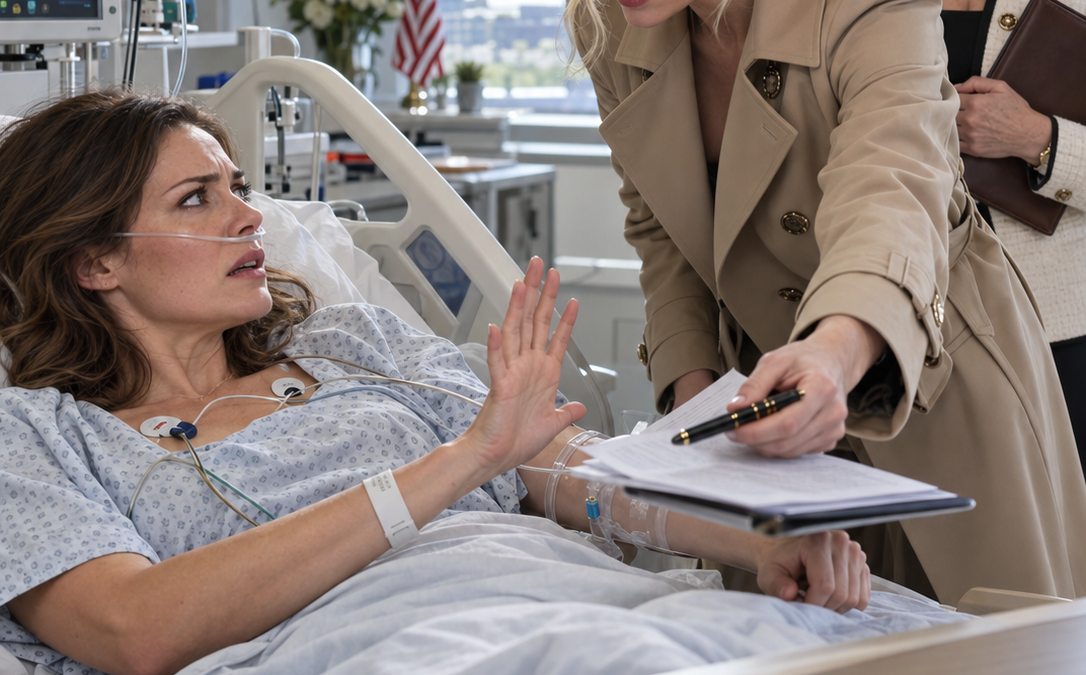
“Stop faking it!” Fallon hissed, ripping the IV from my arm as the ICU monitor screamed. Blood soaked my sheets. My failing heart stumbled while my sister demanded I sign away my rights to the $92,000 she’d raised in my name. She thought I’d die before exposing her. But my phone on the bedside table had recorded every vicious word.
PART 1 — MY SISTER RAISED $92,000 FROM MY DYING HEART. THEN SHE TRIED TO MAKE SURE I NEVER SPOKE AGAIN.
“Stop pretending you’re dying, Sloan. You’re destroying my business.”
My sister Fallon stood beside my intensive care bed in a $3,000 Burberry trench coat, holding a pen against my trembling fingers.
The cardiac monitor beeped faster.
“Sign the papers,” she snapped. “I didn’t spend six months building my brand just to lose everything because you decided to become a problem.”
I was thirty-eight years old, fighting a potentially fatal heart condition, and barely strong enough to lift my head.
Fallon wasn’t there to comfort me.
She was there because the $92,000 she’d collected in my name had disappeared into accounts she controlled. My attorney had uncovered the transactions, and her sponsors were threatening to walk away.
I refused to sign.
Her expression changed.
Then she reached toward the IV tubing connected to my arm.
What happened next nearly killed me.
But there was one thing Fallon hadn’t noticed.
My iPhone was lying face down beside the bed, recording every word.
And four minutes of audio were about to destroy the career she’d built using my illness.
Three weeks earlier, I had been sitting in my downtown Chicago apartment, drinking cold Starbucks coffee and reviewing quarterly insurance liabilities.
My name is Sloan Whitaker. I’m a senior actuarial consultant for a national insurance corporation, and I make a comfortable living finding expensive mistakes.
Companies hire people like me when their numbers don’t add up.
I’ve spent my career tracing suspicious claims, unexplained expenses, and financial discrepancies that executives hope nobody notices.
Unfortunately, I never applied those skills to my own family.
My mother, Mora, called that Tuesday evening while rain rattled against my apartment windows.
“Sloan, sweetheart, I hate bothering you when you’re busy with your important job.”
I already knew where this was going.
“How much, Mom?”
She paused.
“Excuse me?”
“How much money do you need?”
“The sunroom roof is leaking. The contractor says it’ll cost seventy-five hundred dollars, and my pension barely covers groceries.”
I opened my banking app.
“What happened to the insurance settlement you received after the spring storm?”
Another pause.
Longer this time.
“Well, Fallon needed help with her business.”
Of course she did.
My younger sister was thirty-three, professionally unemployed unless you considered posting pictures of expensive candles and sponsored skincare products a career.
She called herself a lifestyle entrepreneur.
Our mother called her gifted.
I called her monthly expenses ridiculous.
“She needed better camera equipment,” Mom continued. “And professional clothing for potential sponsorship meetings.”
“So you spent the roof money on her Instagram account?”
“Don’t use that tone. She’s working very hard.”
“Mom, she posted a picture of a hotel bathtub yesterday with a caption about the importance of doing nothing.”
“That’s called wellness marketing, Sloan.”
I rubbed my forehead.
“Then maybe wellness marketing can repair your roof.”
My mother made the familiar wounded sound she’d perfected over thirty years.
“You’ve always been the strong one. Fallon isn’t like you. She needs encouragement, not criticism.”
There it was.
The sentence that had financed most of my sister’s adult life.
You’re the strong one.
In our family, that meant I was expected to pay the bills while Fallon received applause for existing.
I transferred the $7,500.
Mom thanked me for exactly four seconds before mentioning that Fallon might need assistance with an upcoming brand retreat.
I ended the call.
That evening, I opened the storage box at the back of my closet.
Inside were documents I’d never quite managed to throw away.
The oldest was a bank withdrawal receipt for $18,000.
That had been my college savings.
When I turned eighteen, I discovered my mother had emptied the account to cover Fallon’s debts from a disastrous cosmetics business she’d gotten involved with.
I still remembered standing in the bank lobby with my university acceptance letter.
Mom had explained everything that night.
“You’ll get scholarships, Sloan. You’re smart. Fallon doesn’t have your advantages.”
I worked two jobs through college.
Fallon attended weekend retreats and complained about negativity.
The next folder contained a canceled check for $11,400.
I’d written it when Mom couldn’t make her mortgage payments.
Then there was the $6,800 credit card balance I’d cleared after Fallon convinced our mother to buy furniture for a rented photography studio.
The studio lasted eleven weeks.
I flipped through those records until my phone buzzed.
A text from Uncle Brooks.
Your mother’s blood pressure is up because you refused to help Fallon with her retreat. You make good money. Stop being selfish.
I stared at the message.
Then something tightened inside my chest.
At first, I thought I was having a panic attack.
I stood up, reached for the bedroom door, and suddenly couldn’t get enough air.
Pain spread toward my jaw.
My left arm went strangely heavy.
I grabbed my phone and called 911.
By the time the dispatcher answered, I was sitting on the hardwood floor, struggling to speak.
I managed to unlock my front door before everything went dark.
The diagnosis was acute viral myocarditis.
A viral infection had caused serious inflammation in my heart muscle, leaving it dangerously weak.
My cardiologist, Dr. Daniel Mercer, didn’t soften the explanation.
“Your heart isn’t pumping effectively. We’ve stabilized you, but you’re at significant risk for dangerous rhythm problems.”
“How long until I can go back to work?”
He gave me a look.
“Right now, I’d be more interested in keeping you alive.”
I spent nearly two weeks in the hospital.
My employer approved medical leave, and our benefits department helped me organize the insurance paperwork.
Marin, our director of compliance investigations and one of my closest friends, visited whenever she could.
She brought clean clothes, charged my laptop, and organized grocery deliveries for when I went home.
My mother sent two texts.
Fallon sent one.
Can you FaceTime tomorrow? I have a content idea.
I should have blocked her then.
Instead, I told myself that a medical emergency might finally change how my family treated me.
Three days after my discharge, I learned otherwise.
I was sitting in my recliner wearing an oxygen cannula when my apartment door opened.
Mom had an emergency key.
Fallon walked in first, carrying a ring light and tripod.
“Hey, everyone!” she chirped into her phone. “I’m here with my incredibly brave sister, who’s fighting for her life.”
She swung the camera toward me.
I hadn’t showered in two days. There were bruises on my arms from IV placements, and I was still wearing the faded T-shirt I’d slept in.
“Fallon, turn that off.”
She kept filming.
“It’s been such an emotional journey for our family.”
“Turn. It. Off.”
She lowered the phone.
“Seriously, Sloan? I’m trying to help you.”
“Then put the equipment away.”
“People care about you because of my platform.”
“People don’t even know me.”
“Exactly. That’s what I’m fixing.”
Mom stepped forward with a leather folder.
“Sweetheart, we need to discuss something important.”
She placed several documents on the coffee table.
A medical power of attorney.
A durable financial power of attorney.
Both naming Mom and Fallon as authorized decision-makers.
I read the financial document twice.
It included broad authority over my bank accounts, investments, and property.
“Absolutely not.”
Mom blinked.
“Sloan, be reasonable.”
“I’m perfectly capable of making financial decisions.”
“But your condition could change.”
“Then my attorney and doctors can help with the appropriate arrangements. I’m not signing this.”
Fallon folded her arms.
“You’re unbelievable. We’re giving up our lives to care for you.”
“You’ve been here eleven minutes.”
“I’m talking about the emotional responsibility.”
“You brought a camera.”
Mom picked up the papers.
“Your sister is under enormous pressure.”
I looked at the oxygen machine humming beside my chair.
“I’m sorry my heart condition has been inconvenient for her.”
Fallon snatched her tripod.
“Fine. Handle everything yourself.”
They left without asking whether I needed groceries, prescriptions, or even a glass of water.
Two days later, Marin sent me a message.
Please tell me you know about this fundraiser.
A link followed.
I opened it.
And saw my own face.
It was a screenshot from the video Fallon had recorded inside my apartment.
The campaign headline read:
SAVE MY SISTER’S FAILING HEART.
Underneath was a long story about Fallon’s heroic sacrifice as my full-time caregiver.
According to her description, she’d abandoned a successful career to take care of me around the clock.
She claimed my medical insurance had stopped covering essential treatments.
She described urgent unpaid hospital bills, expensive home nursing, and specialized medical supplies.
Almost none of it was true.
Then I looked at the donation total.
$92,000.
Ninety-two thousand dollars from people who thought they were saving my life.
Some names belonged to my coworkers.
Others were former classmates, distant relatives, and strangers.
I opened the campaign updates.
Three hours earlier, Fallon had posted a picture of herself crying inside a parked car.
Her caption thanked donors for helping her make a $25,000 payment toward my hospital bills.
I opened my hospital billing portal.
One payment had been credited from an outside source.
Six hundred dollars.
I called the billing department and verified the figure.
Then I called Marin.
“Are you sitting down?” I asked.
“What happened?”
“My sister raised ninety-two thousand dollars for my medical expenses.”
“I saw.”
“She paid six hundred dollars toward them.”
Marin was quiet.
Then she said, “Send me everything.”
I spent the afternoon taking screenshots, preserving receipts, and downloading every campaign update.
I created a spreadsheet named Project Parasite.
Column A contained Fallon’s public claims.
Column B contained the corresponding documented expenses.
Column C recorded discrepancies.
By dinner, the spreadsheet had more than forty entries.
I wasn’t guessing about my sister anymore.
I was building a case.
The next afternoon, a black Range Rover pulled into the courtyard outside my apartment.
Fallon climbed out wearing oversized Prada sunglasses and carrying an iced matcha latte.
I recognized the vehicle immediately.
A Range Rover Autobiography.
The kind of SUV that can cost well over $100,000 depending on its configuration.
She walked into my apartment using Mom’s key.
“Brought you soup,” she announced, setting down a plastic container.
I looked through the window.
“New car?”
She smiled.
“Isn’t she gorgeous?”
“How did you pay for it?”
“Business lease.”
“What business?”
“My wellness company.”
I waited.
She removed her sunglasses.
“Look, Sloan, when you’re caring for someone with a life-threatening condition, you need reliable transportation.”
“You drove me to the hospital?”
“Not yet.”
“You’ve driven me to a doctor’s appointment?”
“I’ve been busy.”
“Then whose medical emergency is that Range Rover transporting?”
Her smile disappeared.
“You know, most people would appreciate having a sister who’s trying this hard.”
Before I could answer, someone knocked.
Marin stood outside carrying a briefcase and a grocery bag.
She looked past Fallon at the oxygen tubing running across my living room.
“Nice car,” she said.
Fallon brightened.
“Thank you!”
“Interesting purchase for someone collecting emergency medical donations.”
Fallon stopped smiling.
“It’s a business necessity.”
“For what? Delivering sympathy in luxury?”
I almost laughed.
That would have hurt, so I settled for a small smile.
Fallon grabbed her keys.
“I have banking errands. Don’t stress her out, Marin. Her heart can’t handle it.”
She stormed out.
Marin waited until the elevator doors closed.
“Okay,” she said, sitting beside me. “Tell me what you found.”
I handed her the spreadsheet.
She studied it without speaking.
Then she opened her laptop.
“Sloan, this isn’t an awkward family misunderstanding. It’s a potentially serious fundraising fraud.”
“I know.”
“Have you authorized her to raise money on your behalf?”
“No.”
“Do you control any of the donations?”
“No.”
“Then we get an attorney involved before she moves another dollar.”
That evening, Hayes Bennett, a white-collar litigation attorney I’d worked with professionally, agreed to review my evidence.
He advised me to preserve the original campaign records and avoid confronting Fallon while the financial trail was being secured.
Marin also contacted the fundraising platform’s trust and safety department to flag the campaign.
Within twenty-four hours, Hayes had sent preservation notices concerning the donation records and associated accounts.
The investigation had started.
And Fallon had no idea how much evidence she’d already published herself.
The first major break came from a freelance website designer named Tegan.
Fallon’s company had submitted a $35,000 website development invoice as part of its claimed campaign expenses.
I recognized Tegan’s business name.
She’d done contract work for our firm before.
I called her.
“Tegan, did you build my sister’s fundraising website?”
“Yes. Is everything okay?”
“How much did you charge?”
“Twenty-five hundred dollars.”
I sat up straighter.
“Not thirty-five thousand?”
She laughed once.
Then stopped.
“Sloan, why would you ask me that?”
“Because there’s an expense statement claiming you charged that much.”
She went quiet.
Then she said, “I’m emailing you my original invoice and payment receipt.”
When those documents arrived, I forwarded them to Hayes.
The difference was $32,500.
Someone had altered the invoice.
And Fallon had used that inflated expense to explain where donor money had gone.
Hayes called me that evening.
“Your sister’s accounting is remarkably creative.”
“That’s one word for it.”
“Unfortunately for her, bank transactions don’t care about creativity.”
He explained that the fundraiser wasn’t simply a matter of one relative behaving badly.
It could involve misrepresentations to donors, falsified financial records, and misuse of my personal information.
That last issue arrived the following morning.
An email appeared concerning a federal employer identification number application.
I hadn’t submitted one.
The application named a new organization claiming to support patients with severe cardiac illnesses.
My personal identifying information appeared in the paperwork.
So did the address of my childhood home.
I checked the documents attached to my records.
Information from my birth certificate and old tax filings had been used.
Those records were supposed to be locked inside a fireproof safe in my mother’s basement.
Mom had the key.
I called her.
“Did you give Fallon my personal documents?”
“Good morning to you too, sweetheart.”
“Answer the question.”
“She needed some things for the foundation.”
I gripped the edge of my kitchen counter.
“What foundation?”
“The one she’s starting to help people like you.”
“With my Social Security number?”
“Sloan, you always get so dramatic about paperwork.”
“That’s identity theft, Mom.”
“Don’t say things like that about your sister.”
“She used my identity without permission.”
“She was trying to help the family.”
“Which family? Because the family I’m in has one person in cardiac rehabilitation and another driving a new Range Rover.”
Mom raised her voice.
“You’ve never understood how much Fallon sacrifices.”
I ended the call.
Then I froze my credit, reported the suspicious application, and sent Hayes copies of everything.
He added the documents to the investigation.
A few hours later, I received another text from Mom.
You need to stop this before you ruin Fallon’s future.
I typed a reply.
She should have thought about her future before stealing mine.
Then I blocked her.
It was the first time I’d ever done that.
I should have felt relieved.
Instead, my chest began hurting.
At first, I tried to sit down and rest.
Then the room tilted.
The portable oxygen machine hummed beside me while my heart beat faster and increasingly unevenly.
I pressed the emergency alert button around my neck.
I remember hearing someone speaking through the device.
Then I was on the floor.
I woke up in intensive care two days later.
My heart had developed a dangerous rhythm disturbance, and the doctors were monitoring me continuously.
Dr. Mercer stood beside my bed.
“Sloan, we need you to understand something. You cannot keep putting yourself through extreme stress.”
I nodded.
“We’re treating a serious cardiac condition. Whatever is happening outside this hospital needs to be handled by someone else.”
Marin took my hand.
“That’s me,” she said.
For once, I didn’t argue.
Hayes coordinated with the fundraising platform and investigators while Marin handled communication on my behalf.
The fundraising campaign was suspended.
Remaining accessible funds were restricted pending review.
Fallon’s proposed sponsorship contracts were placed on hold.
And the luxury SUV suddenly became a very expensive problem.
That evening, Marin left around ten.
A nurse checked my vital signs and dimmed the lights.
I was finally beginning to fall asleep when my phone vibrated.
An unfamiliar number.
You think you’re clever? You have no idea what you’ve done.
I didn’t respond.
Three minutes later, the ICU door opened.
Fallon walked in.
No tripod.
No camera.
No sympathetic smile.
Just a wrinkled designer coat and a stack of legal papers.
“What the hell did you do?” she demanded.
I watched her approach.
“They froze everything, Sloan. Every account. Every dollar. My sponsors are demanding proof that you approved the campaign.”
She slapped the papers onto my bedside table.
“This is an image-rights release and a confidentiality agreement. Sign both.”
I shook my head.
“Don’t do this,” she warned.
I reached toward my phone.
My fingers found the Voice Memos app.
I tapped record and placed the phone face down.
Fallon didn’t notice.
“There’s a documentary sponsorship worth a hundred and fifty thousand dollars,” she continued. “One signature, and I can fix everything.”
I looked at her.
“You forged Tegan’s invoice.”
She stopped.
“You don’t know what you’re talking about.”
“Thirty-five thousand dollars. She actually charged twenty-five hundred.”
Her jaw tightened.
“And you used Mom to get my personal documents.”
Fallon leaned over the bed.
“You went through my finances?”
“Your fundraising records are being investigated.”
“You ungrateful little parasite.”
My monitor beeped faster.
“I made you important,” she whispered. “Nobody cared about your boring life until I put you online.”
I swallowed.
“Then you shouldn’t have used my life to sell yours.”
She stared at me.
For the first time, Fallon looked genuinely frightened.
Not because I might die.
Because I might live long enough to testify.
“Sign the papers, Sloan.”
“No.”
“I’m not asking again.”
“No.”
She snatched the pen off the table and slammed it down.
“You’ve ruined my entire schedule. My contracts. My company. Everything.”
I reached for the call button.
Fallon’s eyes followed my hand.
Then she looked at the IV tubing connected to my arm.
“Stop acting sick,” she hissed. “You just want attention.”
“Fallon, don’t.”
She grabbed the tubing.
I tried to pull away.
“Please—”
She yanked.
A sharp pain tore through my arm.
Blood spread across the white sheet, and the infusion pump screamed its alarm.
My heartbeat became chaotic.
I couldn’t get enough air.
Fallon stepped back.
“Relax,” she said. “You’re just faking it.”
I tried to reach the call button again.
My fingers missed.
The last thing I saw was my sister checking her reflection in the dark hospital window while the alarms continued.
Then everything disappeared.
But what Fallon didn’t know was that the phone she’d ignored was still recording. And when I woke up, she had already told the police a completely different story.
PART 2 — SHE TOLD THE POLICE I ATTACKED HER. THEN THEY PLAYED FOUR MINUTES OF AUDIO THAT ENDED HER ENTIRE CAREER.
“She attacked me! My sister completely lost her mind!”
Those were the first words I heard when I regained consciousness.
My eyes opened to unfamiliar ceiling lights.
A nurse was adjusting an IV pump beside my bed.
Two police officers stood near the doorway.
And my sister Fallon was in the hallway, crying into a tissue while telling hospital security that I had suffered a violent psychiatric episode.
Apparently, nearly killing me hadn’t been enough.
She also wanted everyone to believe I was dangerous.
“Sloan?” the nurse asked gently. “Can you hear me?”
I nodded.
My throat hurt. There was a fresh dressing on my arm, and every breath reminded me how close I’d come to dying.
Dr. Mercer explained what had happened.
The pump alarm had alerted the nursing staff. They’d rushed into the room, found my IV line dislodged, and treated the complications while my heart rhythm became dangerously unstable.
I had survived.
But Fallon had been preparing her defense while I was unconscious.
One officer stepped closer.
“Ms. Whitaker, your sister claims you became confused and physically aggressive. She says she attempted to protect herself, and your medical equipment was accidentally disconnected.”
I stared at him.
“She also provided a video,” he continued.
Of course she had.
Fallon had recorded herself crying outside my room immediately after the incident.
She’d added a short clip showing me struggling in bed while the alarms sounded.
The video made it appear that I had knocked away my own medical equipment.
“She says your medication affected your judgment,” the officer explained. “We’re trying to establish what happened.”
I glanced toward the hallway.
Fallon caught my eye.
For half a second, she stopped crying.
Then she pressed the tissue against her face again.
I turned back to the officer.
“Did she record herself pulling out my IV?”
He checked his notes.
“No, ma’am.”
“Interesting.”
“Why?”
“Because I recorded her.”
Marin, who had been standing silently near the window, immediately stepped forward.
I pointed toward my bedside table.
“My phone. Voice Memos. Last night.”
The officer retrieved it.
I gave him permission to access the recording.
He pressed play.
Fallon’s voice filled the room.
“They froze everything, Sloan. Every account. Every dollar.”
The officer looked at his partner.
The recording continued.
“This is an image-rights release and a confidentiality agreement. Sign both.”
Then my voice.
“You forged Tegan’s invoice.”
Fallon’s furious response followed.
“You ungrateful little parasite.”
Marin crossed her arms.
Neither officer spoke.
Then came the part Fallon hadn’t expected anyone to hear.
“Stop acting sick. You just want attention.”
My voice, barely audible.
“Fallon, don’t.”
A sudden scraping noise.
The metallic rattle of the bed rail.
The sharp alarm from the infusion pump.
My desperate attempt to breathe.
And finally, my sister’s voice.
“Relax. You’re just faking it.”
The officer stopped the recording.
For several seconds, nobody spoke.
Then he turned to the nurse.
“I need the exact time of the equipment alarm and the names of everyone who entered this room afterward.”
She nodded.
“We have those records.”
“And hospital security footage covering the hallway?”
“Yes.”
“Preserve it.”
He looked back at me.
“Ms. Whitaker, we’re going to need a formal statement when you’re medically able.”
I nodded.
Then he asked something I hadn’t expected.
“Has your sister been threatening you about money?”
Marin answered before I could.
“She has an active fraud investigation involving more than ninety thousand dollars in medical donations.”
The officer slowly closed his notebook.
“Then I think we need to have a longer conversation.”
Through the window, I watched the officers approach Fallon.
She straightened immediately.
Her crying stopped.
One officer spoke to her while the other contacted an investigator.
Fallon pointed toward my room.
Then she began shouting.
“You’re taking her side? She’s mentally unstable!”
A security guard asked her to lower her voice.
She grabbed her handbag.
“I have attorneys. You can’t treat me like this.”
The officers requested that she preserve her phone and the original video.
When she refused to cooperate voluntarily, they explained that the device and recordings could become evidence.
For the first time in my life, my sister couldn’t simply demand that someone believe her.
And she looked terrified.
The next morning, Hayes arrived at the hospital carrying a thick legal folder.
He placed it on the table beside my bed.
“Before you ask,” he said, “your sister hasn’t been charged yet.”
I nodded.
“But law enforcement is investigating the hospital incident, and the fundraising records have attracted considerably more attention.”
“How much?”
“Enough that I wouldn’t recommend buying a car with questionable donations right now.”
Marin sat beside him.
“Too late for Fallon.”
Hayes almost smiled.
Then his expression turned serious.
“Here’s what we know. Fallon Wellness LLC received transfers connected to the fundraiser. We have documentation supporting serious discrepancies between public claims and actual medical expenses.”
He opened the folder.
“The platform has restricted the campaign. Investigators can seek the underlying transaction records. Tegan has confirmed the altered invoice, and your unauthorized identity information is now part of the complaint.”
“What about Mom?”
Hayes looked at me carefully.
“We have evidence she provided access to your documents. Whether prosecutors pursue charges against her will depend on her knowledge and participation.”
I stared at the blanket.
For most of my life, I’d wanted someone to tell me my mother hadn’t meant to hurt me.
That she was merely confused.
That she’d been manipulated.
But confusion didn’t explain why she’d emptied my college fund.
It didn’t explain twenty years of demanding money whenever Fallon made another expensive mistake.
And it certainly didn’t explain handing my personal documents to someone running a fraudulent fundraiser.
“She knew,” I said.
Hayes didn’t argue.
Instead, he slid another document toward me.
It was a formal notice from one of Fallon’s prospective sponsors.
A healthcare company had been negotiating a documentary sponsorship valued at $150,000.
The contract required confirmation that I had authorized the use of my medical history and image.
Fallon had claimed that I had.
Without my signature.
“They’ve put everything on hold,” Hayes explained. “They’ve requested a meeting with counsel and compliance representatives.”
“Does Fallon know?”
“Yes.”
“Good.”
Hayes raised an eyebrow.
“Why?”
“Because I want to see what she says when someone finally asks her for receipts.”
Five weeks later, I was finally strong enough to attend the meeting.
My doctors still insisted on strict limitations.
I couldn’t return to normal work.
I needed medication, careful monitoring, and frequent rest.
But I could sit in a conference room for an hour.
And this was one meeting I wasn’t missing.
Hayes’s law firm occupied several floors of a glass office building in downtown Chicago.
Marin accompanied me.
We arrived early.
Hayes had arranged for me to participate remotely if I became tired, but I wanted to be physically present.
The conference room overlooked the Chicago River.
A long walnut table stretched across the center.
Bottled water, coffee, and neatly arranged legal folders waited at each seat.
I sat beside Hayes.
Marin opened her laptop.
Across the table were two representatives from the fundraising platform and three people from the healthcare company’s legal and compliance departments.
Then Fallon arrived.
She wore a soft gray cashmere sweater, minimal makeup, and flat shoes.
It was a carefully constructed outfit.
The devastated caregiver.
The exhausted sister.
The misunderstood philanthropist.
Mom followed her, clutching a designer handbag I’d helped pay for two Christmases earlier.
Fallon avoided looking at me.
Her attorney began speaking almost immediately.
“My client acted with the best intentions during an extraordinarily stressful family medical emergency.”
Hayes said nothing.
“Any accounting irregularities,” the attorney continued, “were administrative oversights resulting from the emotional demands of caregiving.”
One sponsor representative leaned forward.
“Was your client authorized to use Ms. Whitaker’s medical information?”
The attorney hesitated.
“We believe there was an understanding between family members.”
“That’s not what I asked.”
Fallon interrupted.
“Of course Sloan agreed. She’s just angry with me now.”
The representative turned toward me.
“Ms. Whitaker, did you authorize the fundraising campaign?”
“No.”
“Did you approve the use of your medical information for sponsorship purposes?”
“No.”
“Did your sister provide full-time care?”
I glanced at Fallon.
“She delivered one bowl of soup and filmed me without permission.”
Marin lowered her head.
I suspected she was trying not to laugh.
Fallon slammed her palm against the table.
“That’s incredibly unfair!”
Hayes opened his binder.
“Then perhaps we should review the financial records.”
He placed the first document on the table.
“Exhibit A. The fundraising campaign reported receiving ninety-two thousand dollars.”
Fallon folded her arms.
“That money was for Sloan.”
“Then you’ll have no difficulty explaining where it went.”
Hayes placed another document beside it.
“Verified payments made toward Ms. Whitaker’s hospital account totaled six hundred dollars at the time of our initial review.”
One of the company representatives frowned.
“Six hundred?”
“Yes.”
“Out of ninety-two thousand?”
“Correct.”
Fallon leaned forward.
“There were other expenses.”
Hayes nodded.
“That’s exactly what we’re here to discuss.”
He displayed the first set of transactions.
A luxury vehicle lease.
Designer retail purchases.
Spa appointments.
Restaurant charges.
Transfers designated as management compensation.
Fallon shifted in her chair.
“Those were legitimate operational costs.”
“For what operation?” Hayes asked.
“My caregiving business.”
“Were you providing licensed medical services?”
“No, but—”
“Were you paying home healthcare professionals?”
“I was planning to.”
“Can you identify any professional you hired to treat Sloan?”
Fallon looked toward Mom.
Mom suddenly became fascinated by the carpet.
Hayes turned another page.
“Exhibit B. The website-development invoice.”
He projected the document onto the conference room screen.
Thirty-five thousand dollars.
Fallon nodded quickly.
“Yes. Professional websites are expensive.”
Hayes placed the original invoice next to it.
Two thousand five hundred dollars.
He let everyone compare the figures.
“This is the verified invoice provided directly by the designer, along with evidence of payment.”
The sponsor’s legal director leaned forward.
“Why does your copy show an additional thirty-two thousand five hundred dollars?”
Fallon opened her mouth.
Closed it.
Then said, “My accountant must have made an error.”
Hayes looked at her.
“Who is your accountant?”
She didn’t answer.
“Because your filings list you as the individual responsible for the company’s financial reporting.”
Her attorney interrupted.
“We’d advise our client not to speculate.”
“An excellent suggestion,” Hayes replied.
Marin advanced the presentation.
The next document showed the suspicious application using my personal information.
Mom shifted in her chair.
Hayes addressed her directly.
“Mrs. Whitaker, were Sloan’s personal documents kept in a safe at your home?”
Mom gripped her handbag.
“Yes.”
“Who had access?”
“I did.”
“Did you give Fallon permission to retrieve them?”
Mom hesitated.
“She’s her sister.”
“That wasn’t the question.”
“I thought it was for the medical foundation.”
I looked at her.
“Mom, you told me the same thing when I called.”
Her face tightened.
“Sloan, please don’t start.”
“I’m not starting anything. I’m answering questions.”
The legal director spoke again.
“Was there a registered, independently operated medical charity?”
Hayes shook his head.
“Not one that has been substantiated by the records provided to us.”
Fallon suddenly stood up.
“This is ridiculous!”
Everyone turned toward her.
“I’ve spent months helping my sister, and now she’s trying to destroy me because she’s jealous!”
I almost couldn’t believe it.
“Jealous of what?”
“My success!”
I looked at the projected bank records.
“Fallon, your success is currently listed under questionable expenses.”
Marin coughed into her coffee cup.
Fallon pointed at me.
“You’ve always hated that people like me!”
I leaned forward.
“No. I hate that people trusted you with money intended for medical care, and you spent it on yourself.”
“You wouldn’t have any of that money without my followers!”
“Exactly. It wasn’t yours.”
Hayes closed his binder.
“There’s one final matter.”
Fallon dropped back into her chair.
Her attorney spoke sharply.
“My client will not answer further questions concerning the hospital allegations.”
“She doesn’t need to,” Hayes said.
He turned toward the corporate representatives.
“The incident has been reported to police, who are reviewing the original evidence. We have a preserved recording that directly contradicts Ms. Fallon’s account.”
He played a short authorized excerpt.
Fallon’s voice filled the room.
“You ungrateful little parasite.”
Then:
“Stop acting sick. You just want attention.”
The sound of the pump alarm followed.
The room became completely still.
One corporate representative removed his glasses.
The woman beside him looked directly at Fallon.
“You told us your sister experienced a psychiatric emergency and attacked you.”
Fallon stared at the table.
“That recording is taken out of context.”
I spoke.
“Which part?”
She looked up.
“The part where you tried to force me to sign a contract? Or the part where you pulled out my IV?”
“That’s not what happened!”
“Then explain it.”
She said nothing.
The corporate legal director stood.
“We’re terminating sponsorship negotiations immediately. Our organization will cooperate fully with the authorities.”
The fundraising platform’s representative announced that the campaign would remain suspended while its financial review and refund process continued.
Fallon turned to her lawyer.
“Do something.”
He leaned toward her and whispered urgently.
She shook her head.
Then she looked at Mom.
“Tell them I’m a good person.”
Mom opened her mouth.
Nothing came out.
For once, she couldn’t rescue Fallon with a speech about how sensitive and misunderstood she was.
The meeting ended shortly afterward.
As everyone gathered their papers, Hayes’s phone vibrated.
He checked the message, then quietly excused himself.
A few minutes later, two investigators appeared outside the conference room with local law enforcement.
The financial investigation had progressed beyond our civil complaints.
Authorities had obtained the necessary warrant.
One investigator approached Fallon.
“Fallon Whitaker?”
She straightened.
“Yes?”
“We need you to come with us. There’s a warrant for your arrest.”
She laughed nervously.
“No. You have the wrong person.”
The investigator identified the charges and explained the procedure.
Fallon stepped backward.
“This is insane.”
Then she turned toward me.
“Tell them!”
I didn’t move.
“Sloan! Tell them this is a family misunderstanding!”
I looked at the officers.
Then back at my sister.
“No.”
Her face twisted.
“You’re really going to let them do this?”
I answered quietly.
“You had every opportunity to stop.”
As the officers secured her hands, Mom started crying.
Fallon shouted my name all the way into the hallway.
I sat still until the doors closed.
Then I asked Marin for a glass of water.
My hands were trembling.
Not from regret.
From exhaustion.
For the first time in my adult life, someone else was handling the consequences of Fallon’s decisions.
And I could finally stop paying for them.
The criminal proceedings took months.
Investigators examined the bank records, financial filings, altered invoices, campaign statements, and communications recovered from Fallon’s devices.
The hospital incident became a separate, serious part of the investigation.
Medical records documented the disconnection of my IV line and the emergency treatment that followed.
The audio recording, the clinical timeline, and the other evidence undermined Fallon’s claim that I’d attacked her.
The prosecution didn’t depend on my memory alone.
Eventually, her attorney negotiated a plea agreement covering financial fraud offenses and the hospital assault.
Fallon admitted to misappropriating donor funds, falsifying financial documentation, and deliberately interfering with my medical treatment.
At sentencing, the courtroom was crowded.
Several donors had submitted statements.
One woman had donated $200 after losing her husband to heart disease.
A retired teacher had sent $500 because she believed Fallon was struggling to care for a critically ill sister.
Two of my coworkers had donated more than a thousand dollars each.
Listening to their statements was worse than hearing the financial totals.
Fallon hadn’t merely stolen money.
She had taken advantage of people who thought they were helping someone survive.
The judge imposed a five-year prison sentence under the plea agreement, followed by supervised release.
Restitution obligations were also imposed, and recovered funds were directed toward eligible victims through the appropriate process.
Fallon’s vehicle and other assets became part of the efforts to recover money.
Her social media accounts had already lost most of their commercial partnerships.
The documentary deal was gone.
So was the business she’d spent years boasting about.
When the judge asked whether she wished to address the court, Fallon stood.
She apologized for making “mistakes under pressure.”
She talked about stress.
She talked about how difficult her life had become.
She talked about how much she’d sacrificed.
She never directly apologized to me.
I wasn’t surprised.
As the hearing ended, she turned and looked toward the back of the courtroom.
I was sitting beside Marin.
Fallon stared at me.
“You ruined everything,” she said as the bailiff guided her away.
I looked straight back.
“No, Fallon. I finally checked the numbers.”
Then she was gone.
Mom’s situation was less dramatic, but not much better.
Her involvement in providing my personal documents remained under scrutiny.
She cooperated with investigators and eventually entered into a civil settlement relating to her role in the unauthorized use of my information and the fundraising representations.
The settlement consumed much of her remaining savings.
Uncle Brooks stopped sending me lectures about being a better daughter.
Apparently, his opinions were less enthusiastic once attorneys began asking questions about what relatives knew and when.
I changed my locks.
Replaced compromised identification documents.
Updated my banking security.
Removed Mom and Fallon from every account and authorization where either name appeared.
Hayes helped me establish a new medical directive naming someone I actually trusted.
Marin agreed to be my emergency contact.
Her response was typically practical.
“Fine. But if you ever buy a Range Rover with my medical donations, I’m haunting you.”
I laughed so hard I had to stop and catch my breath.
It was the first proper laugh I’d had in months.
Three days after Fallon’s sentencing, my building concierge called.
“Ms. Whitaker, there’s a woman downstairs asking to see you.”
“Who?”
“She says she’s your mother.”
I looked toward the kitchen.
Sunlight was falling across the same counter where I’d once transferred thousands of dollars whenever Mom demanded it.
“Send her up,” I said.
A few minutes later, someone knocked.
Mom stood outside wearing an old cardigan.
She looked tired.
Her handbag was no longer designer.
“Sloan.”
“Mom.”
She glanced past me into the apartment.
“Can I come in?”
“No.”
Her lips tightened.
“I just want to talk.”
“Then talk.”
She shifted her weight.
“The house needs repairs.”
I didn’t respond.
“The roof is getting worse, and the contractor says there’s water damage behind the walls.”
Still, I said nothing.
“I’ve used almost all my savings dealing with this terrible situation.”
I rested my hand against the doorframe.
“I see.”
She looked at me expectantly.
Then came the sentence I’d heard in a hundred different forms.
“You have a good job, Sloan. You always land on your feet.”
I almost smiled.
Even now.
Even after the hospital.
Even after everything Fallon had done.
Mom was still standing at my door asking me to pay.
“How much?” I asked.
Her face brightened.
“Just eight thousand to get the urgent work started.”
I nodded.
“That’s what I thought.”
She reached toward my arm.
“Sloan, please. I don’t have anyone else.”
I stepped back.
“You had me, Mom.”
Her hand dropped.
“For twenty years, you had me.”
“Sloan—”
“You took my college savings. You made me responsible for Fallon’s debts. You taught everyone in this family that my money belonged to whoever demanded it loudest.”
She looked away.
“And when I nearly died, you helped her steal my identity.”
“I didn’t know what she was going to do.”
“You knew I hadn’t agreed.”
She had no answer.
I continued.
“You weren’t protecting me. You were protecting Fallon from consequences. Again.”
Mom began crying.
“We’re still family.”
I looked at her for a long moment
Then I said the words I’d spent my whole adult life being afraid to say.
“Being family doesn’t give you access to my bank account.”
She covered her mouth.
“I could lose the house.”
“Then speak to a housing counselor. Talk to your lender. Find out what options are available.”
“You’d really let your own mother struggle?”
I held her gaze.
“You let your daughter struggle for years because you knew she’d keep paying.”
Mom stared at me.
I opened the door a little wider, making it clear our conversation was over.
“I hope you find a solution. But I’m not financing another one.”
She stood there for another few seconds.
Then she turned toward the elevator.
I closed the door.
Locked it.
And went back to my kitchen.
No guilt-driven transfer.
No emergency check.
No frantic call to the bank.
Just a quiet apartment and a cup of coffee that I could finally finish while it was hot.
Eight months after the hospital incident, my life looked different.
Not perfect.
Recovery from myocarditis wasn’t something I could schedule in a spreadsheet.
I still attended cardiology appointments and followed restrictions on physical activity.
Some days were better than others.
But my heart function had improved enough that I no longer needed supplemental oxygen, and my doctors had cleared me to return to carefully managed remote work.
My employer welcomed me back.
I worked fewer hours.
I took actual lunch breaks.
I stopped answering messages after dinner.
Marin said the last change was the most shocking medical development of all.
One Thursday afternoon, we had lunch at a little restaurant overlooking the Chicago River.
She ordered a salad.
I ordered grilled salmon.
Neither of us talked about Fallon for the first half hour.
Instead, we discussed work, the terrible parking situation downtown, and Marin’s latest attempt at dating.
When the waiter brought coffee, she finally asked a question.
“Do you ever think about visiting your sister?”
I looked out at the river.
“Sometimes.”
“Would you?”
“No.”
Marin nodded.
“Fair enough.”
I stirred my coffee.
“People keep expecting me to feel guilty.”
“Do you?”
I thought about it.
About the $18,000 college fund.
The roof repairs.
The money I’d handed over because I was supposedly stronger than everyone else.
The ring light shining into my face while I struggled to breathe.
The IV tubing in Fallon’s hand.
And the sound of her voice telling me I was faking it.
“No,” I said.
Marin smiled.
“Good.”
I looked down at the financial report I’d brought to review after lunch.
It concerned a company suspected of misreporting insurance claims.
A familiar kind of problem.
Missing money.
Misleading documents.
People certain that nobody would ever examine the details.
I closed the folder.
It could wait until Monday.
That evening, I went home, opened the balcony doors, and watched the lights come on across the Chicago skyline.
My phone buzzed.
For a split second, I expected another demand from Mom.
Instead, it was a message from Hayes.
The latest recovered funds had been allocated through the restitution process, with additional payments scheduled as assets were recovered.
Several donors would be receiving money back.
I read the message twice.
Then I replied.
Thank you.
Hayes responded a minute later.
Take care of yourself, Sloan. That’s the only assignment you have left.
I put the phone down.
Inside, my apartment was warm.
Dinner was waiting in the kitchen.
My medical records were private.
My accounts were secure.
Nobody had a spare key who shouldn’t.
Nobody was filming me.
Nobody was demanding that I sacrifice my health to protect their reputation.
For years, my family had called me the strong one because it made taking from me easier.
They’d mistaken my patience for permission.
My financial stability for an unlimited supply of cash.
My loyalty for a willingness to endure anything.
And when I finally became too sick to keep providing, they tried to profit from that, too.
Fallon thought she had built a business on my suffering.
Mom thought she could keep sending me the bill for Fallon’s mistakes.
Both were wrong.
I took one last look at the city, switched off my phone, and sat down to enjoy my dinner.
My sister had tried to take everything from me.
My money.
My identity.
Even my chance to survive.
But she made one mistake.
She assumed the woman who had spent her entire career finding the truth in financial records would never investigate her own family.
And when she tried to silence me in that hospital room, she gave me the one piece of evidence she could never explain away.
Her own voice.
I’d spent twenty years paying the price for keeping my family together.
Now, for the first time, I was living a life that belonged entirely to me.