My cousin forgot to sign out of her messaging app on my laptop, and one notification revealed a family secret I was never supposed to discover. I had spent years believing I was loved in my own home. But that afternoon, four familiar names on a computer screen showed me exactly where I stood.
Chapter 2
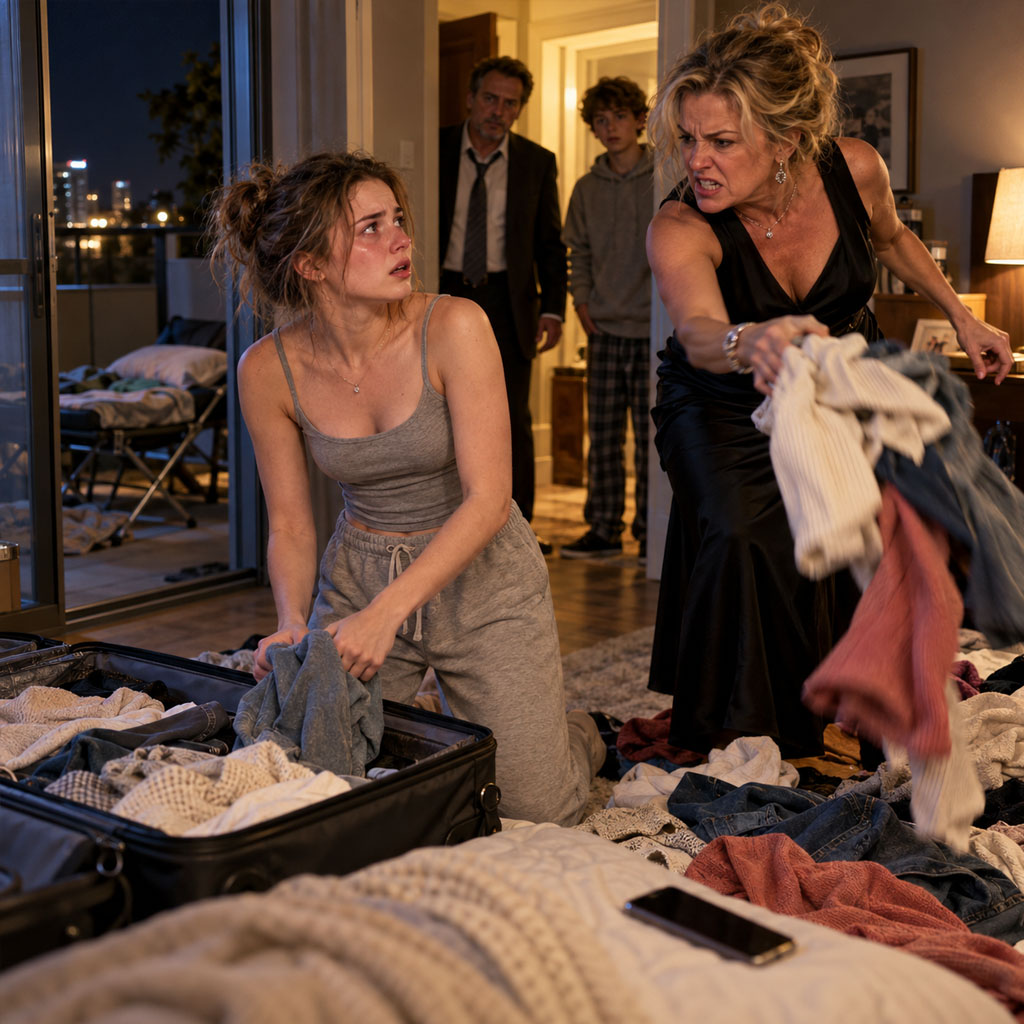
By eleven that night, my suitcase was half packed. I had gathered my clothes, college portfolio, important documents, and the small photograph of my grandmother that had always stood beside my bed. Everything I cared to take fit into one suitcase and a backpack.
The front door opened just as I zipped the outside pocket.
Mom’s laughter floated down the hallway, followed by Tyler’s voice and Emily’s excited description of dessert. They sounded like people returning from a wonderful family celebration.
Then Mom saw my suitcase.
“What on earth are you doing?”
“I’m leaving tomorrow.”
Her smile disappeared.
“Leaving? Where?”
“Denver. Natalie has offered me a position on her design team.”
Mom marched over and pulled a sweater from my suitcase.
“Don’t be ridiculous. You’re not going anywhere just because we went out to dinner without you.”
I picked up the sweater.
“This isn’t about dinner.”
“Then what is it?”
“I saw your family group chat.”
The room fell silent.
Dad glanced at Mom. Tyler looked toward Emily, whose expression changed so quickly I almost missed it.
Mom cleared her throat.
“Hannah, that doesn’t mean anything.”
“You made a family group without me. You planned a celebration without me. You lied about where you were going and left me home to do your laundry.”
“You’re twisting everything,” Dad said.
I turned toward him.
“Dad, when was the last time you asked how I was doing?”
He looked irritated.
“Don’t change the subject.”
I almost laughed.
For years, I’d told myself Dad simply disliked emotional conversations. But whenever Tyler needed money or Emily cried, he always seemed to know exactly what to say.
Emily stepped forward, her eyes already filling with tears.
“Hannah, please. If this is because of me, I’ll leave. I never wanted to destroy your family.”
“Then stop pretending you don’t understand what’s happening.”
She reached for my arm.
“I’m sorry. Please don’t hate me.”
I pulled away.
Emily stumbled backward, bumping against the table.
Tyler immediately grabbed her.
“What is wrong with you?” he shouted.
“Tyler, I barely touched her.”
He shoved me hard.
I lost my balance and fell against the dresser before landing on my knee. A sharp pain shot through my leg.
“Don’t ever put your hands on Emily again!” he yelled.
I looked toward my parents.
Mom started forward, but Emily began sobbing.
“Aunt Karen, maybe I should go. I don’t want everyone fighting because of me.”
Mom immediately wrapped her arms around her.
“Don’t say that, sweetheart. This is your home.”
I was still sitting on the floor.
Nobody helped me up.
Dad folded his arms.
“Hannah, apologize to your cousin. Then we can forget this nonsense.”
I stared at him.
“She grabbed me. Tyler pushed me. And you want me to apologize?”
“Watch your tone.”
For the first time in my life, I refused.
“No.”
Tyler stepped toward me again.
“You think you’re better than everyone?”
“Leave me alone.”
“Apologize.”
“No.”
His next blow caught me across the mouth.
I tasted blood and stumbled backward. He struck me again before Dad finally grabbed his shoulders.
“That’s enough!” Dad shouted.
Tyler struggled against him.
“She deserved it! She’s been making Emily miserable for years.”
I held a hand against my bleeding lip.
“Tyler, I’m your sister.”
He looked at me with cold eyes.
“Emily’s more of a sister to me than you’ve ever been.”
Those words hurt worse than the punches.
Mom led Emily toward the bedroom.
“Hannah, I’m deeply disappointed in you,” she said without turning around.
Dad followed them, telling Tyler to calm down.
Then their bedroom doors closed.
I remained on the floor for several minutes.
From the hallway, I heard Mom speaking softly.
“She’ll get over it. Hannah always does. We’ll make her favorite breakfast tomorrow.”
Dad answered, “Just let her cool off. She isn’t going anywhere.”
I slowly pulled myself upright.
They were right about one thing.
For years, I had stayed no matter how badly they treated me.
But they were wrong about tomorrow.
I took my backpack, phone, and identification and walked out of the house.
The night air was cold against my swollen face. I stood beneath the porch light, waiting without knowing exactly what I was waiting for.
Perhaps I still hoped someone would open the door and call my name.
Nobody did.
I ordered a ride to the emergency department.
The nurse at the desk took one look at my face and immediately asked whether I needed help.
My first instinct was to minimize everything.
“It’s a family disagreement,” I whispered.
She looked at me kindly.
“You’re injured. Let’s make sure you’re okay.”
A doctor examined my swollen knee, bruised ribs, and split lip. Fortunately, nothing was broken, but I needed treatment and rest.
When the doctor gently asked what had happened, I told the truth.
“My brother hurt me. My parents were there.”
Saying it aloud made my hands shake.
I had spent so long protecting my family’s reputation that telling the truth felt almost like betrayal.
But lying would have meant protecting the people who had hurt me.
Before dawn, I made a police report.
I didn’t know what consequences would follow, and the thought frightened me. But I knew I could never return to a house where violence was treated as a lesson I deserved.
Natalie called while I waited for my discharge paperwork.
“Hannah, where are you?”
“At the hospital.”
“What happened?”
I told her.
For several seconds, she said nothing.
Then her voice became steady.
“You’re not going back there. I’ve arranged a hotel near the airport, and I’ll meet you when you land.”
My throat tightened.
“Natalie, I don’t want to be a burden.”
“You’re my best friend,” she answered. “You don’t have to earn the right to be cared about.”
I cried then.
Not because she had said something complicated or extraordinary.
Because she believed I deserved help without asking what I could give her in return.
At seven the next morning, I boarded a plane for Denver.
My phone was filled with messages from home.
Mom wanted to know where I was. Dad demanded that I stop being dramatic. Tyler ordered me to return and apologize to Emily.
Not one of them asked whether I was hurt.
I turned off my phone before takeoff.
When the plane rose above the clouds, I pressed my forehead against the cool window.
Below me was the house where I had grown up, the family I had loved, and the porch where I had slept for nearly two years.
I didn’t know what my future would look like.
But for the first time, I was willing to find out.
Chapter 3
Natalie was waiting at Denver International Airport when I arrived. The moment she saw my swollen face, her cheerful expression disappeared. She hurried toward me and embraced me so carefully that I knew she was afraid of hurting me.
“Oh, Hannah,” she whispered. “What did they do to you?”
I tried to smile.
“I’m here. That’s what matters.”
She drove me to her apartment and showed me a guest bedroom with a real bed, fresh sheets, and a small lamp beside the window.
“You can stay as long as you need,” she said.
I stood in the doorway, staring at the room.
For nearly two years, I’d slept beside a washing machine. Now someone was offering me a comfortable bedroom without expecting anything in return.
I sat on the mattress and burst into tears.
Natalie didn’t ask questions. She simply sat beside me until I could breathe normally again.
The following morning, my phone rang repeatedly.
Mom had left several messages.
“Hannah, sweetheart, where are you? I made pancakes. Your favorites. Please come home so we can talk.”
Dad’s message was less gentle.
“Your mother is worried sick. Running away won’t solve anything.”
Then came Tyler’s text.
“Emily hasn’t stopped crying. Look what you’ve done.”
I stared at those words for a long time.
Even after what had happened, Tyler was worried about Emily’s tears rather than my injuries.
That afternoon, my parents learned about the police report.
Mom called fourteen times before leaving a frantic voicemail.
“Hannah, how could you report your own brother? He’s young! He lost his temper. You know this could damage his future.”
Dad followed with another message.
“Tyler has worked hard to improve his grades. His school is considering him for an academic program. Please think carefully about what you’re doing.”
I listened without answering.
They still couldn’t see me as the person who had been hurt.
They only saw Tyler as the person who might face consequences.
When Tyler finally called, I answered.
“Withdraw the report,” he demanded.
“No.”
“I barely touched you!”
“The doctor disagrees.”
He went quiet.
Then he said, “I’m your brother, Hannah.”
I closed my eyes.
“You told me Emily was your only sister.”
He began to argue, but I ended the call.
There was nothing left to discuss.
During my first week in Denver, I rested while Natalie helped me settle into my new surroundings. She had started a small technology company with several former classmates, developing a platform that connected volunteers with older adults who needed help with groceries, transportation, and everyday errands.
The project had enormous potential, but its software was difficult to navigate.
That was where I came in.
I’d studied digital design in college, specializing in making websites and applications easier to use. Natalie had been asking me to join her team because she believed I could transform their complicated system into something welcoming.
On my fourth day, she introduced me to everyone.
“This is Hannah,” she announced. “She’s the designer I’ve been telling you about.”
A young programmer named Ben immediately opened his laptop.
“Please tell me you can fix our homepage.”
I studied the screen.
Bright orange buttons covered a green background, and three separate menus appeared to lead to the same page.
I raised an eyebrow.
“Did you design this during a power outage?”
Everyone burst out laughing.
It was the first genuine laugh I’d managed since leaving home.
Over the next several weeks, I threw myself into the project.
I redesigned the homepage, simplified the navigation, and created larger, clearer buttons for people who weren’t comfortable using smartphones. I wanted the platform to feel friendly, particularly to older people who might hesitate to ask for assistance.
The team respected my ideas.
Nobody interrupted me because I was younger. Nobody accused me of being selfish when I disagreed.
For the first time in years, I felt useful without feeling used.
One evening, we stayed late preparing a demonstration.
Natalie ordered sandwiches and placed a bowl of fruit on the conference table.
I noticed a single apple remaining.
For some reason, my chest tightened.
Natalie saw me looking at it.
“Want that?”
I hesitated.
She picked it up, cut it in half, and handed me one piece.
“There. We can share.”
I stared at the apple.
A memory flashed through my mind: Mom throwing Emily’s half into the trash, Tyler calling me selfish, and my own frightened apology.
Natalie frowned.
“Hannah? Are you okay?”
I nodded, though my eyes had filled with tears.
“It’s just something I remembered.”
She didn’t press.
Instead, she smiled.
“Well, around here, nobody gets in trouble for wanting a snack.”
I laughed through my tears.
Such a small kindness.
Yet it reminded me that affection didn’t have to come with humiliation.
Back home, Emily began posting messages online.
At first, they were vague.
“Sometimes people mistake kindness for selfishness. I pray everyone finds peace.”
Then came photographs of my parents looking distressed.
“I never wanted to take anyone’s place. I only wanted another chance at having a family.”
Strangers left sympathetic comments.
I didn’t respond.
Natalie worried that Emily was trying to turn people against me, but I had no interest in arguing publicly.
“I know what happened,” I told her. “That’s enough for now.”
Meanwhile, the police investigation continued. Tyler was a minor, and the case was handled through the appropriate juvenile process.
His school learned about the incident during a review of his academic program recommendation. Ultimately, the school withdrew its support and required him to attend counseling as part of its disciplinary response.
Mom was furious.
She left me a tearful message accusing me of destroying my brother’s opportunities.
I listened once, then put the phone away.
Tyler had made his own choices.
I could no longer carry responsibility for everyone else’s behavior.
Two months after I arrived in Denver, our project won first place at a regional technology competition.
The judges praised the platform’s accessibility and its potential to help older adults live more independently.
Natalie hugged me so tightly I nearly lost my breath.
“We did it!” she shouted.
Our team posed for photographs holding the award.
I stood in the middle, smiling with genuine pride.
That evening, the official photograph appeared online.
Beneath it, Mom left a comment.
“That’s our beautiful daughter! We’re so proud of you, Hannah!”
I stared at the words.
Our beautiful daughter.
The same daughter who had slept on a folding bed while her cousin occupied her room.
The same daughter whose brother had struck her while her parents demanded she apologize.
I closed the app.
For once, I didn’t feel compelled to correct anyone.
But I knew the past wasn’t finished with me.
Chapter 4
Three months later, our team was invited to present the platform at a national technology showcase in Denver. By then, my injuries had healed, and I’d moved into a small apartment of my own. It wasn’t fancy, but it had tall windows, a comfortable bedroom, and a kitchen where I could cook whatever I wanted.
Most importantly, it felt safe.
The showcase was our biggest opportunity yet. Investors, nonprofit organizations, and local reporters would attend, and Natalie hoped we could secure enough funding to expand nationwide.
I spent the morning rehearsing my presentation.
Then, just as the ceremony ended, I saw four familiar faces standing near the entrance.
Mom.
Dad.
Tyler.
Emily.
My stomach tightened.
Natalie noticed immediately.
“Do you want me to ask security to help?”
I took a slow breath.
“Not yet. I can speak for myself.”
Mom rushed toward me.
“Hannah!”
She reached out, but I stepped back.
Her eyes filled with tears.
“Oh, sweetheart, we’ve missed you so much.”
I looked at her carefully.
She wore the same blue coat she’d worn the afternoon she told me to move my belongings onto the porch so Emily could sleep comfortably.
“Why are you here?” I asked.
“We saw the announcement online,” Dad said. “We wanted to support you.”
I glanced toward the cameras near our display.
“That’s interesting. You didn’t seem very interested in supporting me when I lived with you.”
Mom flinched.
“Hannah, please. Not here.”
“Then where, Mom? At home, where nobody listened?”
Tyler shifted uncomfortably.
“You’re making a scene.”
I turned toward him.
“That’s what you said before you hurt me.”
Several nearby conversations fell quiet.
Tyler’s face reddened.
“I was angry. You pushed Emily.”
“I pulled my arm away because she wouldn’t let go. You shoved me to the floor, then hit me.”
Dad stepped forward.
“Enough. This is private.”
I looked directly at him.
“It was private when you watched it happen, Dad. That didn’t make it acceptable.”
He lowered his eyes.
Emily began crying.
“I never wanted any of this,” she whispered. “I lost my mother. I just wanted people to love me.”
I felt a familiar pull of sympathy.
I remembered how devastated she’d been when Aunt Sarah died, how frightened and lonely she’d seemed during those first months.
I had loved her then.
Part of me still grieved for the cousin I’d once known.
“Emily,” I said quietly, “you deserved love after losing your mother. But I deserved love too.”
Her tears continued.
“I never asked them to hurt you.”
“No. But you watched it happen, and afterward you told everyone I was jealous of you.”
She looked away.
I continued.
“When Mom gave you my bedroom, I understood. When everyone expected me to do the housework, I tried to understand. But somewhere along the way, being understanding became the price I had to pay for belonging.”
Mom covered her mouth.
“Hannah, I never meant for you to feel that way.”
“I told you how I felt. You called me selfish.”
Her tears spilled over.
“I was trying to help Emily.
“And I needed you to remember I was your daughter.”
For the first time, Mom had no answer.
Tyler spoke next, his voice unsteady.
“I’ve already paid for what happened. I lost the academic program. What else do you want?”
I looked at my younger brother.
I remembered teaching him to ride a bicycle, helping with homework, and defending him when other children teased him.
I’d once believed he’d always be my little brother.
“I don’t want anything from you, Tyler,” I said. “I just want you to understand that you can’t hurt people because they refuse to do what you demand.”
He stared at the floor.
“I’m sorry,” he muttered.
I didn’t know whether he meant it, but I acknowledged his words with a nod.
Dad cleared his throat.
“Your mother hasn’t been the same since you left.”
I met his eyes.
“Neither have I.”
His expression changed.
“I thought staying out of arguments would keep peace in the family.”
“It didn’t keep peace, Dad. It just left me alone when I needed you.”
He looked away, blinking rapidly.
Around us, the event continued. Guests moved between exhibits while an announcer called the next award recipients to the stage.
I could have raised my voice. I could have drawn a crowd and told every painful detail.
But I didn’t want my proudest professional achievement to become another stage for my family’s conflict.
Instead, I turned toward Natalie.
“Would you ask someone to escort them out? I don’t want any more disruption.”
Mom began crying harder.
“Hannah, please come home with us. Just for a visit. We can make everything right.”
I shook my head.
“Home isn’t a place where you have to beg to be treated kindly.”
Then I walked away.
My legs trembled, but I kept walking.
Natalie accompanied my family toward the exit with an event staff member. When she returned, she squeezed my shoulder.
“You okay?”
I looked at the award sitting on our table.
“I think I will be.”
And I meant it.
The aftermath was quieter than I’d expected.
Tyler completed the counseling required by his juvenile case. Emily stopped posting about me online, and my parents gradually stopped calling every day.
Dad eventually sent a letter.
He admitted that he’d mistaken silence for fairness and that his refusal to intervene had allowed the situation to become dangerous.
Mom wrote too.
She told me she’d gone onto the enclosed porch and sat on my folding bed. For the first time, she’d noticed how cold the room became after sunset.
“I don’t know how I convinced myself that was good enough for you,” she wrote.
I read her words twice.
Then I put the letter away.
I didn’t hate my parents.
But I wasn’t ready to rebuild a relationship simply because they finally recognized what I’d been telling them for years.
Forgiveness, I was learning, didn’t require returning to the circumstances that had caused the pain.
By the following spring, our project had secured funding and become a small but promising company.
We rented an office above a neighborhood bookstore. The heating system rattled, the coffee machine leaked, and our conference table had one uneven leg.
I loved every inch of it.
My name appeared on the office door beside Natalie’s.
For the first time, I had something that belonged to me because of my work, my choices, and the people who believed in me.
One Friday evening, after we signed an agreement with a senior services organization, Natalie brought a bag of apples into the office.
She placed a bright red one in front of me.
“For our brilliant design director,” she announced.
Ben looked offended.
“Where’s mine?”
Natalie tossed him another apple.
He missed it, and it rolled beneath the conference table.
Everyone laughed.
I picked up my apple and turned it slowly in my hands.
It reminded me of the afternoon that had become a family joke at my expense. Back then, I’d been made to feel ashamed for wanting something as ordinary as half a piece of fruit.
Now I sat at a table surrounded by people who respected me.
Nobody expected me to surrender my share to prove I was kind.
I reached for a knife, cut my apple in half, and offered one piece to Natalie.
She smiled.
“You sure?”
“Absolutely.”
We sat together eating apples while Ben crawled beneath the table searching for his.
I laughed until my cheeks hurt.
Later that evening, I returned to my apartment, opened the windows, and watched the sunset spread across the city.
My phone was quiet.
There were no demands to fold clothes, no accusations, and no reminders that somebody else’s happiness mattered more than mine.
I thought about my family.
There would probably always be a little sadness when I remembered how easily they’d replaced me. I might someday speak with my parents again, provided our relationship could begin with genuine respect.
But I no longer needed their approval to believe I deserved a place in the world.
I’d spent years thinking family meant sacrificing whatever someone else wanted.
Now I understood that real love didn’t require one person to become smaller so another could feel important.
A real family made room for everyone.
I looked around my peaceful apartment and smiled.
There was a comfortable bed in my bedroom, food in my kitchen, and a career I was proud of building.
And whenever someone walked through my door, it was because we genuinely wanted to see each other.
I had once believed leaving home meant losing everything.
Instead, leaving had given me the chance to discover what home was supposed to feel like.
That night, I placed the remaining half of my apple on a plate and saved it for breakfast.
It was such a simple thing.
But nobody could take it away and make me apologize for wanting it.
And somehow, that small freedom meant more to me than all the family dinners I’d never been invited to attend.