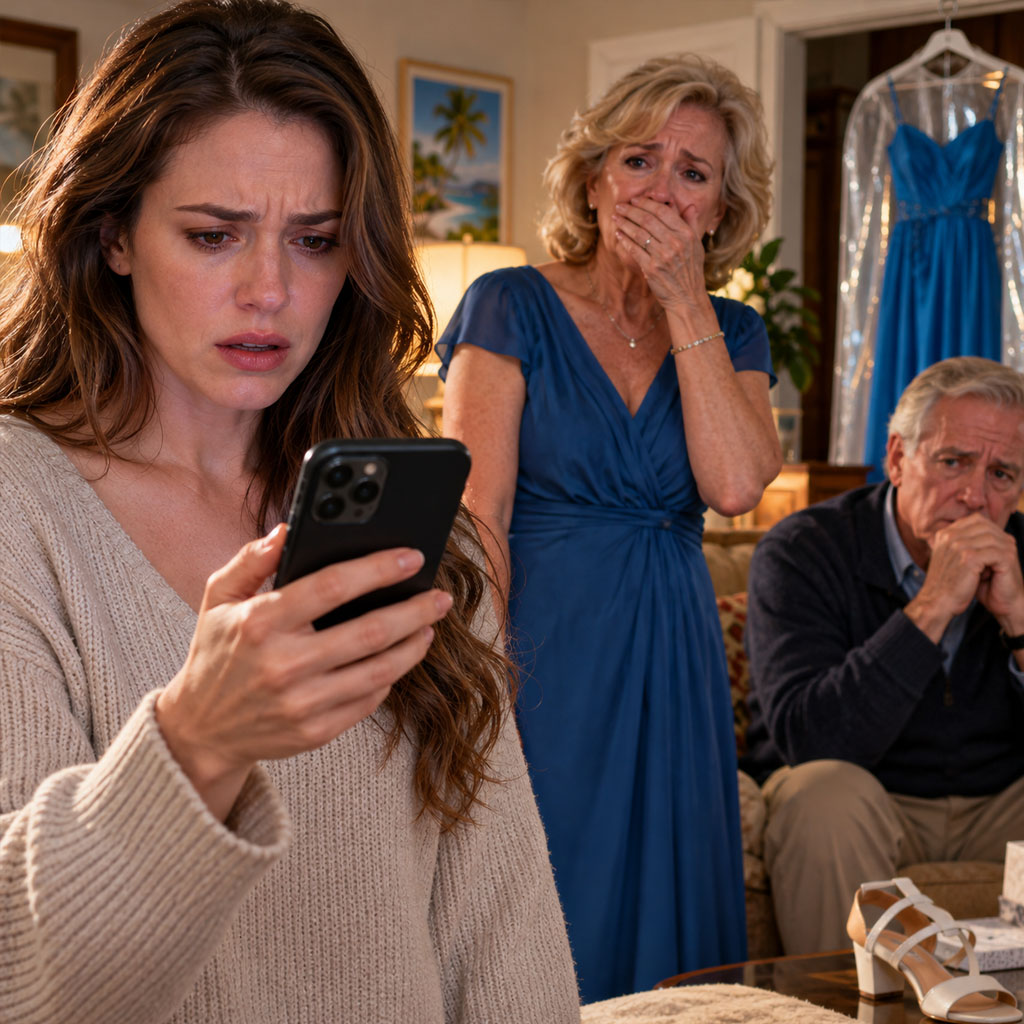
“Tell your parents to swim to Hawaii if they want to come so badly. We’re not buying them plane tickets.”
Chapter 2
I didn’t sleep that night.
Instead, I sat at my kitchen table with a notebook and added up the hours I’d spent planning Ryan’s wedding.
The number came to nearly six hundred.
At my professional rate, I’d given Ashley’s family more than fifty thousand dollars of free work.
And the only thing my parents had asked for was a chance to watch their son get married.
The following Monday, I printed every wedding schedule, contract, contact sheet, and vendor agreement I’d prepared. I organized everything in a thick binder, attached a one-page handoff letter, and drove to Ashley’s townhouse.
She answered wearing silk pajamas and holding an iced coffee.
“Claire! What a surprise.”
I set the binder on her kitchen island.
“Everything you need for the wedding is here. Effective today, I’m no longer coordinating it.”
She stared at me.
“You’re joking.”
“No.”
“Over plane tickets?”
“Over the way you’ve treated my parents.”
Ashley laughed.
“Oh, please. They’re elderly. Your father’s been sick. We thought it would be easier if they stayed home.”
“Then why did you tell them their flights were being arranged?”
Her expression tightened.
“You’re being dramatic.”
I looked at her for a long moment.
“Good luck with your wedding, Ashley.”
As I walked toward the door, she called after me.
“You can’t abandon us two weeks before the ceremony!”
I turned.
“I’m not abandoning anyone. I’ve handed over thirteen months of work. Your company can handle the rest.”
Then I left.
The next difficult conversation happened at my parents’ kitchen table.
Mom had made pot roast. Dad was working on a crossword puzzle, wearing the reading glasses he’d had for twenty years.
I told them everything.
The group chat. The missing tickets. The transportation schedule. Ashley’s explanation.
I watched my mother’s face slowly change.
When I finished, she looked toward the hallway where her blue dress hung inside a garment bag.
“Well,” she said quietly, “I suppose I can return it.”
Dad put down his pencil.
“Eleanor, don’t.”
She looked at him.
“Harold, where would I wear it?”
He took her hand.
“Next Sunday is our fortieth wedding anniversary.”
Mom gave a sad little laugh.
“We weren’t planning anything.”
“Maybe we should.”
He turned toward me.
“Claire, your mother and I got married at the county courthouse. We had twelve dollars, two witnesses, and sandwiches afterward.”
I smiled despite myself.
“I remember that story.”
“Well, I think after forty years, we deserve a proper celebration.”
Mom looked doubtful.
“But the expense—”
“Let me worry about that,” I said.
For the first time in weeks, I felt excited about planning something.
Not for people who treated me like unpaid help.
For the two people who had spent their entire lives loving us without keeping score.
Over the next five days, I organized a fortieth-anniversary celebration in my parents’ backyard.
I rented a white tent, ordered flowers, hired a small string trio, and arranged dinner for fifty guests.
I invited old friends, retired coworkers, neighbors, and relatives who had stood beside my parents through good years and difficult ones.
When Dad saw the invitation, he read it three times.
Then he quietly went into the bedroom and took his wedding band from a drawer.
He hadn’t worn it since his fingers swelled during surgery.
The following morning, he visited a jeweler to have it resized.
Meanwhile, Ashley’s wedding plans began unraveling.
The transportation company called because a deposit hadn’t been paid.
The band called because the updated schedule placed the first dance before the vows.
The officiant called because nobody could tell him who had the wedding rings.
Each time, I politely directed them to Ashley’s family business.
I didn’t delete documents or interfere with contracts. I had left complete instructions in the binder.
I simply stopped doing everybody else’s job.
Three days before the wedding, an email arrived from Victoria.
Its subject line read, “A Generous Compromise.”
She offered my parents two economy tickets arriving in Maui after the ceremony. They could attend the reception, though seating would be in an outdoor overflow area.
They would not participate in any formal family traditions.
However, they were expected to appear for a photograph with the bride and groom.
I read the message aloud to Dad.
He listened without interrupting.
When I finished, he took the printed itinerary and studied it.
“Claire, look at this.”
At the bottom was a small notation.
“Previous ticket credit applied: $4,360.”
Dad tapped the paper.
“That’s interesting.”
“What is?”
“A credit means someone bought tickets before.”
I stared at him.
He continued.
“You can’t receive credit for something that was never purchased.”
I looked more closely.
He was right.
Someone had booked my parents’ flights.
And someone had canceled them.
That night, I received a frantic telephone call from Ashley.
“Claire, we need to talk.”
I could hear music and laughter behind her.
“What’s wrong?”
“There’s been a misunderstanding. Some important guests are asking why Ryan’s parents aren’t here.”
I said nothing.
“We can send a private plane tomorrow. Your parents will have a beautiful suite. Oceanfront. And I’ll pay you for all your planning work.”
“That’s generous.”
She hesitated.
“I was thinking fifty thousand dollars.”
I nearly laughed
She had somehow calculated almost exactly what my unpaid labor was worth.
“What’s the catch, Ashley?”
Her voice softened.
“We just need you to explain that the airline made an error. Nobody has to feel embarrassed.”
I looked at the framed photograph on my desk.
My parents on their thirty-ninth anniversary, standing beside a grocery-store cake.
“You’re not buying my parents’ dignity,” I said.
“Claire, be reasonable.”
“I am.”
Then I ended the call.
On the morning of June 13, I turned off my phone and drove to my parents’ house.
Mom and I arranged flowers beneath the tent. Dad inspected the folding chairs, determined to make sure every one was steady.
Around six that evening, Colorado time, we sat together in the backyard with glasses of iced tea.
Dad looked at his watch.
“They’re probably exchanging vows about now.”
Mom reached for his hand.
“I hope it’s a beautiful ceremony.”
That was my mother.
After everything, she still wished her son happiness.
I went home later that evening, exhausted.
When I switched on my phone, twenty-seven missed calls appeared.
Most were from Ashley and Victoria.
But one message came from Ryan.
“Claire, I found the canceled tickets. I’m standing at the ceremony site. Please call me.”
Before I could respond, a voicemail arrived from an unfamiliar Maui number.
A woman introduced herself as Rachel Kim, the guest services manager at the wedding estate.
Her voice trembled.
“Ms. Thompson, I need to tell you something. Your parents had confirmed business-class reservations. Ashley personally instructed me to cancel them on May eighth.”
I sat down.
Rachel continued.
“She said your parents would embarrass the family in front of an important business investor. The unused credit went toward upgrades for her relatives.”
I covered my mouth.
“And Ms. Thompson,” Rachel added, “your brother has seen the booking records. He’s asking Ashley for an explanation right now.”
Chapter 3
I called Ryan immediately.
He answered before the second ring.
“Claire.”
His voice sounded broken.
“I’m here.”
“I’m so sorry.”
Behind him, I could hear ocean waves, faint music, and people talking.
“Where are you?”
“Standing beside the wedding arch. Everybody’s waiting.”
I closed my eyes.
“Ryan, what happened?”
“Rachel showed me the booking records. Ashley canceled Mom and Dad’s flights herself.”
He struggled to continue.
“She told me Dad wasn’t healthy enough to travel. She said Mom was afraid of flying. I believed her.”
“Why didn’t you ask them?”
He didn’t answer.
Then he began crying.
“Because it was easier not to.”
Those words hurt more than anything Ashley had said.
My brother had ignored the people who loved him because asking one uncomfortable question seemed harder than trusting a convenient explanation.
“Ryan, I’m not going to tell you what to do.”
“Please, Claire. I don’t know what to do.”
“You have to decide what kind of marriage you want. I can’t make that decision for you.”
He was quiet.
Then I heard Ashley approaching.
“Ryan, what are you doing? Everyone is waiting!”
Her voice was sharp and impatient.
Ryan spoke calmly.
“I’m talking to Claire.”
“Hang up. We’ll deal with your sister afterward.”
“No.”
A long silence followed.
Then Ryan said, “Put her on speaker.”
Suddenly, I could hear everything.
Wind rustled across the microphone. Guests murmured in the background. Somebody moved a chair.
Ashley sounded irritated.
“Ryan, this is ridiculous.”
“Did you cancel my parents’ plane tickets?”
“Can we discuss this privately?”
“Answer me.”
Ashley sighed.
“Your father just had major surgery. I was protecting him.”
“Then why did you tell Rachel they would embarrass us?”
Silence.
Victoria’s voice entered the conversation.
“Ryan, we’re talking about an important event with influential guests. Surely you understand that appearances matter.”
Ryan answered slowly.
“Appearances?”
Ashley finally lost her patience.
“Fine. Yes, I canceled them. Your mother would have shown up in some cheap dress, and your father would be coughing through the ceremony. Do you know how humiliating that would’ve been?”
I felt my stomach turn.
Ryan didn’t speak.
Ashley continued, her voice rising.
“My mother’s company has an eleven-million-dollar investment under negotiation. We have business partners here. Everything has to look perfect!”
“And my parents don’t?”
“Ryan, don’t twist my words.”
“You said they would embarrass us.”
“I was trying to protect our future!”
A man’s unfamiliar voice interrupted.
“Ashley, is that really what you think of his family?”
Victoria immediately became nervous.
“Mr. Henderson, this is a private matter.”
The man identified himself as Thomas Henderson, the investor whose company was considering a major partnership with the Whitmore business.
He spoke with quiet disbelief.
“I came here because your family described this wedding as a celebration of loyalty and togetherness. I’m having trouble reconciling that with what I’ve just heard.”
Ashley began explaining.
Then Ryan interrupted her.
“Claire, are you still there?”
“Yes.”
“Tell me about Dad.”
My throat tightened.
“What do you want to know?”
“Did he really work that hard to recover for this wedding?”
I stared out my kitchen window.
“He went to cardiac rehabilitation three times a week. Mom helped him practice walking on uneven ground because she was worried about the beach. He bought a new tie and called you to ask which color you preferred.”
Ryan made a terrible sound.
“I never called him back.”
“No.”
“Mom bought a dress?”
“Ocean blue. Eighty-nine dollars.”
I heard him crying.
Then I said something I had kept inside for months.
“Ryan, Ashley didn’t just cancel two plane tickets. She decided our parents weren’t good enough to stand beside you. Those are the people who raised us. Dad worked overtime so you could play baseball. Mom drove you to practice even when she was sick. They loved you before anybody knew your name.”
Ashley interrupted.
“Oh, please. Your sister is making this all about herself again.”
Ryan’s voice changed.
“No, Ashley. She’s telling me the truth.”
For several seconds, nobody spoke.
Then he said, “I can’t marry you today.”
Ashley gasped.
“What?”
“I can’t stand here making promises about love and loyalty when you’ve treated my parents like something shameful.”
“Ryan, don’t be stupid!”
But he was already speaking to the guests.
“Ladies and gentlemen, I’m sorry. There won’t be a wedding today.”
A wave of shocked voices rose behind him.
“I learned something this afternoon that I should have known weeks ago. My parents aren’t here because their invitations were deliberately taken away. I didn’t know, but I should have asked. And I can’t begin a marriage built around that kind of cruelty.”
Ashley began shouting.
Victoria demanded that someone stop him.
But Ryan continued.
“Please enjoy the dinner. Everything is paid for. I’m sorry you’ve traveled so far.”
Then he returned to the phone.
“Claire?”
“I’m here.”
“I’m coming home tomorrow.”
“Okay.”
“Is there still room at Mom and Dad’s anniversary party?”
I started crying.
“There’s always room for you, Ryan.”
After we hung up, I sat in the kitchen for a long time.
I didn’t feel triumphant.
A wedding had collapsed. My brother was heartbroken. Two families had been publicly humiliated.
But for the first time, Ryan had made a difficult choice without asking me to solve the problem for him.
That night, I drove to my parents’ house and told them what happened.
Mom listened quietly.
When I finished, she asked, “Is Ryan all right?”
I smiled sadly.
“He’s hurting, Mom.”
Dad stood up.
“I’ll get the guest room ready.”
I stared at him.
“After everything, you’re not angry?”
He looked at me.
“Of course I’m angry. But he’s still my son.”
Then he added something I’ll never forget.
“Claire, love doesn’t mean pretending someone did nothing wrong. It means leaving a door open when they finally understand.”
Chapter 4
Sunday afternoon arrived bright and warm.
The backyard tent glowed beneath strands of white lights. Fifty folding chairs stood in neat rows, and the string trio played softly as friends and relatives arrived.
My mother came outside wearing her blue dress.
Her white sandals clicked against the patio stones.
For a moment, everyone stopped talking.
She looked beautiful.
Dad stood near the flower-covered arch in a gray suit, his newly resized wedding band shining on his hand.
When he saw Mom, his eyes filled with tears.
“Eleanor,” he whispered.
She laughed nervously.
“Oh, Harold. It’s just an old lady in a new dress.”
He shook his head.
“No. It’s the prettiest woman I’ve ever seen.”
The ceremony began at five.
Dad had prepared a few words, but when the moment came, he folded the paper and slipped it into his pocket.
“Eleanor, forty years ago, I promised I’d love you through better and worse. I didn’t know how much better we’d have, or how hard some of the worse would be.”
Mom wiped her eyes.
“You stood beside me when we had nothing. You raised our children with me. You held my hand when I was frightened, and you never made me feel small.”
He paused.
“I wanted to take you to Hawaii. Maybe someday I still will. But right now, standing here with you, I wouldn’t trade this moment for any beach in the world.”
My mother reached for his face.
“You already gave me the best forty years of my life.”
The guests began applauding.
Then a car pulled up outside.
I turned toward the driveway.
Ryan stepped out wearing a wrinkled white shirt and carrying a small flower lei.
He looked exhausted.
His eyes were red, and his hair was flattened from hours on airplanes.
When he saw the celebration, he stopped.
I walked toward him.
“You’re here.”
He swallowed.
“I almost missed my connection.”
“You’re not late.”
He looked toward the tent.
“Do you think Dad will want me there?”
I took his hand.
“Go find out.”
Ryan walked slowly down the aisle.
Dad saw him first.
For a moment, neither moved.
Then Dad opened his arms.
“Come here, son.”
Ryan broke down.
“I’m sorry, Dad. I’m so sorry.”
My father held him tightly.
“We’ll talk about everything later. Right now, come stand with your family.”
Mom joined them, wrapping her arms around both men.
I stood nearby, crying harder than I’d cried in years.
A friend took our photograph.
All four of us stood beneath the flowers, my mother in her blue dress, Dad in his gray suit, Ryan holding the white lei, and me with my arms around them.
Nobody was pushed into the background.
Nobody was cropped out.
The photograph became my favorite possession.
News of the canceled Hawaii wedding spread quickly.
Someone had recorded part of Ryan’s announcement, and within days the video was circulating online.
The Whitmore family’s business began facing difficult questions. A major potential investor suspended discussions, and several clients reconsidered their contracts.
Ashley posted a statement claiming that her wedding had been destroyed by jealous relatives and misunderstandings.
I didn’t respond.
I had no interest in arguing with strangers.
Then a letter arrived from a Denver law firm.
The Whitmore company accused me of interfering with business relationships and abandoning an agreement to coordinate the wedding.
They demanded seventy-five thousand dollars.
For the first time since the ordeal began, I felt genuinely frightened.
I took the letter to an attorney recommended by one of Dad’s former coworkers.
Her name was Susan Martinez, and she spent nearly an hour reviewing my documents.
When she finished, she leaned back in her chair
“Claire, did they ever pay you?”
“No.”
“Did you sign a contract requiring you to provide services?”
“No.”
“And you gave them all your planning materials before withdrawing?”
“Every page.”
She nodded.
“Then they have some serious obstacles to overcome.”
Susan prepared a response challenging the allegations and documenting the substantial unpaid work I’d provided.
Several weeks later, the Whitmores withdrew their demand.
There was no apology.
I didn’t need one.
Ryan’s life changed dramatically.
His planned position with Ashley’s family business disappeared. He lost money he’d contributed toward the wedding, and the engagement ring was returned at a substantial loss.
For six weeks, he slept on my couch while looking for a new job.
Some evenings, we’d sit together after dinner, neither of us knowing what to say.
One night, he finally spoke.
“Claire, why didn’t I see it?”
I looked at him.
“Because Ashley was good at making you feel important.”
He nodded.
“And because you always handled everything.”
I didn’t answer.
Ryan turned toward me.
“I think I let you carry too much.”
“You did.”
He looked surprised by my honesty.
“I know.”
I took a deep breath.
“I love you, Ryan. But I can’t spend the rest of my life being responsible for everybody else’s happiness.”
He nodded slowly.
“I’m not asking you to.”
That conversation mattered more than a hundred apologies.
Over the following months, he found a sales position with a software company in Denver. He moved into his own apartment, paid back money he owed me, and started calling our parents every Sunday.
He didn’t become a different person overnight.
Sometimes he still forgot things. Sometimes he asked me to fix problems he could handle himself.
But now, when I told him no, he accepted it.
I changed, too.
After fourteen years in corporate event management, I left my job and opened a small consulting business.
For the first time, I charged properly for my time.
When Mom teased me about it, I laughed.
“Everybody gets an invoice now.”
She grinned.
“Even for Sunday dinner?”
“Especially for Sunday dinner.”
The following September, something wonderful happened.
Ryan surprised our parents with two round-trip plane tickets to Maui.
He paid for them himself.
No luxury resort. No elaborate wedding schedule. Just a quiet beachfront hotel and a week together.
Dad initially refused.
“Ryan, you’ve already lost enough money.”
But my brother shook his head.
“This isn’t about money, Dad. I want you and Mom to take the trip you were supposed to have.”
Mom looked at the tickets for a long time.
“Are you sure?”
“Positive.”
Then he smiled.
“And this time, nobody gets to decide whether you’re important enough to come.”
They flew to Hawaii on a Tuesday morning.
I drove them to the airport.
Mom wore her white sandals, carrying the blue dress in a garment bag. Dad wore a Hawaiian shirt she’d bought him at a department store.
Before entering security, he hugged me.
“Claire, I need to tell you something.”
“What is it, Dad?”
“You didn’t ruin your brother’s wedding.”
I swallowed.
“I know.”
“No, sweetheart. I want you to understand. You stopped helping people pretend everything was fine. There’s a difference.”
I hugged him.
Then I watched my parents walk toward their gate, holding hands like they had for forty years.
Three days later, my phone buzzed.
It was a photograph.
Mom stood barefoot on a Maui beach, the ocean-blue dress blowing around her knees. Dad stood beside her with his pant legs rolled up, smiling beneath a straw hat.
Both were standing ankle-deep in the Pacific.
Underneath, Mom had written:
“CLAIRE, WE SWAM!”
I laughed until tears rolled down my face.
For so long, I’d believed being a good daughter and sister meant preventing every problem, smoothing every conflict, and making sure nobody was disappointed.
But I had confused being needed with being appreciated.
The people who truly loved me didn’t require me to exhaust myself proving my worth.
My parents had never asked for an expensive trip or a grand celebration. They wanted to share an important day with their son. They wanted to stand proudly with the family they’d spent a lifetime building.
Ashley thought they were ordinary people who would spoil the appearance of a perfect wedding.
She was wrong.
My father had worked thirty-eight years in public education, checking budgets so children had classrooms, books, and teachers. My mother had spent three decades as a school secretary, remembering birthdays, comforting frightened students, and helping families who had nowhere else to turn.
They didn’t own fancy properties.
They didn’t know wealthy investors.
But they understood something that money couldn’t buy.
A family isn’t measured by how impressive it looks in a photograph.
It’s measured by who makes room for you when the chairs are almost full.
That autumn, I hung our anniversary photograph in the hallway of my new office.
Four people stood together beneath an arch of white flowers. My mother’s blue dress caught the afternoon sunlight, Dad’s arm rested around Ryan’s shoulders, and I stood beside them, laughing.
Sometimes clients ask about that photograph.
I tell them it’s my parents’ fortieth wedding anniversary.
I don’t explain the plane tickets, the canceled ceremony, or the cruel message that started everything.
Those details no longer define us.
What matters is the moment we chose to stop accepting humiliation as the price of belonging.
Ryan and I still talk often. Our relationship is different now, quieter and more balanced. He doesn’t expect me to rescue him, and I’ve stopped measuring love by how much I sacrifice.
I haven’t spoken to Ashley or Victoria since that summer.
I wish them no harm, but I no longer feel responsible for how their story ends.
As for my parents, they returned from Hawaii with sunburned noses, seashell souvenirs, and more photographs than either of them knew what to do with.
Mom replaced the old Maui postcard on her refrigerator with a picture of herself and Dad standing together in the ocean.
Every time I visit, I stop to look at it.
And every time, Mom smiles.
“See, Claire? We made it.”
Yes, Mom.
You certainly did.
In the end, the wedding Ashley wanted never happened. The perfect pictures, the wealthy guests, and the magnificent oceanfront ceremony couldn’t hide the disrespect beneath them.
But my parents got something far more valuable
They celebrated forty years of marriage surrounded by people who truly loved them. Their son found his way home, their daughter learned to value herself, and the family began rebuilding on something stronger than appearances.
We lost the wedding we thought we wanted.
But we found the family we were supposed to be.
And whenever I remember that terrible message telling my parents to swim to Hawaii, I think of Mom’s photograph from the beach.
Her dress blowing in the wind.
Dad’s hand holding hers.
Two people who had never needed anyone’s permission to belong.
Sometimes the greatest victory isn’t proving cruel people wrong.
It’s finally understanding that you never needed their approval in the first place.