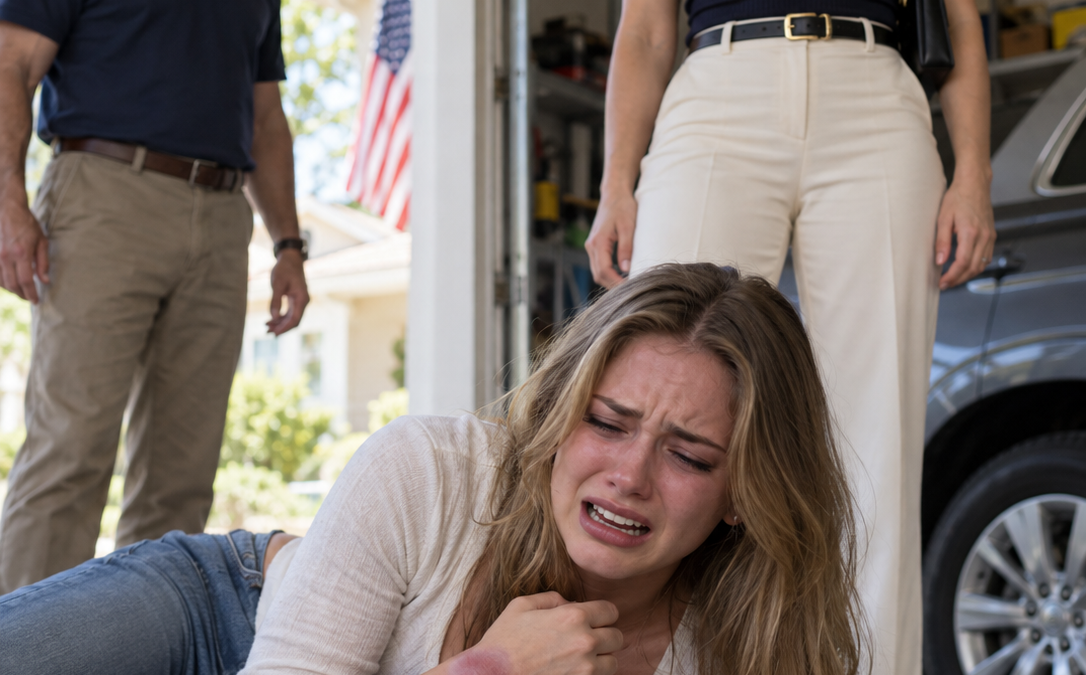
“Good luck passing now,” my sister sneered as my wrist snapped in our garage. I collapsed against the concrete, my exam ticket waiting inside my backpack, my right hand swelling before my eyes. Dad walked in, saw my injury, and ordered me to tell the doctor I fell. He thought that would protect her. Then our neighbor checked her cameras.
PART 1 — MY SISTER BROKE MY HAND BEFORE THE BAR EXAM. MY FATHER TOLD ME TO KEEP MY MOUTH SHUT.
“Good luck passing your stupid exam now.”
My sister smiled as I sat on our garage floor, holding my broken right wrist against my chest.
The car keys were still in my other hand. My admission ticket was in my backpack. In less than twenty-four hours, I was supposed to take the most important examination of my life.
Tamsin looked at my swelling wrist, then at the watch on her arm.
“You should probably get that checked out,” she said. “Looks expensive.”
She stepped around me and walked into the house.
I heard the kitchen door close.
Then I tried moving my fingers.
The pain was so sharp that I nearly passed out.
My name is Verity. I was twenty-four years old, living outside Columbus, Ohio, and working as a paralegal at a downtown litigation firm.
After years of college, law school, student loans, and late-night study sessions, I was finally one exam away from becoming an attorney.
My managing partner had already discussed an associate position with me.
The salary would be $150,000.
For someone who had spent years checking grocery prices and calculating which bills could wait until payday, that number represented something specific.
My own apartment. My own car insurance. My name on a lease that nobody in my family could threaten to cancel.
And freedom from my parents.
My father, Merrick, was the kind of man who believed being the loudest person in a room made him the smartest.
My mother, Althea, supported that theory whenever it benefited her.
Together, they had raised two daughters under two completely different sets of rules.
Tamsin, twenty-seven, was their favorite.
I was their backup plan.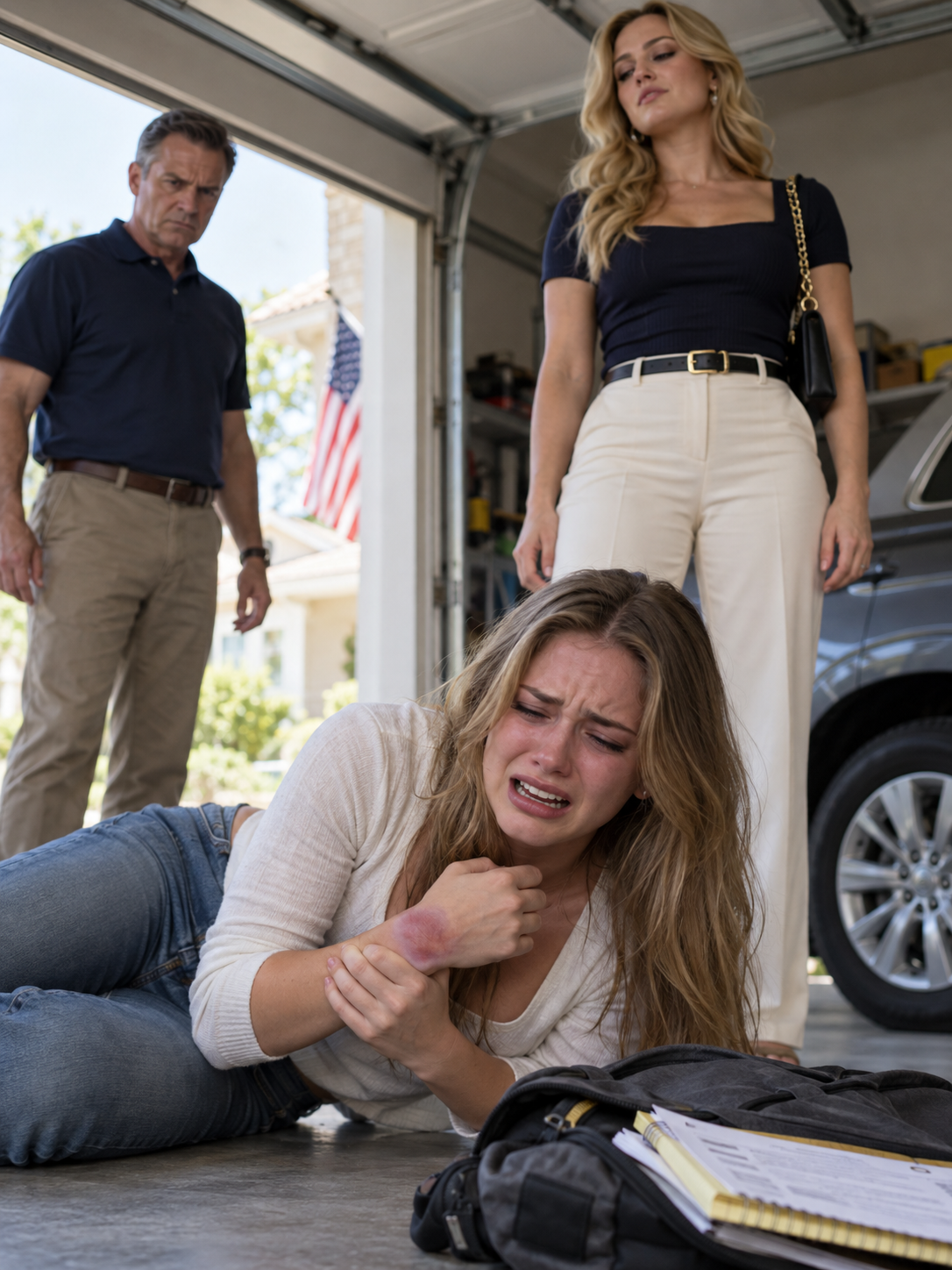
Tamsin had been calling herself a luxury real estate consultant for almost four years. She had an Instagram page filled with expensive restaurants, designer handbags, and photographs taken outside houses she didn’t own.
What she didn’t have was an active real estate license.
Or a steady income.
Or any intention of getting a conventional job.
My parents paid for her BMW lease, her credit cards, her insurance, and practically everything else.
Meanwhile, when I asked my father for help purchasing a used laptop during law school, he handed me a newspaper advertisement for a warehouse job.
“Build some character,” he told me.
Tamsin received a new MacBook that Christmas.
I received a twenty-five-dollar Starbucks gift card.
That was how our family operated.
When Tamsin wanted something, it became an emergency.
When I needed something, it became a character-building opportunity.
For years, I convinced myself that earning my own money and staying out of their arguments would eventually solve everything.
I was wrong.
Three months before my exam, I came home after fourteen hours at the firm and found Tamsin sitting at the kitchen island with a stack of credit card statements.
She pushed one toward me.
“Dad says you should contribute more.”
I looked at the statement.
$9,870.
Designer clothing, hotel reservations, and restaurant charges.
“Contribute to what?”
“Household expenses.”
I turned the statement around.
“Since when is a Gucci handbag a household expense?”
She snatched it away.
“You think you’re better than everybody because you went to law school.”
“No. I think you should pay for your own handbags.”
Her expression changed.
“You’ve always been jealous of me.”
I laughed.
“Tamsin, I drive a twelve-year-old Honda because I don’t want a car payment. You’re twenty-seven and need Dad’s permission to increase your credit limit.”
She stood up so quickly her chair scraped the tile.
Our mother entered the kitchen before Tamsin could respond.
“What is going on?”
“Verity is being abusive,” Tamsin announced.
Althea looked at me.
“Apologize to your sister.”
“For what?”
“For making her feel embarrassed.”
I picked up my bag.
“If a credit card statement embarrasses her, wait until the bank starts calling.”
I went upstairs while my mother shouted that I had an attitude problem.
The next morning, my father informed me that I was expected to help repay Tamsin’s debt after I became an attorney.
He said it as casually as someone assigning lawn work.
“Your sister needs time to get established,” he explained.
“She’s had four years.”
“She’s building something.”
“Debt?”
He slammed his coffee mug onto the table.
“Watch your mouth.”
I didn’t argue further.
Instead, I opened a savings account at a different bank and started moving every spare dollar into it.
I planned to leave as soon as my exam was behind me.
Unfortunately, Tamsin figured that out.
A month before the test, I came downstairs for water around midnight and heard her arguing with Dad in the living room.
“She thinks she’s going to get that lawyer job and move out,” Tamsin complained.
Dad sounded exhausted.
“Let her finish the exam.”
“And then what? She takes all that money and leaves?”
“We’ll talk to her about contributing.”
“You need to make sure she helps me.”
“I will.”
There was a pause.
Then my father said something that settled the question of whether I would ever be treated fairly in that house.
“Once she’s making attorney money, she can afford to take care of everybody.”
Everybody.
Meaning Tamsin.
I stood in the hallway holding an empty glass, listening to them distribute a salary I hadn’t earned yet.
I went upstairs and started looking at apartments.
The following weeks were miserable.
Tamsin suddenly developed a passion for playing music at midnight.
She misplaced my car keys twice.
She unplugged the router during a timed practice examination.
Once, I found coffee poured across a stack of handwritten study notes.
She claimed the cat had done it.
We didn’t own a cat.
My parents dismissed every incident.
“Your sister’s under pressure,” Mom said.
“From what? Her Netflix subscription?”
“Don’t start.”
Three nights before my exam, I caught Tamsin standing outside my bedroom door.
She was watching me massage my right wrist after a four-hour writing session.
“What?” I asked.
“Nothing.”
Her eyes stayed on my hand.
“Does writing that much hurt?”
“Sometimes.”
She nodded slowly.
“Interesting.”
Then she walked away.
I should have paid more attention to that conversation.
But I was exhausted, and I had spent twenty-four years convincing myself that Tamsin’s cruelty had limits.
On the morning she attacked me, I was leaving early to review notes with a friend before the following day’s first examination session.
I had already loaded my backpack.
My admission ticket, identification, legal pads, and approved supplies were inside.
I entered the garage and reached for the driver’s door.
Someone grabbed my right wrist from behind.
Before I could turn around, Tamsin twisted my arm backward and forced it down.
There was a sharp crack.
My knees struck the concrete.
I couldn’t breathe properly.
She released me and stepped back.
For a moment, neither of us spoke.
Then she smiled.
“Good luck writing your exam now.”
I stared at her.
“You did that on purpose.”
She shrugged.
“Prove it.”
That was when our father entered the garage.
He took one look at my wrist and the way I was sitting against the car.
“What happened?”
“Tamsin broke my hand.”
Dad looked toward the kitchen door.
Tamsin was already gone.
“Get up, Verity.”
“I can’t.”
“Stop being dramatic.”
“Dad, I think it’s broken.”
He crouched, examined the swelling without touching it, and stood again.
“Fine. I’ll drive you to urgent care.”
I tried to get up.
The pain made me stagger against the car.
He didn’t offer his arm.
Instead, he pulled out his phone and checked the time.
Then he gave me instructions.
“You tripped over a storage box. That’s what you’re telling the doctor.”
I looked at him.
“What?”
“We’re not involving the police.”
“She attacked me.”
“And you probably provoked her.”
I couldn’t believe he had said it.
“Are you serious?”
He leaned closer.
“Your sister has business opportunities. An assault charge could ruin everything.”
I held up my swollen wrist.
“My exam is tomorrow.”
“Then take it another time.”
“That’s your solution?”
“Lower your voice.”
He pointed toward the house.
“This stays in the family. If you embarrass us over this, don’t expect to come back.”
I stared at the man who had spent years telling me to work harder and stop expecting handouts.
Now he expected me to throw away my future because his favorite daughter might face consequences.
“Take me to the hospital,” I said.
He opened the truck door.
“Then get in.”
At the emergency department, the X-ray confirmed a displaced fracture near my right wrist.
The physician explained that I’d need immobilization, follow-up treatment, and possibly further intervention depending on how the fracture healed.
When she asked how the injury happened, my father answered before I could.
“She fell in the garage.”
The physician looked at me.
“Is that correct?”
Dad stood beside the examination bed.
His arms were folded.
I looked at him, then back at her.
“Yes,” I said.
It was the last lie I ever told to protect my sister.
The physician applied a cast, gave me instructions for managing the swelling, and scheduled orthopedic follow-up.
When I asked whether I could write for several hours the following day, she examined my hand again.
“Not with this one.”
I showed her my exam admission ticket.
She was sympathetic but clear.
My right hand wasn’t going to be usable for the test.
I left with medical records, copies of my X-rays, and a prescription for pain medication.
My father paid the hospital parking fee with his credit card.
On the drive home, he finally spoke.
“Your mother thinks you should postpone the exam.”
I looked out the window.
“Tell her thanks for the professional advice.”
“Don’t get sarcastic.”
“Should I send Tamsin a thank-you card too?”
He hit the steering wheel.
“Enough.”
I turned toward him.
“You watched me sit on that floor with a broken wrist and worried about her career.”
“She made a mistake.”
“She grabbed my arm and broke it.”
“She lost her temper.”
“And you think that makes it better?”
He pulled into our driveway.
“I’m done discussing this.”
So was I.
But I wasn’t done doing something about it.
I went upstairs, locked my bedroom door, and called my best friend.
Kayla answered on the third ring.
“Please tell me you finally moved out.”
“Tamsin broke my wrist.”
There was silence.
“Say that again.”
I told her what happened.
Every detail.
The garage. The threat. My father ordering me to lie. The hospital.
When I finished, Kayla asked one question.
“Are you somewhere safe?”
“My bedroom. The door’s locked.”
“I’m coming.”
Twenty-five minutes later, she arrived with legal pads, iced coffee, and the expression of someone who had spent the entire drive considering several bad decisions.
She worked as a paralegal at another firm.
She knew exactly what losing this examination opportunity meant.
When she saw my cast, she stopped talking.
Then she took out her phone.
“We’re documenting everything.”
She photographed my injury, the cast, and the discharge paperwork.
She wrote down my account while it was fresh.
Then she sent copies to a secure folder.
“Now,” she said, opening my laptop, “we contact the exam board.”
I watched her type the accommodation request.
Severe injury to dominant hand.
Medical documentation attached.
Request for emergency assistance or additional time during the written sections.
We submitted it through the official portal and emailed the examination coordinator.
Then Kayla pushed a pen across the desk.
“Pick it up.”
“With what?”
“Your left hand.”
I gave her a look.
“Kayla.”
“Pick it up.”
My first sentence looked like it had been written on a moving bus.
She examined it.
“Terrible.”
“Thank you.”
“But readable.”
For the next several hours, we practiced.
Issue. Rule. Application. Conclusion.
One paragraph at a time.
My fingers cramped. I dropped the pen repeatedly. My handwriting slanted across the page like someone had tilted the desk.
Kayla made me concentrate on accuracy instead of appearance.
“You don’t need to win a penmanship contest,” she said. “You need to show them you understand the law.”
By eight that evening, I could write slowly enough to hate every second of it but clearly enough for someone else to read.
My mother knocked once.
“Dinner’s ready.”
“We’re busy,” I answered.
“Tamsin says you’re being ridiculous.”
Kayla looked up.
“Tell Tamsin she can explain that to the police.”
My mother’s footsteps retreated immediately.
Kayla gave me a satisfied smile.
“That’s one way to clear a hallway.”
We returned to work.
At approximately nine, the doorbell rang.
My father answered.
A woman’s voice came from downstairs.
It belonged to Mrs. Margaret Alden, our seventy-eight-year-old neighbor across the street.
Mrs. Alden had security cameras pointed at nearly every inch of her property.
She once identified a delivery driver who had accidentally taken her neighbor’s package two houses down.
She also happened to have a camera with a clear view of our driveway.
And our garage whenever the garage door was open.
I moved toward my bedroom door.
Then I heard her speak.
“Merrick, I’m sorry to bother you, but I was reviewing my camera footage from this morning.”
My father said nothing.
“I saw something happen between your daughters.”
I froze.
Kayla stood behind me.
Mrs. Alden continued.
“I brought you a copy of the recording. I thought you might need it for the police.”
There was a brief silence.
Then my father spoke.
“Thank you, Margaret. I’ll take care of it.”
I heard the front door shut.
And then his footsteps moved quickly toward the kitchen.
He had the recording.
The one thing that could prove Tamsin had deliberately attacked me.
I started down the stairs.
But before I reached the bottom, I heard my father’s voice coming from the kitchen.
“Tamsin, we’ve got a problem. The neighbor recorded everything.”
And my sister answered with four words that changed my plan completely.
“Then destroy the evidence.”
PART 2 — I PASSED THE EXAM WITH MY LEFT HAND. THEN MY SISTER CONFESSED IN FRONT OF EVERYONE.
“Dad, just delete it.”
Tamsin sounded annoyed, as though our neighbor had recorded her parking illegally instead of deliberately breaking my wrist.
My father lowered his voice.
“I don’t know how to delete security footage.”
“Then smash the stupid thing.”
I stood at the bottom of the staircase.
Kayla stepped beside me, already recording on her phone.
“Before you do that,” I said, “you might want to consider who’s going to explain it to the police.”
My father turned.
He was holding a silver USB drive.
Tamsin stood near the refrigerator with a glass of wine.
For the first time in my life, she looked genuinely nervous.
“Verity,” Dad said, “go upstairs.”
“Give me the drive.”
“No.”
“Dad.”
“I said no.”
Kayla raised her phone.
“Mr. Merrick, I’m recording this conversation. You should know that destroying evidence after learning it may relate to a criminal investigation could create serious legal problems.”
He glared at her.
“This doesn’t concern you.”
“She’s my best friend,” Kayla replied. “So, congratulations. Now it does.”
Tamsin put her wineglass down.
“You’re seriously threatening Dad over a stupid argument?”
I lifted my cast.
“Does this look like an argument?”
“You fell!”
“Funny. That’s not what you told me in the garage.”
Dad stepped between us.
“Enough. This family isn’t getting dragged through a criminal investigation because two sisters can’t get along.”
I looked at the USB drive.
Then I did something he wasn’t expecting.
I backed away.
“Fine.”
He frowned.
“What?”
“Keep it.”
Kayla looked at me.
I continued.
“Mrs. Alden gave you a copy. Her cameras record to a security system. I’m sure she’d be happy to provide another.”
My father’s expression changed.
Tamsin grabbed her purse.
“I’m going out.”
“No, you’re not,” Dad snapped.
She stopped.
For once, his anger was directed at her.
I turned toward the front door.
“I’m going across the street.”
Dad moved to block me.
“You are not leaving this house.”
Kayla stepped forward.
“Touch her, and I’ll call 911.”
He stared at us for several seconds.
Then he moved aside.
Mrs. Alden answered her door wearing fuzzy slippers and a thick cardigan.
She took one look at my cast.
“Oh, sweetheart.”
I explained what had happened.
Her mouth tightened.
“Well, I certainly wish I’d brought the recording to you first.”
She invited us inside.
Within ten minutes, we had watched the footage.
It was worse than I remembered.
The camera had captured Tamsin following me into the open garage.
She grabbed my wrist from behind.
Twisted it.
Forced my arm down.
Then stood over me while I struggled on the concrete.
There was no accidental collision.
No mutual argument.
No misunderstanding.
Mrs. Alden pressed a hand against her chest.
“That girl knew exactly what she was doing.”
Kayla copied the original file and recorded the camera system’s date and time.
Mrs. Alden agreed to preserve the footage and cooperate with investigators.
Then Kayla looked at me.
“We’re calling the police.”
This time, I didn’t argue.
We made the report that night.
An officer took my statement, documented my injury, and obtained the information needed to request the original security recording.
I also explained my father’s instructions to lie at the hospital.
The officer listened without interrupting.
When I finished, he asked whether I had somewhere safe to stay.
Kayla answered before I could.
“She does now.”
We returned to my parents’ house long enough to collect my examination materials.
My mother was waiting in the hallway.
“Your father says you’ve been speaking to the police.”
“Yes.”
She glanced toward the kitchen.
“Verity, please. Think about what you’re doing.”
“I have.”
“Tamsin could go to jail.”
I looked at my cast.
“She should have considered that before breaking my wrist.”
Mom lowered her voice.
“Can’t you forgive one mistake?”
I took my backpack off the hook.
“She didn’t accidentally spill coffee on my blouse. She deliberately injured me to keep me from taking a professional licensing exam.”
“You’ve always been so unforgiving.”
“And you’ve always been very generous with forgiveness that costs you nothing.”
I walked outside.
Kayla’s Toyota was waiting at the curb.
For the first time in twenty-four years, I left that house without wondering whether my parents would be angry when I came back.
Because I wasn’t planning to come back.
The following morning, I stood outside the Columbus convention center with my left hand wrapped around a Starbucks cup.
Hundreds of candidates lined up at the entrance.
Some were reviewing flashcards.
Others were staring at their phones.
Everyone looked nervous.
I looked exhausted.
Kayla took the coffee from my hand.
“Did the board respond?”
I checked my email.
There it was.
My emergency accommodation had been approved after review of my hospital records.
I would receive additional writing time and a separate testing space.
It wasn’t everything I’d requested, but it was enough to give me a chance.
I showed Kayla.
She grinned.
“See? Bureaucracy occasionally does something useful.”
Inside, the chief examination coordinator, Mr. Stellan, verified my documentation.
He was a silver-haired attorney in his late fifties with the expression of someone who had spent decades listening to people invent excuses.
His eyes moved to my cast.
“That’s unfortunate timing.”
“My sister thought so too.”
He looked up.
I didn’t smile.
“I was assaulted yesterday. I’ve filed a police report.”
Stellan’s expression became serious.
“I’m sorry to hear that.”
“I have medical documentation and a pending investigation. I just want to make sure the injury doesn’t affect my eligibility.”
“Your accommodation has been approved,” he said. “Your job today is to demonstrate your knowledge.”
He handed me my testing assignment.
“Let us deal with everything else through the proper channels.”
I thanked him and entered the examination room.
The first morning was manageable.
The multiple-choice questions were difficult, but I knew the material.
My left hand filled in the answer sheet slowly.
By lunch, my fingers were stiff.
The afternoon essays were another matter.
I had spent years practicing legal analysis with my right hand.
Now every letter required deliberate concentration.
My handwriting looked terrible.
I couldn’t afford elaborate introductions.
I couldn’t afford unnecessary sentences.
So I wrote exactly what the questions demanded.
Issue.
Rule.
Application.
Conclusion.
One legal argument after another.
Whenever I felt my attention slipping, I put the pen down for a few seconds, stretched my fingers, and started again.
The second day was harder.
My left forearm ached.
My right wrist throbbed inside the cast.
At one point, I read the same paragraph four times before it registered.
But I kept working.
When the final session ended, I placed my pen on the desk and looked at the pages in front of me.
Ugly handwriting.
Clear arguments.
Two days of work that Tamsin had tried to take from me.
I handed in my examination booklet.
Then I walked outside, found Kayla waiting near the entrance, and said the only thing I could manage.
“I need a cheeseburger.”
She laughed.
“That’s it?”
“And fries.”
“Done.”
I didn’t know whether I’d passed.
But I’d taken the exam.
And my sister hadn’t stopped me.
The police investigation continued over the following weeks.
Detectives interviewed Mrs. Alden, obtained the video, reviewed my medical records, and contacted the witnesses involved.
My father tried calling me repeatedly.
I didn’t answer.
Tamsin sent a message from a number I didn’t recognize.
You’re really going to ruin my life over one fight?
I forwarded it to the detective.
Then I blocked the number.
Eight weeks after the examination, my results were due.
By then, I was staying in Kayla’s spare bedroom and had returned to work at my law firm.
I was saving for an apartment and attending orthopedic appointments.
My wrist was healing slowly.
My family, meanwhile, had apparently decided that ignoring reality was still an excellent financial strategy.
I learned from a cousin that Tamsin was hosting a party to celebrate another supposed commercial real estate deal.
There was catered food.
Expensive wine.
A new silk dress.
All purchased with my father’s credit cards.
That afternoon, my mother sent me a text.
You should come tonight. It’s time to stop holding grudges.
I stared at the message.
Then another appeared.
Your sister is making important connections. Don’t embarrass her.
I showed Kayla.
She raised an eyebrow.
“You want to go?”
I considered it.
Then I checked the time.
The examination board was releasing results that evening.
I had also completed interviews for an associate position at a prestigious litigation firm.
The hiring partner had told me to expect a decision soon.
For eight weeks, Tamsin had been telling relatives that I’d failed.
She had bragged that breaking my hand had been the best thing that ever happened to her.
I looked at the message again.
“Yes,” I told Kayla. “I think I do.”
At seven that evening, I walked into my parents’ house wearing a black dress and a lightweight brace on my recovering wrist.
Tamsin was standing beside the fireplace with a glass of champagne.
She looked surprised.
Then she smiled.
“Well, look who finally came out of hiding.”
I glanced around.
About a dozen guests were gathered in the living room.
Dad stood beside the bar.
Mom was arranging appetizers.
Nobody asked how my wrist was healing.
Tamsin lifted her glass.
“Did you finally get your exam results?”
“Not yet.”
“Oh, that’s awkward.”
She turned toward her friends.
“My little sister wanted to be a lawyer. Unfortunately, she had a little accident right before the exam.”
A woman near the sofa looked at my brace.
“Oh, that’s awful.”
Tamsin shrugged.
“Some people just aren’t cut out for the pressure.”
My father laughed.
“Verity’s always been a little sensitive.”
I walked toward the kitchen.
Mom intercepted me.
“Since you’re here, could you help with the appetizers?”
I looked at the silver trays covering the counter.
“Sure.”
Her eyebrows lifted.
She clearly hadn’t expected me to cooperate.
I carried one tray into the living room.
Tamsin saw me and snapped her fingers.
“Verity, over here. We’re out of napkins.”
I handed her a stack.
She grinned.
“See? You’re finally doing something useful.”
I didn’t answer.
A few minutes later, she tapped a fork against her glass.
Everyone fell quiet.
“I just want to thank my parents for supporting my career,” she began.
Dad lifted his drink.
“We’re proud of you, honey.”
Tamsin continued.
“Success takes talent, confidence, and the courage to follow your dreams. Not everybody has that.”
She looked directly at me.
“Some people spend years studying for careers they’ll never have.”
Several guests chuckled.
My father joined them.
Then my phone vibrated.
I put the tray down.
A new email had arrived.
Official Bar Examination Results.
I opened it in the hallway.
My eyes moved straight to the first paragraph.
Congratulations. You have successfully passed.
I read it again.
Then I noticed the next sentence.
My score ranked in the top one percent of candidates in the state testing cycle.
I leaned against the wall.
For several seconds, I didn’t move.
Then another email arrived.
It was from the litigation firm.
Their hiring committee had approved my offer, subject to the remaining licensing requirements.
Associate attorney.
Starting salary: $150,000.
Signing bonus: $50,000.
I looked toward the living room.
Tamsin was laughing at something my father had said.
She had no idea.
I called Kayla.
“I passed.”
She screamed so loudly I had to move the phone away from my ear.
“YOU PASSED?”
“Top one percent.”
There was another scream.
“Kayla, please. I need my hearing.”
“I’m coming over.”
“No,” I said. “I have something to finish.”
I ended the call.
Then I forwarded the examination results and employment offer to our family group chat.
I walked back into the living room.
“Dad. Check your phone.”
He frowned.
“What?”
“Your phone.”
Tamsin rolled her eyes.
“God, what now?”
She opened the message.
Her smile disappeared.
She scrolled.
Then she scrolled again.
“No.”
My mother leaned over her shoulder.
“What is it?”
Tamsin stared at me.
“This is fake.”
I folded my arms.
“Which part?”
“You couldn’t have passed.”
“I did.”
“You couldn’t write!”
“I used my left hand.”
Her voice rose.
“No! That’s impossible!”
Every conversation stopped.
My father opened the attachment.
I watched him read the salary.
Then the bonus.
His expression changed.
Suddenly, the daughter he’d treated as worthless was earning more than he’d expected.
“Verity,” he said slowly, “why didn’t you tell us?”
“Because you were busy celebrating Tamsin’s imaginary business deal.”
Tamsin slammed her phone onto the table.
“You cheated!”
I laughed.
“That’s your explanation?”
“You couldn’t have written those essays!”
“Apparently, I could.”
She stepped closer.
Her face was flushed.
“I made sure you couldn’t write! I broke your hand!”
The entire room went silent.
A man near the fireplace lowered his glass.
Someone whispered, “What did she just say?”
Tamsin stopped.
She looked around.
Then she looked at me.
I held up my phone.
“Thank you for clarifying that.”
Dad took a step toward me.
“You did this on purpose.”
“No, Dad. She did.”
“You’ve humiliated this family!”
“Tamsin just admitted to assaulting me in front of twelve people. I think the humiliation is coming from inside the house.”
He raised his hand.
I didn’t move.
“Go ahead,” I said. “Give them another charge to investigate.”
He stopped.
And then someone knocked on the front door.
Three firm knocks.
A man’s voice called from outside.
“Columbus Police. We’re looking for Tamsin.”
My father turned toward the entryway.
Tamsin grabbed his sleeve.
“Dad?”
The detective investigating my case had called me earlier that afternoon. A warrant had been issued, and officers were attempting to locate her.
I hadn’t told anyone in the house.
Now the police were standing on the porch.
My mother hurried to the door.
Two officers entered and confirmed Tamsin’s identity.
One explained that she was being arrested in connection with the assault.
Tamsin immediately started crying.
“It was an accident!”
Nobody answered.
She looked at me.
“Tell them!”
I shook my head.
“No.”
Dad stepped forward.
“Officers, this is a misunderstanding. They’re sisters.”
The lead officer looked at him.
“Sir, we have a warrant. Please step aside.”
Dad’s mouth opened.
Nothing came out.
The officer placed Tamsin in handcuffs.
Her expensive bracelet slid against the metal.
She was still shouting when they escorted her outside.
The guests began collecting their coats.
Within five minutes, the party was over.
My mother sat on the sofa, staring at the front door.
My father turned toward me.
“You destroyed her.”
I picked up my purse.
“No. I passed my exam.”
Then I walked outside.
Kayla was already pulling into the driveway.
She saw my expression and lowered her window.
“Well?”
I got into the passenger seat.
“Take me apartment hunting.”
Three months later, my life looked completely different.
I had moved into a modern apartment downtown.
My new job was demanding, but I loved it.
I was working with attorneys who cared about deadlines, preparation, and results instead of family politics.
My wrist was improving after treatment and physical therapy.
Tamsin had been released on bail while her criminal case proceeded.
My parents had stopped calling after I refused to contribute to her attorney fees.
For the first time, I wasn’t financing anyone else’s bad decisions.
Then, on a rainy Tuesday afternoon, a senior partner dropped a foreclosure file onto my desk.
“New bank client,” he said. “Take a preliminary look at the intake information and flag any conflicts.”
I opened the folder.
The borrower names were printed on the first page.
Merrick and Althea.
My parents.
I stared at the addresses and account references.
Then I looked at the total defaulted debt.
$450,000.
The property securing the largest loan was my childhood home.
I read the summary twice.
My parents had taken out a second mortgage and guaranteed additional business loans to finance Tamsin’s supposed real estate ventures.
The money had disappeared into business expenses, credit cards, and lifestyle spending.
There was no successful brokerage.
No commercial property empire.
No fortune waiting to arrive.
Just debt.
And the bank wanted its money.
I closed the file and immediately disclosed the conflict to my supervisor.
The matter was reassigned to another attorney, as it should have been.
But seeing those names was enough.
For years, my parents had insisted that Tamsin was their future.
Now the future had sent them a foreclosure notice.
Three days later, my father called from a number I didn’t recognize.
I almost hung up.
Then he said something I’d never heard from him before.
“Verity, I need your help.”
I leaned back in my office chair.
“With what?”
“The house.”
“What about it?”
He cleared his throat.
“We’re behind on some payments.”
“How far behind?”
Silence.
“Dad.”
“It’s complicated.”
“Try using a number.”
He finally admitted the amount.
Four hundred and fifty thousand dollars in outstanding obligations.
Not all of it was immediately payable, but enough was delinquent that their home was in serious danger.
“We thought Tamsin’s business would take off,” he said.
“I know.”
“We invested everything.”
“I know that too.”
He hesitated.
“How do you know?”
“Your lender retained my firm. I disclosed the conflict and I’m not working on your case.”
Another silence.
Then his voice changed.
Suddenly, he sounded like the father I had spent my entire childhood hoping to have.
“Sweetheart, I’m sorry about what happened.”
I glanced at the scar on my wrist.
“Which part?”
“All of it.”
“Be specific.”
He sighed.
“Your sister shouldn’t have hurt you.”
“And?”
“We should have handled things differently.”
“You ordered me to lie to a doctor.”
“Verity, please.”
“You threatened to throw me out if I told the truth.”
“I was trying to protect the family.”
“Then you protected the wrong person.”
He began talking about the house.
About how long they’d lived there.
About my mother’s health.
About how difficult it would be to start over at their age.
Finally, he reached the reason for the call.
“With your salary and bonus, you could help us get current.”
I looked at the framed copy of my examination results sitting on the bookshelf beside my desk.
“So that’s why you’re apologizing.”
“No. That’s not fair.”
“Would you have called if the bank wasn’t foreclosing?”
He said nothing.
I had my answer.
“Dad, I’m not paying your debt.”
His voice hardened immediately.
“After everything we’ve done for you?”
I almost laughed.
“You mean letting me live at home while I worked my way through school?”
“We raised you.”
“That was your responsibility.”
“We’re your parents!”
“And I’m not your retirement account.”
He started shouting.
I ended the call.
The foreclosure process continued through the ordinary legal channels.
My parents had opportunities to respond, seek assistance, and propose ways to resolve the delinquency.
They couldn’t obtain financing.
They couldn’t sell enough assets to satisfy the obligations.
Eventually, the bank obtained the necessary judgment, the property was sold through the foreclosure process, and my parents had to move.
They rented a small place outside the city.
The manicured lawn, the oversized dining table, the expensive furniture, and the house where Tamsin had been treated like royalty were gone.
I didn’t celebrate.
I also didn’t send a check.
Tamsin’s criminal case ended a few months later.
She pleaded guilty under an agreement that required probation, community service, restitution, and compliance with the court’s conditions.
Her conviction made the professional future she had been pretending to build significantly harder.
Her online real estate persona disappeared.
So did most of the friends who had applauded her at that dinner party.
Last I heard, she was working overnight cleaning shifts and struggling to repay what she owed.
I didn’t contact her.
I didn’t need to.
Six months after the foreclosure, Kayla came over for dinner.
We ordered takeout from a Thai restaurant and sat on my balcony overlooking downtown Columbus.
She noticed me flexing my right hand.
“How’s the wrist?”
“Much better.”
“Still hurts?”
“When it rains sometimes.”
She nodded.
Then she asked a question she’d clearly been thinking about for a while.
“Do you ever feel bad about your parents losing the house?”
I considered it.
I didn’t have to pretend I was happy that two people in their sixties had lost almost everything.
It was an ugly outcome.
But it wasn’t an outcome I’d created.
“They spent money they didn’t have,” I said. “They kept borrowing because they refused to acknowledge what Tamsin was doing.”
Kayla took a sip of her drink.
“And you could’ve helped.”
“I could’ve.”
“But you didn’t.”
“No.”
She looked at me.
“Why?”
I set my glass on the table.
“Because they didn’t ask me to be their daughter. They asked me to be their bailout.”
Kayla nodded.
“That sounds about right.”
I looked toward the skyline.
For years, my parents had made me believe that being a good daughter meant accepting whatever Tamsin did and cleaning up whatever mess she left behind.
When she destroyed my belongings, I was expected to forgive her.
When she insulted me, I was expected to ignore her.
When she broke my wrist, I was expected to lie.
And when she buried my parents in $450,000 of debt, I was expected to pay.
I had spent most of my life trying to earn a place in a family that already had a designated favorite.
Eventually, I stopped applying for the position.
My phone buzzed on the balcony table.
A message from an unknown number.
Verity, it’s Mom. We miss you. Your father says we should all meet for dinner. Tamsin wants to apologize. Maybe we can finally put everything behind us.
I read it.
Then another message arrived.
And if you’re able to help with the rent this month, it would mean so much.
I showed Kayla.
She read both messages.
Then she looked at me.
“You going to answer?”
“Yes.”
I opened the message and typed:
I’m glad you’re considering an apology. I hope you follow through with the work necessary to change. But I won’t be providing money, and I won’t be meeting with Tamsin. Please don’t contact me about your bills again.
I sent it.
Then I put my phone away.
Kayla smiled.
“Dinner’s getting cold.”
I picked up my chopsticks with my right hand.
The same hand my sister had deliberately broken because she believed it was the only thing standing between me and my future.
She had been wrong about that.
And my parents had been wrong about something else.
They believed that if they pushed me hard enough, I would eventually surrender and spend my life supporting them.
Instead, I became an attorney.
I earned the salary they had already planned to spend.
I built the life they insisted I would never have.
And when their debts finally caught up with them, I let the bank handle the consequences.
My sister once told me I should know my place.
Now I do.
It’s in my own home, with my own career, paying my own bills, surrounded by people who don’t expect me to suffer so they can stay comfortable.
My family didn’t lose me because I refused to forgive a mistake. They lost me because they expected me to keep paying for their choices.
And for the first time in my life, their next mistake wouldn’t cost me a single dollar.