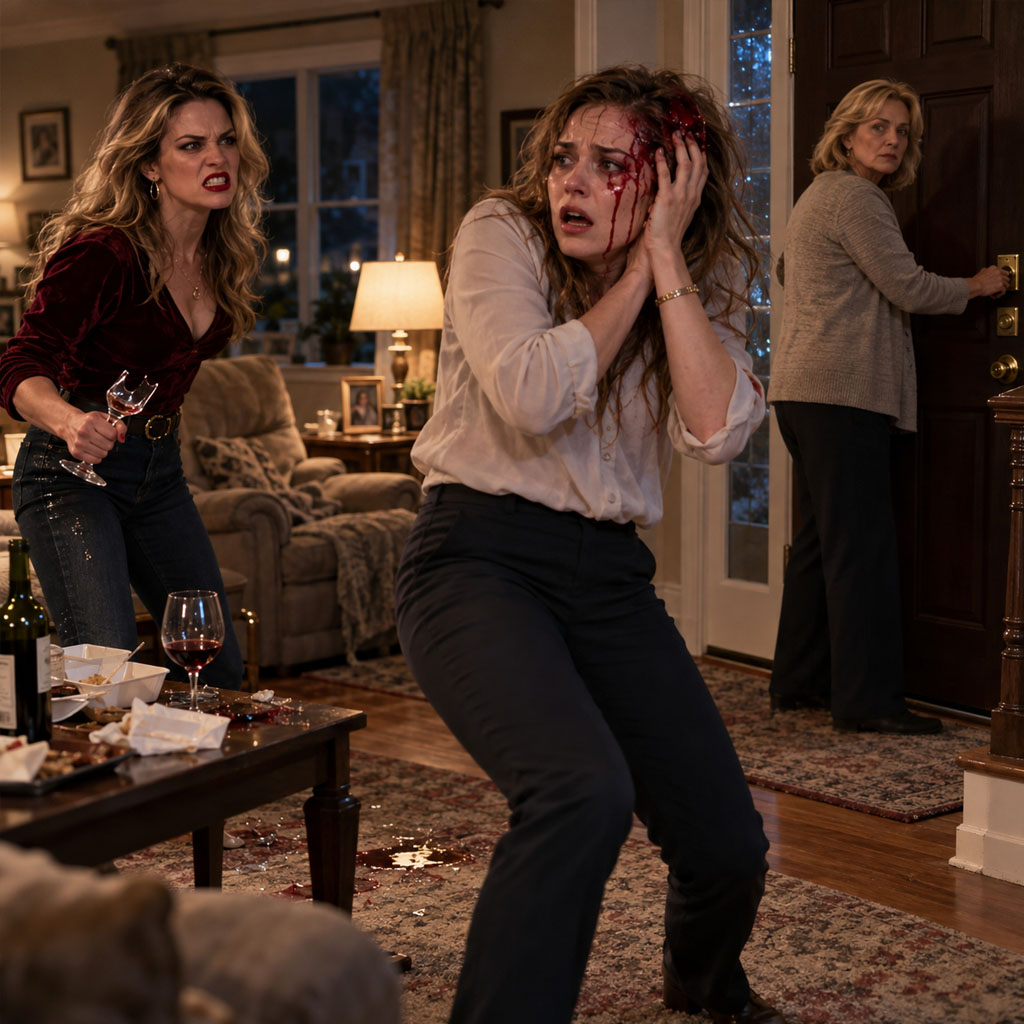
Blood was running into my left eye when I saw my mother turn the deadbolt. My sister was standing over me with a broken wineglass in her hand, and I was begging for someone to call an ambulance. Instead, Mom looked at my sister and said five words I’ll remember for the rest of my life: “Don’t let her out now.”
Chapter 2
The impact sent me stumbling backward. The glass shattered, pain exploded above my temple, and I fell against the coffee table before collapsing onto the rug. When I touched my head, my fingers came away covered in blood.
Vanessa dropped onto me, pinning my shoulders while screaming that I wasn’t going anywhere. I struggled beneath her, dizzy and frightened, while blood soaked the collar of my blouse. I called for Mom, certain that whatever our disagreements, she would never allow her daughter to be seriously hurt.
Instead, she locked the front door.
“Keep her there until she agrees to stay,” she told Vanessa.
Something inside me broke more completely than the glass.
I managed to push Vanessa away and scramble toward the door. My hands were shaking, but I got the lock open and stumbled outside. I reached the sidewalk before realizing I could barely see, so I called 911 and waited beneath a neighbor’s porch light.
At the emergency room, a doctor closed the wound with eight stitches and diagnosed a concussion. A police officer came to take my statement, and a victim advocate explained the process of seeking a protective order. I told them exactly what happened, including what my mother had said.
For years, I’d protected my family from embarrassment. That night, I finally understood that keeping their secrets had never protected me.
Shortly before I was discharged, Mom called.
“Claire, you’ve made a terrible mess,” she said sharply. “There’s blood all over my good rug, and Vanessa hurt her wrist when you shoved her. I expect you home to clean things up.”
I stared at the hospital wall.
“Mom, I have eight stitches in my head.”
“Don’t exaggerate. Your sister was upset because you threatened to abandon us.”
I closed my eyes.
“I’m not coming back,” I told her. “Please don’t contact me again.”
My new life in Philadelphia began with a bandage across my temple and nightmares that woke me in the middle of the night. But each morning, I opened my eyes in a quiet apartment where nobody demanded breakfast or complained about the bills.
Patricia helped ensure my workplace was aware of the protective order. She never treated me as damaged or incapable. Instead, she trusted me with important decisions and reminded me that I’d earned my position.
Then Aunt Dorothy appeared.
She was Mom’s older sister, sixty-eight, and a firm believer that family disagreements belonged behind closed doors. She arrived at my apartment carrying a list of complaints about how badly things were going back home.
“The trash is piling up,” she said. “Your mother’s missed appointments, and Vanessa doesn’t know how to manage the bills. You need to stop this foolishness and come home.”
I pointed toward the fading bruises around my eye.
“Vanessa attacked me, Aunt Dorothy. Mom locked the door while I was bleeding.”
Dorothy looked uncomfortable.
“Your sister has always been emotional. Surely you understand how frightened they are.”
“I understand that they’re frightened of losing my paycheck.”
She left calling me stubborn and unforgiving.
But her visit raised a troubling question. Mom received Social Security benefits and a pension from Dad’s former employer. The house had supposedly been paid off years earlier, so why was she claiming she couldn’t afford basic necessities?
I spoke with a legal adviser and reviewed the household financial documents I’d maintained while managing Mom’s bills. Among those records were statements she’d previously given me from an investment account connected to my grandfather’s estate.
What I discovered made me physically sick.
Mom had received approximately $120,000 from Grandpa’s estate three years earlier. She’d told me the inheritance was tied up in legal expenses and practically worthless.
But the statements showed substantial savings.
They also revealed repeated payments benefiting Vanessa, totaling nearly $50,000 over two years.
While I skipped lunches to afford groceries, Mom was quietly paying off Vanessa’s shopping debts. While I worried about heating bills, my sister was buying expensive handbags and taking weekend vacations.
They hadn’t needed me to keep the household afloat.
They’d needed me to keep funding their comfortable lifestyle.
I gathered copies of the statements I was entitled to retain and sent them to Aunt Dorothy with a letter explaining what I’d discovered. Two days later, she called me crying.
“Claire, I had no idea,” she whispered. “Your mother told me she was nearly destitute.”
“She told me the same thing.”
“I’m so sorry I blamed you.”
I accepted her apology, but I made one thing clear.
“I won’t be going back.”
The following week, Vanessa appeared at my company’s headquarters.
She had driven across Pennsylvania, entered the lobby, and begun shouting that I was a dishonest daughter who’d stolen money from our mother. By the time security contacted Patricia, several clients had witnessed the disturbance.
Vanessa spotted me near the elevators and charged forward.
“You ruined everything!” she screamed. “Aunt Dorothy confronted Mom, and now she won’t pay my bills!”
Security stopped her before she reached me.
I kept my distance and told the officers responding to the incident that a protective order was in effect. Vanessa continued shouting, insisting that I had sabotaged her event-planning career.
She claimed she was coordinating a major wedding expo for a hospitality company that happened to be one of our freight customers. Apparently, she believed embarrassing me at work would force me to support her again.
“You’re going to regret this,” she shouted.
I looked at her calmly.
“No, Vanessa. I’m finally done regretting my own decisions.”
The officers escorted her away after confirming the circumstances of the order.
For the first time, my sister’s temper had consequences that Mom couldn’t erase with an excuse or a check.
Chapter 3
The incident at headquarters frightened me more than I wanted to admit. For several nights, I checked the locks repeatedly and jumped whenever someone knocked on my door. My counselor reminded me that recovering from violence could take time, even after the immediate danger had passed.
Patricia encouraged me to take a few personal days, but I preferred working. My new position was demanding, and I loved the responsibility. Each successful project reminded me that I was capable of building a life beyond my family’s expectations.
Meanwhile, Mom’s financial problems were becoming impossible to ignore.
Aunt Dorothy occasionally called with updates, though I asked her not to involve me in household decisions. Vanessa had lost some of her financial support, and Mom was struggling with expenses she’d never expected to manage alone.
Then, on a cold Saturday morning, my apartment building’s concierge called upstairs.
“Miss Bennett, there’s an older woman here who says she’s your mother. She’s quite upset and asking to see you.”
I nearly refused. But I wanted to make it unmistakably clear that her surprise visit wouldn’t change my decision, so I went downstairs and met her in the public lobby.
Mom was sitting on a sofa, clutching a thick envelope. She looked smaller than I remembered, with gray hair escaping from beneath her knitted hat. When she saw me, she began crying.
“Claire, they’re going to take the house.”
I stopped several feet away.
“What are you talking about?”
She held out the envelope.
“The bank says we’re behind on a loan. They’re threatening foreclosure, and I don’t know what to do.”
I glanced at the notice she offered me.
The outstanding debt exceeded $200,000.
“Mom, I thought the house was paid off.”
Her eyes dropped to the carpet.
Eventually, she admitted she’d borrowed against the property’s value to support Vanessa’s business ambitions and expenses. When the inheritance began dwindling, she’d taken out a substantial loan, believing Vanessa would eventually earn enough to repay it.
Instead, Vanessa continued spending.
Now the payments were overdue, and Mom was facing the possibility of losing the home she’d lived in for thirty years.
“I was trying to help your sister succeed,” she whispered.
I felt an old, familiar ache.
For three years, Mom had watched me work exhausting shifts and worry about grocery bills. She’d let me surrender my apartment and sacrifice my savings while she quietly financed Vanessa’s luxuries.
And somehow, she still expected me to rescue them.
“I know you have a wonderful new salary,” Mom continued. “Maybe you could make the payments until Vanessa gets her business established. We could all work something out.”
I stared at her.
“You’re asking me to take responsibility for another loan you used to support Vanessa?”
“She’s your sister.”
“And I’m your daughter.”
Mom began crying harder.
“Please, Claire. I don’t want to lose my home.”
For one moment, I felt sorry for her. She was an older woman frightened of losing the house she’d shared with Dad, and I understood how painful that must be.
But sympathy wasn’t the same as surrender.
“Mom, you need professional financial advice,” I said gently. “You may have options, but I can’t pay this debt.”
She reached for my arm.
“Please come home. We can be a family again.”
I stepped back.
“Do you remember what happened the night Vanessa attacked me?”
Her expression changed.
“We were all upset.”
“She broke a glass against my head.”
“I know, sweetheart, but—”
“And you locked the door.”
Mom said nothing.
“I needed you to help me, and you stopped me from escaping. You never even asked whether I was going to be all right.”
Her eyes filled with tears.
“I didn’t think she’d hurt you that badly.”
The words struck me with terrible clarity.
She was still measuring my suffering against Vanessa’s convenience.
“You don’t understand what you did,” I said. “And until you do, there isn’t anything left for us to discuss.”
I turned toward the elevators.
“Claire, I’m your mother!”
I stopped briefly.
“I know,” I answered. “That’s what makes it so difficult.”
Then I went upstairs.
Several months later, Vanessa’s criminal case finally reached a resolution. Medical records, testimony, and evidence from the workplace incident established what had happened. Her attorney suggested that our family’s financial disagreement had provoked the confrontation, but the prosecutor emphasized that an argument never justified violence.
I testified about the attack and the moment Mom locked the door. Sitting in the courtroom, speaking in front of strangers, was frightening. Yet every truthful sentence seemed to loosen something that had been tied inside me for years.
Vanessa was convicted of assault and the protective-order violation. She received supervised probation, was ordered to pay restitution for my medical expenses, and had to comply with strict conditions. The court also required her to maintain lawful employment and complete an anger-management program.
For the first time in years, Vanessa couldn’t simply announce that she was too sensitive or creative to accept responsibility.
She eventually found work at a local diner.
Aunt Dorothy told me she complained about the early hours, the demanding customers, and the plain uniform. But the job gave her regular wages, and she began making restitution payments.
I didn’t celebrate her humiliation.
I hoped having real responsibilities would teach her something Mom’s endless indulgence never had.
The situation with our mother’s house ended less favorably.
After months of missed payments and unsuccessful attempts to resolve the debt, the property was sold through foreclosure. Mom moved into a modest senior apartment complex where she could receive assistance with daily activities.
One final coincidence reached me through Aunt Dorothy.
The home-care agency serving Mom’s new residence was the same agency I’d originally arranged before leaving. The supervisor responsible for her care team was Helen, the experienced caregiver Mom had dismissed when she canceled the services.
Helen treated her professionally, according to Dorothy, but Mom now had to follow the agency’s schedules and policies. She couldn’t demand that a daughter sacrifice her career to accommodate every preference.
I wondered whether she ever remembered the day she’d deliberately sent Helen away.
Perhaps she did.
Perhaps she still believed she’d done nothing wrong.
Either way, it was no longer my responsibility to find out.
Chapter 4
Eighteen months after the attack, my life had become almost unrecognizable.
I’d been promoted again, this time to director of regional logistics. The company trusted me to oversee several distribution centers, and Patricia remained both my mentor and a good friend.
I purchased a sunny two-bedroom condominium overlooking a tree-lined street in Philadelphia. It had hardwood floors, a small balcony, and a kitchen where I could make breakfast without worrying about someone criticizing the coffee.
I filled the rooms with plants and books. On weekends, I visited farmers markets, explored the city, and occasionally drove into the countryside simply because I enjoyed the scenery.
My life wasn’t perfect.
Some nights, I still remembered the sound of glass breaking. Sudden arguments could make my heart race, and the thin scar above my left temple would probably never disappear completely.
But I was healing.
I was also learning something that should have been obvious years earlier: love doesn’t require you to become smaller so another person can feel important.
One Sunday morning, I was cleaning a closet when I discovered a cardboard box containing old family photographs. I carried it into the living room and opened the lid.
There were pictures of birthdays, Christmas mornings, summer vacations, and backyard cookouts. Dad was smiling in most of them, his arm around Mom or one of us girls. He’d died when I was twenty-three, before our family began falling apart.
In one photograph, I was about ten years old, standing beside Vanessa at the county fair. She was holding an enormous stuffed bear she’d won at a carnival booth. I was smiling proudly because I’d helped her win it.
I remembered that afternoon.
Vanessa had missed the target several times, and I’d given her the last of my tickets so she could try again. When she finally won, Mom praised her determination and told everyone what a talented girl she was.
I hadn’t minded.
Back then, making my sister happy had felt like enough.
Looking at that photograph now, I realized how early I’d learned to measure my own worth by what I could provide for someone else.
I closed the album.
For years, I’d wanted Mom to acknowledge that she loved me as much as Vanessa. I’d hoped that if I worked harder, earned more, complained less, or sacrificed enough, she’d finally recognize everything I’d done.
But there was no amount of sacrifice that could make another person grateful.
I put the photographs away and went outside to water my balcony plants.
The air was cool, and sunlight touched the rooftops across the street. A church bell rang somewhere in the distance, reminding me of Sunday mornings when Dad used to make pancakes while Mom got us ready for services.
My phone buzzed on the table.
It was Aunt Dorothy.
We still exchanged occasional messages, though our relationship had changed. She’d apologized for believing Mom’s accusations, and I appreciated that, but I remained cautious about how much of my new life I shared.
Her message was longer than usual.
“Claire, I know this may be difficult to hear. Your mother is having hip replacement surgery on Tuesday. She’s frightened, and she’s been asking for you. She wants to see you for a few minutes before the operation. I promised I’d ask, but the decision is yours.”
I sat down.
For several minutes, I simply stared at the screen.
I imagined Mom lying in a hospital bed, frightened of anesthesia and worried about whether she’d survive. She was getting older, and despite everything, she was still the woman who’d raised me.
I remembered her reading bedtime stories when I was little. I remembered the smell of her Sunday pot roast and the way she used to brush my hair before school.
Those memories were real.
So were the others.
I remembered standing in the kitchen after a twelve-hour shift, trying to stretch my last forty dollars until payday while Vanessa admired another expensive handbag.
I remembered losing my mountain vacation because Mom decided Vanessa’s wine festival mattered more.
And I remembered lying on the living room carpet, blood running into my eye, while the woman who’d given me life turned the lock against me.
That memory didn’t erase every good thing she’d ever done.
But it changed what I could safely allow her to do again.
I thought carefully about what forgiveness meant.
For a long time, I’d believed forgiveness required reconciliation. I’d assumed that being a good daughter meant returning whenever Mom called, regardless of how much pain it caused me.
My counselor had helped me understand that those were separate decisions.
I could release my anger without pretending nothing had happened. I could wish my mother peace without placing myself back under her control. And I could acknowledge her fear without accepting responsibility for making it disappear.
I picked up my phone.
“Please tell Mom I hope her surgery goes well,” I wrote to Dorothy. “But I won’t be visiting. I need you to respect that decision.”
I read the message once before sending it.
Then I placed my phone on the table and went back to watering the flowers.
For a moment, sadness washed over me. I wished our family had been different. I wished Vanessa and I could have remained the little girls in that county fair photograph, laughing over a stuffed bear without knowing how cruel we might someday become to each other.
Most of all, I wished Mom had opened the door that night.
But wishing couldn’t change the past.
I had spent three years surrendering my independence and eighteen months rebuilding it. I had worked too hard to return to a life where my value was determined by how much I could endure.
That afternoon, I made myself a cup of coffee and sat outside with a book. The city was peaceful, and the flowers along my balcony railing moved gently in the breeze.
My fingers brushed the faint scar near my temple.
Once, I’d hated that mark because it reminded me of the worst night of my life. Now it reminded me that I had survived, asked for help, told the truth, and found the courage to begin again.
I no longer needed my mother to admit what she’d done before I could move forward. I didn’t need Vanessa to apologize, and I didn’t need anyone’s permission to be happy.
The woman who’d once been afraid to take a three-day vacation now had an entire future waiting for her.
And for the first time, I intended to enjoy it.
As the afternoon sun warmed my face, I thought of the heavy wooden door in my mother’s house and the sound of the deadbolt sliding into place.
That night, Mom had locked the door because she believed she could keep me from leaving.
What she never understood was that she hadn’t trapped me forever.
She’d finally given me the reason to walk away.
And this time, I wasn’t looking back.
THE END.