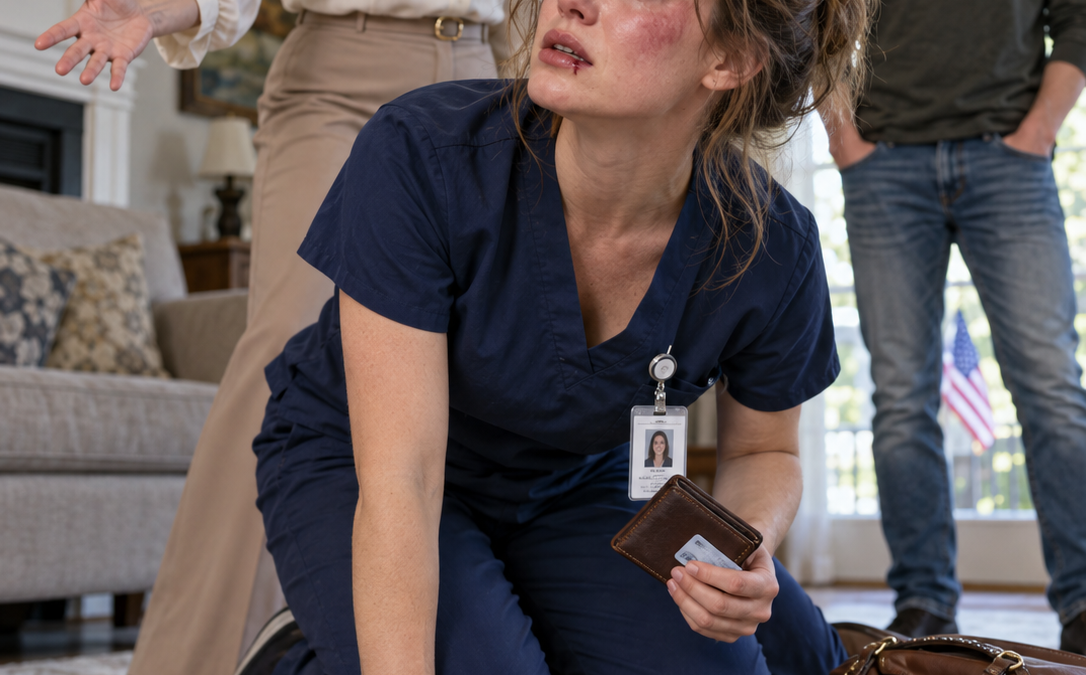
“Pay Caleb $1,200 or get out!” my stepmother screamed before slapping me across the face. My stepbrother laughed as I hit the floor, my hospital badge digging into my chest and Dad’s framed photograph shattering beside me. I fled into Tennessee rain, bleeding and shaking. Then my fingers found the silver card Dad had hidden in his old leather wallet.
Part 1
“Pay Caleb $1,200 tonight, or get the hell out of my house.”
Those were the first words my stepmother said when I walked through the front door after twelve hours in the ICU.
I was still wearing navy-blue scrubs. My hospital badge hung from my collar, my feet hurt inside my sneakers, and the only thing I’d eaten since breakfast was half a turkey sandwich from the nurses’ lounge.
I looked at Jillian standing in the middle of our living room.
“Good evening to you, too.”
“Don’t get smart with me, Avery.”
“I’m not getting smart. I’m getting home from work.”
She held out her hand.
“Caleb needs the money.”
I glanced toward the couch. My twenty-two-year-old stepbrother was stretched out with a PlayStation controller in his hands, an open beer beside him.
He didn’t even bother looking embarrassed.
“For what?” I asked.
“That’s none of your business,” Jillian said.
“Then neither is my bank account.”
Caleb paused his game.
“Wow. Somebody thinks she’s important because she works at a hospital.”
I ignored him.
“Jillian, I paid you $900 in rent last Friday. My student loan payment came out this morning, and I bought groceries on Sunday. I’m not giving Caleb another twelve hundred dollars.”
Her expression changed.
“You live under my roof.”
“I pay to live under your roof.”
“You should be grateful I haven’t thrown you out.”
“Then maybe stop charging me like I’m your tenant and treating me like I’m your unpaid employee.”
The slap came before I finished speaking.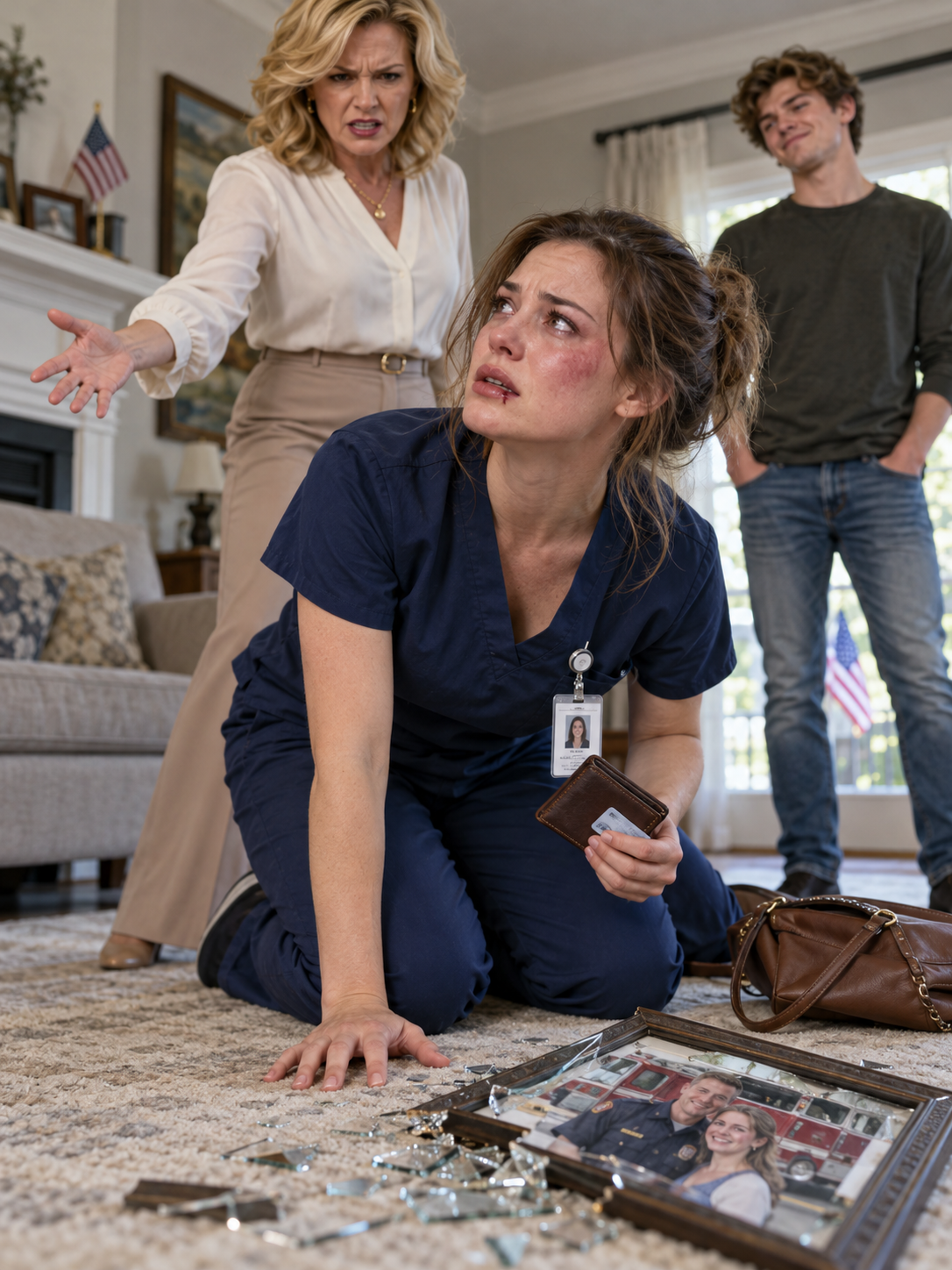
My head snapped sideways. My cheek burned, and the metal edge of my badge struck my collarbone.
For a moment, I couldn’t believe she’d actually done it.
Jillian had grabbed me before. She’d shoved me into doorframes and once pulled my hair because I’d refused to cancel a shift.
But this was different.
I straightened slowly.
“Don’t touch me again.”
She slapped me a second time.
Caleb laughed.
“You really don’t know when to shut up.”
I stepped backward, bumping the framed photograph of my father hanging beside the hallway.
“I’m leaving,” I said.
Jillian moved between me and the door.
“Not until you apologize.”
“Move.”
“Excuse me?”
“I said move.”
Caleb got off the couch.
He smelled like cheap beer when he approached.
“You don’t talk to my mother like that.”
“Caleb, stay out of this.”
He shoved me.
My shoulder struck the wall. The photograph behind me fell, and glass scattered across the carpet.
I looked down.
It was the picture Dad and I had taken outside his Nashville fire station when I graduated from high school.
He had one arm around me. I was wearing my graduation gown, holding my diploma and grinning so hard my cheeks hurt.
Now a crack ran straight across his face.
“Look what you did,” Jillian snapped.
I stared at her.
“Are you serious?”
“Pick it up.”
“No.”
Caleb grabbed my arm.
“You heard her.”
“Let go.”
He shoved me again.
I lost my balance and landed hard on my knees. Before I could get up, he struck me in the back, and Jillian kicked my side.
The pain made it difficult to inhale.
“Maybe that’ll teach you some respect,” she said.
I heard Caleb laughing again.
That’s what I remember most clearly.
Not the slap. Not the broken glass.
His laughter while I struggled to get off the floor.
I pushed myself upright, grabbed my purse from the entryway, and ran.
Behind me, Jillian shouted, “And don’t expect to come back when you realize you can’t afford to live on your own!”
I slammed the door.
Cold Tennessee rain soaked my scrubs before I reached my car.
My fingers slipped twice on the keys. When I finally got inside, I locked the doors and leaned against the steering wheel.
I was twenty-nine years old.
I had a nursing degree, a full-time job at a respected Nashville hospital, and years of experience keeping critically ill patients alive.
Yet I’d just run out of my childhood home because two people who depended on my paycheck had decided I wasn’t giving them enough.
I looked at my swollen cheek in the rearview mirror.
Then I noticed the blood on my lower lip.
“Enough,” I said aloud.
It was the first time I’d said that word and actually meant it.
I reached into my purse for my phone, but my fingers brushed against something else.
An old brown leather wallet.
Dad’s wallet.
I hadn’t used it for money in years. The stitching was coming apart, and the leather had softened from being carried everywhere.
Inside was a faded photograph of us at a county fair.
Behind it was a silver bank card.
I took it out.
The card had no familiar bank logo across the front. Just a discreet emblem and my father’s initials engraved in the corner.
He’d given it to me on my seventeenth birthday.
“Avery, keep this somewhere safe,” he’d said.
I’d been sitting at our kitchen table eating birthday cake.
“What is it?”
“Something for you.”
“Is there money on it?”
He’d smiled.
“Enough for an emergency.”
“How much?”
“Hopefully, you’ll never need to find out.”
I’d laughed and tucked it into my wallet.
Then he’d reached across the table and covered my hand.
“Listen to me, sweetheart. If you ever find yourself somewhere you can’t stay, don’t let pride keep you there.”
I remembered rolling my eyes.
“Dad, I’m seventeen. Where exactly am I going?”
“Just promise me.”
So I had.
Twelve years later, I sat in my car with bruised ribs and a swollen face, staring at that card.
I had always assumed it contained a few hundred dollars.
Maybe enough for a hotel.
Maybe a security deposit if I got lucky.
I started the engine.
And instead of turning toward the cheapest motel in town, I drove toward the old brick bank near the hospital.
I didn’t know it yet, but my father had been keeping a secret for most of my life.
Dad was a firefighter.
For twenty-seven years, he worked for the Nashville Fire Department, coming home smelling of smoke, diesel, and whatever terrible coffee the guys at the station had made that day.
He wasn’t wealthy, at least not as far as I knew.
He drove an aging Ford pickup, fixed things instead of replacing them, and argued with himself every time he considered buying a new television.
But he always found money for my school supplies, field trips, and birthday dinners.
When I was fifteen, he introduced me to Jillian.
She arrived wearing a pale-blue dress and carrying a homemade peach cobbler.
“I’ve heard so much about you, Avery,” she said.
She hugged me before I had a chance to decide whether I wanted one.
Dad looked happy.
My mother had been out of our lives for years, and he had raised me mostly alone. I wanted him to have someone who made him laugh when he came home.
So when he announced their engagement, I told him I was excited.
I meant it.
That was before Jillian started calling our house hers.
The first argument was over a coffee mug left in the kitchen sink.
Dad had left it there.
Jillian blamed me.
When I explained, she folded her arms.
“Don’t correct me in my own home.”
I remember thinking it was an odd thing to say.
Dad had owned the house long before meeting her.
A few months later, she’d started deciding when I could use the kitchen, what clothes I could wear, and how long I was allowed to talk to my father after he came home.
If I challenged her, she cried.
If Dad questioned her, she claimed I was deliberately making her feel unwelcome.
Eventually, he stopped asking what had happened and started asking us both to get along.
Caleb learned quickly how useful that was.
He was Jillian’s son from her previous relationship, and she defended him regardless of what he did.
He could break something, blame me, and walk away while I cleaned it up.
He could take cash from her purse, and somehow I’d end up explaining why I’d been in the kitchen that afternoon.
Dad tried.
I know he did.
But his shifts were long, Jillian was relentless, and he kept believing things would improve.
They didn’t.
When I started nursing school, Jillian complained that I spent too much time studying.
When I got my first hospital job, she accused me of acting superior.
And when Dad became sick, she found a new reason to make everything about herself.
Stage-four lung cancer.
My father had never smoked, but he’d spent decades responding to fires and breathing whatever came out of burning buildings.
The doctors explained his prognosis carefully.
I understood what they were telling us.
I just didn’t want to believe it.
He spent his final weeks in the hospital.
I came straight from nursing school whenever I could, sitting beside his bed with my textbooks open while he slept.
Jillian would arrive, complain about parking, and ask whether the hospital could provide better food.
Once, when Dad was barely awake, she told him he should have increased his life insurance.
I walked out before I said something I’d regret.
The night he died, I was holding his hand.
He opened his eyes and looked directly at me.
“Everything’s taken care of, Avery.”
I thought he meant the funeral.
“I love you, Dad.”
“Love you, sweetheart.”
Those were his last words.
Within two weeks, Jillian told me he’d left everything to her.
“The house is mine now,” she said. “If you want to stay, you’ll need to start contributing.”
I was twenty-five, working while managing my remaining student loans.
I asked to see the paperwork.
She told me she was handling the estate and that I needed to stop making her grief harder.
Eventually, I stopped asking.
She charged rent.
Then she expected groceries.
Then she started asking me to cover utilities whenever Caleb spent too much.
I stayed because I couldn’t imagine abandoning the home Dad had built for us.
And because, after enough years of being told you aren’t wanted, you start believing you should be grateful for whatever space you’re allowed to occupy.
That changed the night Jillian demanded $1,200.
The bank was preparing to close when I arrived.
A security guard held the door for me, giving my wet scrubs and swollen cheek a quick, concerned look.
Inside, the lobby was almost empty.
A woman behind the counter asked whether I needed assistance.
“I hope so.”
I placed the silver card in front of her.
“My father gave me this years ago. I need to know whether the account is still active.”
She examined it.
“May I see your identification?”
I handed over my driver’s license.
She entered the information, checked something on her monitor, and stopped typing.
“Could you give me one moment, Ms. Dalton?”
“Is something wrong?”
“No. I just need to speak with my manager.”
She picked up the phone.
Less than five minutes later, a gray-haired man in a dark suit came into the lobby.
“Ms. Dalton? I’m Robert Hughes, the branch manager.”
He glanced at my cheek.
“Before we discuss anything else, are you safe?”
I almost said yes automatically.
Instead, I answered, “I am now.”
He nodded.
“Would you mind coming into my office?”
I followed him down a quiet hallway.
He offered me water and asked whether I needed medical assistance. I told him I’d get checked at the hospital afterward.
Then he verified my identity through several additional questions and began explaining the card.
“Your father established a trust for your benefit many years ago,” he said.
“A trust?”
“Yes. The card identifies an account associated with it, although the actual assets are held across several accounts and investments.”
I stared at him.
“Are we talking about a savings account?”
“Not exactly.”
He turned his monitor toward me.
There was a statement on the screen.
I looked at the figures.
Then I looked again.
The combined value of the assets was in the millions.
Not thousands.
Millions.
“I think you have the wrong person,” I said.
Mr. Hughes checked the documents.
“Avery Dalton, daughter of Daniel Dalton?”
“Yes.”
“Date of birth?”
I gave it to him.
He nodded.
“Then we have the right person.”
I sat back in the chair.
My father, the man who clipped grocery coupons and wore the same winter coat for ten years, had left me more money than I’d earned in my entire career.
Mr. Hughes explained that Dad had invested consistently for decades.
He’d purchased property around greater Nashville when prices were much lower, invested early in technology and healthcare companies, and reinvested much of what those assets earned.
The trust had been established before he married Jillian.
I was its beneficiary.
Its protections meant Jillian couldn’t simply claim the money as part of Dad’s estate.
“Why didn’t he tell me?” I asked.
Mr. Hughes was quiet for a moment.
“He left a letter for you.”
He opened an archived document.
There was my father’s handwriting.
I recognized the slightly crooked capital A immediately.
My daughter Avery is stronger than she realizes. If she’s reading this, life has pushed her too far, and she needs a way forward. This account is for her protection. Tell her I love her and I’m proud of her.
I read it three times.
Then I lowered my head and cried.
Mr. Hughes didn’t interrupt.
When I could speak again, I asked, “Did he know something was going to happen?”
“I can’t tell you what he knew. But he was very particular about keeping these assets separate and making sure you could access them independently.”
That sounded like Dad.
He had spent his entire career preparing for emergencies other people never imagined.
Apparently, he had prepared for mine, too.
I spent another forty minutes reviewing what could be accessed immediately and what required additional paperwork.
I didn’t ask for everything.
I asked for enough to get somewhere safe, hire an attorney, and stop worrying about next month’s rent.
Mr. Hughes arranged the necessary banking steps.
Before I left, he handed me a folder.
“Ms. Dalton, whatever brought you here tonight, please take care of yourself.”
I looked at the silver card.
“I think I finally will.”
I drove to the hospital emergency department to have my injuries documented.
Afterward, I booked a hotel room near downtown Nashville, ordered a turkey club sandwich, and sat on the bed in borrowed hotel slippers.
For the first time in four years, I didn’t have to listen for Jillian’s footsteps outside my door.
My phone had thirty-seven missed calls.
The first voicemail was from Caleb.
“You better come home and apologize.”
The next was Jillian.
“Don’t think you’re getting your rent money back.”
Then another.
“Avery, honey, I think we all got a little upset.”
I listened to that one twice.
Apparently, being assaulted in your own living room was now a mutual misunderstanding.
I saved the messages.
Then I searched for a Nashville attorney.
Monica Graves didn’t waste time.
She was in her late forties, wore a charcoal pantsuit, and had the kind of direct manner I appreciated in emergency physicians.
When I arrived at her office the following morning, she noticed my face immediately.
“Did you report this?”
“I had the injuries documented last night. I still need to make the police report.”
“Good. We’ll make sure that happens today. Start at the beginning.”
I told her about Jillian.
About Caleb.
About the rent, the intimidation, and the night I’d finally run.
Then I placed the bank folder on her desk.
Monica studied it.
“Your father created this before his marriage?”
“Yes.”
“And Jillian told you he’d left her everything?”
“Yes.”
“Did you ever see a will?”
“No.”
“What about the probate documents?”
“I didn’t know there were any.”
She set down her pen.
“Avery, we’re going to look into the estate. But first, we’re going to address your safety.”
Over the next several days, Monica helped me begin the process of seeking protection from Jillian and Caleb.
I moved into a one-bedroom apartment near the hospital.
It had hardwood floors, a small balcony, and a kitchen barely big enough for two people.
I loved it.
I ate Chinese takeout on the living room floor because my furniture hadn’t arrived.
Nobody complained about the food.
Nobody demanded money.
Nobody told me when to go to bed.
Then the messages started again.
Jillian accused me of abandoning her.
Caleb threatened to show up at the hospital.
One evening, Monica called with her first findings from the county records.
“Avery, I need to ask you something. Did your father ever talk about refinancing the house?”
“No. Why?”
“Because Jillian refinanced it twice after his death, and some of the paperwork raises serious questions about the signatures used to establish her authority.”
I stared at the wall.
“What kind of questions?”
“The kind that require an independent document examiner.”
The next morning, I found a photograph beneath my apartment doormat.
It showed Dad and me at the Nashville Zoo.
Someone had torn it in half and taped it back together.
The tear ran directly through my face.
Two days later, a shoebox appeared outside my door.
Inside was the stuffed giraffe Dad had won for me at a county fair.
Its ear had been ripped off.
I called the police.
I installed security cameras.
I asked my coworker Jenna to walk me to my car after shifts.
Then, during a break at the hospital, my phone received a message from an unknown number.
It was a photograph of my apartment building.
Taken from across the street.
That night.
Underneath were five words.
You cannot hide from family.
I forwarded everything to Monica.
She called immediately.
“Avery, don’t respond. I’m requesting an emergency hearing, and I need you to preserve every message.”
Then she paused.
“There’s something else.”
I gripped my phone.
“What?”
“We’ve received additional estate records. Your father supposedly signed documents giving Jillian control over property he had planned for you.”
“I don’t understand.”
“Neither do I. The signatures don’t match his verified records, and some of the transactions were made after he died.”
I sat completely still.
Monica continued.
“Avery, your stepmother may not have just lied about inheriting the house.”
I waited.
“She may have stolen it.”
And suddenly, I understood why Jillian had been so desperate to keep me under her roof.
The woman who’d spent four years calling me a parasite might have been living in a house she had no legal right to claim.
And I had just hired the attorney who intended to prove it.
Part 2
“You’re trying to steal my house!”
Jillian screamed those words into a voicemail three days after Monica filed the first court papers.
I was sitting at my kitchen counter eating cereal when I heard it.
She sounded furious.
Then, without warning, her tone changed.
“Avery, sweetheart, please. Your father wouldn’t want us fighting.”
I paused the recording.
My father wouldn’t have wanted his daughter assaulted, either.
That detail never seemed to make it into Jillian’s speeches.
I saved the voicemail and forwarded it to Monica.
Ten minutes later, Caleb left another message.
“Keep running your mouth to that lawyer. See what happens.”
I saved that one, too.
For years, I’d deleted his threats because I didn’t want to look at them again.
Now I wanted every word preserved.
Monica had explained that we were dealing with two related but separate issues.
The first was my safety.
The second was my father’s estate.
“We’re not going to turn your protection hearing into a full probate trial,” she told me. “We need the right evidence in front of the right judge.”
She hired a forensic document examiner, requested additional estate records, and began challenging the property transfers.
She also made sure I understood something important.
“Having money doesn’t automatically mean you’ll win. We’re going to prove what happened.”
I respected that.
I didn’t want someone telling me what I wanted to hear.
I’d lived with that kind of manipulation long enough.
The emergency protection hearing was scheduled for the following week.
Monica met me outside the courthouse.
I wore a navy blouse, black slacks, and flats. My cheek had mostly healed, although my ribs still hurt when I twisted too quickly.
Inside the courtroom, Jillian was already seated.
Pearl earrings.
Perfect makeup.
A floral blouse that made her look like she was attending a Sunday church luncheon.
Caleb sat beside her, bouncing one knee.
When he saw me, he smirked.
Jillian looked me over and whispered something to her attorney.
I couldn’t hear it.
For once, I didn’t need to.
Monica presented the police reports, photographs of my injuries, threatening voicemails, and records of the items left outside my apartment.
She showed the court the photograph of Dad and me that had been torn apart.
Then the damaged stuffed giraffe.
Then the messages from the unknown number.
Finally, she played Caleb’s voicemail.
Keep running your mouth to that lawyer. See what happens.
His attorney looked down at his notes.
Caleb stopped smiling.
Jillian claimed the whole situation was exaggerated.
“She has always been emotional,” she told the judge. “We had a disagreement. She’s turning it into something ugly.”
Monica asked whether she considered striking me twice a disagreement.
Jillian adjusted her pearls
“I was under tremendous stress.”
“And your son?”
“Caleb was protecting me.”
“From what?”
Jillian hesitated.
“She was being disrespectful.”
Monica didn’t raise her voice.
“Was Ms. Dalton physically threatening you?”
“No, but—”
“Had she struck you?”
“No.”
“Was she trying to leave?”
Jillian looked toward her attorney.
“Yes.”
Monica let the answer sit.
Then she asked, “So your son was protecting you from a woman trying to leave the house?”
Nobody laughed.
But Jillian looked like she’d just realized how her explanation sounded.
When I testified, I didn’t deliver a speech.
I described coming home from the hospital.
I explained the demand for $1,200.
I described the slaps, Caleb’s shove, the fall, and the kick.
I told the judge I’d gone to the emergency department afterward.
Then I explained what happened after I moved out.
The photograph.
The giraffe.
The messages.
The person watching my apartment.
When the judge asked whether I was afraid, I answered directly.
“Yes.”
“Why?”
“Because they’ve already hurt me, and they don’t like that I left.”
The judge granted a protective order restricting contact and requiring them to stay at least 500 feet away from me, subject to the order’s terms.
Jillian shook her head.
Caleb whispered something his attorney immediately told him to stop saying.
The estate fraud allegations remained for separate proceedings, but the judge took notice of the apparent financial conflict underlying the harassment.
Outside the courtroom, Jillian called after me.
“Your father would be ashamed of what you’re doing!”
A court officer told her to stop.
I turned.
“My father spent twenty-seven years running into burning buildings to help strangers,” I said. “I don’t think he’d be impressed by what you did to his daughter.”
Then I walked away.
Three days later, Monica called while I was washing my hands after an ICU shift.
“The handwriting examination is back.”
I stepped into an empty consultation room.
“And?”
“The signatures on multiple property documents were not written by your father.”
I sat down.
For a moment, I could hear the air-conditioning unit rattling above me.
Monica continued.
“The report supports our challenge to the property transfers. We’re also referring the suspected forgery and financial misconduct to the appropriate investigators.”
“How much did she take?”
“We’re still tracing it.”
“Monica.”
She paused.
“The transactions under review exceed one million dollars.”
I stared at the floor.
My father had spent years putting money away for my future.
Jillian had spent the years after his death extracting value from his estate while charging me rent to stay in my childhood bedroom.
It was almost impressive.
If you ignored the part where it was fraud.
Monica’s team found unauthorized transfers, suspicious loans, and property transactions that Jillian had no valid authority to make.
She had refinanced the house twice.
She had used Dad’s truck as collateral for a loan.
And Caleb had continued using one of Dad’s credit cards after his death.
When investigators reviewed the financial history, the pattern became increasingly difficult for Jillian to explain.
She’d claimed she was barely surviving.
Yet money had been moving into her personal accounts while she demanded rent and grocery money from me.
The court eventually froze disputed assets pending further review and appointed an independent administrator to protect the estate.
Jillian was ordered to leave the house while the property dispute proceeded under court supervision.
Monica called me when it happened.
“She’s out.”
I was standing in a Starbucks line near the hospital.
I stepped aside.
“What did she say?”
“Nothing suitable for polite conversation.”
“That’s never stopped her before.”
Monica actually laughed.
“Apparently, she informed the deputy that she’s being persecuted.”
“Did she mention the forged signatures?”
“Not voluntarily.”
I looked down at the coffee I’d just ordered.
For years, Jillian had treated that house as proof that she controlled me.
Now she couldn’t even get through the front door.
I expected to feel victorious.
Instead, I remembered Dad teaching me how to fix a loose porch step when I was twelve.
I remembered him planting a rosebush beside the driveway because I’d insisted the front yard needed flowers.
I remembered sitting at the kitchen table studying for nursing exams while he made grilled cheese sandwiches.
Those memories belonged to him and me.
Jillian had never been entitled to rewrite them.
The investigation became public when a local Nashville news station reported questions surrounding the Dalton estate.
The reporter stood outside our old house discussing disputed property transfers and a pending investigation.
My name wasn’t included.
Jillian’s was.
One of Dad’s former coworkers contacted investigators after seeing the report.
He remembered Dad talking about making sure I would always have a home.
Another confirmed that Dad had mentioned creating a trust for me years before his cancer diagnosis.
Meanwhile, Jillian’s attorney withdrew from the case after their working relationship broke down.
Caleb wasn’t doing much better.
He’d become increasingly reckless, and police documented a separate incident involving suspected impaired driving.
His use of Dad’s credit card also attracted criminal scrutiny.
For the first time, Jillian and Caleb had to answer questions they couldn’t settle by shouting at me.
At one point, Jillian called Monica’s office asking to speak with me.
She said she was frightened.
She said she had nowhere to live.
She said I needed to remember that we were family.
Monica relayed the request because it involved my case.
“Do you want me to communicate any response through counsel?” she asked.
“No.”
“Are you sure?”
“Yes.”
I looked around my apartment.
There were framed photographs on the shelves now.
Plants beside the balcony.
A new sofa I’d chosen without anyone telling me I was wasting money.
I had a place to live.
I had a job.
I had a bank account Jillian couldn’t touch.
And I had no obligation to comfort someone who had repeatedly hurt me.
“No message,” I repeated.
Monica said she understood.
That was the end of it.
Not everything improved just because the legal case was going well.
I still woke up some nights convinced I’d heard Caleb outside my door.
I checked the locks more often than necessary.
Sometimes, when someone raised their voice at work, my body reacted before I could remind myself I was safe.
Monica recommended speaking with a therapist.
So I began meeting with Dr. Harrison.
She was a woman in her early fifties who asked straightforward questions and didn’t seem interested in telling me how I was supposed to feel.
During our third session, she asked why I’d stayed with Jillian for so long.
“Student loans,” I said.
She waited.
“Rent was expensive.”
She waited again.
Finally, I admitted the part I’d avoided.
“It was Dad’s house.”
“What would leaving have meant to you?”
I stared at the tissue box on her desk.
“That I was abandoning him.”
Dr. Harrison nodded.
“Do you believe your father wanted you to stay somewhere unsafe?”
I thought about the silver card.
About the letter at the bank.
About the promise I’d made when I was seventeen.
“No.”
“Then perhaps leaving wasn’t abandoning him.”
I didn’t have an answer.
But I thought about that conversation for days.
Around that time, I started spending more time with Evan.
We’d worked at the same hospital for years, although I’d never allowed myself much of a social life.
When you spend every shift caring for patients and every evening trying to avoid conflict at home, dating doesn’t rank very high on your list of priorities.
Evan had always been friendly.
He remembered how I took my coffee.
He’d cover a task without making a production of it.
And after difficult shifts, he seemed to know when I wanted to talk and when I needed five minutes without another person asking me for something.
One evening, I found him in the break room reviewing patient charts.
“Have you eaten?” he asked.
“Does a packet of crackers count?”
“Only if you’re stranded on a mountain.”
“Then no.”
“There’s a diner two blocks away. Want to get dinner?”
My first instinct was to decline.
Not because I didn’t like him.
Because I was used to going home immediately after work.
Then I remembered I no longer had to.
“Sure.”
We went to a small diner with vinyl booths and coffee that tasted considerably better than anything from our hospital vending machine.
He ordered a burger.
I ordered breakfast for dinner.
We talked about work, favorite movies, and whether the Tennessee Titans would ever stop making Sundays unnecessarily stressful.
He didn’t ask about Jillian.
He didn’t press me for details about the court case.
Eventually, I brought it up myself.
“Things at home were pretty bad for a while,” I said.
He set down his coffee.
“Do you want to talk about it?”
“A little.”
“Okay.”
So I told him some of it.
Not everything.
Enough.
He listened.
When I finished, he didn’t tell me I should have left sooner.
He didn’t suggest revenge.
He didn’t promise he could fix it.
He said, “I’m sorry that happened to you.”
Then he asked whether I wanted another cup of coffee.
It was such a normal response that I nearly laughed.
I’d spent years around people who treated every conversation as an opportunity to control me.
Evan just wanted to know whether I needed anything.
We began getting dinner occasionally after work.
Then coffee on our days off.
Then walks in Centennial Park.
It was slow.
I liked slow.
Once, after an especially difficult ICU shift, he walked me to my car.
“Can I give you a hug?” he asked.
I nodded.
He held me briefly, then stepped back.
“Get home safe.”
That was all.
He didn’t act entitled to anything because he’d been kind to me.
And over time, I stopped expecting him to.
The final estate proceedings took months.
By spring, Monica’s team had assembled the records establishing the history of Dad’s property, the disputed transfers, the forged documents, and the assets that had been improperly diverted.
The courtroom felt different from the first time I’d entered it.
I was no longer checking every doorway for Caleb.
I wasn’t wondering whether Jillian could force me to return home.
She couldn’t.
The evidence was documented, and my lawyer knew exactly what she was doing.
Jillian arrived looking exhausted.
Her hair was pulled into a loose bun. She wore a plain jacket instead of her usual expensive clothes.
Caleb sat several seats away from her.
Neither looked at the other.
That alone told me something had changed.
Monica presented the findings.
The handwriting expert’s report identified signatures that did not belong to my father.
Financial records showed unauthorized transfers and loans.
The verified estate records contradicted Jillian’s claims of ownership.
Her attorney attempted to explain some transactions as misunderstandings during a period of grief.
Monica responded by directing attention to their timing.
“And what about the second refinancing?” she asked.
Jillian’s attorney hesitated.
“Mrs. Dalton believed she had authority to manage the property.”
“Based on documents that the forensic examiner has identified as forged?”
Jillian abruptly leaned toward her lawyer.
He motioned for her to stop speaking.
Then Caleb was questioned about transactions made using my father’s credit card after his death.
He claimed he thought Jillian had permission to use it.
Jillian immediately objected to that characterization.
Caleb turned toward her.
“You told me it was fine.”
“I never told you to spend that much!”
He stared at her.
“You literally gave me the card.”
“Caleb, stop talking.”
“Why? So I can take the blame for you?”
The judge interrupted and instructed them to let their attorneys handle the proceedings.
I watched without saying anything.
For years, they had presented a united front whenever they wanted something from me.
Now they were arguing over who would be held responsible.
Monica leaned toward me.
“Don’t react,” she whispered.
“I wasn’t going to.”
And I meant it.
I had no interest in making their situation worse.
They’d already done that themselves.
The court ultimately rejected the fraudulent transfers, confirmed the estate’s lawful ownership interests, and ordered the return or recovery of misappropriated assets where legally available.
The house was restored through the estate proceedings and transferred to me under the established ownership and inheritance rights.
Jillian was held financially responsible for the improper transactions addressed in the civil case.
The protective order remained in effect.
Separate criminal proceedings followed the investigation.
Jillian faced charges connected to the forgery and financial misconduct.
Caleb’s unauthorized use of Dad’s credit card resulted in a criminal case that ended with probation, community service, and required counseling.
Neither could claim that everything had simply been a misunderstanding anymore.
After the estate ruling, Jillian tried to approach me near the courtroom exit.
An officer stopped her before she came close.
“Avery,” she called.
I kept walking.
“Please. I have nothing left.”
I stopped beside Monica.
For four years, I’d been forced to listen whenever Jillian wanted to lecture me.
Now the decision was mine.
I turned toward her.
“You had a husband who loved you, a house to live in, and a daughter who tried to make things work.”
Jillian opened her mouth.
I continued.
“You wanted my paycheck, too. And when that wasn’t enough, you took what Dad left behind.”
Her face tightened.
“I did what I had to do.”
“No,” I said. “You did what you thought you could get away with.”
She looked past me toward the courthouse doors.
“What am I supposed to do now?”
I thought about the night she’d slapped me and told me to get out.
About Caleb laughing while I struggled to stand.
About the rain running down my face as I searched for my car keys.
Then I gave her the same answer she’d spent years giving me.
“Figure it out.”
I walked out with Monica.
Jillian didn’t follow.
When the final house documents were completed, I drove there alone.
It was a clear Saturday morning.
The rosebush beside the driveway was blooming, and the porch railing still needed repairs.
I unlocked the front door.
The living room was empty except for a few pieces of furniture that remained from Dad’s time.
I stood where Caleb had shoved me.
The photograph we’d broken was gone.
The wall had been repainted.
I thought about that night for a moment.
Then I walked into the kitchen.
I remembered Dad making pancakes on Sunday mornings, always turning the first one into an awful-looking mess.
He’d insist it tasted exactly the same.
I’d insist he eat it.
Somehow, we’d both end up laughing.
I opened the kitchen window.
Fresh air moved through the room.
Then I called a contractor.
There was work to do.
I repaired the roof, refinished the hardwood floors, and replaced Jillian’s heavy curtains with lighter ones.
I painted the walls cream and sage green.
I fixed the porch step Dad and I had worked on together years earlier.
I kept the rosebush.
That wasn’t negotiable.
By early summer, I’d moved in.
Evan helped me carry boxes.
At one point, he stood in the hallway holding a lamp.
“Where does this go?”
“Bedroom.”
“Which one?”
“Mine.”
He grinned.
“Just checking. You have approximately forty-seven rooms.”
“Four bedrooms, Evan.”
“Forty-seven emotionally.”
I laughed so hard I had to set down the box I was carrying.
It felt good.
Not because something wonderful had happened.
Because nothing terrible was happening.
It was just an ordinary afternoon with someone I liked, arranging furniture in a house where I was allowed to make my own decisions.
I returned to work with more energy than I’d had in years.
My supervisor eventually approached me about applying for a charge nurse position.
I told her I’d think about it.
Then I went home and filled out the application.
I didn’t ask Jillian whether she thought I was capable.
I didn’t ask Caleb whether he’d laugh at me.
I didn’t ask anyone for permission.
I applied because I wanted the job.
One Friday afternoon toward the end of summer, Evan came over after work.
We made dinner together, then walked into the backyard.
The rosebush was still blooming.
Evan stopped beside it.
“Can I ask you something?”
“Depends. Is this another argument about where the grill should go?”
“No.”
“Then go ahead.”
He reached into his pocket.
When I saw the small velvet box, I stopped smiling.
He opened it.
Inside was a simple gold ring.
“Avery, I love you,” he said. “I love how seriously you take your work, how you laugh at terrible jokes, and how you always remember when somebody needs help.”
I covered my mouth.
He continued.
“I don’t want to make decisions for you. I don’t want to change the life you’ve built.”
He smiled nervously.
“I’d just really like to be part of it.”
I looked at him.
“Are you proposing?”
He laughed.
“That was the plan, yes.”
“Then you’re supposed to ask the question.”
He shook his head.
“Right. Sorry. I’m apparently terrible at this.”
He took my hand.
“Avery Dalton, will you marry me?”
“Yes.”
He blinked.
“Really?”
“Evan, if you ask me twice, I’m charging you a consultation fee.”
He laughed and slipped the ring onto my finger.
A few months later, we married in the backyard.
We invited close friends, coworkers, and the people who had supported us.
There were no elaborate centerpieces.
No expensive ballroom.
No relatives demanding to control the guest list.
We rented chairs, hired a local caterer, and served cake beneath the trees.
Monica attended.
So did Jenna.
Dr. Harrison sent us a card.
I wore a simple white dress.
Evan wore a navy suit.
When he kissed me, our friends applauded, and somebody from the hospital whistled loudly enough to make us both laugh.
It was exactly the wedding I wanted.
A year after the estate ruling, I found myself standing in Dad’s old study.
I’d kept his leather wallet in a drawer beside my desk.
That morning, while looking for a spare pen, I came across it again.
I sat down and opened it.
The county fair photograph was still tucked inside.
So was the silver card.
I ran my thumb over Dad’s initials.
For years, I’d believed my father had left me an old house, a few photographs, and memories I was afraid of losing.
I hadn’t known about the investments.
Or the trust.
Or how carefully he’d arranged things before he died.
But the most important thing he left me wasn’t the money.
It was a choice.
A way to leave when I finally understood that staying was destroying me.
I remembered the night I’d arrived home in my scrubs and found Jillian waiting.
She’d called me a burden.
Caleb had laughed when I fell.
They believed I had nowhere to go.
They believed my paycheck, my fear, and my attachment to that house would keep me obedient forever.
They were wrong.
I still work at the hospital.
I still buy groceries, complain about traffic on I-40, and occasionally spend too much money on coffee.
I live in the house my father loved.
Evan and I have built a marriage based on trust, not control.
And the small room at the end of the hallway, with Dad’s old rocking chair and a bookshelf, is ready for whatever our family becomes.
I don’t spend my evenings checking what happened to Jillian and Caleb.
Their legal consequences are theirs to deal with.
I don’t need another apology.
I don’t need to watch them suffer.
I don’t need to prove anything else to them.
Sometimes I still think about the last birthday I spent with Dad.
I was seventeen, eating cake at our kitchen table, annoyed that he wanted me to make such a serious promise.
He’d handed me the silver card.
I had asked what it was for.
And he’d told me I’d understand if I ever needed it.
I wish I could tell him how much that card changed my life.
I wish I could tell him I became the nurse he’d always said I’d be.
That I got married.
That I repaired the porch.
That his rosebush is still growing.
But most of all, I’d like to tell him something I couldn’t have said on the night I ran out of our house.
I’m safe now, Dad.
And I’m finally happy.