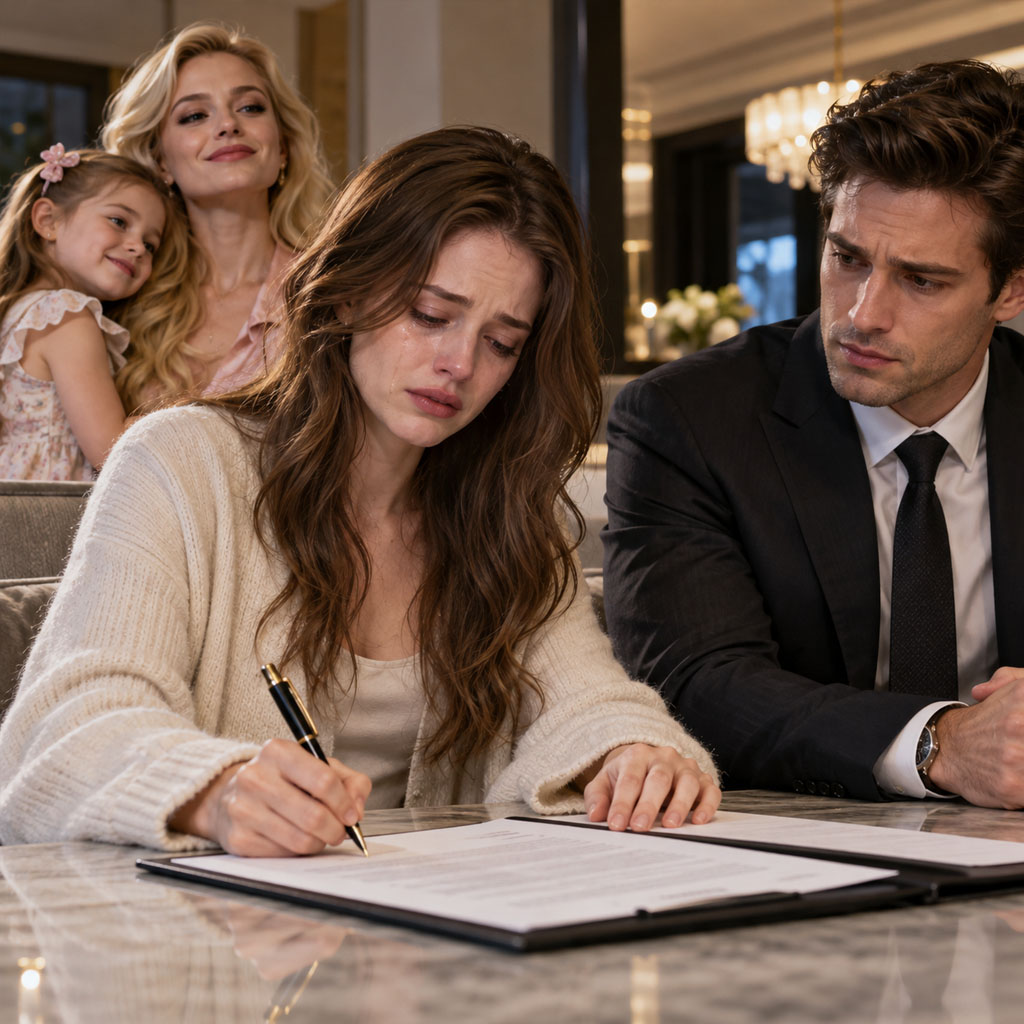
The only treatment that might save my life was given to my adopted sister by the very man who had promised to love me until death. When I discovered what my husband had done, I didn’t scream or demand an explanation. I simply signed away my chance to survive, because I finally understood how little my life mattered to the people I loved most.
Chapter 2
The following morning, I accompanied Ethan and Chloe to the hospital. I carried another folder of documents, this time containing the transfer of my remaining investments and properties. I had spent seven years building my financial independence, and I was about to surrender almost everything.
Serena welcomed us with a delighted smile.
“Cora, you really didn’t have to come.”
“I brought the rest of the paperwork,” I replied. “The properties and accounts will be yours as well.”
Even Ethan seemed uncomfortable.
“Everything, Cora? Are you sure?”
I almost laughed. For years, he had told me that loving Serena meant sharing whatever I possessed. Now that I was offering it freely, he suddenly seemed bewildered.
Dad recovered first.
“That’s my girl. We can finally be proud of the woman you’ve become.”
I felt something warm running from my nose. When I touched my face, my fingers came away stained red.
Mom glanced at me.
“Goodness, Cora. You should take better care of yourself.”
I looked around the room and asked a question I had carried in my heart for years.
“If I were seriously ill, would any of you regret how you’ve treated me?”
Dad frowned impatiently.
“Stop being dramatic. You’re standing here perfectly healthy.”
“Serena is the one we need to worry about,” Mom added.
I turned toward Chloe, who was holding Ethan’s hand.
“Sweetheart, would you be happy if Serena became your mommy?”
Her eyes widened.
“Really? Could she?”
“If that’s what you want.”
Chloe squealed and ran into Serena’s arms.
“Thank you, Mommy! I love you!”
Everyone laughed.
I stood there while my daughter celebrated replacing me.
Then I quietly walked out.
No one followed.
I took a train to a small coastal town in Maine, where I had spent summers as a child. The ocean had always made me feel peaceful. I remembered collecting seashells with my best friend, Jane Vance, before life became complicated.
Jane had warned me against marrying Ethan. She believed he was charming when he wanted something and cruel when he no longer needed it. We argued so bitterly that we stopped speaking.
Sitting on the cold beach that evening, I finally called her.
“Jane,” I whispered when she answered. “I’m sorry.”
“Cora? What’s wrong?”
I tried to explain, but my voice failed. Pain spread through my abdomen, and my vision blurred.
“Cora, where are you?”
I managed to tell her the name of the beach before losing consciousness.
When I woke, I was lying in a hospital bed. Jane sat beside me, her face swollen from crying.
“You stubborn woman,” she whispered. “Why didn’t you call me sooner?”
I wanted to apologize again, but the oxygen mask made speaking difficult.
She took my hand.
“The doctors told me everything. They said your organs are failing. They said you may not survive the night.”
I nodded weakly.
Jane began crying harder.
“You should have told me. I would have come for you.”
I pointed toward my bag. Inside were documents I had prepared during my final days: medical records, business agreements, evidence of Serena’s financial dealings, and a letter naming Jane as the person I trusted to carry out my final wishes.
Jane read everything in silence.
Then she looked at me with a changed expression.
“They’ve taken everything from you.”
I squeezed her hand.
“Not everything,” I managed to whisper.
She understood.
Before I lost the ability to speak, Jane helped me record one final message. I didn’t want revenge against my daughter, who was too young to understand what had happened. I wanted the adults who had made these decisions to hear the truth without Serena speaking over me.
Later, a message arrived from my mother.
“Cora, arrange for the master bedroom to be painted pink. Serena likes that color. Move your clothes into storage before she comes home.”
I stared at the screen until the words blurred.
Even now, my mother was thinking about making my home comfortable for someone else.
Jane gently took the phone away.
“You don’t have to answer.”
I closed my eyes.
For ten years, I had believed Serena stole my family. But a painful truth had become clear: people cannot steal love that others freely choose to give them.
My final moments were quiet. Jane held my hand and reminded me of the summer we were twelve, when we promised to remain friends forever. I could hear the rain tapping against the hospital window and imagined the waves beyond it.
I died early the following morning.
Three days later, Ethan stood inside our townhouse, watching painters cover the bedroom walls with soft pink paint.
He was irritated because my clothes were still in the closet.
“She was supposed to clear everything out,” he complained.
Chloe skipped around the room carrying a stuffed rabbit.
“Daddy, is Mama Serena coming home soon?”
“Hopefully.”
Ethan opened my closet and found my sketchbooks stacked neatly on the top shelf. Beneath them sat a small velvet box containing my wedding ring.
There was also a note.
“Everything is settled. You don’t owe me anything.”
He read it twice.
For reasons he couldn’t explain, his stomach tightened.
His phone rang.
It was Dr. Jonathan Hayes, the oncologist overseeing the clinical trial.
“Ethan, we need to discuss Cora.”
Ethan sighed.
“What about her?”
“Why did you authorize the transfer of her treatment opportunity to Serena?”
“Because Serena was the patient who needed it.”
There was a long silence.
“Ethan, Cora was the primary candidate. Her cancer had advanced much further than anyone realized. She was the patient most likely to benefit from that protocol.”
Ethan gripped the edge of the dresser.
“That’s impossible. Cora wasn’t that sick.”
“Her diagnosis was confirmed weeks ago. Didn’t she tell you?”
He remembered her collapsing in the living room. He remembered telling her to stop pretending.
Dr. Hayes continued.
“She withdrew from the trial, but that didn’t make transferring her eligibility to another patient medically appropriate. There are serious questions about how Serena was approved.”
Ethan’s voice trembled.
“Where is Cora now?”
“We’ve been unable to contact her. Her last medical appointment was canceled.”
Ethan rushed downstairs and called my number.
Someone answered.
A woman’s voice, cold and unfamiliar.
“This is Jane Vance.”
“Where’s my wife?”
There was a pause.
“Your former wife, Ethan.”
He swallowed.
“Please. Where is Cora?”
Jane’s reply changed his life forever.
“Cora died yesterday morning. And before she died, she left behind the truth about every one of you.”
Chapter 3
Ethan drove to Serena’s hospital so recklessly that he barely remembered the journey. His hands shook against the steering wheel, and the words Jane had spoken repeated endlessly in his mind.
Cora died yesterday morning.
When he entered Serena’s room, my parents were discussing plans to rename my boutiques. Serena was sitting upright, wearing a cashmere sweater that had once belonged to me.
“Ethan!” she said cheerfully. “Did you see the new bedroom?”
He threw my medical report onto her blanket.
“Did you know Cora had terminal cancer?”
Serena went pale.
“What?”
“Did you know?”
Mom stood.
“Don’t speak to Serena like that. She’s sick.”
“So was Cora!” Ethan shouted.
The room fell silent.
He turned toward my parents.
“Cora was dying. She had been dying for weeks, and none of us noticed.”
Dad shook his head.
“That’s ridiculous. She looked perfectly fine.”
“She was taking dangerous medication to hide her symptoms. She collapsed in our house, and I accused her of pretending.”
Ethan covered his face.
“I let her lie on the floor while I complained about visiting Serena.”
Mom slowly sat down.
“But she never told us.”
Ethan looked at her.
“Would you have believed her?”
No one answered.
He then showed them a message Jane had forwarded from Serena’s phone.
“Cora, everything you own belongs to me now. You were never going to win. Your parents love me more, and Ethan chose me. You’ll have to accept that.”
Dad stared at Serena.
“Did you send this?”
Serena’s expression hardened.
“So what if I did?”
Mom gasped.
“Serena!”
“Oh, please.” Serena threw the blanket aside. “Don’t suddenly pretend you all adored Cora. You criticized her every chance you got.”
She pointed at Ethan.
“You were the one who wanted the divorce.”
Then at Dad.
“You were the one who demanded her businesses.”
Finally, she looked at Mom.
“And you told her you wished she’d never been born.”
Mom began crying.
Serena laughed bitterly.
“You all made your choices. Don’t blame me because she finally stopped fighting.”
Ethan sank into a chair.
For years, he had seen Serena as someone fragile who needed protection. Now he understood that he had used her suffering as an excuse for his own selfish desires.
His phone rang again.
Jane was calling.
“The memorial arrangements will be handled according to Cora’s wishes,” she said. “There will also be a meeting with the attorneys tomorrow. You and her parents need to attend.”
“Jane, please let me see her.”
Her voice cracked slightly.
“You had years to see her, Ethan.”
Then she hung up.
The following morning, Ethan and my parents arrived at Jane’s law office. They looked as though they had aged ten years overnight.
Jane placed several folders on the conference table.
“Cora asked me to make sure everyone understood exactly what she left behind.”
Dad leaned forward.
“She gave Serena the boutiques. That’s already settled.”
“Ownership was transferred,” Jane replied. “But Serena also acquired the financial obligations attached to the companies.”
Dad frowned.
“What obligations?”
“Cora’s businesses had significant outstanding loans and supplier commitments. Their success depended heavily on her personal designs, management, and relationships with buyers.”
Jane opened an accounting report.
“Without Cora, the companies are in serious financial trouble. Serena signed the transfer documents without reviewing the underlying obligations.”
Ethan stared at the papers.
“How serious?”
“Several million dollars in outstanding commitments, some of them secured against company property. Creditors are already asking questions.”
Dad went white.
Jane continued.
“Serena also obtained authority over parts of the Foster family’s property holdings months ago. She used that authority to arrange additional financing.”
Mom shook her head.
“We signed some papers for her medical expenses.”
“Those papers authorized much more than medical expenses.”
Jane showed them the transactions.
Money had been moved through several accounts. There were questionable loans, unauthorized expenditures, and documents suggesting Serena had been preparing to move abroad.
Ethan could barely speak.
“She was planning to leave?”
“That is what the evidence suggests.”
Dad lowered his head.
He had trusted Serena with documents he had refused to let me examine. He had called me suspicious and unkind whenever I questioned her decisions.
Now that trust threatened everything he had built.
Jane turned another page.
“There’s also the clinical trial.”
Dr. Hayes had discovered that the treatment was designed for a specific tumor profile. Serena’s cancer was different, and the treatment had never been properly cleared for her.
Ethan had used his position to influence the enrollment process.
An independent investigation had already begun.
“You didn’t save Serena by replacing Cora,” Jane said. “You compromised a medical study and denied Cora the fair consideration she deserved.”
Ethan closed his eyes.
He had spent years believing he was a good physician, a good husband, and a good father. Now all three identities were collapsing around him.
Jane placed a small flash drive on the table.
“Cora recorded a message before she died. She asked me to share it with you after the documents were reviewed.”
No one moved.
Jane opened her laptop.
The screen showed me sitting on a quiet beach, wrapped in a navy coat. My face was pale, but I was smiling faintly.
“Mom, Dad, Ethan,” I began. “If you’re watching this, I’m no longer here.”
Mom covered her mouth.
“I spent most of my life trying to become someone you could love. I thought if I worked harder, earned more, or complained less, I might finally be enough.”
I looked toward the water.
“When Serena came into our family, I was happy. I wanted her to have everything I had. I never imagined that helping her would eventually mean losing my place in my own home.”
Dad began to cry.
“But I don’t blame her for every choice you made. You chose whose feelings mattered. You chose whom to believe. And when I needed you most, you chose not to listen.”
The camera shifted slightly in the wind.
“Ethan, I loved you when you had nothing but student loans and a dream of becoming a doctor. I never needed you to be rich or important. I only needed you to stand beside me.”
His shoulders began shaking.
“When you asked me to divorce you so you could marry Serena, I understood that I had already lost you.”
I paused, swallowing against the pain.
“Chloe, sweetheart, if you ever see this when you’re older, I want you to know something. You never had to choose between loving me and loving someone else. You’re a little girl, and none of this is your fault.”
Jane wiped tears from her cheeks.
“I hope you grow up surrounded by people who teach you kindness without asking you to disappear for someone else’s happiness.”
I looked into the camera one final time.
“I cannot change the past. But I can stop spending whatever time I have left begging to be loved.”
The screen went dark.
For several minutes, no one spoke.
Then Mom whispered, “We have to bring her home.”
Jane slowly closed the laptop.
“Cora is already home.”
Chapter 4
The investigation into Ethan’s conduct lasted months. His medical privileges were suspended, and he eventually lost his license after admitting that he had improperly interfered with the clinical trial enrollment process. Criminal charges followed, though the final outcome was far less dramatic than the punishment he carried inside himself.
He had lost the woman who once believed he could do no wrong.
Serena’s condition deteriorated, and the experimental treatment was discontinued when doctors determined it was unsuitable for her cancer. She survived the immediate medical crisis, but her illness remained serious.
Her financial dealings were investigated separately. Several transfers were challenged, accounts were frozen, and creditors pursued repayment through the courts.
For the first time since joining our family, Serena could no longer rely on everyone accepting her version of events.
When Dad visited her, she asked whether he still loved her.
He sat beside her bed for a long time before answering.
“I tried so hard to make up for everything you didn’t have as a child that I stopped seeing what I was taking away from Cora.”
Serena turned toward the window.
“You always said I was your daughter.”
“You are,” he replied. “But so was she.”
It was the first time he had spoken those words without placing one of us above the other.
Mom never fully recovered from the guilt. She kept one of my childhood photographs beside her bed and often spoke about things she wished she had done differently.
She remembered my eighth birthday, when I had baked crooked cupcakes and proudly served them to the neighborhood children. She remembered my graduation, when she had left early because Serena wasn’t feeling well.
Most painfully, she remembered the afternoon I had asked whether she would regret losing me.
She had laughed.
Now she would have given anything to answer that question again.
Chloe’s situation required special care.
Jane had no intention of making a little girl suffer for the mistakes of adults. With the help of family services and my cousin Rebecca, Chloe moved to a safe, stable home while Ethan’s legal problems were resolved.
Rebecca lived outside Portland, Maine, with her husband and two children. She had always been kind to me, even when the rest of the family treated me like an inconvenience.
Chloe struggled at first.
She sometimes cried for Ethan. Other nights, she woke asking when I would return.
Rebecca never told her that she had been a bad daughter.
Instead, she held her and explained that children sometimes repeat things adults say without understanding how much those words can hurt.
“Your mommy loved you,” Rebecca assured her. “Nothing you said could ever change that.”
Over time, Chloe began to remember our life differently.
She remembered how I stayed awake sewing costumes for her school plays. How I cut the crusts from her sandwiches because she disliked them. How I sat beside her bed through every fever, reading the same story until she fell asleep.
She remembered that I had loved her quietly, in a thousand ordinary ways.
Three years passed.
On a cold November afternoon, Ethan traveled to the small coastal cemetery where I was buried. He was thirty-two, but his face looked much older. His hair had begun to turn gray, and the confidence he once carried was gone.
He had taken a warehouse job after losing his medical career. He lived in a modest apartment and spent most evenings alone.
Every year, he visited my grave.
The headstone was simple gray granite, overlooking the Atlantic.
CORA FOSTER
1995–2024
Beloved mother, friend, and artist.
Ethan knelt beside it and placed a bouquet of white flowers in the grass.
“I’m sorry,” he whispered. “I know that doesn’t mean much now.”
He traced the letters of my name with one trembling finger.
“I used to think love meant providing a nice house and paying the bills. You gave us your time, your talent, your patience, and your whole heart. I treated those things as though they cost you nothing.”
Footsteps sounded behind him.
He turned.
Jane was walking along the gravel path with Chloe.
My daughter was nine now. She wore a navy coat and bright red mittens, and her dark hair brushed her shoulders. In her hands was a small bouquet tied with a purple ribbon.
Ethan stood slowly.
“Chloe?”
She stopped beside Jane, looking at him with cautious recognition.
“Hello, Daddy.”
His face crumpled.
“Sweetheart.”
He took a step forward, then stopped, remembering that he no longer had the right to expect her affection.
Chloe looked toward my grave.
“I brought Mommy flowers.”
Ethan nodded.
“She loved those.”
“Miss Jane says you visit sometimes.”
“Yes.”
Chloe studied him for a moment.
“Why didn’t you believe Mommy when she was sick?”
The question struck harder than anything a judge had said to him.
He looked down.
“Because I was selfish, sweetheart. And because I made terrible mistakes.”
“Did you love her?”
Ethan began crying.
“I did. But I didn’t treat her like someone I loved.”
Chloe seemed to consider that answer carefully.
Then she walked to the headstone and knelt beside the flowers already resting there.
“Hi, Mommy,” she whispered. “Aunt Rebecca taught me how to make your chicken soup. Mine wasn’t as good as yours, but everybody ate it.”
Jane turned away, wiping her eyes.
“I got an A on my spelling test, too. And I’m learning to draw dresses. Aunt Jane says I have your imagination.”
Chloe smoothed the purple ribbon against the stone.
“I miss you. Sometimes I wish I could tell you I’m sorry for being mean about your cooking.”
She paused.
“But Aunt Rebecca says you knew I loved you.”
The wind lifted a strand of hair across her face.
“I hope you did, Mommy.”
Jane knelt and put an arm around her.
“She knew, sweetheart.”
For a while, the three of them stood quietly beneath the gray November sky.
Ethan wanted to embrace his daughter. He wanted to ask her to come home with him, to give him another chance to become the father he should have been.
But he understood that love could no longer mean asking someone else to sacrifice their peace for his comfort.
He remained where he was.
When Chloe finished arranging the flowers, she turned toward him.
“Goodbye, Daddy.”
“Goodbye, sweetheart.”
She walked back to Jane and slipped her hand into hers.
“Can we go home now? Aunt Rebecca said we could make cookies.”
Jane smiled through her tears.
“Of course we can.”
They disappeared down the path.
Ethan stayed beside my grave until the sun began to sink over the ocean.
He had once believed that losing his career, his money, and his reputation would be the worst punishment imaginable. But standing alone among the headstones, he understood that the heaviest consequence was remembering how much love he had been given and how carelessly he had thrown it away.
Years later, Chloe would grow into a thoughtful young woman who understood that kindness should never require surrendering her dignity. She would become a fashion designer, filling sketchbooks with beautiful clothes just as I once had.
And whenever someone asked where she found her inspiration, she would smile and speak about her mother.
Not Serena.
Me.
She would tell them about the woman who worked late into the night, who made imperfect chicken soup, who loved flowers and quiet beaches, and who had once dreamed of building something beautiful with her own hands.
My story would no longer be remembered only for its sorrow.
It would live in the daughter who learned to love without cruelty, in the friend who never abandoned me, and in the simple truth my family understood too late.
Love is not measured by how much a person is willing to surrender.
It is measured by how carefully we protect the heart that trusts us.