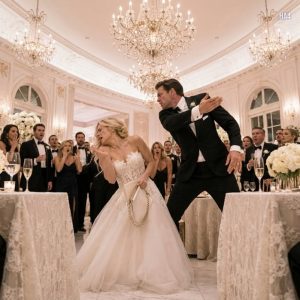
her husband slapped her in front of 300 wedding guests, but the document she hid in her purse destroyed his family before the bruises faded
“When I realized someone was erasing their tracks.”
The first set of files showed small changes in retaining wall measurements. The second showed a supplier change after a risk warning. The third contained digital signatures from engineers Nora knew had been out of the country on the dates listed.
“They wanted you to be where the blame landed,” Mira said.
Nora opened a hidden spreadsheet inside a finance folder. Payments had been split into smaller amounts around inspection dates. Victor’s name never appeared directly, but the codes followed him like fingerprints. Austin appeared not as the man who signed, but as the man who benefited from decisions he pretended not to know about.
By 5 a.m., the video of the slap was online.
Not the office.
Not the contract.
Not the pressure.
Just Austin’s hand, Nora’s face, the ring, the exit.
And by 7 a.m., the Brackett machine was awake.
“They’re saying you had a breakdown,” Mira said, scrolling. “They’re saying you threatened the family before the ceremony. They’re saying Austin was trying to calm you down.”
Lydia slammed a cup into the sink.
Nora read the posts without expression. A photo of her in a hard hat and muddy boots was circulating as if competence were proof of coldness. One anonymous account claimed she had been caught manipulating company documents. Another suggested she had targeted Austin for money.
The lie had not been invented overnight.
It had been waiting.
“Don’t respond,” Mira said quickly.
“I won’t respond with outrage,” Nora said, opening a new document. “I’ll respond with method.”
She built a timeline.
Her hiring as independent consultant.
The first meeting with Victor.
The denied access to original reports.
Austin’s vague messages.
The wedding office.
The contract.
The slap.
Each item received a date, source, and risk level.
Pain remained on her face.
But inside her, pain was becoming architecture.
By midmorning, flowers arrived.
White lilies.
The same flowers from the ballroom.
The card read:
I’m sorry for the confusion. I hope you recover your reason before you destroy us both.
Austin.
Nora photographed the card, slid it into a plastic sleeve, and told Mira to throw the flowers away.
She did not touch a single petal.
Part 2
Emma Sargent answered Nora’s call on the second ring.
She was not the kind of attorney who gasped, softened her voice, or filled silence with pity. That was why Nora trusted her.
For fifteen minutes, Emma listened.
Then she said, “Photographs. Medical exam. Police report. Preserve every file. Do not sleep alone. Do not talk to his people without me.”
It was a cold list.
The right kind of cold.
At the police station, people recognized Nora from the video and pretended they didn’t. She described the slap, the contract, the pressure, the office, the witnesses. When the officer asked whether she wanted to make a formal complaint, Nora said yes before the question ended.
Not because she believed one report would bring down Austin Brackett.
Because silence would be his first victory.
Outside, a reporter rushed toward her.
“Nora, is it true you illegally accessed your husband’s company servers?”
The word husband hit less than it should have.
Nora faced the camera.
“I will not discuss documents under review. As for the assault, everyone saw it. Everything else will be handled through the proper channels.”
Then she got into Mira’s SUV and left them starving.
Across town, Austin watched the clip from the top floor of Brackett Urban Development’s headquarters. Celia wanted a statement about a private misunderstanding. Charles wanted to destroy Nora’s professional credibility. Victor said little.
Reputation was smoke.
Data was a blade.
“She can’t prove anything,” Austin said.
Victor adjusted his glasses.
“That depends on what she copied.”
Austin turned.
“What does that mean?”
Victor swallowed. “The protocol receipt is missing from the wedding folder.”
Charles stared at him. “You left proof loose in front of her?”
“It was secondary.”
Austin struck the conference table with his palm.
“Nothing is secondary in her hands. Find out who is helping her. Find out who she talks to. Find out who can be bought.”
That afternoon, two men came to Nora’s building claiming to be messengers. The superintendent called her first. Mira checked the security footage and recognized one of them as private security contracted for Brackett events.
The threat was obvious enough to scare her.
Vague enough to deny.
Lydia wanted Nora to come stay with her.
Nora kissed her aunt’s hand.
“They’re counting on panic. I won’t give them my address, my routine, and my mind.”
That night, Thomas Avery entered Nora’s story.
Not as a savior.
As a man who knew how to wait on the correct side of a closed door.
He reached out through Emma Sargent, identifying himself as an assistant district attorney investigating South Ridge Homes. Nora knew his name from small articles buried under larger scandals. Months earlier, he had tried to pursue Brackett Urban over housing complaints, but the case had weakened when documents vanished and witnesses withdrew.
They met at Emma’s office, a quiet place with no luxury meant to intimidate anyone.
Thomas arrived exactly on time, carrying one slim folder. He had a low voice, watchful eyes, and the restraint of a man who did not expect trust for free.
Nora appreciated that he did not mention the slap until she did.
“You want my files,” she said.
“I want to know whether your files can protect people,” he replied.
That did not convince her.
But it opened a door.
Thomas explained that South Ridge Homes was not only a project with cracks. Families had been displaced by questionable risk reports. Compensation had been reduced. Residents had been pressured into accepting smaller apartments. One newly delivered building showed signs of settling. Two complaints had disappeared inside administrative offices. A junior engineer had resigned after questioning soil measurements.
The files had faces now.
“Why didn’t you move sooner?” Nora asked.
Thomas accepted the sharpness without flinching.
“Witnesses backed out. Documents vanished. And I underestimated the level of political protection around the Bracketts. That was my mistake.”
Nora studied him.
She found fatigue.
Maybe guilt.
Not arrogance.
“I won’t hand over raw files without copies, protocol, and a chain of custody,” Nora said. “They already tried to put my signature where it never belonged.”
Emma nodded.
Thomas looked relieved rather than annoyed.
“Rushed people ruin evidence,” he said.
For the first time since the wedding, Nora almost smiled.
The bruise pulled at her cheek and stopped her.
On the way home, Nora asked Mira to drive by South Ridge before dark.
The development rose on the edge of Providence like a broken promise in pale concrete. Children played near fresh paint covering old cracks. Women folded laundry on narrow balconies. Men watched unfamiliar cars with tired suspicion.
Nora stepped out without a badge, without a clipboard held like a weapon.
A woman named Daisy Archer approached first, holding a little girl’s hand.
“You from the builder?”
The question had more exhaustion than anger.
“No,” Nora said. “Not the way you’re afraid of.”
She explained that she was a structural engineer and consultant and needed to understand what had happened.
Daisy laughed without humor.
“Everybody needs to understand after we already signed the papers, lost our old homes, and got told cracks are normal.”
Nora took the accusation because it belonged to the system, and she had nearly become part of the system’s cover.
“I won’t promise what I can’t deliver,” Nora said. “But with your permission, I can listen, document common areas, and help make sure your concerns are recorded through counsel.”
Daisy looked at the bruise on Nora’s face.
Violence recognizes violence, even when it comes wearing a different suit.
Other residents gathered. They spoke of doors that would not close, floors dipping, meetings where Brackett staff treated them like inconveniences, notices written to confuse more than inform.
Nora listened.
A technical report without human voices could become a dead document.
That night, Brackett Urban released its statement.
Austin deeply regretted the private incident but expressed concern for Nora’s emotional instability. The company would take action regarding the unauthorized leaking of confidential information.
It did not apologize.
It replaced assault with fog.
Nora saved the statement, archived screenshots, and sent everything to Emma.
Then she turned off her phone for exactly five minutes.
That was all the time she allowed herself to feel disgust before turning disgust into strategy.
The next morning, Emma arranged for a forensic specialist, Caleb Sales, to preserve the files. He was gray-haired, patient, and suspicious of everything in a useful way. He connected the flash drive to an isolated machine, documenting each step.
“There are signs of hurried export,” Caleb said after reviewing metadata. “That doesn’t invalidate the content. It may help show when and where some of the copying occurred.”
Thomas asked, “Can you identify deletion from the original source?”
“With server logs, maybe. Without them, only shadows.”
Nora liked the honesty.
Good evidence did not grow from fake certainty.
Then Thomas told her he had located the junior engineer who resigned from Brackett Urban: Sonia Mayfield, now teaching at a technical college two hours away.
“She refused contact before,” Thomas said. “But she might speak if she knows another engineer is willing to stand behind the technical issue.”
Emma warned Nora carefully.
“You are not an investigator. We do this properly. Formal invitation. I’m present. Recording only with consent.”
Nora nodded.
“Then we do it properly.”
Sonia agreed to meet three days later.
She was in her early thirties, hair tied back, no makeup, hands restless, eyes carrying the dull shine of a person who had slept badly for a long time.
When she saw Nora, her eyes moved from the bruise to the folder.
“They did that to you?”
“Austin did,” Nora said. “The company is trying to do the rest.”
The distinction seemed to help Sonia name the enemy.
At first, Sonia was guarded. She feared losing her job. Being sued. Being called bitter. Being told she misunderstood data older men had intentionally buried.
Nora did not push.
She placed two reports side by side.
“I need to know whether these measurements were yours.”
Sonia touched the page with two fingers.
“They were,” she whispered. “I warned them the soil wouldn’t support the schedule without deeper foundation work. Victor said I was too young to understand financial impact. Then my name disappeared.”
Thomas, on a secure call with consent, asked objective questions.
Sonia explained off-site meetings, shortened reports, technicians pressured to sign summaries, a public inspector treated like an honored guest at Brackett events. She also described Austin—not as a distant heir, but as an occasional presence who entered rooms when people resisted, smiled, asked about careers, and made it clear that futures depended on flexibility.
At the end, Sonia agreed to give formal testimony if her documents were protected.
Before Nora left, Sonia touched her arm.
“Why are you doing this after what he did to you?”
Nora looked down at the reports.
“Because now I know it wasn’t only me.”
On the drive back, Nora said nothing.
Mira kept checking the mirrors.
That afternoon, Austin tried a different weapon.
An audio message.
Emma and Mira sat beside Nora while she played it.
At first, Austin sounded soft. He used an old nickname from their engagement. He said things had gotten out of control. He said powerful families had protocols. He said people were using her.
Then the tenderness turned into command.
“Turn over the files, withdraw the complaint, and I can still protect you.”
Nora saved the audio, transcribed it, and archived it.
Mira gave a humorless laugh.
“He calls blackmail protection.”
Emma nodded. “And it proves he knows you have something.”
Nora stared at the frozen audio bar.
For some reason, the message hurt more than the public statement.
The man who had promised to build a home with her was offering her permission to survive after destroying her.
That was the moment the last romantic grief dried up.
The next attack came dressed as journalism.
A paid article suggested Nora had accessed Brackett files out of jealousy over an alleged affair. It hinted at emotional instability, criminal exposure, and revenge. Coordinated accounts spread it within minutes.
Professional colleagues began sending cautious messages.
Not support.
Questions.
Is it true?
That was when loneliness turned cold.
Nora wanted to dump every file online and let shame change sides.
Thomas warned her not to.
“If you release evidence without a proper chain, they’ll turn truth into noise. And you may put witnesses in danger.”
Nora hated that he was right.
So she did what she knew.
She wrote a technical statement.
No sensitive attachments. No insults. No dramatic adjectives. She explained basic principles of professional responsibility, document chain, structural liability, and the ethical impossibility of validating reports never reviewed. She confirmed cooperation with authorities and stated that public campaigns did not replace evidence, testimony, and forensic review.
It did not go viral like scandal.
It reached the right people.
One of them was Henry Larkin, Nora’s former professor and a respected forensic engineering expert. He called that evening.
“I read your statement,” he said. “And I saw enough public information about South Ridge to be concerned. When the time comes, I’ll serve as an independent technical observer.”
Nora closed her eyes.
It was not rescue.
It was recognition.
In a war of reputation, being seen correctly by one honorable person could keep the lie from occupying every mirror.
Austin heard about Henry and smiled with contempt, but Victor saw the unease beneath it.
“She’s building a network,” Victor said.
Austin moved closer.
“Then cut the wires.”
Victor tried to explain that direct threats would increase risk. That the district attorney was already moving. That perhaps they should sacrifice a minor supplier.
Austin’s smile vanished.
“You talk like you still get to choose who gets sacrificed.”
For the first time, Victor understood that loyalty to the Bracketts was a staircase with no railing.
He knew the numbers.
The intermediaries.
The accounts.
The places where documents had been hidden.
He also knew how easily Charles and Austin rewrote stories to keep the name clean.
That night, when Victor returned home, a dark sedan waited outside his building.
He did not recognize the driver.
But he recognized the message.
Part 3
The internal dossier became Nora’s obsession.
She found the first sign of it before dawn, sitting at a borrowed kitchen table in Mira’s cousin’s house, because Emma had insisted she sleep somewhere else for a few nights.
Aunt Lydia had brought three sweaters, one envelope of family photos, and a small rosemary plant she refused to abandon.
Nora had almost laughed when she saw her aunt carrying it into the elevator.
Almost.
That small almost felt like proof she was still alive.
At the kitchen table, Nora wrote by hand because screens had begun to feel too bright.
Austin in the center.
Victor in payments.
Sonia in reports.
Daisy in residents.
Inspectors in approvals.
Suppliers in invoices.
Media in narratives.
At the bottom of the page she wrote one question:
Where is the document they cannot explain?
The answer came when she compared the protocol receipt she had taken from the wedding folder with a repeated code in the files.
It was not merely a contract preparation record.
It referenced an internal dossier delivered to Brackett Urban’s board before the wedding, warning of legal exposure on South Ridge if technical responsibility was not reassigned.
They had known.
Not suspected.
Known.
Before they tried to make her sign.
When Nora showed Mira, her friend put both hands in her hair.
“If we find the full dossier, administrative error dies.”
Nora did not celebrate.
Finding it meant entering the place Austin would protect hardest.
Thomas adjusted his search request based on the clue. Emma kept Nora from saying too much too early. Caleb prepared supplemental forensic notes.
Austin, meanwhile, prepared a public execution.
At noon two days later, he held a press conference in a spotless conference room with Celia, Charles, and two attorneys beside him.
He wore a dark tie and a wounded expression.
He said he deeply regretted the personal episode at the wedding, but he could not allow an intimate crisis to threaten thousands of jobs and community projects. Then he presented alleged message records showing Nora demanding money in exchange for not turning over internal documents.
Mira cursed at the screen.
Nora raised one hand for silence.
The messages were good forgeries.
They used her dry style, her punctuation, even the hours she usually worked.
That had not been improvised after the wedding.
It had been prepared in case she refused to obey.
When the press conference ended, hatred hit her phone in waves.
Lydia wanted to answer everyone.
Nora gently took the phone away.
“We don’t fight on the stage he built.”
“He’s calling you a criminal,” Lydia said, shaking.
“Then we show who wrote the script.”
The first crack came from Victor.
During the press conference, Mira noticed him at the edge of the camera frame, taking a call and leaving through a side door seconds before Austin presented the fake messages.
That afternoon, an envelope with no return address was left at Emma’s office.
Inside was part of a board meeting memo dated ten days before the wedding.
It referenced legal exposure at South Ridge, document restructuring, and a recommendation to transfer technical responsibility to an outside consultant connected through family contract.
It was not enough.
But it was enough to prove the dossier existed.
Then Austin called Nora directly.
Emma told her not to answer.
Nora said, “He isn’t calling to persuade me. He’s calling because something scared him.”
They arranged to record the call legally through counsel.
Austin demanded to meet in person instead.
Emma refused.
Austin sent one line:
Then watch what happens to your aunt.
Nora’s face went white.
For the first time, rage burned through her discipline so fast Mira had to take the phone from her hand.
Thomas moved quickly. Protection requests. Additional reports. Documentation of threats. A search warrant pushed with urgency. But legal urgency was still slower than fear.
That evening, Nora agreed to a controlled meeting in a glass-walled conference room at Emma’s office building with security downstairs, Emma nearby, and law enforcement aware.
Austin arrived without a tie.
It was a small detail, but Nora understood it. He wanted to appear human.
“You look tired,” he said.
“You look scared.”
His mouth tightened.
“I came to end this.”
“You came to see what I know.”
He laughed softly. “You always did think intelligence was the same as power.”
“No,” Nora said. “I learned the difference from you.”
For a moment, the room was quiet.
Then Austin leaned forward.
“South Ridge will be adjusted. complain. Projects of that scale always have noise. Nothing collapses overnight.”
The ease with which he said nothing collapses made Nora’s stomach turn.
People were variables to him.
Variables could be compressed until they fit a convenient spreadsheet.
“You know there’s an internal dossier,” she said.
For the first time, he hesitated.
Briefly.
But enough.
“Did Victor feed you garbage?”
Nora said nothing.
Austin’s anger sharpened.
“Victor forgets I know everything he did. If someone falls, he falls alone. My father signs nothing. I sign nothing. Men like Victor exist to understand that.”
There it was.
Not the whole confession.
But the anatomy of the empire.
“And me?” Nora asked.
Austin smiled without charm.
“You can still leave smaller than you entered. Withdraw the complaint. Admit emotional pressure. Turn over the files. Disappear for a while. I’ll pay discreet compensation. Your aunt stays peaceful. Your assistant keeps working somewhere far away.”
His voice lowered.
“Or keep pushing, and everyone near you learns the price of your pride.”
Nora’s face stayed calm.
Inside, something broke with clarity, not pain.
Austin’s phone vibrated on the table.
He glanced at it.
Color drained from his face.
Maybe Victor.
Maybe an attorney.
Maybe the first sign that the search had started before dawn after all.
He stood.
“We’re done.”
“No,” Nora said. “You’re done. You just haven’t read it yet.”
By morning, investigators entered selected departments at Brackett Urban with warrants. They did not raid the whole empire. They took finance servers, legal folders tied to South Ridge, board communications, and devices linked to the fake messages.
Reporters waited outside before lunch.
Nora said only one sentence.
“I am cooperating with authorities, and the at South Ridge deserve safety, truth, and repair.”
Then she left.
That night, Thomas confirmed what they had found.
References to the internal dossier.
Meeting minutes.
Communications about transferring responsibility.
Indications that the messages used against Nora had been manipulated.
It was not over.
But the lie had lost speed.
Two days later, Victor Denny requested a cooperation agreement.
He was terrified of becoming the only man sacrificed.
His first formal statement confirmed what Nora had built from fragments. The internal dossier existed. It had been presented to the board before the wedding. It recommended reducing legal exposure by connecting Nora to the process through marriage and retroactive technical documents.
According to Victor, Charles demanded that the Brackett name stay clean.
Austin suggested Nora.
Victor tried to soften his own role.
The seized documents did not let him.
That afternoon, assets tied to South Ridge contractors were frozen. The project entered independent review. Residents finally received inspection teams who measured cracks without smiling like threats.
Daisy Archer called Nora crying.
“They’re measuring the cracks like they finally see us,” she said.
Nora closed her eyes.
That sentence mattered more than any public apology.
Being seen was the first step of repair.
Austin did not fall gracefully.
He accused Victor of betrayal, Thomas of persecution, and Nora of manipulation. But every accusation now sounded like furniture being dragged through a burning house.
Charles stepped down temporarily from the board.
Celia issued a statement about pain.
Austin’s attorneys argued.
The bruises faded.
The evidence did not.
Months passed before the first hearing that truly mattered.
Nora entered the courthouse in a navy suit, no jewelry, no dramatic makeup, Aunt Lydia on one side, Mira on the other. Outside, cameras waited. Inside, Austin sat at the defense table with his expensive face looking thinner than before.
For the first time since the wedding, he saw her and did not smile.
The hearing was not as cinematic as people online wanted it to be.
Justice rarely is.
It was folders, objections, timestamps, signatures, metadata, witness protection, inspection records, and a judge who interrupted anyone who tried to turn facts into theater.
Sonia testified about the altered soil reports.
Daisy testified about the residents’ warnings.
Caleb explained the digital chain.
Henry Larkin explained why no competent engineer would have signed the documents Nora was pressured to sign.
Victor testified last.
He did not look at Austin when he described the meeting where Nora’s name was proposed as a convenient shield.
He did not look at Charles when he admitted the board had been warned.
But Nora looked at all of them.
Not with triumph.
With witness.
Austin’s assault charge moved separately, smaller in legal scale than the corporate case, but not small to Nora. The wedding video, the photographs, the medical report, and the messages afterward became part of a record nobody could politely erase.
At the end of the day, Austin tried to pass her in the courthouse hallway.
Security shifted.
Emma stepped forward.
But Austin stopped several feet away.
His eyes moved over Nora’s face, searching for the red mark that was no longer there.
“You ruined everything,” he said quietly.
Nora looked at him.
“No. I stopped signing for it.”
For once, he had no answer.
That was the last time she spoke to him.
A year later, South Ridge Homes looked different.
Not beautiful.
Not magically healed.
But honest.
Two buildings had been evacuated for full repair. Compensation funds had been ordered. Contractors were under investigation. Brackett Urban had been forced into restructuring, with independent oversight and a board no longer controlled by one family name. Civil cases continued. Criminal charges moved slowly. Some people still lied. Some people still delayed.
But the residents were no longer whispers inside someone else’s balance sheet.
On a cool Saturday morning, Nora stood beside Daisy near one of the repaired walkways while children drew chalk suns on concrete that had once split under their feet.
Daisy’s little girl offered Nora a piece of yellow chalk.
Nora accepted it.
“What should I draw?” she asked.
“A house,” the girl said. “But a safe one.”
Nora knelt and drew four uneven walls, a roof, and a door that opened wide.
Mira laughed.
“That house would never pass inspection.”
Nora looked at the crooked chalk lines.
“It’s conceptual.”
Aunt Lydia sat nearby on a folding chair, her rosemary plant in a bigger pot at her feet, because she had somehow turned it into a family mascot. Emma was talking to a residents’ committee. Thomas stood by the curb, speaking with an inspector, careful as ever not to look like he owned any part of Nora’s victory.
He didn’t.
No one did.
Nora’s life was not rebuilt by one man, one case, or one viral video.
It was rebuilt by every small refusal to disappear.
That evening, she drove alone to the Royal Atlantic Hotel.
The ballroom had been booked for another wedding. Through the tall windows, she could see flowers, waiters, candles, a bride laughing with both hands around a glass of champagne.
Nora did not go inside.
She stood on the marble steps where her veil had fallen.
The hotel had cleaned everything, of course.
Marble remembers nothing.
People do.
For a moment, she touched her cheek.
There was no pain now.
Only memory.
A year ago, Austin Brackett had believed his hand could reduce her to silence.
Instead, it had ended a marriage, exposed a fraud, protected , fractured an empire, and returned Nora Vance to herself.
Her phone buzzed.
A message from Lydia:
Come home. I made coffee strong enough to restart a dead truck
Nora smiled.
Home.
Not the mansion Austin had promised.
Not the name he had offered like a crown with teeth.
Home was an old apartment, a stubborn aunt, a fierce friend, a table covered in work, a plant that refused to die, and a life where no one got to call violence love.
Nora turned away from the hotel.
Behind her, through the glass, another bride stepped into another bright room.
Ahead of her, the night air was cold, clean, and wide.
She walked down the steps without looking back.