🚨BREAKING NEWS🚨 Maduro removes his… See more
This is a narrative based on the extraordinary events of early 2026.
The Fall of the Fortress: The Capture of Nicolás Maduro
The humidity of Caracas usually hung heavy over the Miraflores Palace, but on the night of January 3, 2026, the air felt unnervingly still. Inside the “fortress”—as President Donald Trump would later describe it—Nicolás Maduro was reportedly finishing a late meal when the sky above the capital went black.
It wasn’t a standard Caracas blackout. The United States had deployed specialized electronic warfare to “turn off the lights,” jamming the city’s grid and blinding Venezuela’s Russian-made air defense systems.
Operation Absolute Resolve
At precisely 2:01 AM, the silence was shattered by the roar of F-35A jets and the rhythmic thump of Black Hawk helicopters. The mission, codenamed Operation Absolute Resolve, was the culmination of months of rehearsal. U.S. Delta Force operators and CIA teams descended on the presidential compound with surgical precision.
Maduro, alerted by the first explosions, reportedly made a desperate dash for a “safe room”—a reinforced steel bunker designed to withstand a siege. But the Americans were faster. According to later briefings, Maduro was “bum-rushed” just feet from the bunker’s heavy door. For the first time in decades, the man who had survived countless internal threats found himself staring down the barrels of specialized U.S. carbines.
By 4:30 AM, Maduro and his wife, Cilia Flores, were no longer in Venezuela. They were airborne, bound for the USS Iwo Jima in the Caribbean, and eventually, a federal holding cell in New York.
The Charges in Manhattan
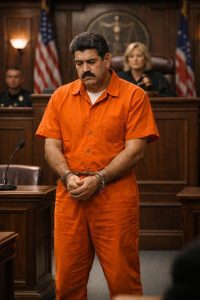
Two days later, the world watched a sight once deemed impossible: the deposed leader of a sovereign nation appearing in a Manhattan federal court. Handcuffed and wearing a standard-issue jumpsuit, Maduro stood before a judge to face a 25-page indictment.
The U.S. Department of Justice leveled four primary counts against him:
-
Narco-Terrorism Conspiracy: Alleging he led the “Cartel of the Suns” to flood the U.S. with cocaine.
-
Cocaine Importation: Coordinating massive shipments via sea and air.
-
Weapons Charges: Possession and conspiracy to use machine guns and destructive devices to protect drug routes.
Maduro’s response was defiant. “I am the President of my country,” he declared, pleading not guilty to all charges. His legal team quickly argued that the capture was an “international kidnapping” and a violation of diplomatic immunity.
A Nation in Limbo
While Maduro sits in the Metropolitan Detention Center in Brooklyn, Venezuela has entered a state of profound uncertainty.
-
The Interim Government: Vice President Delcy Rodríguez was sworn in as acting president, though the U.S. has signaled it intends to oversee a “safe transition.”
-
The Oil Factor: U.S. energy companies have already begun assessing Venezuela’s crippled oil infrastructure, with reports of over $1 billion in sales since the capture.
-
International Friction: While many in Caracas celebrated with fireworks, nations like Russia and Cuba have condemned the raid as a “return to colonial-era interventionism.”
What’s Next?
The legal battle is expected to last years. Currently, Maduro’s lawyers are fighting the U.S. Treasury to allow the Venezuelan government to pay for his defense, arguing that his right to counsel is being unconstitutionally blocked. As of late February 2026, he remains in high-security custody, awaiting a trial that will likely be the most high-profile international criminal case since the prosecution of Manuel Noriega.
Would you like me to focus on a specific part of this story, such as the tactical details of the raid or the legal arguments being used in court?