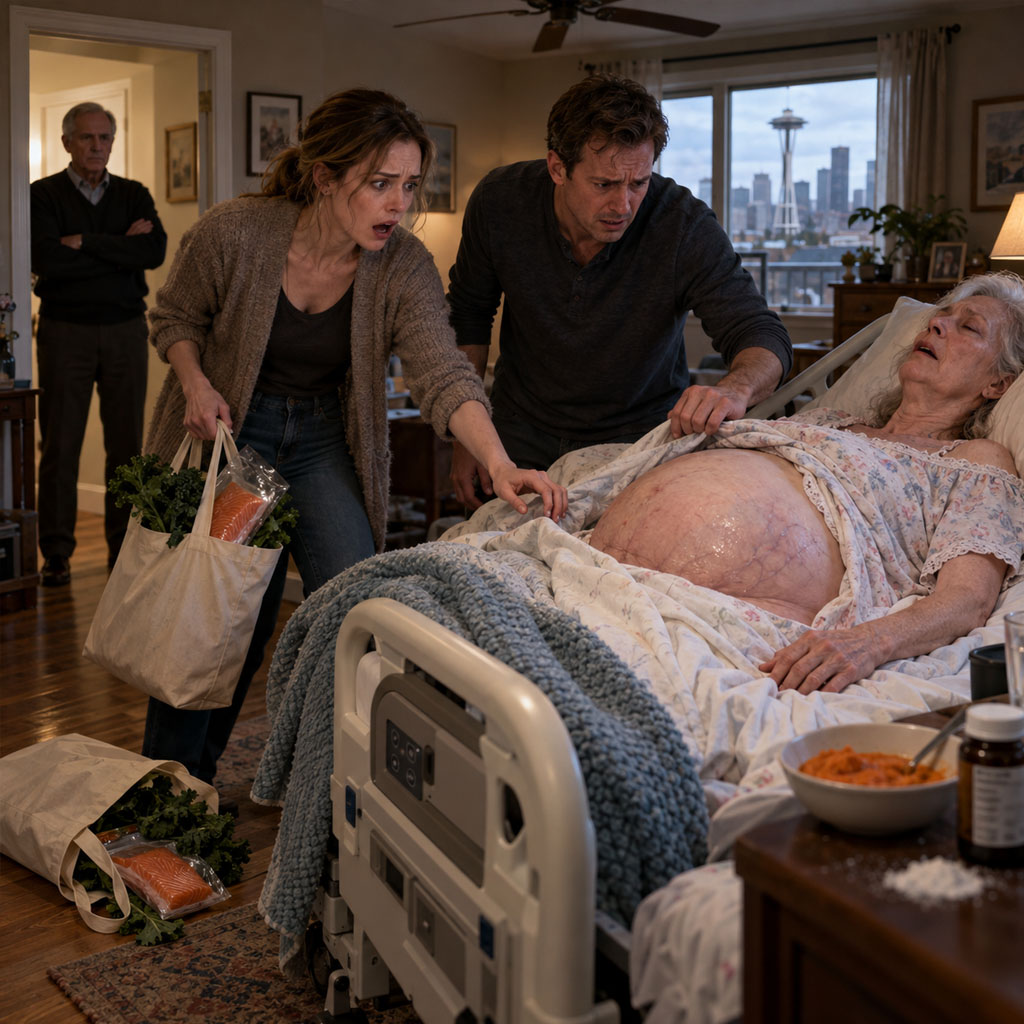
My mother-in-law had been paralyzed for four years, so when her stomach suddenly swelled until she looked eight months pregnant, I knew something was terribly wrong. But the most frightening thing wasn’t her condition. It was the way her husband smiled when I said we needed to take her to the hospital.
Chapter 2
By morning, Lawrence looked ten years older. He sat at the kitchen table staring at the recording, unable to reconcile the cruel stranger on the screen with the father who had raised him. I wanted to comfort him, but every minute we spent grieving was another minute Constance remained in danger.
When Theodore went out for his morning coffee, I checked the cabinet where he kept Constance’s supplements. Inside were several unmarked packets, medication bottles, and receipts tucked beneath a stack of envelopes. One receipt showed repeated payments to a woman named Gloria Bennett.
In the bottom drawer lay documents concerning the house. Constance had inherited it from her parents, and although Theodore lived there, the property remained in her name. Someone had prepared paperwork to transfer ownership, but several pages were unsigned.
I photographed the documents and stepped away. I had no intention of confronting Theodore with guesses when Constance needed immediate care. Lawrence and I called emergency services and told the dispatcher about her breathing difficulties and severe abdominal swelling.
Theodore returned just as the paramedics arrived.
“What have you done?” he shouted.
“What we should’ve done yesterday,” Lawrence replied. “We’re getting Mom help.”
At Harborview Medical Center, doctors immediately ordered imaging and blood tests. Constance’s abdomen was filled with fluid, a condition called ascites, and her liver and kidneys were functioning poorly. Her physician warned that the illness was serious and required urgent treatment.
When we described the unidentified substances Theodore had been giving her, the doctor became concerned. She explained that some medications and supplements could worsen organ damage, though testing would be needed to establish what had happened. She also noticed unexplained puncture marks on Constance’s arm.
“Has anyone been administering injections at home?” she asked.
Lawrence shook his head.
“Not that we know of.”
I remembered Theodore spending long periods alone beside Constance’s bed. My stomach twisted as I thought about how often I’d assumed he was simply helping his wife.
We showed the doctor the recording.
Within an hour, hospital staff had documented their concerns and contacted the appropriate authorities.
I called Theodore to tell him Constance had been admitted. He didn’t ask whether she was frightened or whether she would survive. Instead, he asked one question.
“What did the doctors say about her stomach?”
I stared at Lawrence, who had heard the conversation on speakerphone.
“They said she’s very sick,” I answered.
Theodore remained silent for several seconds.
Then he hung up.
That evening, he arrived at the hospital carrying a leather briefcase. Without asking permission to see Constance, he pulled out a legal document and demanded that Lawrence sign it.
The paperwork would have given Theodore broad authority over his wife’s medical decisions.
Lawrence read the first page, then looked at his father.
“Why are you worried about paperwork when Mom is fighting for her life?”
“Because I’m her husband,” Theodore said. “And I’m tired of you two interfering.”
I watched Lawrence fold the document and place it on the chair beside him.
“We’re having an attorney review this,” he said. “You don’t get to bully us anymore.”
Theodore stepped toward me, his face red with anger.
“You’ve poisoned my son against me.”
“No,” Lawrence answered quietly. “Your own behavior did that.”
For the first time, I saw fear flicker across Theodore’s face.
Then a nurse hurried from Constance’s room.
Her blood pressure had dropped dangerously low, and the medical team was working to stabilize her. Lawrence rushed toward the doorway while I stood motionless, listening to the alarms behind the curtain.
When the doctor finally emerged, she said Constance had responded to treatment but remained critically ill.
We stayed at the hospital until late that night.
Before leaving, I asked Lawrence to remain with his mother while I went home to collect her clothes and the original documents. I also wanted to preserve the security recording for investigators.
When I reached the house, I noticed Theodore’s bedroom door was locked.
That was unusual. In thirty years of marriage, according to Lawrence, his parents had rarely bothered locking their bedroom.
I left it alone and retrieved the documents from the family desk.
As I was gathering Constance’s belongings, I noticed a small voice recorder beside the telephone. Theodore sometimes used it to dictate reminders for his construction projects, and several recordings were labeled with recent dates.
I brought it to Lawrence rather than listening through someone else’s private belongings.
When an investigator later reviewed its contents, the discovery was devastating.
Theodore had recorded a conversation with Gloria.
“Make sure she goes quietly,” a woman’s voice said. “Once the house belongs to you, we can settle everything.”
Theodore answered, “My daughter-in-law keeps interfering, but Lawrence won’t stand up to me. He never has.”
Gloria laughed.
“Then stop worrying about them and finish what you started.”
I felt physically sick.
The recording suggested a conspiracy far more deliberate than anything we’d imagined.
But we still didn’t know who Gloria was or why Constance’s death mattered so much to her.
The answer came the following afternoon.
A detective arrived at the hospital and asked whether we recognized the name Arthur Vance.
Lawrence frowned.
“Arthur was Dad’s old business partner. He disappeared years ago.”
The detective exchanged a glance with another officer.
“There’s reason to believe his disappearance may be connected to what happened to your mother.”
Chapter 3
Arthur Vance had vanished seven years earlier after a business dispute involving Theodore. According to the original investigation, his truck was found near the Seattle waterfront, but no one ever established what happened to him. Theodore had always maintained that Arthur left town to escape financial trouble.
Investigators now believed the story deserved another look.
Gloria Bennett, they discovered, had been involved with Theodore for years. She was also connected to several questionable financial transactions, including loans he had taken out after developing a serious gambling problem.
Theodore owed more money than Lawrence and I could have imagined.
Constance’s house represented the largest remaining asset within his reach.
And her life insurance policy, recently changed to name Theodore as the sole beneficiary, offered another possible source of money.
When Lawrence learned about the policy, he broke down.
“Mom worked her whole life for that house,” he said. “She used to tell me she wanted it to stay in the family.”
I remembered Constance before her stroke. She had been a lively woman who loved tending roses, baking peach cobbler, and inviting neighbors over for Sunday dinner. She used to tell me that a home wasn’t valuable because of its price but because of the people who felt welcome inside.
Now the man she’d married was apparently treating her life as an obstacle.
That night, investigators told us something even more disturbing.
A preliminary review of Constance’s old medical records showed unexplained health problems in the weeks before her stroke. Her liver and kidney tests had been abnormal, and she had repeatedly complained of dizziness and exhaustion.
It was too early to determine whether those problems had contributed to her stroke. But investigators were examining the possibility that she had been exposed to harmful substances long before her abdomen began swelling.
Lawrence leaned against the hospital corridor wall.
“Four years,” he whispered. “She might have been suffering because of him for four years.”
I held his hand.
“We don’t know everything yet.”
“But we know enough.”
That evening, hospital security noticed Theodore attempting to enter Constance’s room without authorization. Staff stopped him before he reached her bed. During the confrontation, they saw him holding an unmarked vial and a syringe.
When questioned, he claimed he was bringing medication recommended by a friend.
The hospital called police.
Lawrence was with me when officers arrived. His father stood in the hallway, furious that anyone would question him.
“That’s my wife!” Theodore shouted. “Nobody tells me when I can see her!”
A police officer spoke firmly.
“Sir, step away from the patient’s room.”
Theodore turned toward Lawrence.
“Are you really going to let strangers treat your father like a criminal?”
Lawrence’s eyes filled with tears.
“Dad, I’ve defended you my entire life,” he said. “I made excuses every time you yelled at Mom. I told myself you were exhausted and frustrated. But I saw what you did to her.”
Theodore’s face hardened.
“Your wife put these ideas in your head.”
“No,” Lawrence said. “I saw it with my own eyes.”
Officers escorted Theodore away while the hospital arranged additional protection for Constance.
Hours later, Gloria appeared.
She wore a dark coat and claimed she was a distant relative who wanted to visit. I recognized her from the photograph investigators had shown us, and I immediately alerted the nursing staff.
Hospital security stopped her near Constance’s room.
Inside her purse were several unlabeled vials and medical supplies. Gloria insisted she had brought them for personal use, but officers detained her while determining why she’d attempted to reach a critically ill patient.
When she saw me, her expression changed.
“You have no idea what you’ve gotten yourself into,” she hissed.
I thought about Constance lying helpless beyond the closed door.
“I know exactly why I’m here,” I answered.
The police questioned Gloria and Theodore separately. After investigators confronted Gloria with the recordings and financial evidence, she began describing what she said had happened years earlier.
Her account revealed a terrible secret.
According to Gloria, Theodore had argued with Arthur Vance over money at the waterfront. During the confrontation, Arthur fell into Puget Sound after Theodore pushed him. Theodore had concealed his involvement, and Gloria later learned enough about the incident to use it against him.
Constance had discovered the truth.
She had threatened to tell the police.
Gloria claimed Theodore first tried to frighten his wife into silence. When Constance became ill, he used her disability to control who visited, what she consumed, and how much she could communicate.
As his gambling debts grew, Gloria pressured him to secure the house and insurance money. Their relationship, once an affair, had become a partnership built on greed, fear, and mutual threats.
Detectives worked to verify Gloria’s account, including reopening Arthur’s case and arranging forensic examinations of the recovered substances.
But for Lawrence, hearing his father’s betrayal described aloud was almost unbearable.
He sat beside Constance’s hospital bed that night, gently holding her uninjured hand.
“Mom, I’m sorry,” he whispered. “I should’ve listened when you were trying to tell us something.”
Her eyelids fluttered.
I stepped closer and brushed a strand of gray hair from her forehead.
“You’re safe now, Mom. We’re both here.”
For a moment, she seemed to recognize us.
Her fingers moved against Lawrence’s palm.
He leaned forward eagerly.
“Mom? Can you hear me?”
Her lips parted, but no words came.
Instead, a tear slipped down her cheek.
Lawrence began crying too.
He rested his forehead against her hand and stayed that way until the nurse gently reminded us that she needed rest.
Over the following days, Constance received intensive treatment. Doctors worked to reduce the fluid in her abdomen and support her failing organs. Some mornings brought encouraging improvements, while others reminded us how fragile she had become.
I brought fresh flowers for her bedside table, just as she used to arrange them in her kitchen. Lawrence played the old country songs she loved, especially the ones she used to sing while cooking Sunday dinner.
One morning, she opened her eyes while a familiar melody played.
She looked directly at her son.
Then, with enormous effort, she whispered his name.
“Lawrence.”
He froze.
For four years, he’d barely heard his mother speak clearly.
“I’m here, Mom,” he said, gripping her hand. “I’m right here.”
She looked toward me, and the faintest smile touched her face.
I leaned close enough to hear her.
“Thank you,” she whispered.
I began crying.
There were a thousand things I wanted to say, but none seemed important anymore.
She had endured so much, and yet she was looking at us with tenderness instead of anger.
For the first time since this nightmare began, I believed we might actually bring her home.
Then, three days later, her condition suddenly deteriorated.
Chapter 4
The doctors called us shortly after sunrise. Constance’s kidneys were failing despite treatment, and her heart was struggling under the strain. They explained that her body had endured severe illness for a long time and might not recover.
Lawrence held the telephone so tightly that his fingers turned white.
“We’re coming,” he said.
By the time we reached the hospital, Constance was awake but terribly weak. Her breathing was shallow, and her skin looked almost transparent beneath the morning light.
Lawrence sat on one side of her bed while I took the other.
For several minutes, nobody spoke.
Then Constance slowly reached toward her son.
He caught her hand immediately.
“Mom, I love you,” he whispered. “I should’ve protected you.”
Her lips moved.
He bent closer.
“Don’t,” she murmured.
“Don’t what, Mom?”
Her eyes filled with tears.
“Don’t live… with hate.”
Lawrence shook his head, crying.
“How can I not hate what he did to you?”
Constance gathered what little strength she had left.
“Live… a good life.”
Then she looked at me.
There was something peaceful in her expression, something I hadn’t seen since before the stroke.
I leaned forward and kissed her forehead.
“We will, Mom,” I promised. “We’ll take care of each other.”
A few minutes later, her eyes closed.
Her breathing grew weaker.
Lawrence continued holding her hand as the medical team responded to the change in her condition.
But despite everything they did, Constance passed away that morning.
She was sixty-two years old.
Four years of helplessness had ended in a quiet hospital room, with the two people who loved her most standing beside her.
I don’t remember much about leaving the hospital.
I remember the cold October air. I remember Lawrence sitting in the passenger seat with his mother’s old cardigan folded across his lap.
And I remember thinking that the cruelest part of what had happened wasn’t simply losing her.
It was realizing how many ordinary, happy years had been stolen from her.
Constance had loved gardening. She had dreamed of visiting the Oregon coast again, where she and Lawrence used to collect seashells when he was little. She’d talked about taking a train through the mountains and spending Christmas in a cabin with everyone she loved.
Instead, she’d spent four years trapped in a bed, dependent on people she couldn’t always trust.
At her funeral, a light rain fell over the cemetery.
Neighbors came carrying flowers and homemade casseroles. Her former coworkers spoke about her kindness, and an elderly friend described how Constance once spent an entire winter sewing blankets for a local children’s shelter.
Lawrence listened quietly.
When everyone had gone, he stood beside her grave for a long time.
“I thought Dad was the strongest person in our family,” he said. “But it was Mom all along.”
I slipped my hand into his.
“She was strong,” I answered. “And she knew you loved her.”
The investigation continued for months.
Forensic testing supported investigators’ concerns that Constance had repeatedly been exposed to harmful substances. Medical experts testified that the exposure had contributed to her organ damage, although some questions surrounding her original stroke could never be answered with certainty.
Evidence from the house, financial records, recordings, and Gloria’s statements helped prosecutors reconstruct the conspiracy.
The case involving Arthur Vance was reopened as well. Investigators uncovered additional evidence supporting the account of his death, giving his surviving relatives answers they had waited years to hear.
Eventually, Theodore and Gloria stood trial in King County Superior Court.
Lawrence and I attended the proceedings, although sitting in that courtroom was among the hardest experiences of our marriage.
Theodore looked nothing like the commanding man who once controlled every conversation in our home. His shoulders were slumped, his hair had turned almost completely white, and he avoided looking at us.
Gloria, meanwhile, tried to convince the jury that Theodore had manipulated her.
But the recordings told a different story.
They revealed two people who had repeatedly discussed Constance’s death as though it were an inconvenience to be managed.
The financial documents showed Theodore’s debts and the anticipated benefits of controlling the house. The medical findings established the harm Constance had suffered.
And the security footage showed exactly how a defenseless woman had been treated behind a closed bedroom door.
Theodore was convicted of serious crimes connected to his wife’s abuse and death, along with offenses arising from the conspiracy. Gloria was also convicted for her role and received a lengthy prison sentence.
Separate proceedings addressed the evidence concerning Arthur Vance.
When the judge pronounced the sentences, I expected Lawrence to feel relief.
Instead, he remained very still.
Outside the courtroom, he said something I’ll never forget.
“I wanted Dad to tell me he was sorry. Just once, I wanted him to admit what he’d done.”
I looked at him.
“Would it have changed anything?”
He shook his head.
“No. But maybe it would’ve helped me believe there was still something human left in him.”
We drove home in silence.
The following spring, Lawrence and I made a decision about Constance’s house.
For months, neither of us had wanted to enter her bedroom. Her favorite quilt still lay folded at the foot of the bed, and the little porcelain birds she’d collected remained on the windowsill.
Every object reminded us of what had happened.
One Saturday morning, Lawrence opened the curtains and stood looking out at the garden.
“Mom loved those roses,” he said.
The bushes were overgrown, their branches tangled with weeds.
I went downstairs, found her old gardening gloves, and handed him a pair.
“Then we ought to take care of them.”
We spent the entire afternoon outside.
Lawrence trimmed the bushes while I cleared the flower beds. By sunset, the garden looked almost like it had before Constance became ill.
We decided to keep the house rather than let it become another casualty of Theodore’s greed.
We renovated Constance’s bedroom, donated the medical equipment she no longer needed, and filled the room with sunlight. Her favorite chair went beside the window, overlooking the roses.
Once a month, we began inviting neighbors and relatives for Sunday dinner.
Sometimes I made Constance’s peach cobbler from the recipe she’d written on an old index card. Lawrence insisted I never used quite enough cinnamon, but he always ate two servings.
Slowly, laughter returned to the house.
There were still difficult days.
Sometimes Lawrence woke from dreams about the hospital, and sometimes I caught myself listening for Constance’s familiar call from the bedroom.
We learned that grief doesn’t disappear when justice is served. It changes shape, becoming something a person carries while learning how to live again.
One afternoon, nearly a year after her death, Lawrence found an old photograph in a box of family keepsakes.
Constance was standing in the garden, wearing a blue dress and holding a basket of roses. Her hair was dark, her cheeks were full, and she was smiling as if someone had just told her a wonderful joke.
On the back, in her delicate handwriting, she’d written a short sentence.
“A beautiful life is made from the love we give.”
Lawrence handed me the photograph without speaking.
We framed it and placed it on the mantel.
Every morning, the sunlight falls across her smiling face.
And whenever I see it, I remember the woman who welcomed me into her family, taught me how to make a proper Sunday roast, and called me her daughter long before I started calling her Mom.
I also remember the day I saw her swollen stomach and realized that something terrible was happening.
For a long time, I blamed myself for not understanding sooner.
I thought about every warning sign I’d dismissed, every strange bottle I’d ignored, and every moment I’d accepted Theodore’s excuses because confronting him seemed too difficult.
But eventually, I understood that responsibility belonged to those who deliberately harmed her.
Constance’s suffering was not caused by our failure to love her enough.
It was caused by people who valued money, secrecy, and control more than another human life.
Lawrence changed after losing his mother.
He became more willing to challenge cruelty, more attentive to quiet suffering, and less concerned with pleasing people simply because they were older or held authority.
Once, while we were tending the roses, he told me he finally understood his mother’s last words.
“She didn’t want us to spend the rest of our lives becoming bitter because of Dad,” he said. “She wanted us to be happy again.”
I nodded.
“Then that’s what we should do.”
We stood together in the garden as the evening sun warmed the windows of the house.
For the first time in years, it felt peaceful.
My mother-in-law never got to enjoy the freedom we fought so hard to restore. That remains a sorrow neither of us can erase.
But her final wish did not die with her.
We chose to honor it every day.
And if there’s one thing her story taught me, it’s that love is not measured by how loudly someone claims to care. It is measured by how they treat those who depend on them when nobody else is watching.
Constance spent four years unable to speak for herself.
In the end, the truth spoke for her.
THE END.