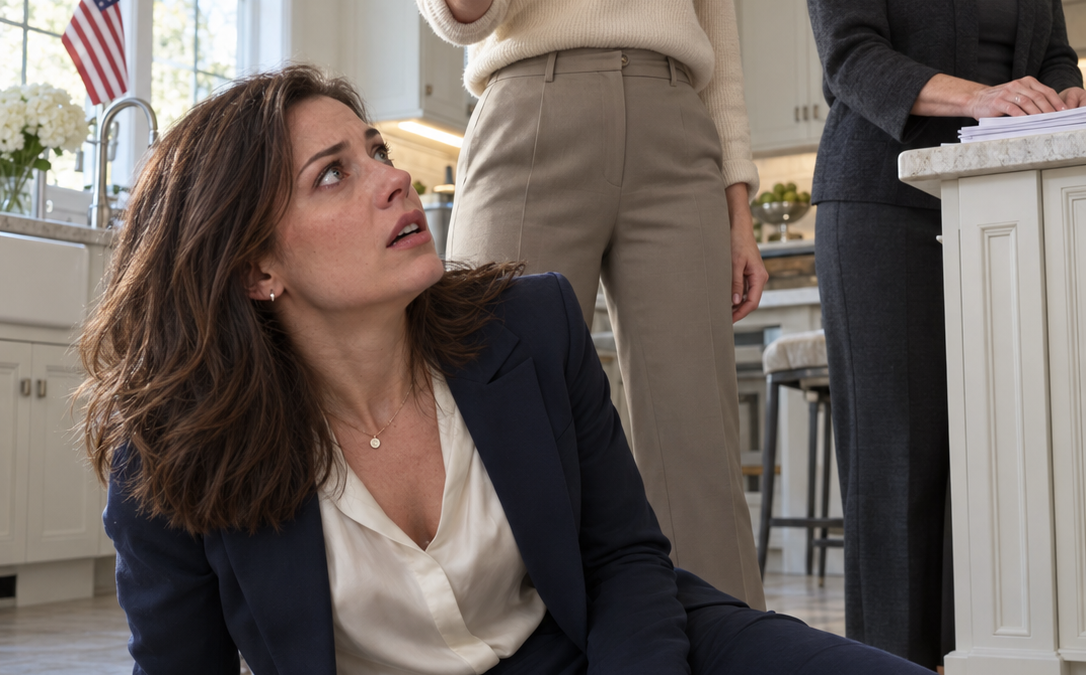
“You should have signed,” my sister said, filming me on the kitchen floor after Mom hit me for refusing her mortgage. I couldn’t control my shaking hands. Mom straightened the loan papers while I struggled to move, and Melissa kept her phone pointed at my face instead of calling 911. Neither knew what the neighbor’s camera would reveal about them.
PART 1 — JUST A SIGNATURE
My mother hit me because I wouldn’t sign my sister’s mortgage. When I collapsed on her kitchen floor, my sister lifted her phone.
She didn’t call 911.
She started recording.
“You should have signed,” Melissa said.
I remember the refrigerator humming beside my head. I remember a black scuff on the baseboard, something Mom would have scrubbed off if she’d noticed it.
Mostly, I remember her straightening the mortgage papers while I struggled to move.
Two weeks earlier, Melissa had called me at work.
“Dinner at Mom’s on Friday,” she said. “Just family. She’s making Dad’s chicken.”
I stopped scrolling through a financial report.
Dad had been dead for four years. Apparently, his recipes were still available for emotional leverage.
“What do you need?”
“Wow. Can’t I invite my sister to dinner?”
“You can. You usually don’t.”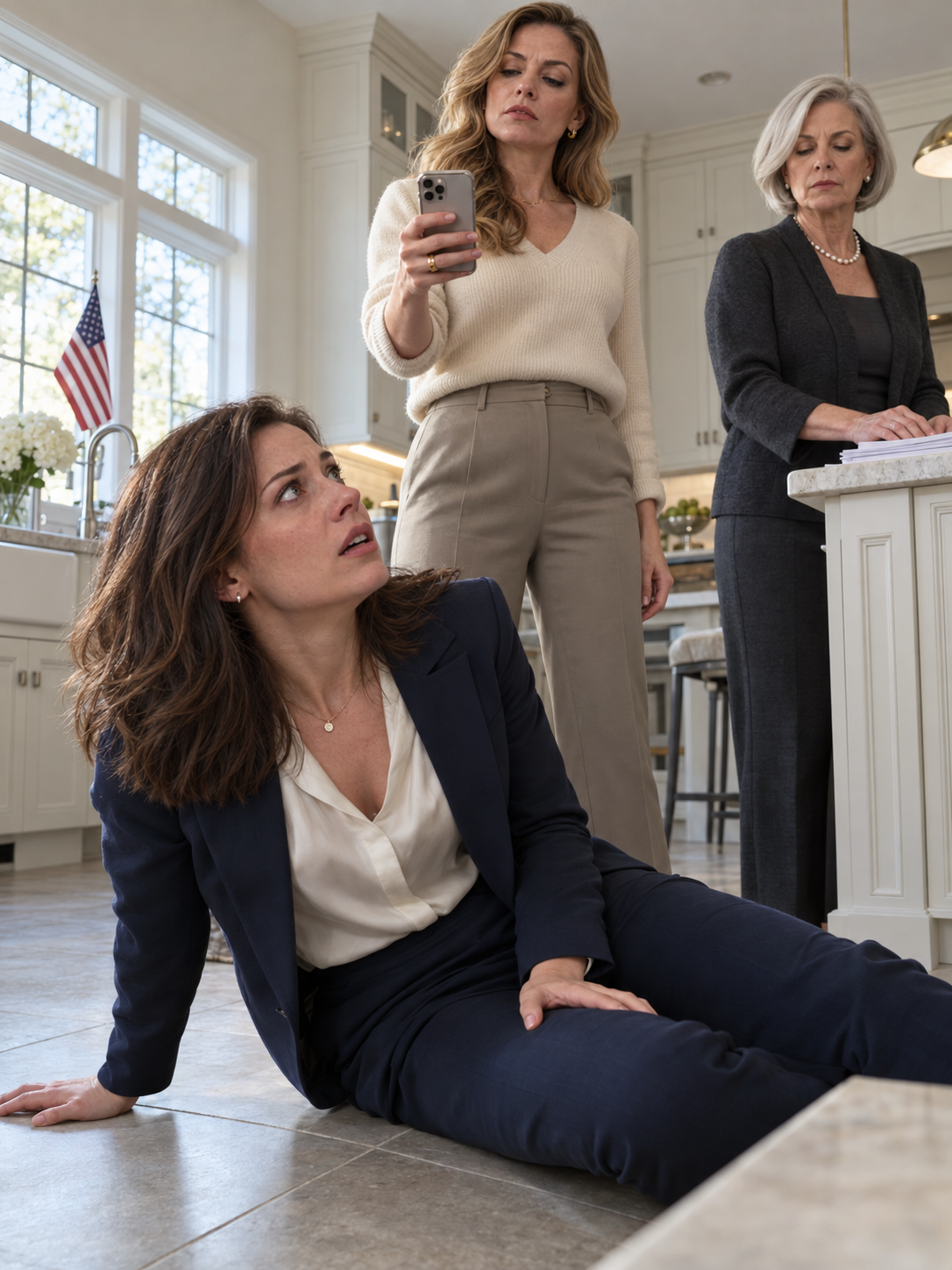
She laughed like we were teasing each other. “Mom misses you, Lauren.”
On my desk sat a Starbucks cup I’d reheated twice. Across my screen, a client’s budget refused to balance.
I could fix that budget. I already knew which expenses needed cutting.
My family was harder.
“I’ll come for dinner,” I said. “I’m not staying late.”
“Perfect.”
She hung up before I could add anything else.
The last time I’d seen Melissa, she’d called me selfish for refusing to cover her credit card payment. She’d made the request while wearing sunglasses that cost more than my monthly car insurance.
Before that, it had been Tyler’s business expenses.
Before that, overdue rent.
Every emergency came with the same promise: this would get them back on their feet.
Somehow, their feet kept landing on my bank account.
Friday evening, I carried a grocery-store cheesecake up Mom’s front steps. Through the window, I could see the good china.
Nobody used the good china for “just family.”
Melissa opened the door wearing cream cashmere and a smile I recognized from the time she’d asked me to lend her five thousand dollars.
“You look exhausted.”
“Good to see you, too.”
She took the cheesecake and checked the label.
In the dining room, Tyler sat with his phone beside his plate, watching something with the sound turned low. He gave me a brief nod.
“Hey, numbers girl.”
“Hey, business guy.”
Mom appeared carrying a serving dish.
“Let’s try to have a pleasant evening.”
She was looking at me when she said it.
For twenty minutes, we performed a family dinner.
Melissa described a kitchen island she wanted. Tyler talked about a deal that was “basically done.” Mom told us which woman at church had volunteered for something and then failed to follow through.
I ate chicken and waited.
The envelope appeared before dessert.
Mom pulled it from the chair beside her and slid it across the table.
“Take a look.”
I left my hands in my lap.
“At what?”
Melissa leaned forward. “We found a house.”
“Congratulations.”
“There’s a little complication with financing.”
Tyler picked up his water glass.
“The bank doesn’t understand self-employed income.”
I opened the envelope.
There were loan documents, income forms, and colored tabs marking places where someone expected my signature.
My name was already typed on several pages.
I looked up.
“Why am I on this?”
“You’d be helping us qualify,” Melissa said. “That’s all.”
Mom reached for the potatoes.
“Just a signature.”
I worked in finance. I spent my days explaining why the words just and signature should never appear together around a major debt.
I turned another page.
“You want me responsible for your mortgage.”
“You wouldn’t actually pay it,” Tyler said.
“Then why does the lender need me?”
He smiled without answering.
Melissa tapped one manicured nail against her wineglass.
“We’ve had a couple of temporary credit issues.”
“How temporary?”
“Lauren.”
“How many missed payments?”
“You’re making this sound ugly.”
“The bank already thinks it’s ugly. That’s why my name is here.”
Mom set down the serving spoon.
“You have a stable job. Excellent credit. Nobody depending on you.”
“I depend on me.”
“Oh, don’t start.”
I read the payment figures again. They were shopping for a house I wouldn’t have bought on my own salary, and they wanted my salary to make it happen.
“Have you considered something less expensive?”
Melissa leaned back.
“Of course you’d say that.”
“It’s a reasonable question.”
“You live in an apartment. You wouldn’t understand.”
“Apparently, my apartment has excellent credit.”
Tyler pushed his chair back an inch.
“Look, we’re not asking for a lecture.”
“Then don’t hand me loan documents over chicken.”
Mom’s expression changed. The hostess was gone.
“Your sister deserves a home.”
“She has a home. She wants a different one.”
I closed the envelope.
“I’ll read everything. I’m not signing tonight.”
Melissa glanced at Mom. It lasted barely a second, but I saw it.
They hadn’t invited me to consider anything.
They’d invited me to comply.
At the door, Mom squeezed my upper arm.
“Don’t make this harder than it needs to be.”
I looked down at her hand until she removed it.
The cheesecake remained unopened on the counter.
Saturday morning, I took the documents to Kelly’s house.
She opened the door in leggings, holding a mug that said she wasn’t available before coffee. We’d been friends since freshman year of college, long enough for her to skip the polite introduction.
“How much?”
“I haven’t told you what happened.”
“You’re carrying a folder from your mother’s house.”
We sat at her kitchen table.
I explained the mortgage. Kelly listened without interrupting, which worried me more than if she’d started yelling.
Finally, she asked, “Are you considering this?”
“I’m considering how to say no.”
“Try those two letters in that order.”
“You know what she’s like.”
“Yes. That’s why I’m asking what you’re going to do.”
I smoothed a bent corner of the envelope.
“Mom says they’ll lose the house.”
“They don’t own the house.”
“The opportunity, then.”
“They can lose an opportunity.”
I stared at the paperwork.
Kelly pulled the envelope toward her.
“Remember Tyler’s business expenses?”
“I remember.”
“They used your card.”
“They had the number from when I booked the hotel.”
“And apparently thought that included permission to buy office equipment.”
I’d paid the balance because Mom said disputing it would humiliate the family. Tyler had promised to repay me after his next contract.
There was always a next contract.
Kelly watched me do the familiar calculation: what saying no would cost emotionally, compared with what saying yes could cost financially.
“I don’t want to lose my family,” I said.
She waited before answering.
“Then they should stop making access to them so expensive.”
I took the documents home.
For once, I read them the way I would have read a client’s paperwork.
Without substituting hope for income.
Without treating promises as assets.
By Sunday night, I had my answer.
I texted Melissa: I reviewed the documents. I won’t participate in the loan.
She called immediately.
I let it ring.
Then Mom called.
Then Tyler sent a message explaining that I was putting them in a difficult position.
I typed back: You need financing that works without me.
Mom responded in the family group chat.
We will discuss this at dinner tomorrow.
I should have declined.
Instead, I convinced myself that saying it in person would make it final.
On Monday, Mom had set the table again.
Same china. Same assigned seat between her and Melissa.
This time, I kept my coat on the back of my chair.
Tyler smiled at me over his plate.
“Still reviewing our entire financial history?”
“No. I’m finished.”
Melissa put down her fork.
“Then what’s the problem?”
“I’m not signing.”
Mom folded her napkin.
“Your sister told me you were upset.”
“I’m not confused or upset. I’ve made a decision.”
Tyler gave a short laugh.
“You don’t even have a family to support.”
I looked at him.
“You’re doing a remarkable job of explaining why I shouldn’t support yours.”
Melissa’s chair scraped against the floor.
“That was unnecessary.”
“So was inviting me back after I answered.”
Mom lowered her voice.
“I raised you better than this.”
“You raised me to pay my bills. That’s what I’m doing.”
“Your father would be ashamed.”
I stopped moving.
She saw it. Of course she saw it.
Dad had been the one who slipped cash into my coat pocket when I went back to college. He never called it a loan. He never asked what I owed him afterward.
“Don’t do that,” I said.
“Then stop forcing me to.”
I stood and picked up my coat.
Mom followed me into the hallway.
“We’ll talk privately on Friday.”
“There’s nothing left to discuss.”
“Then you should have no trouble explaining yourself.”
By Thursday, I had six missed calls, fourteen messages, and an aunt asking why I was punishing Melissa.
I almost gave in just to make the phone stop.
Instead, I agreed to one final visit.
I told myself a conversation without Tyler might be different. I told myself my mother would hear me if I found the right words.
Friday after work, I texted Kelly.
Going to Mom’s. Telling her no one last time.
She replied: You already told her. Keep your keys with you.
I read that message in the driveway.
Then I went inside.
Mom stood in the kitchen beside the papers. Melissa leaned against the counter with her phone in her hand.
I stayed near the doorway.
“I thought we were talking privately.”
“Your sister has a right to be here,” Mom said.
“Fine. My answer is still no.”
Melissa rolled her eyes.
“Can you stop performing for thirty seconds?”
Mom pointed at a chair.
“Sit.”
“I’m not staying.”
She picked up a pen.
“I spoke to Melissa. They can handle the payments.”
“Then they need to convince the lender.”
“I’m telling you they can.”
“That doesn’t change my answer.”
Mom stepped closer.
I smelled whiskey beneath her perfume.
“After everything I’ve done for you.”
“I’m grateful for the things you’ve done. I’m still not taking this loan.”
“You always have an answer.”
“Yes,” I said. “You just don’t like it.”
Her hand struck my face before I realized she’d raised it.
I caught the edge of the table.
For a second, none of us spoke.
I stared at her, waiting for her to react to what she’d done.
Instead, she shoved the pen toward me.
“Now stop this.”
I set it on the table.
“I’m leaving.”
She moved into the doorway.
I tried to get past her. Her hands hit my shoulders, driving me backward into the counter.
Pain caught beneath my ribs.
“Mom. Move.”
Behind her, Melissa raised her phone.
“Are you recording this?” I asked.
“Maybe you should see how you act.”
I reached for my own phone. Mom grabbed my arm, and when I pulled away, she shoved me again.
My heel slipped.
The floor came up hard.
After that, my memory breaks into pieces.
The overhead light.
My hand moving when I wasn’t telling it to.
Melissa’s phone pointed down.
“You should have signed.”
Then nothing I can put in order.
When I could move again, my face was against the tile. My bag lay beneath a chair, impossibly far away.
I called for help.
Mom stood by the sink.
“Get up, Lauren.”
I couldn’t.
I crawled toward the hallway because the front door was there, because outside meant someone else might see me.
At the threshold, they finally touched me.
Each took an arm. They moved me onto the porch, where I tried to brace myself against the railing.
“Cool off,” Mom said.
The door closed.
I heard the lock.
I knocked with the side of my hand.
“Mom. I need help.”
Their voices stopped inside.
I knocked again.
Snow landed on my sleeve. The porch light stayed off.
Then someone was coming across the yard, calling my name.
Mrs. Thompson knelt beside me with her phone already against her ear.
“No, she is not all right,” she told the dispatcher. “Send an ambulance.”
I tried to tell her about the papers.
She took off her scarf and put it around my shoulders.
“We can talk later, honey.”
By the time the ambulance arrived, my mother had closed the curtains.
Neither of them came outside.
At the hospital, Kelly appeared beside my bed while a nurse checked my IV.
She looked at my face, then pulled a chair close.
“Tell me what happened.”
I started with the mortgage.
When I reached the kitchen, she stopped asking questions and held my hand.
Later, after imaging, examinations, and a discussion about keeping me under observation, I finally reached for my phone.
Melissa had posted on Facebook.
Please keep my sister in your prayers. She’s been struggling and had an episode tonight. We did everything we could to calm her down.
Underneath was a picture of me on the kitchen floor.
A picture she had taken while I needed an ambulance.
The comments were already coming in.
Praying for your family.
You’re such a good sister.
I passed Kelly the phone.
She read the post once.
Then she looked at the photograph again.
“Lauren,” she said, “we need to save this before she realizes what she’s posted.”
PART 2 — WHAT THE CAMERA KEPT
Kelly took screenshots while I watched the hospital door.
Every pair of footsteps made me look up.
Finally, the nurse noticed.
“Are you expecting someone?”
“My mother might come.”
“Do you want her here?”
The question was so straightforward that I almost didn’t understand it.
“No.”
The nurse nodded and made a note.
Nobody asked me to consider her feelings.
I stayed under observation while the doctors assessed the head injury and seizure. Kelly took notes because I couldn’t reliably remember a conversation from one hour to the next.
When a police officer came to speak with me, I nearly said I didn’t want any trouble.
The sentence was already waiting.
Then I looked at the swelling reflected in the dark television screen.
“My mother hit me,” I said.
The officer pulled his chair closer.
I gave him her name.
Susan Parker.
I gave him Melissa’s name, too, and described the recording, the porch, the locked door.
He asked what I remembered directly and what I wasn’t sure about.
For once, I didn’t fill the gaps to make the story easier for someone else.
“I don’t know,” I said when I didn’t know.
Kelly drove me home after I was discharged. She carried my bag upstairs, put the follow-up instructions on the refrigerator, and plugged my phone in beside the couch.
Then she opened her overnight bag.
“You don’t have to stay.”
“I brought toothpaste. The discussion is closed.”
I slept badly.
When I woke, I could hear her loading my dishwasher.
Such an ordinary sound.
Someone in my kitchen, doing something useful, without preparing to ask what it would cost me.
That afternoon, we made a folder on my laptop.
Evidence.
The name looked severe.
I almost changed it to something less confrontational.
Then I left it alone.
We saved the discharge paperwork, photographed my injuries, and preserved the messages about the mortgage. Kelly helped me write a timeline while the order of events was still reasonably clear.
I included the details that embarrassed me.
That I had gone back.
That I had begged Mom to open the door.
That some part of me had still expected her to help.
When I hesitated, Kelly pointed at the screen.
“You’re documenting what happened. You’re not applying to be the perfect victim.”
My phone vibrated.
Mom.
I didn’t answer.
Her voicemail arrived a minute later.
“Lauren, this has gotten completely out of hand. Call me before you make things worse.”
She didn’t ask how I was.
Kelly saved that, too.
Melissa’s post kept spreading among people I knew.
An old family friend messaged me about treatment. An aunt suggested I apologize for frightening my mother. Someone from church sent a long paragraph about forgiveness.
I started writing a public response.
Three times, I deleted it.
Finally, Kelly said, “Let someone who knows what they’re doing help you.”
She found an attorney who handled protective orders and civil claims.
At our first meeting, I placed my folder on the desk and began apologizing for how complicated it was.
The attorney opened it.
“You don’t need to make this comfortable for me.”
She reviewed the messages and the post.
Then she explained that there would be separate processes. Protection from further contact. A police investigation into the assault. A possible civil claim over Melissa’s public accusations.
Nothing would be resolved in one dramatic afternoon.
That disappointed me more than I wanted to admit.
I was exhausted. I wanted someone to look at the photographs, say I was telling the truth, and hand me my life back.
Instead, there were forms.
Appointments.
Requests for records.
I signed the paperwork anyway.
A few days later, Mrs. Thompson called.
“Kelly said your lawyer is gathering everything.”
“Yes.”
“I have a camera over my garage.”
I sat down.
It faced part of Mom’s driveway and the front steps.
Mrs. Thompson had checked the recording after the ambulance left. She had preserved the original and was willing to provide it.
When Kelly brought the copy over, she asked whether I wanted to watch.
“I need to know.”
The footage didn’t show the kitchen.
It showed the porch.
Mom and Melissa appeared in the doorway holding my arms. My feet weren’t moving properly.
They put me outside.
Melissa stepped back into the house first. Mom followed.
The door closed.
For a while, the camera recorded me trying to straighten up.
Then it recorded me knocking.
We watched my hand lift against the door and fall.
I had remembered that part.
Seeing it from across the driveway was worse.
There was the whole street, carrying on around it. A car passed. Someone’s porch lights came on.
Inside my mother’s house, they left me there.
Kelly paused the video when Mrs. Thompson entered the frame.
“Enough for today.”
I nodded.
My attorney preserved the footage and contacted Mrs. Thompson. The investigator followed up, too.
The story my family had offered was becoming harder to maintain.
Mom said I’d been hysterical.
Melissa said they’d tried to help.
Tyler, who hadn’t been there, apparently had plenty to say about both.
My attorney kept returning to the same questions.
What did the records show?
What did the witnesses observe?
What had they written in their own messages?
The first protective-order hearing arrived before I felt ready.
Mom wore a navy suit I’d helped her buy for a church fundraiser. Melissa sat beside her, holding her phone until someone told her to put it away.
Neither looked at my bruises.
Mom looked at my attorney.
Apparently, that was the injury she considered serious.
When I testified, I kept my hands flat on the table.
I described the mortgage request, the refusal, and the assault.
Then the porch footage played.
I looked down while it ran.
Across the room, Mom said something quietly to her lawyer.
The judge asked her to let the recording finish.
There was no burst of applause afterward. Nobody delivered a speech that repaired my childhood.
There were questions.
Careful ones.
I answered them.
The court granted protection restricting their contact with me. When my attorney explained the terms afterward, I read the order twice.
A document telling my mother she couldn’t simply decide she had a right to me.
Outside, Kelly handed me a coffee.
“How do you feel?”
“Like I’m going to throw up.”
She took the cup back.
“Okay. We’ll start there.”
The criminal case took longer.
So did the civil action against Melissa.
I went to work when I could. I attended medical appointments. I sat through meetings with my attorney and answered questions I wished I would never hear again.
At night, I sometimes checked my locks twice.
There were days when I wanted to withdraw everything, because the process meant continuing to think about people I was trying to escape.
On those days, I watched only the beginning of the porch footage.
Not the worst part.
Just the moment they decided to put me outside.
It reminded me that missing my family didn’t make them safe.
Eventually, the evidence was presented in the assault case.
The medical records documented my injuries. Mrs. Thompson testified about finding me and calling for help. The recording contradicted the claim that they had been doing everything possible to care for me.
I testified again.
Mom’s lawyer asked whether the argument had been heated.
“Yes.”
Whether I had refused my mother’s request.
“Yes.”
Whether I had wanted to leave.
“Yes.”
The prosecutor returned to the part that mattered.
“Did you give your mother permission to strike you?”
“No.”
Susan Parker was found guilty of assault.
I heard the finding, but it took several seconds to understand that nobody was going to follow it with an explanation of why I had caused it.
I didn’t look at her.
I looked at Kelly.
She was already looking at me.
Melissa’s case had its own record, its own arguments, and its own outcome.
Her lawyer described the Facebook post as concern for a family member.
Our evidence placed her words beside what she had actually done.
She had recorded me in distress.
She had published the image.
She had told people they’d tried to help, while leaving out the assault and the locked door.
The court found her liable for defamation.
The damages judgment and the expense of defending her story were hers to handle.
For once, no one could slide the bill across a dinner table to me.
The case drew local attention.
A reporter contacted my attorney. A short news segment aired, using blurred footage and the public court record.
I declined an interview.
I had already answered enough questions under oath. I didn’t owe strangers a close-up.
Relatives began calling with a different tone.
“We had no idea.”
Some truly hadn’t.
Some had seen the Facebook post and decided the easiest version to believe was the one that required nothing from them.
I answered the people I wanted to answer.
The rest waited.
Mom stepped down from her church volunteer positions. Melissa lost a major design client, and people who had enthusiastically shared her concern for me became much less enthusiastic about attaching their names to hers.
I learned those things secondhand.
I didn’t ask for updates.
One aunt called to say the family had suffered enough.
I was standing in my kitchen, sorting mail.
“Then stop calling me about their suffering,” I said.
She started to explain.
I ended the call.
My hand shook afterward.
I still didn’t call back.
Later that spring, I moved to a neighboring city.
Not across the country. Just far enough that my grocery store wasn’t full of people who knew my mother.
The new apartment had wide windows and a kitchen with room for two people to cook without touching shoulders.
Kelly came furniture shopping with me.
I chose a couch because I liked it.
Not because someone was getting rid of one. Not because Mom thought another color would be more practical.
At the register, I inserted my card and watched the payment go through.
Mine.
An ordinary purchase, made with money that wasn’t waiting to rescue someone else.
Mrs. Thompson came over for dinner after I settled in.
She brought back the scarf she’d lent me, freshly washed, then laughed when she realized it was hers.
“Well,” she said, “apparently I’m bringing my own wardrobe to dinner now.”
I took her coat.
For a moment, I couldn’t say what I wanted without making the evening heavy.
“Thank you for coming outside,” I finally said.
She squeezed my hand.
“Of course I came outside.”
I carried those words into the kitchen.
Of course.
Not after a discussion.
Not after deciding whether I’d earned it.
Months after the first hearing, I received confirmation that the protective order would remain in effect. I filed it with the rest of the court documents.
Then I closed the drawer.
I still had difficult mornings. A slammed cabinet could pull me out of whatever I was doing. Sometimes an unknown number on my phone made me put it facedown and leave the room.
I was getting help with that.
I was also making plans that had nothing to do with what happened.
Dinner reservations. A weekend trip. A Saturday spent buying plants I didn’t know how to keep alive.
One Sunday, Kelly arrived carrying bagels and another plant.
“You’ve confused me with someone responsible for vegetation,” I said.
“You work in finance. Make it a watering schedule.”
I put coffee on.
My phone buzzed on the counter, and for once I didn’t reach for it immediately.
Kelly was telling me something about her neighbor. The bagels were still warm. Sunlight crossed the table where no documents waited for my signature.
Later, she asked if she could stay for dinner.
“Of course,” I said.
When she went downstairs to get something from her car, I left the door open for her.