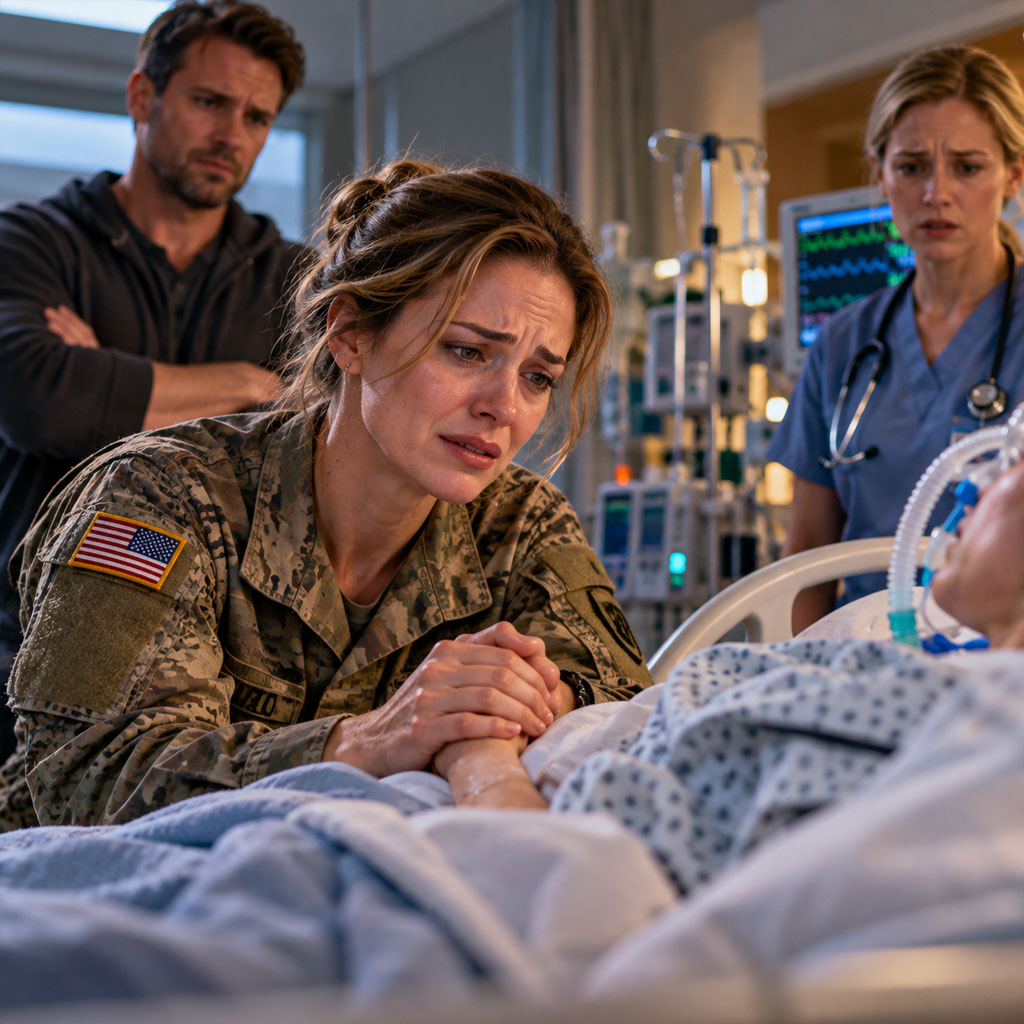
My ex-husband was discussing when to take our twelve-year-old daughter off life support when I walked into the hospital. He spoke as though her death were already scheduled, as though the little girl behind that door had no say in whether she stayed or left. But what happened when I took her hand would make me question everything he’d told me.
Chapter 2
By Friday morning, I had read Emily’s admission paperwork so many times that the numbers blurred together. Every time I closed my eyes, I saw Grant’s message telling me she was safely asleep. Three hours later, she had been rushed to the emergency department with a devastating head injury.
Melissa Carter, the hospital social worker, arrived shortly after breakfast. She was a calm woman with silver-rimmed glasses who immediately noticed the stack of unanswered questions in my lap.
“We understand you’ve had difficulty receiving updates,” she said.
“Difficulty doesn’t begin to describe it.”
I showed her the messages Grant had sent while I was trying to return home. She reviewed the contact information in Emily’s hospital chart and frowned.
“Is this still your telephone number?”
I shook my head. “I changed that number four years ago.”
Melissa looked troubled. “That’s the number we have listed for you.”
“Grant knows my current number. He called it to tell me Emily was hurt.”
She promised to correct the information and review the admission records. Then she asked for our custody agreement.
Grant and I had divorced three years earlier, but we shared legal custody of Emily. My military assignments sometimes required her to stay with him for extended periods, and although our marriage had failed, I’d believed we could still make responsible decisions for our daughter.
Apparently, I’d been wrong.
I called Caroline Brooks, the attorney who’d handled our divorce. After listening to what I knew, she gave me advice I could almost hear her delivering across a courtroom.
“Rebecca, don’t build a case out of anger. Get the records, document what happened, and let the evidence speak. Right now, your job is protecting Emily.”
That afternoon, Denise Walker arrived carrying a turkey sandwich and a bag of apples. Denise was sixty-three, a retired school secretary who’d lived across the street from us for years. She’d become the grandmother Emily never had nearby.
She set the food down and looked at my daughter. Tears filled her eyes, but she quickly wiped them away.
“You need to eat something, honey.”
“I can’t.”
“You can eat half a sandwich while I sit with her.”
I obeyed because arguing with Denise had never accomplished much.
After several minutes, she folded her hands.
“Rebecca, Emily called me the evening before the accident.”
My sandwich suddenly tasted like cardboard.
“What did she say?”
“She asked whether she could stay with me for a few days. Said things were uncomfortable at her father’s house.”
“Did she say somebody hurt her?”
“No. I asked, and she said nobody had. But something was bothering her.”
A memory struck me. Two days before the crash, Emily had sent a message asking whether we could talk about Dad’s house.
I’d promised to call when my assignment allowed it. Communications problems interfered, and I’d told myself we’d have time when I returned.
Now that unfinished conversation felt like a weight on my chest.
“She tried to tell me something,” I whispered.
Denise covered my hand with hers. “You can’t go backward, Rebecca. You can only listen when she needs you now.”
Later, Dr. Samuel Ortiz from neurology examined Emily. She showed some movement, but her responses remained inconsistent.
I explained our two-squeeze signal and watched him write it down.
“That’s useful information,” he said. “We’ll include it when we plan further assessments. But we need to establish whether her responses are intentional.”
For the first time, I felt someone understood why those two squeezes mattered without promising me a miracle.
That evening, Denise returned from the cafeteria with unexpected news.
“A neighbor spoke with someone familiar with the accident investigation,” she said carefully. “Rebecca, I think you need to request the police report.”
“Why?”
She hesitated.
“Because Grant wasn’t driving.”
I stared at her.
“Then who was?”
“Natalie.”
The room seemed to tilt.
For nine days, Grant had allowed me to believe he’d been driving Emily home when another vehicle forced them off the road.
I called the investigating department. Officer Michael Hayes returned my call and confirmed that Natalie Price had been driving when her car left a wet stretch of Ramsey Street and struck a utility pole.
“No other vehicle was struck,” he explained. “The investigation is still active.”
“Grant told me a truck ran them off the road.”
“I can’t explain what he told you, ma’am. I can only confirm what we’ve established.”
“Was he in the car?”
“No.”
I thanked him and ended the call.
When Grant arrived, I asked him to meet me in the family waiting room.
“Natalie was driving,” I said.
He went completely still.
“Rebecca—”
“You told me you were.”
“I didn’t want you panicking overseas.”
“My daughter nearly died. Did you think lying would make that easier?”
He sank into a chair. Natalie had apparently been taking Emily home from a gathering at a friend’s house. Grant had been working late and asked her to pick Emily up.
“Why was she there that late?” I demanded.
“Things ran longer than expected.”
“And why was she uncomfortable staying at your house?”
His expression hardened. “Emily’s been acting difficult lately. She doesn’t always get her way.”
“She’s twelve, Grant. She isn’t an inconvenience.”
He stood abruptly. “You show up after nine days and think you know everything.”
“No,” I said. “I’m starting to realize how much I don’t know.”
He left without another word.
Over the next two days, the truth emerged slowly. Investigators identified a witness who’d seen Natalie’s vehicle braking unpredictably before the crash. Records also raised questions about phone activity shortly before the collision.
Officer Hayes refused to speculate, and I appreciated that. As much as I wanted answers, I didn’t want an innocent assumption to become another lie.
Natalie, however, seemed less interested in finding the truth.
She confronted me outside Emily’s room Saturday afternoon.
“Grant has been here every day,” she snapped. “You don’t get to come marching in wearing your uniform and act like you’re the only parent who matters.”
I closed my notebook. “I’m asking what happened to my daughter.”
“Maybe if you’d spent less time chasing promotions, she wouldn’t have been in that car.”
Her words struck where she intended.
I thought of birthdays celebrated over video calls and school concerts I’d watched in recordings. I thought of the lonely nights when Emily asked when I was coming home.
But I also thought of that little hand squeezing mine.
“You’re entitled to your opinion of me,” I said. “You’re not entitled to hide what happened to Emily.”
I walked into my daughter’s room before Natalie could respond.
Sunday morning brought a small but important change.
During another neurological examination, Emily moved her right hand following a simple instruction. The response wasn’t consistent, and Dr. Ortiz remained cautious.
Still, he ordered further assessments.
That afternoon, Caroline called.
“The investigator has confirmed significant contradictions in Natalie’s account. We also have enough documentation to request an emergency review of the medical decision-making arrangements.”
I looked at Emily lying beneath her pale blue blanket.
“Will Grant lose his right to see her?”
“That’s not what we’re requesting. We’re asking the court to establish safeguards so Emily’s medical care isn’t compromised by withheld information.”
I understood the difference.
I didn’t want revenge. I wanted the truth, and I wanted my daughter to have every medically appropriate chance at recovery.
Chapter 3
Grant was holding Natalie’s hand when I entered the courthouse the following week. I couldn’t help noticing that he hadn’t sat beside Emily’s bed during his last three scheduled visits. Whatever comfort Natalie needed seemed to have taken priority over the daughter who was fighting to wake up.
Caroline met me outside the courtroom.
“Remember why we’re here,” she said.
“Emily.”
“Exactly. Let me handle the arguments.”
Judge Margaret Ellis listened while Caroline presented our custody agreement, the communication problems at the hospital, and Grant’s messages during my attempts to return home.
Grant’s attorney emphasized that he’d remained physically present while I was overseas. Caroline didn’t dispute it, but she showed that I had repeatedly requested updates and had arranged emergency travel as soon as I learned of the accident.
When the judge questioned Grant about my outdated contact information, he shifted in his chair.
“I had a lot happening,” he said.
Judge Ellis studied him. “Mr. Sullivan, a medical emergency does not erase your responsibility to communicate truthfully with your child’s other legal parent.”
Then she turned to me.
“Major Sullivan, what are you asking this court to do?”
I stood, suddenly aware of how badly my hands were trembling.
“Your Honor, my daughter has two parents. My military service sometimes requires me to be away, but that doesn’t mean I stop being her mother. I need accurate information so her medical decisions can be made for her benefit, not based on which parent happens to be standing beside her.”
The judge granted temporary arrangements giving me specified authority to coordinate Emily’s medical care, subject to her doctors’ recommendations and further review. Grant retained appropriate access and the right to receive medical updates.
It wasn’t a victory over him.
It was protection for her.
Outside, Natalie stormed toward us.
“Congratulations,” she snapped. “You’ve managed to make Grant look like a monster.”
Caroline stepped forward, but I gently stopped her.
“Natalie, I didn’t cause that accident. And I didn’t tell Grant to lie.”
“It was an accident!”
“Then you should have told the truth about it.”
For once, she had nothing to say.
Grant approached as we waited for the elevator.
“I was scared, Rebecca,” he murmured.
“So was I.”
“I thought you’d take Emily away if you knew Natalie was driving.”
I looked at the man I’d once promised to love forever.
“You were more afraid of losing control than of telling me what happened to our daughter.”
He lowered his eyes.
I left him standing there.
That evening, I returned to the hospital exhausted. Denise was beside Emily, reading from her favorite book about a girl who rescued abandoned horses.
“How did court go?” she asked.
“We have better arrangements.”
“That’s good.”
I sat down beside Emily. Getting answers hadn’t made her injuries disappear, and no judge could promise she’d recover.
I brushed the hair away from her forehead.
“I’m here, sweetheart.”
Then I squeezed her hand twice.
Nothing.
I stayed anyway.
Shortly after seven, I went downstairs for coffee. My phone rang while I was standing near the vending machines.
It was Dr. Ortiz.
“Major Sullivan, are you still in the hospital?”
“Yes. Is Emily all right?”
“She’s stable. We’ve observed more consistent responses during repeated examinations. I’d like you to come upstairs.”
I left the coffee untouched.
When I entered Emily’s room, her eyes were partially open. They didn’t follow me, but seeing them open made my knees weaken.
Dr. Ortiz stood beside her bed.
“Emily,” he said gently, “I’d like you to move your right thumb.”
Several seconds passed.
Then her thumb shifted.
He waited before repeating the request.
It moved again.
I covered my mouth, afraid that if I spoke, I’d start sobbing and never stop.
“That’s encouraging,” he told me. “But she still has a significant brain injury, and we can’t predict the extent of her recovery.”
I nodded. I wasn’t asking for certainty anymore.
I just wanted my daughter to have tomorrow.
Over the following days, progress came in tiny pieces. Emily opened her eyes more often, sometimes responded to instructions, and eventually began breathing with less mechanical support.
When her doctors determined she could safely come off the ventilator, I stood nearby while the team carefully monitored her.
Recovery was nothing like I’d imagined. She slept for hours, became confused, and sometimes looked directly at me without seeming to understand who I was.
Then one afternoon, she turned toward my voice.
“Mom?”
Her voice was weak and scratchy.
I leaned close. “I’m right here, baby.”
She swallowed.
“Water.”
I started crying.
A nurse gently explained that Emily needed a swallowing assessment before she could drink normally. I listened, nodded, and helped moisten her lips.
Such an ordinary word.
I had never imagined hearing my daughter ask for water could become one of the happiest moments of my life.
The rehabilitation specialists soon explained what lay ahead. Emily had weakness on one side, difficulty concentrating, and periods of overwhelming exhaustion.
She would need physical therapy, occupational therapy, and help with communication and swallowing. Nobody could promise how much she’d regain.
One afternoon, she tried lifting a cup and spilled water across the table.
Her face crumpled.
“I can’t do it anymore.”
I reached for a towel. “Not yet, sweetheart.”
“I used to.”
“I know.”
She turned away, crying quietly.
I wanted to promise everything would return to normal, but I couldn’t. Instead, I sat beside her until she was ready to try again.
A week later, Grant requested a visit.
He came alone, wearing an old gray sweater I’d bought him years earlier. Emily was sitting upright against several pillows when he entered.
“Hey, Peanut.”
She looked at him.
“Dad?”
Grant’s face collapsed.
He sat beside her and gently took her stronger hand.
“I’ve missed you so much.”
Emily studied his face.
“Why are you crying?”
“Because I’m glad you’re here.”
Afterward, Grant asked to speak privately.
“I know I lied,” he said. “I convinced myself I was protecting everyone.”
“You were protecting yourself.”
He nodded.
“I’m sorry.”
“Then show her,” I said. “Be honest. Follow the doctors’ recommendations. Let her feel safe with you again.”
I wasn’t ready to forgive him. But Emily still loved her father, and I wouldn’t use her recovery to punish him.
That evening, while rain tapped softly against the hospital window, Emily reached for my hand.
“Mom?”
“Yes, sweetheart?”
“I remember something.”
I went still.
“About the car?”
She nodded slowly.
“Natalie was angry.”
Her eyes filled with confusion.
“I remember her talking loud. Then everything got noisy.”
I held her hand, resisting the urge to ask more. The doctors had explained that memories after a traumatic brain injury could be incomplete and that Emily shouldn’t be pressured to reconstruct them.
“You don’t have to figure it out tonight,” I whispered. “We’re safe right now, and we’ll work through everything together.”
She closed her eyes.
A moment later, her fingers tightened around mine.
Twice.
Chapter 4
Three months after the accident, Emily carried a glass of water across our kitchen using both hands. It took almost a minute, and she moved with the solemn concentration of someone crossing a narrow bridge. When she finally set it on the table without spilling, she looked at me with a triumphant grin.
“See, Mom? No towel this time.”
I laughed, then turned toward the sink to hide my tears.
We hadn’t gotten our old life back. We were building a different one, slowly, out of appointments, exercises, rest periods, and moments I once would have overlooked.
Emily still had headaches and struggled to remember instructions. Some mornings, getting dressed exhausted her before breakfast.
My commanding officer arranged a temporary assignment that allowed me to remain close to home. Denise visited almost every afternoon, helping with reading exercises and occasionally ordering me outside for fresh air.
“You can’t take care of that girl if you run yourself into the ground,” she’d say.
For once, I listened.
By January, Emily was ready to attend school two mornings each week. Her teachers arranged shorter assignments, extra breaks, and a gradual return to classroom activities.
On her first morning back, she stood by the front door with her purple backpack.
“What if everybody stares?”
“Some people probably will,” I answered. “But the ones who matter will be happy to see you.”
She considered that.
“Will you pick me up?”
“I’ll be there before the bell.”
She reached for my hand and squeezed twice.
I squeezed back.
Meanwhile, the investigation finally reached its conclusion. Evidence established that Natalie had been using her phone while driving, and she eventually pleaded guilty to a traffic offense connected to the crash.
The court imposed penalties and driving restrictions. Separate financial matters continued through the legal process.
There was no dramatic confession. No tearful apology from Natalie.
I wasn’t even at the courthouse when Caroline called with the result.
I was watching Emily practice walking between parallel bars at physical therapy.
That was where I needed to be.
Grant and Natalie separated soon afterward. He told me during a conversation about Emily’s therapy schedule, but I didn’t ask for details.
Their relationship had stopped being my concern.
His relationship with our daughter mattered much more.
As Emily improved, our attorneys helped arrange a revised parenting plan. Medical communication had to be clear, and Grant’s time with Emily would increase gradually as her needs allowed.
He began counseling and started attending rehabilitation appointments. He learned her exercises and, most importantly, listened when she said she was tired.
Trust didn’t return because he apologized.
It returned a little each time he did what he promised.
One Saturday afternoon, Grant helped Emily assemble a wooden birdhouse. He held the pieces steady while she carefully turned a screwdriver, stopping whenever her hand became tired.
When they finished, she painted the roof dark blue.
“Like Mom’s uniform,” she said.
Grant smiled.
“That’s a good color.”
Later, he joined me on the porch while Emily showed Denise her creation.
“I know I can’t undo what happened,” he said.
“No, you can’t.”
He looked toward our daughter.
“But I want to be somebody she can count on.”
“Then keep being that person.”
He nodded.
That was enough for me.
I didn’t need to love Grant again. I didn’t need to pretend the lies hadn’t happened.
I only needed him to understand that being a good father meant putting Emily’s needs ahead of his pride.
By spring, the sunflowers Denise had promised were growing along the back fence. Emily checked them every morning, measuring the tallest stalk with a ruler and recording its progress in a little notebook.
She still had difficult days. Sometimes her memory failed her, or a headache forced her to rest while her friends played outside.
But she was learning to be patient with herself.
And I was learning alongside her.
One Sunday afternoon, a gentle rain moved across the neighborhood. Emily and I sat together on the covered porch while water dripped from the gutters.
She leaned against my shoulder.
“Mom?”
“Yeah, sweetheart?”
“Do you remember our secret signal?”
I smiled. “Of course I do.”
She slipped her hand into mine.
Two squeezes.
I returned them.
She looked up at me.
“When I was in the hospital, did you know it was me?”
I thought about that terrible Thursday afternoon. I remembered the cold fear in my chest, Grant’s terrible words, and the tiny movement that had changed the direction of everything.
“I knew what our signal meant,” I said. “And I hoped with everything in me that you were trying to tell me you were still there.”
“Was I?”
“The doctors had to help us understand what your body was doing. But those squeezes made me ask more questions. They helped me keep looking for answers.”
Emily rested her head against my shoulder again.
“Were you scared?”
“More scared than I’ve ever been.”
“Even more than when you’re overseas?”
“Much more.”
She was quiet for a moment.
“I’m glad you came home, Mom.”
I kissed the top of her head.
“So am I, baby.”
We watched the rain settle over the garden, where the young sunflowers bowed gently in the breeze.
Before the accident, I’d believed strength meant keeping my emotions under control, solving every problem, and never admitting I was afraid. Emily had taught me that real strength sometimes meant sitting beside someone you loved, accepting uncertainty, and refusing to abandon hope without pretending hope was a guarantee.
I’d also learned that truth and forgiveness were different things. Grant was responsible for his choices, and forgiveness couldn’t erase them. But I could give him room to become a better father without surrendering the boundaries that kept our daughter safe.
The rain began to ease, and a patch of sunlight appeared beyond the trees.
Emily lifted her head.
“Mom, do you think the sunflowers will bloom soon?”
“I think they’re getting closer every day.”
She smiled and settled against me again.
I held her hand, remembering how close I’d come to losing the chance to do something so simple.
There would be more appointments, more difficult mornings, and questions we might never fully answer. But that afternoon, my daughter was sitting beside me, warm and alive, watching the rain.
And when she squeezed my hand twice, I didn’t need another word.
I squeezed back.
THE END.