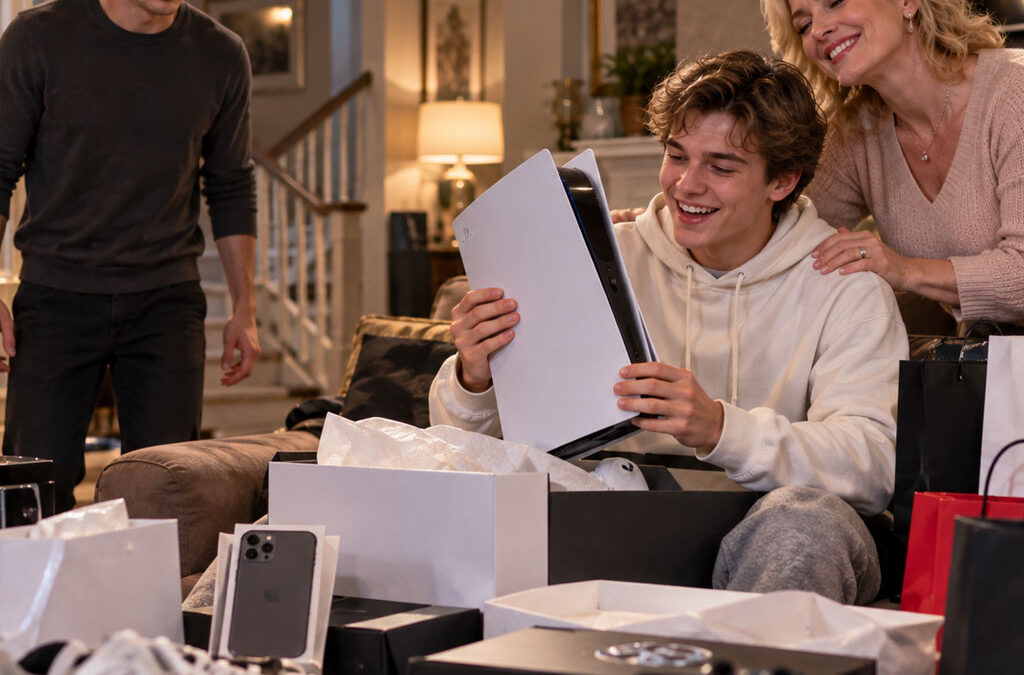
By breakfast, nine thousand dollars had vanished from the account I’d spent four years building, and my eighteen-year-old brother was sitting on our living-room floor peeling plastic from a brand-new PlayStation while my mother smiled at him like Christmas had come early.
Chapter 2
Marcus didn’t ask for the family version.
He didn’t tell me to forgive anyone.
When I admitted I was sleeping in my car, he said, “Absolutely not.”
He owned a small house outside Dayton and had an unfinished basement apartment he’d been renovating whenever construction work slowed down.
“It smells like concrete and sadness,” he warned. “But there’s a shower.”
“I can pay something.”
“You can pay me when you’re breathing normally again.”
Two hours later, I carried my bags down narrow wooden stairs into a basement with exposed pipes, brown carpet and one window at ankle height.
It looked beautiful.
The lock on the door belonged to me.
That alone felt luxurious.
I set my laptop on a folding table and went back to work.
The next month was ugly.
I took every reasonable project I could handle. Dental websites. An inventory app for a regional distributor. A redesign for a bakery chain whose owner changed her mind about colors every forty-eight hours.
I ate too much ramen.
Drank terrible coffee.
Slept badly.
But nobody entered my room while I was sleeping.
Nobody opened my drawers.
Nobody called my money family property.
The bank provisionally restored most of the disputed funds while its investigation continued. The merchants supplied shipping records. Police collected the items still in the house and documented what had already been opened or resold.
Caleb’s online activity made things worse for him.
Not because I hacked anything.
I didn’t.
The bank and investigators obtained records through the normal process, and Caleb had left an astonishing amount of evidence under his own name.
The silence from Mom hurt more than I wanted to admit.
Six weeks after she threw me out, a letter arrived.
Her handwriting was neat enough to belong on a wedding invitation.
Julian,
I hope you’re okay. I miss you.
Everything happened so quickly, and I realize now I handled it badly. I love both my sons. I wish we could sit down calmly and find a solution that doesn’t permanently damage anyone’s future.
Love,
Mom
I read it four times.
Part of me wanted to hear what I had spent most of my life waiting to hear.
I was wrong.
I failed you.
You mattered.
But none of that was actually in the letter.
What it said was solution.
Future.
Calmly.
Words arranged around one obvious request she hadn’t quite made yet.
Drop the case.
That afternoon, my cousin Chloe called.
“Can I ask you something weird?”
“Sure.”
“Did you buy Caleb all that stuff?”
I went silent.
“What?”
“He told Aunt Linda you got some huge promotion and bought him everything for graduation.”
I sat down.
“He said what?”
“At the barbecue Sunday. The shoes, the phone, PlayStation. He said you felt bad because you’d been hard on him growing up.”
I felt cold.
“Was Mom there?”
“Yes.”
“And?”
“She nodded.”
That was worse than the theft in a strange way.
Mom wasn’t merely protecting Caleb inside the house.
She was rewriting me outside it.
I told Chloe what had actually happened.
She listened without interrupting.
When I finished, she said quietly, “Julian, I’m sorry.”
I stared at the basement wall.
“Thank you.”
“You shouldn’t have had to prove this.”
That sentence stayed with me.
A week later, my ex-girlfriend Sarah texted.
We hadn’t spoken in three years.
During college, she had once been the person I trusted most. Then Mom slowly convinced her that I was cold, rigid and cruel.
When I complained that Art wanted rent because I stored two boxes in their attic, Sarah told me family required compromise.
When I told her about my missing college fund, she said carrying resentment wasn’t healthy.
Eventually we broke up.
Now she wrote:
I heard things are bad with your family. Can we get coffee? I owe you an apology.
I almost deleted it.
Instead I agreed.
The diner on Fourth smelled exactly as I remembered: bacon, old coffee and something permanently fried into the walls.
Sarah sat in the back booth.
“You look tired,” she said.
“I am.”
She reached toward my hand.
I moved it.
“What do you want?”
Her face tightened.
“I do owe you an apology.”
“Okay.”
“I didn’t understand your family.”
I waited.
Then she sighed.
“Your mom called me.”
There it was.
“She’s terrified, Julian.”
I leaned back.
“Of course she is.”
“She says you’re trying to get Caleb charged with a felony.”
“I reported a theft.”
“He’s your brother.”
“He stole nine thousand dollars.”
“I know, but—”
The bell over the diner door rang.
Mom and Art walked in.
I actually laughed.
Sarah looked ashamed.
“You set me up?”
“I thought if everybody talked—”
“You thought wrong.”
Mom sat at the end of the booth.
Art slid in beside Sarah.
Mom placed both hands on the table.
“Julian, please.”
I looked at her.
For the first time in weeks, she looked tired too.
Not defeated.
Just tired.
“We want to make this right.”
“How?”
She took an envelope from her purse.
Inside was a cashier’s check for two thousand dollars.
“That’s what we can manage right now,” she said. “Take it. Get yourself an apartment. Call the detective and explain this was a family misunderstanding.”
I pushed the envelope back.
“Keep it.”
Art leaned forward.
“Don’t be stupid.”
“Art.”
“No, Margaret. I’m tired of this kid acting like he holds all the cards.”
I almost smiled.
Kid.
I was twenty-six when they needed me to behave like an adult and suddenly a kid whenever they wanted obedience.
Art lowered his voice.
“If you continue this, we’ll get an attorney.”
“That’s your right.”
“We’ll come after you for spreading lies.”
“What lies?”
He opened his mouth.
Nothing came out.
I looked at Mom.
“Did you tell everyone I bought Caleb those things?”
She glanced at Sarah.
Then back at me.
“We were trying to protect him.”
“By lying about me.”
“We were trying to protect the family.”
I stood.
Mom reached for my wrist.
“Please.”
I pulled away.
“Stop calling what you’re protecting a family.”
That evening, I sent my attorney the letter, screenshots of messages relatives had forwarded to me, and notes from the diner meeting.
He told me something I needed to hear.
“Don’t start a public war. Let the bank and police do their jobs.”
So I did.
No hacking.
No social-media campaign.
No revenge post.
I saved everything and said almost nothing.
For once, silence wasn’t surrender.