“GET ON YOUR KNEES!” Harold snarled, swinging his cane inches from my hand. My mother gripped the porch railing, silent, while my stepsister Tara yanked my hair and filmed me trembling in the dirt. All because I’d sent my grandmother $200 of my own earnings. Harold thought he’d taught me obedience. He never noticed who was watching through the fence.
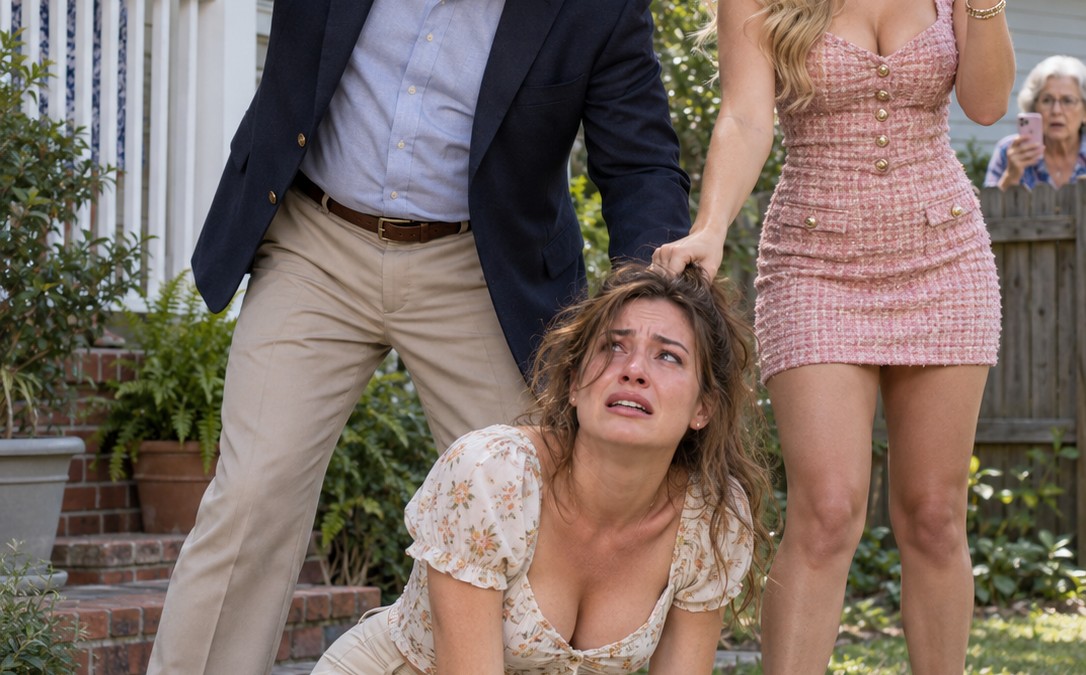
PART 1: HE CALLED IT DISCIPLINE. MY STEPSISTER CALLED IT ENTERTAINMENT.
“GET ON YOUR KNEES, MARA. I’M NOT ASKING AGAIN.”
My stepfather stood in our backyard holding a rattan cane. My mother watched from the porch while my twenty-six-year-old stepsister pointed her iPhone at my face.
I’d committed a terrible crime, apparently.
I’d sent $200 of my own money to my grandmother.
“You’re thirty-two years old,” Harold Briggs said. “You should know better than to steal from the household.”
I stared at him.
“Steal? I earned that money teaching summer classes.”
He tapped the cane against his palm.
“Under my roof, I decide where the money goes.”
Behind him, Tara laughed.
“Come on, Mara. You’re a teacher. You should understand discipline.”
I looked toward my mother.
“Helen? Are you seriously going to stand there?”
She gripped the porch railing.
“Sweetheart, just apologize. Please.”
Harold took another step.
“Your mother isn’t going to save you.”
The cane snapped against the dirt beside my foot.
I flinched.
Tara moved closer, filming every second.
“Oh, that’s perfect,” she said. “Do that again.”
And there, in the backyard of the house where I’d spent most of my childhood, I lowered myself onto my knees.
The Georgia dirt burned through my jeans.
Harold smiled.
“Now we’re making progress.”
Tara leaned down and grabbed my hair, pulling my head toward her camera.
“Look at the phone, teacher.”
I pulled away.
“Get your hands off me.”
She laughed again.
“Someone’s still got an attitude.”
Then Harold raised the cane.
Across the fence, a woman’s voice cut through the afternoon.
“Harold Briggs! What exactly are you doing?”
Nobody moved.
Mrs. Ethel Carter, our seventy-year-old neighbor, stood beside her back gate with a phone pressed against her ear.
Harold lowered the cane.
“This doesn’t concern you, Ethel.”
“That’s funny,” she said. “Because the police seem interested.”
Tara stopped recording.
And for the first time since I’d moved home, I watched Harold Briggs lose his smile.
But to understand what happened next, you need to understand how I ended up kneeling in that yard.
Six months earlier, I was a divorced teacher with three cardboard boxes and $4,800 in savings.
I had no idea that moving back home would become the worst decision of my adult life.
My marriage to Ethan had ended in Atlanta after four exhausting years.
There hadn’t been some dramatic affair or spectacular betrayal. We’d simply spent years trying to convince ourselves we wanted the same life.
By the time we admitted we didn’t, we could barely finish dinner together.
He kept the apartment.
I kept my Honda Civic, my teaching credentials, and the furniture that would fit in my trunk.
My mother offered her spare bedroom in Savannah.
“Stay as long as you need,” she told me. “It’s still your home.”
I believed her.
That was my first mistake.
The house was a narrow, two-story place on Bay View Street, with faded blue shutters and a porch my father had repaired before he died.
I remembered spending entire summers there with my grandmother, drinking sweet tea and watching thunderstorms roll in.
I didn’t remember Harold Briggs.
My mother had married him three years earlier.
A retired correctional officer, Harold had a reputation for being dependable, strict, and involved in local veterans’ organizations.
He was fifty-four when I moved in, broad-shouldered, carefully groomed, and always dressed as though he might be called to supervise somebody.
He greeted me in the driveway.
“Mara Keaton,” he said, squeezing my hand. “Heard you’ve had a rough year.”
“I’ve had better ones.”
“Well, everybody makes mistakes.”
I wasn’t sure whether he meant my divorce or my decision to come home.
His daughter Tara appeared in the doorway wearing designer sunglasses and holding a Starbucks iced latte.
“So you’re the divorced sister.”
“Stepsister,” I corrected.
She looked me over.
“Right. Important distinction.”
That first dinner told me everything I needed to know about the arrangement.
Harold sat at the head of the table.
My mother served the food.
Tara complained about a coworker who’d apparently offended her by asking her to arrive on time.
When I mentioned that I was teaching online over the summer, Harold put down his fork.
“Good. A grown woman ought to contribute.”
“Of course. I can pay rent.”
“Three hundred a month.”
“That works.”
He nodded.
“And you’ll follow the household rules.”
I waited for him to explain.
“No guests without permission. No unnecessary noise after ten. Keep the kitchen clean. And if you’re going somewhere overnight, I expect to know.”
I glanced at my mother.
She stared at her plate.
“I’m thirty-two, Harold.”
“And?”
“I don’t need permission to spend the night somewhere.”
He wiped his mouth with a napkin.
“Then maybe you don’t need a room here.”
Tara laughed into her water glass.
I should have packed my boxes that evening.
Instead, I calculated the cost of renting an apartment in Savannah and reminded myself that three hundred dollars was less than half of what I’d pay anywhere else.
So I stayed.
For the first few weeks, I tried to make the arrangement work.
I taught remote summer courses, tutored high school students preparing for college, and helped my mother with grocery shopping.
Most mornings, I was at my desk by seven with coffee and a laptop.
Harold hated the laptop.
“You’re always on that thing.”
“It’s my job.”
“Doesn’t look like work to me.”
One afternoon, he walked into my bedroom without knocking while I was teaching a video lesson.
I stopped mid-sentence.
“Harold, I’m working.”
He looked at the screen.
“Then work with the door open.”
“Please leave.”
The students watched silently.
He stood there another moment before turning away.
That night, he told my mother I’d embarrassed him.
She asked me to apologize.
I asked her what I was supposed to apologize for.
“He’s adjusting to having another person in the house.”
“Mom, he walked into my classroom.”
“It’s his house, Mara.”
I looked around the kitchen I’d grown up in.
“When did that happen?”
She didn’t answer.
Over the next month, the rules multiplied.
Harold complained about the electricity I used. He wanted receipts for groceries I’d purchased with my own credit card.
He started asking about my tutoring income.
One morning, I found Tara sitting at my desk, scrolling through files on my laptop.
“What are you doing?”
She didn’t even look embarrassed.
“Looking for a picture.”
“On my computer?”
“Dad said it was fine.”
I shut the laptop.
“Don’t touch my things again.”
She stood up.
“Wow. No wonder Ethan divorced you.”
I stared at her.
She smiled.
“What? Too soon?”
When I told Harold, he accused me of creating unnecessary conflict.
“Tara lives here permanently,” he said. “You’re a guest.”
“Then tell your daughter to stay out of my bedroom.”
He pointed toward the hallway.
“Watch your tone.”
That became his favorite phrase.
Watch your tone.
Remember whose house this is.
Show some respect.
He could turn a dirty coffee mug into a lecture about character.
Once, after I parked my Honda on the wrong side of the driveway, he made me move it three times.
Tara watched through the window and took pictures.
By August, I was spending more time at the public library than at home.
I started looking at apartments between tutoring sessions.
My savings were growing, slowly.
I planned to leave before Thanksgiving.
Then my grandmother called.
Gloria Keaton was seventy-eight and living outside Jacksonville, Florida.
She had always been the person who showed up when somebody needed help.
When I was in college, she mailed me twenty-dollar bills tucked inside birthday cards.
After my divorce, she’d called every Sunday without asking a single question about who was to blame.
Now she needed help paying for medication and several medical expenses.
“Don’t worry about me, honey,” she said.
Which, with Grandma Gloria, usually meant I should worry.
I transferred $200 that afternoon.
It wasn’t a loan.
It wasn’t household money.
It wasn’t anybody’s business.
Unfortunately, I’d printed a bank statement while gathering documents for an apartment application.
I forgot the page in the printer tray downstairs.
Harold found it.
The next morning, he held it up at breakfast.
“Who’s Gloria Keaton?”
“My grandmother.”
“Why did you send her money?”
“Because she needed it.”
“Two hundred dollars?”
“Yes.”
He dropped the paper beside my coffee.
“You have money to throw around, but you live in my house for practically nothing?”
“I pay the rent we agreed on.”
“And what about everything else? Electricity? Water? Food?”
“I buy most of my own food.”
Tara rolled her eyes.
“Here we go.”
Harold leaned forward.
“You don’t move money out of this household without discussing it with me.”
I gave a short laugh.
“Harold, you’re not my accountant.”
His chair scraped against the kitchen floor.
“What did you say?”
I stood.
“I said my bank account isn’t yours.”
He looked toward the back door.
“Outside.”
“No.”
My mother appeared from the living room.
“What’s happening?”
Harold reached for the cane he kept beside the kitchen door.
The same cane he claimed was a souvenir from his correctional career.
“Mara needs a lesson in respect.”
I looked at my mother.
“Tell him to put that down.”
“Harold,” she whispered. “Please don’t.”
He opened the door.
“Outside. Now.”
Tara already had her phone out.
And that’s how I ended up in the backyard with my knees in the dirt.
Mrs. Carter’s appearance saved me from whatever Harold intended to do next.
I knew that.
But when two Savannah police officers arrived twenty minutes later, I didn’t tell them the truth.
Harold opened the front door wearing his friendliest smile.
“Afternoon, gentlemen. Bit of a misunderstanding.”
One officer looked past him.
“Someone reported threats involving a cane.”
Harold chuckled.
“My stepdaughter and I had a disagreement. Nothing more.”
The officer noticed the dirt on my jeans.
“Ma’am, could we speak with you separately?”
Harold turned toward me.
That single glance was enough.
I imagined what would happen after the officers left.
My computer.
My savings.
My bedroom.
My mother living with whatever came next.
“I’m okay,” I said.
The officer studied me.
“Are you sure?”
I nodded.
“Just an argument.”
He offered me information about filing a report and getting help. He said I could contact the department again if I changed my mind.
Then the officers left.
Harold watched the patrol car disappear.
“See?” he said. “People around here understand the difference between discipline and abuse.”
I walked upstairs without answering.
That evening, my mother knocked on my door.
She carried a mug of tea.
“I’m sorry about today.”
I stared at her.
“You watched him make me kneel.”
“He was upset.”
“He threatened me with a cane.”
“I know.”
“Tara pulled my hair while filming me.”
Mom sat on the edge of my bed.
“I know.”
Those two words were worse than anything Harold had said.
She knew.
She had seen everything.
And she’d helped him pretend it hadn’t happened.
“Then why didn’t you stop it?”
She set down the tea.
“Because you know what happens when Harold gets angry.”
I looked at her for a long time.
“That’s your explanation?”
“Please don’t make this harder.”
I opened the bedroom door.
“Good night, Mom.”
She left the tea untouched.
For the next several weeks, I barely spoke at dinner.
Harold seemed pleased with himself.
Tara occasionally called me “Teacher’s Pet” and laughed whenever I stepped away from him.
I kept working.
I kept saving.
And I began keeping records.
The idea came from Laura Green, a friend I’d known since teacher training.
We were on a video call when she noticed a bruise on my upper arm.
“Mara, what happened?”
“Nothing.”
“That’s not nothing.”
“I bumped into something.”
“You’re a terrible liar.”
I tried changing the subject.
She refused.
“Listen,” she said. “I don’t need every detail right now. But take pictures, write down dates, and keep copies somewhere he can’t reach.”
I looked toward my bedroom door.
“Why?”
“Because if you ever need somebody to believe you, I don’t want you depending on his version of events.”
That night, I photographed the bruise.
I wrote down the date Harold grabbed my arm.
I recorded the time he’d entered my bedroom and threatened to disconnect my internet.
I saved screenshots of Tara’s messages.
Eventually, I bought a small security camera and positioned it on the bookshelf in my bedroom, aimed at the doorway.
I backed up the recordings to a private cloud account.
Then I kept my head down.
By November, Harold had grown comfortable again.
He thought he’d taught me something.
He had.
Just not what he intended.
One Friday in December, Tara came home drunk from a downtown bar.
I was grading assignments upstairs when I heard her laughing on the phone.
“You should’ve seen her,” she said. “Dad made her kneel like a little kid.”
I stopped typing.
She laughed again.
“Yeah, I filmed it. It’s hilarious.”
I closed my laptop.
For months, I’d wondered whether she’d deleted the video.
Now I knew.
I went downstairs.
Tara was stretched across the couch, scrolling through her phone with a half-empty glass of wine on the coffee table.
She looked up.
“What?”
“Who are you talking to?”
“None of your business.”
“Are you still showing people that video?”
Her expression changed.
Then she grinned.
“Why? Want a copy?”
I held out my hand.
“Actually, yes.”
She laughed so hard she nearly spilled her drink.
“You’re insane.”
Then she turned the screen toward me.
There I was.
On my knees.
Harold stood above me with the cane.
Tara had recorded herself pulling my hair.
She’d captured my mother watching from the porch.
And near the end, Mrs. Carter’s voice could be heard demanding that Harold stop.
I reached for the phone.
Tara pulled it away.
“Don’t touch my stuff.”
I stepped back.
“You’re proud of that?”
She shrugged.
“Dad said you needed to learn.”
“You’re twenty-six, Tara.”
“So?”
“One day you’re going to have to explain why you thought that was funny.”
She rolled her eyes.
“Whatever, teacher.”
What she didn’t notice was my phone resting against the kitchen counter.
I’d recorded the entire conversation, including the video she held up.
The picture wasn’t perfect.
The sound was.
The following morning, I called Laura.
Then I called David Chin, an old high school acquaintance who worked for the Savannah Police Department.
He helped me arrange a meeting with the appropriate investigator.
I took my photographs, notes, recordings, and the incident information from the officers’ earlier visit.
The investigator watched the material carefully.
“Do you have somewhere safe to stay?” she asked.
“Not yet.”
“Then we need to work on that before he finds out.”
She explained my reporting options, including a protective order, and gave me contact information for a local domestic violence advocate.
I told her I wanted to proceed.
But I also knew I needed to leave that house safely.
For the first time in months, I had an actual plan.
A week later, with my mother’s permission, I helped her review her joint savings account.
We found a series of transfers Harold had described as household maintenance expenses.
Several had gone to an account she didn’t recognize.
My mother sat beside me, looking at the screen.
“Maybe there’s an explanation.”
“Then he can explain it to you with a bank representative present.”
She closed the laptop.
“Please don’t start another fight.”
I saved the statements she agreed to share and urged her to contact the bank.
I didn’t know whether the transfers were fraudulent.
I did know Harold had never mentioned them when he accused me of stealing $200.
But then, in January, he found the camera.
I was sitting at my desk when my bedroom door slammed open.
Harold stood there holding the little security camera.
Its power cable dangled from his fist.
“What’s this?”
I closed my laptop.
“It’s a camera.”
“I can see that.”
He stepped inside.
“You been recording me?”
“It’s in my bedroom.”
“Answer the question.”
“Yes.”
He stared at me.
Then he threw the camera against the floor.
Plastic pieces scattered beneath my desk.
My mother hurried into the hallway.
“Harold, what’s going on?”
“Your daughter thinks she’s clever.”
He grabbed my laptop.
“Harold, put that down.”
He ripped out the charging cord.
Then he threw the computer against the window.
The screen struck the wooden frame and cracked.
My mother screamed.
Harold turned back toward me.
“Where are the recordings?”
I said nothing.
He reached for my phone.
I tried to grab it.
He shoved my hand aside.
“Don’t.”
He scrolled through my messages.
His mouth tightened when he found David’s name.
“So that’s what this is.”
He held up the phone.
“You’ve been talking to a cop behind my back?”
I looked straight at him.
“Yes.”
Harold gave a short, ugly laugh.
“After everything I’ve done for you.”
I glanced at my ruined laptop.
“You’re doing a great job of reminding me.”
His smile disappeared.
He walked to the open window and threw my phone into the pond behind the house.
It struck the water with a small splash.
“Call your cop friend now.”
Then he stepped closer.
“You think some recordings are going to make me afraid of you?”
I didn’t answer.
He lowered his voice.
“By the time I’m finished, nobody in Savannah will take you seriously.”
Tara appeared behind him.
She looked at the broken camera, the shattered laptop, and the open window.
Then she smiled.
“Well,” she said, “there goes your little evidence collection.”
I looked from her to Harold.
Neither of them knew what I’d already sent to the investigator.
But I had another problem.
The police had documentation.
I had nowhere safe to sleep that night.
And Harold had just discovered I was preparing to expose him.
When he finally walked out, I waited until the house was quiet.
Then I put on my coat, took my wallet and car keys, and slipped through the side door.
I crossed the street to Mrs. Carter’s house.
Her porch light was on.
I knocked twice.
She opened the door and looked at my face.
“What did he do?”
“He found the camera. He broke my laptop. He threw my phone in the pond.”
She stepped aside.
“Come in.”
I sat at her kitchen table while she made tea.
Then I told her everything.
When I finished, she went to a cabinet above the refrigerator and took out a small metal box.
She placed it between us.
“Mara, there’s something I should have given you months ago.”
“What is it?”
She opened the box.
Inside was a USB flash drive.
“That afternoon in the backyard,” she said, “I wasn’t just calling the police.”
She slid the drive toward me.
“My security camera recorded what happened.”
I stared at it.
Mrs. Carter took my hand.
“And there’s something on that recording your stepsister’s video didn’t show.”
PART 2: HE INVITED EVERYONE TO CELEBRATE HIS BIRTHDAY. I BROUGHT THE ONE THING HE COULDN’T EXPLAIN.
I looked at the flash drive.
“What do you mean?”
Mrs. Carter pulled a chair beside mine.
“My camera covers the back gate and part of your yard. I reviewed the recording after the police came.”
“Why didn’t you tell me?”
“I tried to ask you about it, but every time I saw you, Harold was somewhere nearby.”
She opened her laptop.
“I should have found a safer way. I’m sorry.”
The video began with an empty backyard.
Then Harold appeared, waving the cane toward the porch.
Tara followed him.
Several seconds later, I came into view.
I watched myself standing there, arguing about the money I’d sent Grandma Gloria.
Harold raised the cane.
I stepped backward.
Then he ordered me to kneel.
Mrs. Carter’s camera captured the entire confrontation from the side.
Including the moment Tara stopped recording with her phone.
“What am I looking for?” I asked.
“Keep watching.”
On the screen, I stood up after Mrs. Carter challenged Harold from the fence.
Tara had already lowered her phone.
As I turned toward the house, Harold swung the cane sideways.
It struck my upper arm.
Not hard enough to knock me down.
Hard enough to leave the bruise Laura noticed weeks later.
I’d remembered the contact as a quick blow while he brushed past me. The footage showed he’d deliberately turned and struck me.
Then something else happened.
Harold looked directly toward Mrs. Carter’s fence.
“You better mind your business, Ethel.”
She didn’t back away.
“Put that thing down.”
He pointed the cane at her.
“You want trouble with me too?”
Mrs. Carter stopped the playback.
“The police never saw this part,” she said.
I looked at her.
“Would you be willing to give them a statement?”
She closed the laptop.
“Honey, I was waiting for you to ask.”
I used her phone to contact the investigator.
Mrs. Carter agreed to preserve the original recording and provide it through the proper evidence process.
By the following afternoon, I had somewhere safe to stay.
Mrs. Carter insisted I use her guest bedroom.
Laura helped me arrange a replacement phone and retrieve the backups I’d saved online.
The laptop was gone.
My notes weren’t.
Harold could smash electronics all day.
He couldn’t reach the copies I’d already placed outside his house.
And now we had something even better.
An independent witness.
A recording made before anybody realized the neighbor’s camera was watching.
When I told the investigator what Harold had done to my phone and laptop, she documented the destruction and added it to the case.
She urged me not to return to the house without a safe plan.
For once, I listened.
But there was still something I wanted.
Not revenge.
I wanted the people who called Harold a respectable man to see how he behaved when he thought nobody important was watching.
Two weeks later, my mother called.
“Harold’s birthday is Saturday.”
I knew.
He’d been talking about his fifty-fifth birthday for months.
His former coworkers, friends from the veterans club, and several neighbors were coming.
My mother sounded exhausted.
“He wants you there.”
I almost laughed.
“Why?”
“He says the family should be together.”
“Does he understand I don’t live there anymore?”
“He thinks you’ve been overreacting.”
“That’s convenient.”
She paused.
“He’s told people you’re having difficulties since the divorce.”
There it was.
Harold was already writing his version of the story.
Unstable stepdaughter.
Failed marriage.
Generous stepfather trying to help.
I rubbed my forehead.
“Mom, did you tell those people what happened?”
“No.”
“Of course you didn’t.”
“Mara—”
“I’ll think about Saturday.”
After we hung up, I called my advocate and spoke with the investigator about whether attending was safe or could interfere with the case.
They made the risks clear.
I wasn’t obligated to confront Harold, and I certainly didn’t need to prove anything in front of a crowd.
I knew that.
I also knew he expected me to arrive frightened and grateful for whatever public reconciliation he’d arranged.
I decided I would attend briefly, with Mrs. Carter beside me, my own car available, and people outside the house knowing where I was.
The recording had already been preserved as evidence.
What happened at the party wouldn’t be the beginning of the case against Harold.
It would be the end of his ability to pretend the case was imaginary.
Saturday arrived cold and bright.
By noon, the driveway was full of SUVs and polished pickup trucks.
My mother had spent the morning preparing food.
There were trays of baked ham, macaroni and cheese, potato salad, and enough sweet tea for a church picnic.
The living room smelled of expensive cologne and roasted meat.
Harold stood beside the fireplace wearing a navy blazer.
He greeted me with a broad smile.
“Well, look who decided to come home.”
I kept my coat on.
“Happy birthday, Harold.”
He leaned closer.
“Glad you’ve finally come to your senses.”
“Don’t get ahead of yourself.”
His smile tightened.
Across the room, Tara stood beside two friends in a cream-colored dress and designer heels.
She looked at me, then whispered something.
Both women glanced my way.
Tara smiled.
I smiled back.
She didn’t like that.
Mrs. Carter arrived moments later carrying a casserole dish.
Harold greeted her with considerably less enthusiasm.
“Ethel.”
“Happy birthday.”
“Didn’t expect to see you.”
“Wouldn’t miss it.”
She handed my mother the dish and came to stand near me.
“You okay?” she asked quietly.
“Yes.”
“Remember, we leave whenever you want.”
I touched the car keys in my coat pocket.
“I know.”
Harold spent the next hour moving from guest to guest, telling stories about his correctional career.
He talked about leadership.
Accountability.
Respect.
He told an old coworker that society had gone downhill because people no longer understood consequences.
I nearly choked on my lemonade.
Tara noticed.
“Something funny?”
“Just appreciating the irony.”
She frowned.
“What?”
“Never mind.”
At two o’clock, my mother brought out the birthday cake.
Everyone gathered in the living room.
Harold stood near the television with a drink in his hand.
He thanked his friends for coming.
Then he launched into a speech about family values.
“People need guidance,” he said. “Especially young people who’ve lost their way.”
Several guests nodded.
He looked straight at me.
“Sometimes the people we help don’t appreciate what we sacrifice for them.”
Tara grinned.
My mother stared at the floor.
Then Harold raised his glass.
“But family means giving people another chance.”
He turned toward me.
“Mara, why don’t you come say a few words?”
Mrs. Carter looked at me.
I set down my lemonade.
“Sure.”
Harold smiled.
“That’s my girl.”
I walked to the front of the room.
Thirty people were watching.
Some knew me from childhood.
Others had heard nothing about me except whatever Harold had told them.
I looked at the television.
“Actually, Harold, I brought something I’d like everyone to see.”
His expression brightened.
“A birthday surprise?”
“You could call it that.”
I took out a flash drive containing a copy of the footage Mrs. Carter had shared with the investigators.
The original evidence remained safely preserved.
I connected the drive to the television.
A video thumbnail appeared.
Harold squinted.
“What’s that?”
I picked up the remote.
“Something from last summer.”
Tara stopped smiling.
“Dad.”
He looked at her.
“What?”
“Dad, turn it off.”
Too late.
I pressed play.
The first thing everyone heard was Harold’s voice.
“GET ON YOUR KNEES.”
The room went quiet.
On the television, Harold stood in our backyard gripping his cane.
I stood opposite him.
My mother was visible on the porch.
Someone near the fireplace said, “What the hell?”
Harold took a step toward the screen.
“Turn that off.”
I didn’t move.
The recording continued.
“You stole from this household,” Harold shouted.
My voice came from the speakers.
“That was my money.”
Then the cane struck the dirt.
A woman near the sofa gasped.
Tara was no longer smiling.
The video showed me kneeling.
Harold standing above me.
Tara bending over to grab my hair.
Her recorded voice came through clearly.
“Serves you right, teacher.”
Harold lunged toward the television.
Mrs. Carter stepped into his path.
“Don’t touch her.”
“Get out of my way, Ethel!”
One of his former coworkers stood up.
“Harold, what is this?”
Harold pointed toward me.
“She’s been trying to ruin my reputation for months!”
The video continued.
My mother could be heard pleading with him.
Then came the part nobody had seen.
The angle changed to Mrs. Carter’s security footage.
Harold swung the cane into my arm.
The sound was sharp enough to cut through the room.
A man in a gray suit stood up.
“Jesus Christ, Harold.”
Another guest turned away from the screen.
Nobody was laughing.
Not even Tara.
I paused the video.
Harold stood motionless.
I set down the remote.
“That was the day I sent two hundred dollars to my seventy-eight-year-old grandmother.”
I looked around the room.
“Money I’d earned tutoring students.”
Harold pointed at me.
“You’ve taken everything out of context!”
“Which part?”
He stopped.
“Was it when you threatened me? When Tara pulled my hair? Or when you hit me after she stopped filming?”
He said nothing.
I looked toward the guests.
“He told the police it was a misunderstanding. I was too afraid to contradict him.”
My mother sat down heavily.
“He told people I’d been having problems after my divorce,” I continued. “I have been having problems.”
I turned back toward Harold.
“Specifically, I’ve been having a problem with him.”
One of his old coworkers spoke.
“Harold, you need a lawyer.”
Tara stepped forward.
“She was disrespecting him! You don’t know how she acts!”
I looked at her.
“You’re right, Tara. They should probably see your original recording too.”
Her mouth opened.
Nothing came out.
Then Harold grabbed my wrist.
Hard.
“You little—”
“Take your hand off me,” I said.
He tightened his grip.
Mrs. Carter immediately reached for her phone.
A man beside Harold pulled him away.
“That’s enough!”
Harold shoved the man’s arm aside.
“I don’t need you telling me how to handle my family!”
The man stepped back.
“That’s exactly your problem.”
Harold looked around.
For the first time, nobody was agreeing with him.
Nobody was laughing at his jokes.
Nobody was telling me to apologize.
My mother finally stood up.
“Harold.”
He turned.
She stared at the television.
Then she said, loud enough for everyone to hear, “You did hit her.”
Harold’s face changed.
“Helen, don’t start.”
“I watched you.”
“Shut up.”
She shook her head.
“No.”
It was only one word.
But it was the first time I’d heard her say it to him.
And Harold couldn’t stand it.
He stepped toward her.
Before he reached the sofa, someone knocked at the front door.
Three hard knocks.
Mrs. Carter lowered her phone.
“I called when he grabbed Mara.”
The room went still.
Harold looked toward the entrance.
Outside, a police cruiser had pulled into the driveway.
The officers who entered weren’t there to referee a family argument.
They separated Harold from the rest of us and asked what had happened.
Several guests described watching the recording.
Two confirmed seeing Harold grab my wrist.
Mrs. Carter provided her account.
I described the prior threats, the destruction of my belongings, and the existing investigation.
David Chin was not the arresting officer, but he later learned what had happened through the department.
By the time Harold was taken into custody, he had stopped talking about respect.
He was talking about lawyers.
“This is a setup!” he shouted as officers escorted him outside.
I stood near the doorway.
“No, Harold.”
He turned.
“This is what happens when people see the whole video.”
Tara followed him onto the porch.
“Dad!”
He didn’t look back.
Within minutes, a neighbor was filming the police cruiser from the sidewalk.
By evening, the party had emptied.
The birthday cake remained on the dining room table.
Nobody had eaten a slice.
My mother stood beside it, staring at the blue frosting.
“I don’t know what to say,” she whispered.
I picked up my coat.
“Try the truth.”
She looked at me.
“I’m sorry.”
I stopped.
She continued.
“I should have protected you.”
“Yes.”
“I was afraid of him.”
“I know.”
She began crying.
I didn’t hug her.
That seemed to surprise her more than anything else that afternoon.
“Mara, please.”
I opened the front door.
“I love you, Mom. But I’m not pretending today fixed everything.”
Mrs. Carter was waiting beside her car.
I stepped outside.
For the first time since I’d moved back to Savannah, I left that house without wondering whether Harold would punish me for it.
The legal process took months.
Harold’s attorney initially argued that the confrontation had been exaggerated and that the family had misunderstood his intentions.
The footage made that argument difficult.
So did the earlier police response, Mrs. Carter’s statement, my photographs, and the documentation of his later threats.
The damage to my laptop and phone was added to the record.
My mother cooperated with the separate inquiry into the suspicious financial transfers.
That investigation established that Harold had moved money without fully disclosing it to her.
The man who’d accused me of stealing $200 had been concealing thousands in transactions from his wife.
When my mother learned the extent of it, she finally sought legal advice about separating her finances from his.
Harold eventually entered a guilty plea to charges arising from the assaults, intimidation, and destruction of property.
The court sentenced him to five years in state prison and ordered restitution.
Tara accepted a separate agreement involving probation, community service, and mandatory counseling.
She avoided prison.
But she lost the comfortable assumption that her father would always protect her from consequences.
The first time I saw her in court, she was wearing a plain blouse instead of her usual designer outfits.
She kept looking toward the doors.
When the judge asked whether she wished to address me, she stood.
“I didn’t think it would get this serious.”
I looked at her.
“You recorded it.”
She lowered her head.
“I know.”
“You laughed.”
“I know.”
I waited.
She didn’t have anything else to say.
Neither did I.
Outside the courthouse, David Chin caught up with me.
“How are you holding up?”
“Better than I expected.”
He nodded toward the parking lot.
“Need someone to walk you to your car?”
I smiled.
“I think I can handle that.”
“Figured you could.”
I watched him walk away.
Then I took out my keys and drove home.
Not to Harold’s house.
To Mrs. Carter’s.
Living with Ethel Carter was the first time in almost a year that I stopped listening for footsteps outside my bedroom.
She never entered without knocking.
She never asked where I was going unless she needed me to pick up milk.
And when I spent money on something unnecessary, like a ridiculously expensive candle from Target, she didn’t request a receipt.
She just sniffed it.
“Twenty-eight dollars for something you’re going to set on fire?”
I laughed.
“Don’t start.”
“At least buy one that smells like actual flowers.”
We developed a routine.
Coffee on the porch before work.
Sunday grocery shopping.
Occasional arguments over whether pineapple belonged on pizza.
She said absolutely not.
I told her that was an unfortunate opinion for someone who made such excellent peach pie.
She became family to me in a way I hadn’t expected.
Not because we shared blood.
Because she respected the word no.
Laura helped me replace my teaching equipment.
My school welcomed me back, and colleagues raised enough money to cover a new laptop and classroom supplies.
For the first time since my divorce, I began thinking about things other than surviving the week.
Then my mother called.
She’d moved to Charleston to stay with her sister.
She wanted to meet.
We chose a small cafe near the Savannah courthouse.
When she arrived, she looked exhausted.
She’d started counseling.
She’d separated her finances.
And she’d finally admitted to relatives what had happened in the backyard.
We ordered coffee.
She stirred hers for nearly a minute without drinking it.
“I’ve been trying to understand why I didn’t protect you,” she said.
I waited.
“I kept telling myself that if I could keep Harold calm, everything would be fine.”
I set down my cup.
“Except I was the one paying for it.”
She nodded.
“Yes.”
“You watched him humiliate me.”
“I did.”
“And when the police came, you helped him pretend nothing happened.”
“I did.”
There was no excuse.
No explanation about how difficult her marriage had become.
No demand that I remember all the things she’d done for me growing up.
Just an admission.
It was the first useful conversation we’d had in years.
“I don’t expect you to forgive me,” she said.
“Good.”
She managed a sad smile.
“You’re still my daughter.”
“I know. But being my mother doesn’t automatically make you someone I can trust.”
Her hands tightened around the cup.
“What happens now?”
I thought about that.
“I don’t know. Maybe we start with a phone call once in a while.”
She nodded.
“And if I want to see you?”
“You ask. I’ll decide.”
She accepted it.
When we left the cafe, she hugged me briefly.
I hugged her back.
But I didn’t promise we’d return to the relationship we’d had before Harold.
That relationship hadn’t protected me.
I wasn’t interested in rebuilding it exactly as it was.
Four months after Harold’s sentencing, a letter arrived at Mrs. Carter’s house.
The return address was a correctional facility.
I recognized the handwriting before I opened the envelope.
Harold Briggs.
He had written three pages.
He apologized.
He described his childhood, his father’s temper, and the years he’d spent working in corrections.
He claimed he’d confused obedience with respect.
Then he asked me to help my mother.
He said she shouldn’t suffer for his mistakes.
Near the end, he wrote that he hoped I could forgive him so he could finally sleep peacefully.
I read that sentence twice.
Then I handed the letter to Mrs. Carter.
She read it.
“Well?”
“What do you think?”
She folded the pages carefully.
“I think he spent three pages explaining himself and one sentence asking what he could do for you.”
I laughed.
“That’s pretty accurate.”
“Are you answering?”
“No.”
She returned the envelope.
“Then don’t.”
A week later, Tara emailed me.
Her apology was shorter.
She admitted she’d been jealous.
She said Harold had constantly compared her to me.
She’d hated that I had a career, an education, and people who respected me.
She said filming me had made her feel powerful.
Then she wrote:
I thought hurting you would make me feel better about myself. It didn’t.
I believed that part.
It didn’t mean I wanted her back in my life.
I deleted the message.
Not because I needed to punish her.
Because I was finished giving her access to me.
By the following spring, I’d saved enough for a small one-bedroom apartment near the Savannah River.
It had tall windows, outdated kitchen cabinets, and a balcony barely big enough for two chairs.
I loved every inch of it.
I bought a coffee maker.
A secondhand bookshelf.
A green sofa from a furniture outlet.
And more plants than any reasonable person needed.
On moving day, Mrs. Carter appeared carrying a box of homemade biscuits.
“You can’t live on coffee and determination,” she announced.
“I also eat cereal.”
“That explains a lot.”
We sat on the bare living room floor, eating biscuits from paper plates.
Through the balcony doors, I could see boats moving along the river.
Mrs. Carter looked around.
“Not bad.”
“Not bad at all.”
Then she handed me a small envelope.
Inside was a check from a community fund several neighbors and colleagues had organized after my case became public.
I stared at the amount.
“Ethel, I can’t take this.”
“You’re not taking it from me.”
“I already have an apartment.”
“Then use it for something worthwhile.”
I looked at the check again.
And an idea I’d been considering for months finally seemed possible.
Too many teachers were struggling with dangerous situations at home.
I knew how easily financial dependence could trap someone.
I also knew that teachers weren’t automatically protected just because they spent their days protecting others.
So I contacted a local nonprofit that worked with survivors of domestic violence.
Then I spoke with a school counselor, a legal aid organization, and several colleagues.
We started a small assistance fund.
We called it The Open Classroom.
Initially, we helped educators access emergency housing resources, confidential legal consultations, and replacement teaching equipment.
The first person we helped was a teacher who needed a safe place to stay while separating from an abusive partner.
We didn’t post her name.
We didn’t film a tearful interview.
We helped her move.
That was enough.
Within a year, several schools and nonprofit partners across Georgia were supporting the effort.
I agreed to one local television interview.
The reporter asked why I’d started the fund.
“Because people think abuse only happens to people who don’t know better,” I said.
“They assume a teacher, a nurse, or somebody with a college degree would recognize the danger and leave immediately.”
I looked into the camera.
“Knowing something is wrong doesn’t automatically mean you have the money, housing, or support to get away from it.”
The reporter nodded.
“And do you believe justice was served in your case?”
I thought about Harold.
Tara.
My mother.
The backyard.
The police officers I’d been too frightened to tell the truth.
Then I answered.
“Justice gave me a chance to rebuild. What I do with that chance is up to me.”
The interview aired that evening.
By morning, there were dozens of messages waiting.
Some came from teachers.
Others came from people who’d never worked in a classroom.
They shared stories about relatives, partners, and households where speaking up had carried a price.
One email came from a woman in Macon.
She wrote that she’d finally contacted an advocate after years of telling herself things weren’t bad enough.
I printed the message and placed it in my desk drawer.
Not as a trophy.
As a reminder that the work mattered.
Almost two years after the afternoon in the backyard, I drove down Bay View Street again.
It wasn’t planned.
I’d taken a wrong turn after a doctor’s appointment.
Suddenly, there was the old house.
The blue shutters had been painted white.
The porch railing had been replaced.
A different family lived there now.
After my mother’s separation and the financial problems that followed, the property had eventually been sold.
Somebody had planted roses near the mailbox.
The backyard gate stood open.
I pulled over.
For a moment, I could almost see Harold standing near the fence.
Tara holding her phone.
My mother looking down from the porch.
And myself, kneeling in the dirt because I’d believed I had no other choice.
Then a man came outside carrying a garden hose.
He watered the roses.
A woman appeared in the doorway and called something to him.
He laughed.
It was a perfectly ordinary scene.
The house belonged to someone else.
Whatever happened inside it next had nothing to do with Harold Briggs.
I started the Honda.
Before driving away, I looked one last time toward Mrs. Carter’s old gate.
The woman who’d refused to mind her own business had changed my life.
I still visited her every Sunday.
She still complained about how much coffee I drank.
And whenever I thanked her, she gave the same answer.
“I saw something wrong. I made a phone call. That’s what neighbors are supposed to do.”
She was right.
But she had done more than that.
She’d treated my safety as something worth protecting when the people closest to me hadn’t.
I drove away.
And this time, I didn’t look in the rearview mirror.
The final Friday before summer break, I stayed late at school.
My students had already gone home.
The classroom was littered with abandoned pencils, paper scraps, and the remains of a science project that had involved far too much glitter.
I gathered the supplies into plastic bins.
Then I watered the plants by the window.
A small brass plaque sat beside my desk.
Mrs. Carter had given it to me after The Open Classroom’s first anniversary.
It read:
For Turning Silence Into Strength.
Next to it was a handwritten thank-you card from an educator we’d helped find temporary housing.
I picked up the card.
Then I put it back.
My phone buzzed.
A text from my mother.
Hope you have a wonderful summer. I’m proud of what you’ve built.
I read it.
Then I typed:
Thank you, Mom. Hope you’re doing well.
It was enough for now.
Another message arrived.
Mrs. Carter.
Sunday dinner at six. Bring dessert. And don’t buy that terrible grocery-store pie again.
I laughed.
I’ll bring the good one.
I slipped my phone into my bag and looked around the classroom.
Two years earlier, I had returned home convinced that my divorce meant I’d failed.
Harold had used that belief to convince me I owed him obedience.
Tara had treated my vulnerability as entertainment.
My mother had mistaken keeping the household together for keeping her daughter safe.
And I’d spent months making myself smaller because I thought I had nowhere else to go.
Now I had my own apartment.
A career I loved.
People I trusted.
A growing fund that helped other educators find their way to safety.
I had bills, deadlines, a car that needed new tires, and a refrigerator that made an annoying clicking sound.
My life wasn’t perfect.
But it belonged to me.
I turned off the classroom lights.
As I reached the door, I remembered the last thing Harold had said after throwing my phone into the pond.
Call your cop friend now.
He’d believed destroying my phone would erase what had happened.
He’d believed humiliating me would keep me obedient.
And he’d believed the people who admired him would never listen to me.
He’d been wrong about all three.
I locked the classroom door and walked toward the parking lot.
The late-afternoon sunlight stretched across the sidewalk.
My Honda waited beneath an oak tree.
I opened the driver’s door, tossed my bag onto the passenger seat, and started the engine.
For years, Harold had demanded one thing from me.
Respect.
But he never understood the difference between respect and fear.
Respect isn’t something you can force from another adult.
It isn’t earned with threats, money, family titles, or a cane.
And it certainly doesn’t come from making somebody kneel in the dirt.
I learned that lesson the hardest possible way.
But I made sure Harold learned it, too.
He made me kneel in his backyard to prove he had power over me.
I stood in front of everyone at his birthday party and proved that he didn’t.
And the best part?
I never had to become cruel to defeat him.
I only had to stop protecting his lies.