He abandoned her without a goodbye… five years later, he walked into her hospital and found out she was the only doctor who could keep him alive
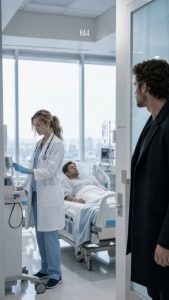
“You nearly collapsed today.”
“I didn’t collapse.”
Everett did not answer.
Forty minutes later, Nora stood in the imaging suite staring at the scan that changed everything.
A bright irregular fleck near the heart.
She leaned closer.
Then she enlarged the image.
Her blood turned cold.
The metal fragment was small, jagged, and lodged dangerously close to his pulmonary artery. The edges showed old scarring and calcification. It had not arrived there recently. It had been moving slowly for years, shifted by muscle, pressure, breath, heartbeat.
Someone had once removed shrapnel from Everett Hale’s body.
Someone had missed a piece.
And now that piece was trying to kill him.
Nora stared at the date of the old injury noted by tissue changes.
Approximately five years.
Her hand tightened around the tablet.
Five years.
The night he vanished.
The night she waited in that diner while her coffee went cold.
The night she decided he had chosen his world over her.
Nora walked back to the exam room so quickly one of the residents stepped out of her way without speaking.
Everett was standing by the window when she entered. Los Angeles glittered below, bright and indifferent.
“Take off your shirt,” she said.
He turned slowly.
Something cautious moved across his face.
“This is a medical instruction.”
He held her gaze.
Then he began unbuttoning his shirt.
Nora had once known that body by warmth, by sleep, by the way it curved around hers in the dark. Now she studied it as evidence. Scar at the ribs. Old burn mark near the shoulder. Knife wound healed badly near the side.
Then she saw it.
A scar along his left flank, pale and uneven, where something had entered hard and deep.
“That wasn’t there before,” she said.
Everett’s eyes lowered.
“When?” she asked.
“Old injury.”
“When, Everett?”
“Five years ago.”
The room changed.
Nora felt it beneath her feet.
Five years ago.
The words did not explain everything, but they destroyed one thing completely.
He had not simply walked away into another woman’s arms, or another city, or another life.
And he had let her believe abandonment was the reason.
Nora turned the tablet toward him. “There is a metal fragment lodged less than five millimeters from your pulmonary artery. It is migrating. That means the dizziness, the palpitations, the arrhythmia, all of it is not stress. It is your body warning you that the fragment is moving toward a place where it will kill you fast.”
Everett looked at the image.
For the first time since she had entered the room, he looked genuinely human.
“How long?” he asked.
“Without surgery? Weeks. Maybe days if it moves again.”
He absorbed that without flinching.
Then he looked at her.
“I need you to save my life.”
The words should have satisfied some broken part of her.
They did not.
“No,” Nora said. “You need a surgeon. Whether I become that surgeon is a separate question.”
“Nora.”
She turned toward the door.
“Nora, wait.”
His voice cracked on her name, barely, but enough.
She stopped.
He did not move closer. Maybe he knew better.
“I know what I owe you,” he said quietly. “And I know there is no apology large enough to cover five years.”
She laughed once, but there was no humor in it.
“You don’t owe me an apology, Everett. You owe me the truth.”
He looked at the floor.
“That night,” he said, “there was a bomb under my car.”
Nora’s throat tightened.
“I found out before it fully detonated. Not soon enough to walk away clean. Soon enough to live.”
Her hand stayed on the doorknob.
He continued, voice low.
“There was a photograph taped to the steering wheel.”
Nora already knew.
“It was you,” Everett said. “Walking out of the hospital after a shift. Whoever left it wanted me to understand that if I stayed in your life, they would come for you next.”
Nora shut her eyes.
For five years, she had hated him for leaving without a word.
Now she hated him for making the decision alone.
“So you disappeared,” she said.
“Yes.”
“You let me think I meant nothing.”
“No.” His voice was rougher now. “I let you think you meant less than you did, because the truth would have made you stay.”
Tears did not fall. Nora had trained herself out of crying in hospital rooms. But her eyes burned.
“You had no right.”
“I know.”
“I was not some helpless girl you could tuck away from danger.”
“I know.”
“You should have let me choose.”
“I know.”
That was the worst part.
He had known for five years.
The intercom crackled overhead, saving neither of them.
“Dr. Whitaker, security is requesting you at the private wing reception desk.”
Nora frowned.
Everett’s expression sharpened instantly.
“Why?”
The intercom continued.
“A woman is here claiming medical power of attorney for Mr. Hale. Name: Vanessa Cross.”
Nora saw his face change.
Not fear.
Recognition.
Then calculation.
“Is she?” Nora asked. “Your medical power of attorney?”
“No.”
“Family?”
“No.”
Everett looked toward the door.
“My second-in-command.”
Outside, somewhere deep in the hospital, the lights flickered once.
Then the private wing went dark.
Part 2
The emergency lights came on after eleven seconds.
Eleven seconds was not long in ordinary life.
In a hospital, eleven seconds could kill someone.
Nora reached for the door.
Everett caught her wrist.
“Don’t.”
She looked down at his hand.
He released her immediately, but his eyes stayed on the dark hallway beyond the glass panel.
“This hospital is compromised,” he said.
“This is St. Luke’s West.”
“This is a building with entrances, blind spots, generators, and people who can be bought. Don’t make the mistake of thinking money only buys medicine here.”
She stepped to the side of the door and looked through the narrow glass. The hallway was lit in red emergency strips. A nurse hurried past with her head down. Behind her, two men in maintenance uniforms moved too slowly to be maintenance.
Nora had spent enough years in emergency medicine to recognize wrong movement.
Wrong movement saved lives.
Or ended them.
“Who is Vanessa Cross?” she asked.
Everett’s eyes stayed on the hallway.
“My chief strategist. Corporate on paper. Criminal everywhere else.”
“Why would she come here with forged medical documents?”
“Because if I die, she inherits pieces of my organization that she has wanted for years.”
“That’s comforting.”
“It wasn’t meant to be.”
Nora glanced at his chest. “And you need surgery.”
“I am aware.”
“No, I don’t think you are.” Her voice sharpened. “That fragment is not waiting politely because people with guns are having a dramatic evening. Your blood pressure is elevated. Your heart rhythm is unstable. Stress can move it faster.”
Everett looked at her.
For a second, the old tenderness almost surfaced.
“Then I suppose I should try to stay calm.”
Nora stared at him.
“You are impossible.”
“I’ve been told.”
“By women who liked you?”
“By one who loved me.”
That silenced them both.
Another noise came from the hall.
A metallic click.
Everett moved first.
He took Nora’s wrist again, not hard, and pulled her through a side door into the supply corridor. She knew the hospital. He knew threats. Together, they moved like two halves of a plan neither of them had agreed to.
The corridor was narrow, lined with carts of sterile linens, sealed bins, and stacked boxes of IV tubing. The red emergency lights made everything look like a warning.
Nora kept her voice low. “Where are we going?”
“Somewhere with a lock.”
“I run this surgical floor. I choose the lock.”
“Then choose quickly.”
She led him down two turns, past a medication storage room and into a restricted pharmaceutical lab on the lower level. The lab had reinforced doors because controlled substances were stored there. Nora entered her code, pressed her thumb to the scanner, and pushed him inside.
The door sealed behind them.
For one breath, they were safe.
Everett leaned against the counter.
Nora saw the color of his face.
“You’re bleeding.”
“I tore the IV.”
“You tore the IV running from assassins in my hospital. That is not a normal complication.”
“Normal has never been one of my strengths.”
“Sit down.”
“I’m fine.”
“Sit down, or I sedate you myself.”
Everett sat.
Nora pulled a kit from the wall and cut the sleeve of his shirt where blood had spread under the cuff. Her hands worked quickly, cleaning the torn skin, applying pressure, taping gauze into place.
He watched her like a man trying not to touch a flame.
She could feel it.
That was the problem. After five years of silence, after all the therapy she had refused and all the grief she had buried under fellowships and surgeries and awards, she could still feel him.
“You could have sent a letter,” she said.
His eyes lowered.
“I wanted to.”
“You could have called from anywhere.”
“They were watching everyone connected to me.”
“You could have told Miles to tell me.”
“I almost did.”
“But you didn’t.”
“No.”
The simplicity of his answer hurt more than excuses.
Nora pressed the gauze harder than necessary.
Everett did not react.
“Do you know what those first six months were like?” she asked. “I thought you were dead. Then I thought you were alive and cruel. Then I thought maybe I was the stupid one for believing a man like you could ever belong to anyone.”
He swallowed.
“I know.”
“No, you don’t.”
His voice dropped. “I know what it is to wake up reaching for someone you decided to lose.”
Nora froze.
Outside the door, footsteps passed.
Both of them went silent.
The footsteps faded.
Nora turned back to the wound, but her hands were slower now.
“Vanessa planted the photograph,” Everett said.
Nora looked up.
“You know that?”
“No. I suspect it now. Tonight makes too many things clear.”
He leaned back, face pale beneath the emergency light.
“Five years ago, the official story was a rival crew. I believed it because I needed something clean to hate. But Vanessa was close enough to know about you. Close enough to know my routes. Close enough to access my car.”
“And you trusted her afterward?”
“I trusted very few people. She made herself useful.”
“That is not an answer.”
“It is the answer men like me give when we don’t want to admit we were lonely.”
The honesty hit harder than charm ever had.
Nora looked away first.
In the silence, her phone buzzed.
She checked the screen.
A message from Dr. Alan Price, her anesthesiologist.
OR Three secure. Two nurses confirmed. Security unreliable. Come through service elevator B.
Nora exhaled.
“We have an operating room.”
Everett stood.
Too fast.
His hand went to his chest.
Nora grabbed his arm before he fell.
The moment was brief, but it terrified her.
Because for one second, Everett Hale’s strength disappeared.
And she felt the weight of his life in her hands.
“Don’t,” he whispered.
“Don’t what?”
“Look at me like that.”
“Like what?”
“Like you still care whether I die.”
Nora’s jaw tightened.
“I’m a doctor.”
“That’s not what I said.”
She helped him straighten.
“No, Everett. You don’t get to ask for clean categories now. You made a mess. I survived it. Tonight, I am going to operate because you need surgery and because I am the best person in this building to do it. What I feel beyond that is none of your business until I decide it is.”
He nodded once.
“Fair.”
“It is more than fair.”
“Yes.”
“And if you die on my table, I will be furious.”
A faint smile touched his mouth.
“I’ll do my best to avoid inconveniencing you.”
“Start now.”
They moved.
The service elevator was waiting, but not empty.
A man in scrubs stood inside with his back turned. Nora stopped before Everett did.
Wrong shoes.
Expensive shoes.
Not hospital shoes.
The man turned.
Everett shoved Nora behind him as the man reached under his scrub top.
But Nora was already moving.
She slammed the emergency stop button with one hand and drove the heel of her palm into the man’s wrist with the other. The gun clattered against the elevator wall. Everett struck him once in the throat, caught him as he folded, and lowered him silently to the floor.
Nora stared at the unconscious man.
Then at Everett.
He stared back.
“You hit a gunman,” he said.
“You strangled him in an elevator.”
“I didn’t strangle him.”
“That makes it better?”
“A little.”
Despite herself, she almost laughed.
Almost.
They reached OR Three at 7:52 p.m.
By then, Nora had become entirely doctor.
She had no room left for the woman who had loved him.
The surgical suite was bright, sterile, controlled. Her nurses, Elise and Dana, were waiting. Alan Price stood near anesthesia with the grim expression of a man who understood that tonight’s procedure might become evidence.
Nora looked at each of them.
“No one enters without my approval,” she said. “No exceptions. No administrative overrides. No family. No legal representatives. No police unless I call them. Understood?”
“Yes, Doctor,” Elise said.
Everett sat on the edge of the surgical table.
His shirt was gone now. Electrodes marked his chest. The old scar along his ribs looked almost silver beneath the lights.
Nora stood beside him, marker in hand, reviewing the incision site.
He watched her.
“What?” she asked.
“I used to think your hands were too gentle for what you do.”
Nora did not look up.
“And now?”
“Now I think gentleness was never the point.”
She paused.
Then she marked the skin.
“You are going under, Everett.”
“I know.”
“No tricks. No trying to control the room from unconsciousness.”
“That will be difficult.”
“Try.”
Alan placed the mask.
Everett’s eyes found Nora’s one last time.
“I didn’t stop loving you,” he said quietly.
The room seemed to hold its breath.
Nora’s face did not change.
“That is not anesthesia clearance.”
His mouth curved faintly.
Then his eyes closed.
The surgery began at 8:04 p.m.
Nora made the first incision with hands that did not shake.
Inside the body, there was no history. No abandonment. No diner. No unanswered questions. There was only anatomy, risk, blood, pressure, timing.
The fragment was worse than the scan suggested.
It had nested near the pulmonary artery, caught in scar tissue, surrounded by delicate structures that pulsed with every heartbeat. One wrong movement could open him faster than any bullet.
Nora worked in silence.
Minutes became measurements.
Measurements became decisions.
Sweat gathered at her temple.
“Suction,” she said.
Elise moved.
“Pressure stable,” Alan said.
“Not for long,” Nora replied.
She saw the fragment.
A dark metallic thorn inside the man who had carried it for five years.
The sight made something inside her twist.
He had left her with silence.
He had kept the shrapnel.
Both of them had lived with pieces of the same night inside them.
“Forceps,” Nora said.
Dana placed them in her hand.
The door alarm beeped.
Everyone froze.
Alan looked toward the sealed entrance. “Someone is trying an override.”
Nora did not look up.
“Denied.”
“It’s an administrative code.”
“I said denied.”
The alarm beeped again.
Then stopped.
Nora eased the forceps closer to the fragment.
“Almost there,” she said.
Then Everett’s blood pressure dropped.
Fast.
Too fast.
Alan’s voice sharpened. “Pressure falling. Heart rhythm unstable.”
Nora’s eyes snapped to the monitor.
“What changed?”
“Nothing on my end.”
Elise checked the line. “IV line is clear.”
Dana’s face had gone pale.
Nora looked at the medication tray.
One vial was out of place.
Tiny detail.
Huge consequence.
“Who touched the line?” Nora asked.
No one answered.
The door opened behind them.
Not fully.
Just enough.
A woman stepped inside wearing blue surgical scrubs over a silver dress.
Vanessa Cross.
She held a gun low at her side.
Her blond hair was tucked under a surgical cap. Her makeup was flawless. Her smile was almost kind.
“Oh, Nora,” Vanessa said. “You really should have let him die naturally.”
Part 3
No one moved.
In an operating room, stillness had a sound.
The hiss of oxygen.
The steady electronic pulse of monitors.
The wet silence of an open chest beneath surgical lights.
Vanessa Cross stood just inside the door with a gun in her hand and a smile that looked practiced in mirrors.
Nora did not step away from Everett.
Her gloved hands remained over the surgical field.
“You contaminated my OR,” Nora said.
Vanessa blinked once.
Of all the reactions she expected, professional irritation had clearly not been one of them.
“That is your concern?”
“One of them.”
Vanessa’s smile sharpened. “You always were impressive. I understand why he made such a poor decision over you.”
Alan stood frozen near anesthesia.
Nora kept her eyes on Vanessa.
“Did you tamper with his medication?”
“Not personally. I prefer delegation.”
Nora glanced at the monitor.
Everett’s pressure was still falling, but not as fast as before. Alan was already correcting. Good man.
“Five years ago,” Nora said. “The bomb. That was you.”
Vanessa’s expression changed.
There it was.
Pride.
The one weakness of patient monsters. They always wanted someone to admire the architecture of their cruelty.
“You have no idea how difficult it was,” Vanessa said. “Everett was impossible to move directly. Loyal men. Careful routes. Armored vehicles. But love makes even intelligent men predictable.”
“I gave him a choice.”
“You threatened me.”
“I clarified consequences.”
Nora looked down at Everett’s unconscious face.
For five years, she had imagined him choosing power over her.
Now she understood something worse.
He had chosen her life over his happiness and never asked whether she would have chosen the same.
Vanessa stepped closer.
“Move away from the table, Doctor.”
“No.”
The word was quiet.
Vanessa laughed softly. “No?”
“If you shoot me, he dies before you get what you want.”
“He is already dying.”
“Not fast enough for you, apparently.”
Vanessa’s eyes narrowed.
Nora looked at Alan without turning her head.
“Correct the pressure.”
Alan moved instantly.
Vanessa lifted the gun.
“Stop.”
Alan froze.
Nora’s voice cut through the room. “You need him declared dead from surgical complications. That only works if the surgical team survives long enough to document it. Otherwise this becomes murder in a hospital full of cameras.”
Vanessa tilted her head.
“You think the cameras are working?”
“I think you’re not as careful as you believe.”
That was partly a lie.
But not entirely.
Because Nora had pressed record on her phone when the OR door alarm first sounded. It sat on the metal instrument shelf behind her, screen down, catching every word.
Vanessa did not know that.
“You don’t understand men like Everett,” Vanessa said. “He could have ruled this city cleanly. Efficiently. But he kept hesitating. He kept protecting useless things. Old friends. Weak employees. You.”
Nora looked at her.
“Love must have been very embarrassing for you to witness.”
Vanessa’s smile vanished.
There.
Nora had found the wound.
“You think this is about love?” Vanessa asked.
“No. I think this is about being near power for so long that you mistook proximity for ownership.”
For the first time, Vanessa’s hand tightened around the gun.
The monitor screamed.
Everett’s rhythm collapsed into chaos.
Alan cursed.
Nora moved.
She did not ask permission. She did not think about the gun. She turned back into the storm and put both hands where they belonged.
“Paddles,” she said.
Elise moved before fear could stop her.
“Charge to two hundred.”
Vanessa shouted, “Step away!”
Nora ignored her.
“Clear.”
The shock hit Everett’s body.
His chest lifted.
The monitor stuttered, then resumed a weak rhythm.
Nora went back in.
The fragment was exposed.
Now or never.
“Forceps.”
Dana handed them to her with shaking fingers.
Nora leaned into the light, every part of her narrowing to the tiny piece of metal beside Everett’s heart.
Outside the OR, thunder rolled over Los Angeles, or maybe it was only the hospital generators shifting load. Nora did not know. She did not care.
Vanessa was still talking.
Something about succession. Something about loyalty. Something about how men like Everett always needed to be saved from their own softness.
Nora tuned her out.
She had listened to enough powerful people explain cruelty as strategy.
The forceps closed.
The fragment resisted.
Scar tissue held it like the past refusing removal.
Nora breathed once.
Then she freed it.
The tiny piece of metal came out slick with blood, smaller than a dime and heavier than five years.
“Got it,” she said.
Alan exhaled.
Everett’s pressure began to stabilize.
Vanessa saw it happen.
Her face changed.
“No.”
Nora dropped the fragment into a steel tray.
It rang once.
A small, bright sound.
The sound of history changing.
Vanessa raised the gun fully.
Before she could fire, the OR door burst open.
Miles Arden entered with hospital security and two uniformed police officers behind him.
Vanessa turned, but Elise had already kicked the rolling stool into her knees.
The gun fired once into the ceiling.
Dana screamed.
Miles crossed the room in three strides and took Vanessa down hard enough that her head struck the floor.
The gun skidded under the anesthesia cart.
One officer cuffed her.
The other stared at the open surgical field with the horrified expression of a man realizing he had entered the wrong kind of nightmare.
Nora did not look up.
“Everyone who is not sterile gets out,” she said.
No one argued.
Vanessa was dragged from the room shouting Everett’s name.
Everett did not hear her.
Nora closed him.
For the next ninety minutes, she rebuilt what violence had tried to claim.
When it was over, she stood at the sink scrubbing blood from her hands until Elise gently said, “Dr. Whitaker. It’s gone.”
Nora looked down.
Her hands were clean.
She had not noticed.
Everett woke sixteen hours later in a guarded recovery room with rain tapping the windows and Nora asleep in a chair beside his bed.
That was the first thing he saw.
Not the machines.
Not Miles standing near the door.
Not the bandage across his chest.
Nora.
Her arms were folded, her head tilted slightly to one side, her hair loosened from its bun. She looked exhausted. Younger in sleep. Less armored.
Everett did not speak.
He only watched her breathe.
Miles noticed first.
“You’re awake,” he said quietly.
Nora’s eyes opened at once.
Doctor first.
Always doctor first.
She stood, checked his monitor, examined the drain, checked his pupils with a small light, and pressed two fingers to his wrist.
“Pain?” she asked.
“Yes.”
“Good. Means you’re alive.”
His voice was rough. “Vanessa?”
“Alive. Arrested. Talking, according to the police, because people like her only enjoy loyalty when it belongs to someone else.”
Miles stepped forward. “She confessed enough before they took her. The recording helped.”
Everett looked at Nora.
“You recorded her?”
“I’m a surgeon, Everett. Not an idiot.”
A faint smile touched his mouth, then vanished as pain caught him.
Nora adjusted his medication.
Miles cleared his throat. “I’ll be outside.”
When the door closed, the room became too quiet.
Everett looked at the rain-streaked glass.
“I’m sorry,” he said.
Nora sat back down, but not close.
“I know.”
“No. I need to say it without excuses.” He swallowed carefully. “I am sorry I made your choice for you. I am sorry I let you grieve someone who was alive. I am sorry I confused protection with love and silence with sacrifice.”
Nora looked at him for a long time.
Five years ago, those words would have saved her.
Now they could only honor the scar.
“I needed you then,” she said. “Not because I was weak. Because I loved you.”
His eyes glistened.
“I know.”
“And when you disappeared, something in me hardened. At first I thought that was strength. Then I realized it was just grief with a better schedule.”
Everett turned his hand palm-up on the blanket.
He did not reach for her.
He only left the choice there.
Nora looked at his hand.
Then away.
“I don’t know what forgiveness looks like,” she said.
“I’m not asking for it.”
“Good.”
“I’m asking for the chance to earn whatever comes after the truth.”
Her laugh was soft and tired.
“You nearly died and you’re negotiating already.”
“Bad habit.”
“One of many.”
“Yes.”
The rain continued.
Nora leaned back in the chair.
“You cannot go back to that life.”
Everett closed his eyes.
“I know.”
“I mean it. No empire. No back rooms. No men with guns outside restaurants. No disappearing because you decide danger makes you noble.”
“I know.”
“Do you?”
He opened his eyes again.
“The night you operated, I understood something. I spent years thinking power meant being untouchable. But all it did was make sure no one could reach me when I was dying.”
Nora said nothing.
He continued, weaker now.
“I don’t want to be untouchable anymore.”
Six months later, Los Angeles woke to sunlight after three straight days of rain.
The new Whitaker Cardiac Pavilion opened on a Thursday morning with news cameras on the sidewalk and donors smiling beneath white tents. No one mentioned Everett Hale by name. Officially, the pavilion had been funded by an anonymous trust established years earlier.
Nora knew better.
She had read every document.
The trust had begun three years after he left and two years before he walked into her exam room. He had funded research fellowships, surgical equipment, rural cardiac outreach, and patient grants for families who could not pay.
He had built something in her name while believing he would never stand beside her again.
It did not erase what he had done.
But it complicated the shape of the wound.
At noon, Nora stepped onto the east balcony where the city stretched bright and restless beneath her. She wore a navy dress under her white coat, and her hair was down for once, moving softly in the wind.
Everett was already there.
He looked different without the armor of his old life. No black suit. No security shadow. No cold command in his posture. Just a man in a gray jacket, still healing, standing in sunlight like he wasn’t entirely sure he deserved it.
“You’re early,” Nora said.
“You hate waiting.”
“I hate being made to wait.”
“I remember.”
She stood beside him, leaving a careful distance.
Below them, doctors and nurses crossed the courtyard. A little boy held his mother’s hand near the entrance, staring up at the glass building with open wonder.
“You built this before you knew I’d come back,” Nora said.
“Yes.”
“Why?”
Everett looked at the pavilion.
“Because somewhere in the world, you were saving people. I wanted the world to be better equipped for you.”
Nora’s throat tightened.
“That is unfairly good.”
“I have had months to practice not ruining conversations.”
“You still ruin plenty.”
“I know.”
For a while, they simply watched the city.
Then Nora reached over and pressed two fingers to his wrist.
Not as a lover.
Not quite.
Not only as a doctor either.
His pulse was steady beneath her touch.
“You’re still running high,” she said.
“I walked stairs.”
“You were told not to.”
“I walked slowly.”
“That is not the same as medical compliance.”
“No.”
She let go, but did not step away.
“Dinner,” she said.
Everett turned.
“What?”
“I have surgery at two. Rounds after that. I’m free at seven. Dinner. Public place. No private rooms. No armed men. No secrets.”
His face changed slowly, carefully, like joy was something fragile he did not want to frighten away.
“Yes,” he said.
Nora pointed at him. “This is not forgiveness.”
“I know.”
“It is not us going back.”
“I don’t want to go back.”
“It is dinner.”
His smile was quiet.
“Dinner sounds extraordinary.”
Nora started toward the door, then stopped.
“One more thing.”
“Anything.”
“If danger ever comes for me again, you tell me. You do not vanish. You do not decide for me. You stand beside me and let me decide what I am willing to risk.”
Everett looked at the woman he had loved, lost, feared for, and finally learned to respect fully.
Not as a weakness.
Not as a memory.
As a force.
“Not negotiable?” he asked.
“Not even slightly.”
He nodded.
“Then I accept.”
Nora studied him one last time.
The old wound was still there. Maybe it always would be. But wounds, she knew better than anyone, were not proof that the body had failed.
Sometimes they were proof that the body had chosen to live anyway.
She opened the door and stepped back into the hospital that carried her name.
Everett remained on the balcony for another minute, sunlight warming his face, the city below him loud and alive.
Five years ago, he had disappeared because he believed love meant leaving before danger arrived.
Now he understood.
Love was not the silence that followed sacrifice.
Love was the truth spoken before the next storm.
And Nora Whitaker had not saved him because he deserved it.
She saved him because she had become powerful enough to choose mercy without surrendering herself.
That was the difference between being broken and being free.