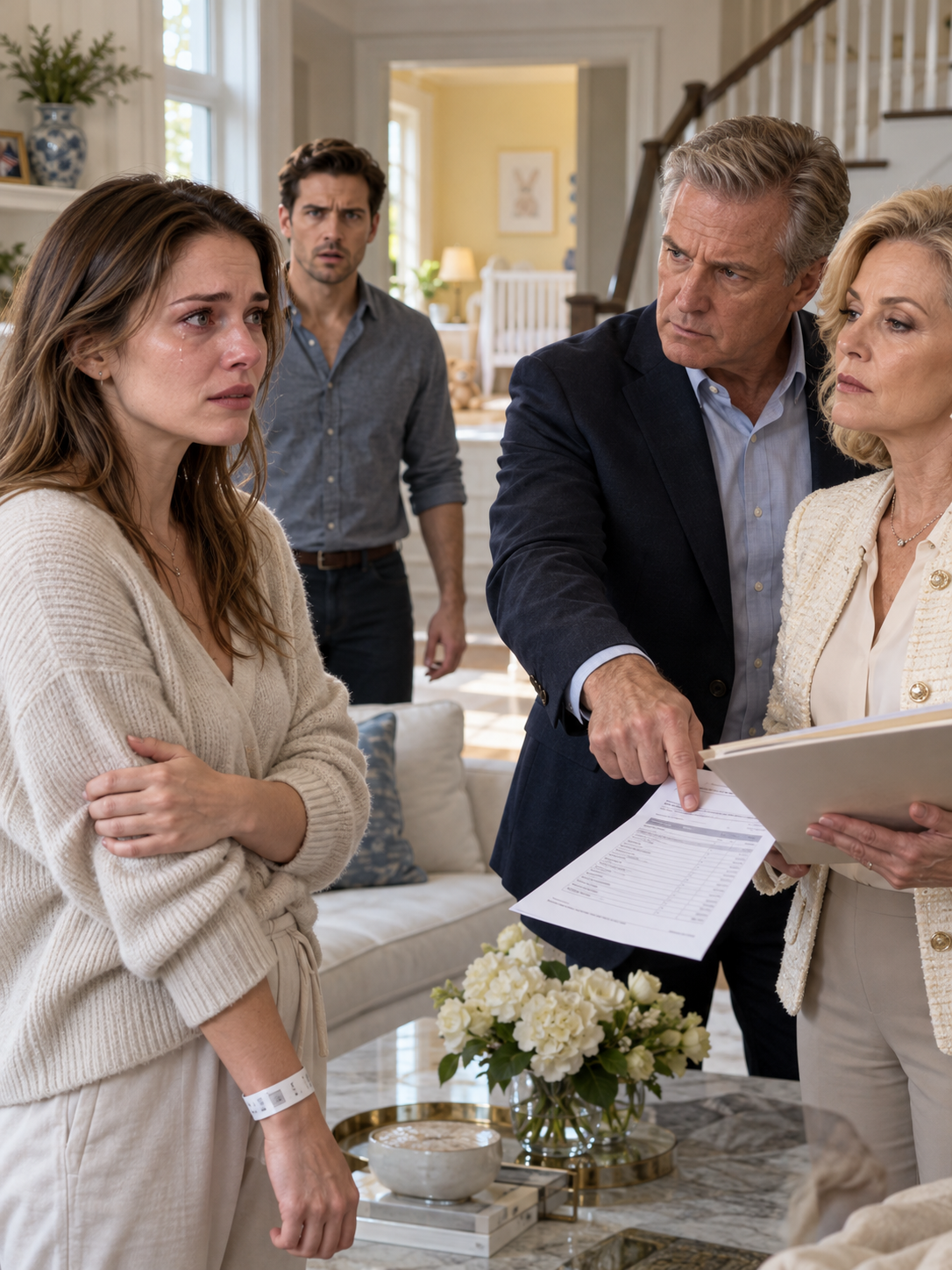
“Your baby is gone. Your sister still has a future,” Dad said, pointing at the $42,000 wedding invoice. Three days after burying my daughter, I stood there with my hospital bracelet still on, while Mom demanded payment and Rosie’s empty crib waited upstairs. My husband heard everything. Then I remembered the signed $52,000 loan agreement Dad thought I’d conveniently forgotten.

PART 1 — MY DAUGHTER DIED WHILE MY PARENTS CELEBRATED MY SISTER’S WEDDING
“Your baby is gone, Natalie. Your sister still has a future.”
My father said those words in my living room, three days after we buried my daughter, while my hospital bracelet was still sitting on the coffee table.
My mother stood beside him, holding a $42,000 wedding invoice. Upstairs, the nursery we’d spent months preparing was empty.
My husband, Owen, had just walked into the room.
He heard every word.
“Say that again,” he told my father.
Dad looked at him, almost amused.
“Don’t make this dramatic. We’re discussing a financial obligation.”
I was thirty-one years old, recovering from childbirth, and still waking up at night convinced I could hear my daughter crying.
And my parents had come to collect money.
They thought I would give it to them, just as I’d given them almost everything else for the previous six years.
They were about to discover how badly they’d miscalculated.
My name is Natalie Hayes. I live in Charlotte, North Carolina, with my husband, Owen.
Before all this happened, I worked as a senior operations coordinator for a medical supply company. Owen was a project manager for a commercial construction firm.
We had a comfortable life.
Not wealthy. Not struggling. Just two people who worked hard, paid their mortgage, and believed that someday we’d fill the extra bedroom with a crib.
For three years, that bedroom stayed empty.
I learned more about pregnancy tests than I ever wanted to know. I knew which brands gave early results, how many days to wait, and how ridiculous I looked holding a test beneath the bathroom light.
Every month, I told myself not to get excited.
Every month, I did anyway.
One Thanksgiving, my younger sister Kelsey announced that she and her boyfriend were moving into a luxury apartment downtown.
My mother clapped so enthusiastically that she knocked over her wineglass.
Later that evening, she pulled me aside.
“Maybe if you stopped obsessing about getting pregnant, it would happen naturally.”
I looked at her.
“That’s your advice?”
“I’m just saying, Natalie. Stress doesn’t help.”
I excused myself and spent twenty minutes sitting in Owen’s truck outside my parents’ house.
When he came looking for me, I didn’t explain.
He climbed into the driver’s seat, started the heater, and asked whether I wanted to stop at Starbucks before we went home.
That was Owen.
He never demanded that I make my pain understandable before he did something kind.
Then, on a Tuesday morning, everything changed.
Two pink lines appeared on a pregnancy test.
I stood in our bathroom staring at them, convinced the second line might disappear if I moved.
“Owen?”
He was getting ready for work.
“Yeah?”
“Can you come here?”
He opened the bathroom door with a toothbrush in his mouth.
I handed him the test.
He looked at it, looked at me, then pulled the toothbrush out.
“Is this real?”
“I think so.”
He checked the instructions twice.
Then he sat on the closed toilet lid and started laughing.
Not because anything was funny.
Because after three years of doctors’ appointments, canceled plans, and disappointing test results, neither of us knew what to do with good news.
At our twenty-week ultrasound, we learned we were having a girl.
Owen squeezed my hand so tightly that I complained.
“You’re cutting off my circulation.”
“Sorry.”
He loosened his grip for about three seconds.
We named her Rosie.
By thirty-four weeks, her nursery was finished.
Pale yellow walls. A white wooden crib. A rocking chair beside the window. Tiny pink socks folded inside the top drawer of her dresser.
Owen had spent an entire Saturday assembling the crib because he refused to admit he’d attached one of the rails backward.
I sat on the floor watching him.
“You know they included instructions, right?”
“I have a construction management degree.”
“And apparently a personal disagreement with furniture.”
He laughed and passed me a screwdriver.
Sometimes I stood in that room longer than necessary, looking at the things we’d bought.
A stuffed rabbit from Target.
A stack of board books.
A little white dress my friend Emily had given us at the baby shower.
I’d already chosen the blanket I wanted to wrap around Rosie when we brought her home.
I had no idea that blanket would become something I couldn’t bear to wash.
Growing up, I’d always been the dependable daughter.
My parents, Richard and Diane, raised Kelsey and me in a four-bedroom house outside Charlotte.
Kelsey was four years younger.
She was beautiful, outgoing, and remarkably skilled at convincing people that her emergencies were more important than everyone else’s responsibilities.
When she turned sixteen, Dad surprised her with a used BMW.
When I turned sixteen, he’d handed me an application for a summer job at a local grocery store.
“Learning responsibility will be good for you.”
I learned responsibility.
Kelsey learned that somebody would always cover the bill.
At twenty-two, I paid off my student loans.
At twenty-two, Kelsey quit her third job because her manager expected her to work weekends.
Mom called me afterward.
“Your sister is having a difficult time.”
“She quit because they scheduled her on Saturday.”
“Not everyone handles pressure the way you do.”
That became the family explanation for almost everything.
Kelsey was sensitive.
Kelsey was overwhelmed.
Kelsey deserved a little help getting started.
I was strong.
I could handle things.
I didn’t need much.
Six years before Rosie was born, Dad’s printing business began losing clients.
He’d operated Hayes Commercial Printing for almost two decades, producing brochures, packaging materials, and promotional displays for local companies.
When two major accounts left, the business started falling behind.
Mom called me one Wednesday evening.
“Natalie, the mortgage is two months overdue.”
I was twenty-five and had just received my first promotion.
“How much do you need?”
She started crying.
“Your father would be humiliated if he knew I was telling you.”
I transferred $3,300 before we finished the conversation.
Two weeks later, she called again.
This time, it was the electric bill.
Then property taxes.
Then a business equipment payment.
Eventually, we established what Mom called a temporary arrangement.
I sent $1,650 every month to help cover their mortgage and household expenses.
Temporary turned into six years.
Whenever I questioned it, Dad brought up everything he’d done raising me.
“You had a roof over your head, didn’t you?”
“Yes, Dad.”
“Food on the table?”
“Yes.”
“Then I don’t understand why you’re acting like helping your family is some terrible burden.”
I would apologize.
Then I’d make another transfer.
Three years into that arrangement, Dad called about an urgent business debt.
A supplier was threatening legal action.
He needed $52,000.
Owen and I discussed it over dinner.
“That’s a substantial amount of money,” Owen said.
“I know.”
“Are we giving it to him or lending it?”
“Lending. He says he can pay it back within three years.”
Owen put down his fork.
“Then get it in writing.”
I hated the suggestion.
Not because it was unreasonable, but because some part of me still believed my parents would see a written agreement as an insult.
Owen didn’t apologize.
“Natalie, a family member who intends to repay you shouldn’t have a problem documenting the terms.”
He was right.
Dad signed a loan agreement.
He made several payments.
Then the payments stopped.
At first, he blamed slow business.
Later, he stopped discussing the loan altogether.
Whenever I brought it up, Mom would sigh.
“Your father is under enough pressure.”
So I stopped bringing it up.
Then Kelsey got engaged.
Her fiancé, Brandon, worked in commercial real estate. He was polite, reasonably successful, and apparently unaware of how much my parents subsidized his future wife’s lifestyle.
Kelsey wanted what she called an unforgettable wedding.
An upscale venue outside Charlotte.
An elaborate floral installation.
A string quartet.
A designer wedding gown.
A photographer whose package cost more than my first car.
The estimated total reached $95,000.
When Owen heard the number, he nearly dropped his coffee.
“Ninety-five thousand dollars?”
“That’s what Mom said.”
“Are they getting married or purchasing a small restaurant?”
I laughed.
Then Mom called.
Kelsey needed help with the initial deposits.
“Just $9,500, Natalie. Think of it as your wedding gift.”
I reminded her that Owen and I were expecting a baby.
“You know we’re trying to save.”
“Oh, sweetheart. You and Owen are doing fine.”
“We still have expenses.”
“And Kelsey only gets married once.”
I transferred the money.
When Owen saw the transaction, he didn’t yell.
He opened our savings spreadsheet.
The numbers were right there.
Hospital expenses.
Maternity leave.
Emergency savings.
The money we’d planned to put toward renovations.
“Nat,” he said, “when does somebody start taking care of you?”
I closed the laptop.
“They’re my parents.”
“I know who they are.”
“They’ll be there when it really matters.”
Owen leaned against the kitchen counter.
“I hope you’re right.”
I wish I could go back to that evening.
Not to argue with him.
To tell him he was right about something I wasn’t ready to admit.
The Thursday everything happened started at six in the morning.
I woke up and immediately noticed that Rosie wasn’t moving.
Usually, she kicked whenever I rolled onto my left side.
Sometimes she kicked so hard that Owen could see my stomach shift beneath my shirt.
That morning, nothing.
I waited.
Changed positions.
Drank some cold water.
Then I called Owen, who was already downstairs making coffee.
“Can you come up here?”
He appeared less than a minute later.
“What’s wrong?”
“I haven’t felt Rosie move.”
He looked at the clock.
“Let’s call the hospital.”
I was already reaching for my phone.
The labor and delivery nurse told us to come in immediately.
Owen grabbed my hospital bag and car keys.
We drove without turning on the radio.
I kept one hand on my stomach.
“Come on, baby. Give me something.”
At a traffic light, Owen reached across the center console and took my other hand.
He didn’t tell me everything would be fine.
Neither of us knew that.
At the hospital, a nurse led us into an examination room.
She attached the monitor and adjusted it several times.
I watched her face.
“Is something wrong?”
“I’m going to have the doctor come in.”
She spoke calmly, but her movements were suddenly more deliberate.
A few minutes later, an ultrasound machine was wheeled beside the bed.
The doctor studied the screen.
She adjusted the probe.
Then she looked at Owen and me.
“I’m very sorry. I’m not finding a heartbeat.”
I shook my head.
“She was moving yesterday.”
The doctor waited.
“Please check again.”
She did.
I watched the monitor, searching for something I couldn’t even identify.
“Please,” I said. “There has to be something.”
There wasn’t.
Rosie had died before she ever had the chance to meet us.
Owen sat beside me, both hands covering his face.
I remember asking whether the machine could be wrong.
I remember the doctor explaining what would happen next.
And I remember reaching for my phone because, despite everything, I still wanted my mother.
She answered on the fourth ring.
“Natalie? Is everything okay?”
“Mom, I’m at the hospital.”
“What happened?”
I couldn’t get the words out at first.
Then I said them.
“Rosie doesn’t have a heartbeat.”
Silence.
“Mom?”
“Oh, Natalie.”
I started crying.
“Can you come? Please? I need you.”
There was noise behind her.
Women’s voices.
Somebody laughing.
My mother lowered her voice.
“Honey, we’re dealing with Kelsey’s rehearsal arrangements today.”
I stared at the hospital wall.
“What?”
“Your sister’s rehearsal dinner is tonight. The coordinator has been a nightmare.”
“Mom, my daughter died.”
“I know. This is terrible.”
“Then please come.”
She hesitated.
“We’ll see what we can do.”
I didn’t understand those words yet.
Not fully.
I thought she meant she’d arrange for someone else to handle the rehearsal.
I thought my father would drive her straight to the hospital.
I thought parents came when something like this happened.
The hours that followed were exhausting and difficult.
The doctors explained that I would need to deliver Rosie.
Owen stayed beside me, leaving only when the nurses asked him to sign paperwork or get something from our bag.
He helped me change positions.
Held water to my mouth.
Answered questions when I couldn’t speak.
Every time the door opened, I looked toward it.
I kept expecting my parents.
At one point, I asked Owen to check his phone.
“Have they texted?”
He looked.
“Not yet.”
I nodded.
Twenty minutes later, I asked again.
Nothing.
I called Dad.
He didn’t answer.
I texted him.
Please come to the hospital. We lost Rosie. I need you and Mom.
The message showed as delivered.
Nobody responded.
Later that day, I gave birth to my daughter.
She was beautiful.
She had Owen’s nose and a small, delicate mouth.
A nurse wrapped her in the blanket we’d brought from home and placed her in my arms.
I studied her face.
I counted her fingers.
I touched her cheek.
“Hi, Rosie,” I whispered.
Owen leaned down and kissed her forehead.
For a while, neither of us spoke.
We had imagined this moment for months.
We’d planned the photographs.
The phone calls.
The ridiculous arguments about whether she resembled her mother or father.
Instead, we were trying to memorize her face because we wouldn’t have another chance.
A nurse offered to take photographs for us.
I said yes.
I had never hated making a decision more.
As evening approached, Owen pulled a chair beside my bed.
I asked him to leave it open on the other side.
“For Mom,” I said.
He looked at the empty chair.
Then at me.
“Okay.”
My parents never came.
At 7:46 that evening, my phone lit up.
I expected a message from Mom.
Instead, Instagram showed a new story from Kelsey.
I opened it.
There was my mother, wearing a champagne-colored dress, holding a glass beneath a canopy of gold lights.
Dad stood beside her in a navy suit.
Kelsey smiled between them.
Behind them was the expensive venue I’d helped pay for.
The caption celebrated the beginning of her wedding festivities.
I watched the video twice.
Then I called Mom.
She answered with obvious irritation.
“Natalie, we’re in the middle of dinner.”
“You promised you’d come.”
“Honey, please. Not right now.”
I looked down at Rosie.
“Mom, I’m holding my daughter.”
My mother didn’t respond.
“She died. I gave birth to her, and she’s dead.”
“I know, sweetheart.”
“Then why are you at a party?”
A chair scraped against the floor on her end.
“Because your sister needs us tonight.”
I couldn’t speak.
“We’ll come tomorrow,” she continued. “There’s nothing we can do about what’s happened now.”
I looked at the empty chair beside my hospital bed.
“You could have been here.”
“Natalie, you’re making this harder than it already is.”
I ended the call.
Owen looked at me.
I handed him the phone.
He watched the Instagram story.
Then he locked the screen and set it facedown.
“Don’t call them again tonight,” he said.
I nodded.
But part of me still hoped they’d walk through the door.
Even after that conversation.
Even after seeing the photographs.
I kept looking toward the hallway.
Before we left the hospital, a nurse brought us a white memory box.
Inside were Rosie’s footprints, her hospital bracelet, photographs, and the little blanket she’d worn.
She explained what everything was.
I listened carefully, terrified I might forget something.
Then Owen carried our bags downstairs.
I held the box.
We’d arrived with a car seat installed in the back of our SUV.
On the drive home, I couldn’t stop looking at it.
Owen offered to remove it when we reached the house.
“Not yet,” I said.
He didn’t argue.
The next several days passed in paperwork, quiet phone calls, and arrangements no parent should have to make.
We chose a small cemetery outside Charlotte.
Owen handled most of the conversations because I couldn’t get through them.
Our friends brought groceries from Harris Teeter.
Emily left dinner on our porch.
Owen’s parents drove in from Raleigh and sat with us without demanding conversation.
His mother helped me keep track of medications and follow-up appointments.
His father took out the trash, picked up prescriptions, and made sure Owen ate something.
My own parents sent flowers.
There was a card attached.
Thinking of you during this difficult time. Love, Mom and Dad.
No apology.
No mention of why they hadn’t come.
I set the card inside a kitchen drawer.
At Rosie’s funeral, I stood beside Owen as the officiant read her name.
We’d purchased a tiny white casket.
I don’t remember much of the service.
I remember Owen holding my hand.
I remember the sound of gravel beneath people’s shoes.
And I remember going home afterward and realizing I had no reason to walk into the nursery.
I closed its door.
Three days later, my parents arrived.
It was eleven in the morning.
I was wearing an oversized gray sweater and leggings.
My body still ached from childbirth, and I’d slept perhaps three hours.
Owen was upstairs when the doorbell rang.
I looked through the glass.
Mom and Dad stood on the porch.
For one second, I felt relieved.
I opened the door.
“Mom.”
She stepped inside.
“Is Owen home?”
“Upstairs.”
“Good. We need to discuss something important.”
Dad followed her into the living room.
Neither of them hugged me.
Neither asked how I was feeling.
Mom sat on our couch and pulled a folder from her handbag.
“Natalie, I know the timing isn’t ideal.”
I stared at her.
She opened the folder.
Inside was an invoice.
At the bottom, in bold numbers, was the amount due.
$42,000.
“What’s this?”
“Kelsey’s remaining wedding balance,” Mom explained. “The venue needs payment by Friday.”
I looked at Dad.
He nodded as though we were discussing an ordinary household expense.
“We’ve already committed to the vendors.”
I looked back at Mom.
“You came here to ask me for money?”
She straightened the folder.
“Don’t use that tone. This affects the entire family.”
I glanced toward the staircase.
Rosie’s nursery was directly above us.
“Your granddaughter just died.”
“We know that, Natalie.”
“I haven’t even recovered from giving birth.”
Mom pressed her lips together.
“Nobody is minimizing your loss. But your sister deserves her special day, and these commitments were made months ago.”
I looked at the invoice again.
Forty-two thousand dollars.
More than some families earned in a year.
For one wedding.
I pushed it back across the coffee table.
“I’m not paying it.”
Dad leaned forward.
“Excuse me?”
“I said no.”
His expression changed.
He wasn’t used to hearing that word from me.
“Natalie, you’re letting grief cloud your judgment.”
I looked directly at him.
“Then explain it to me. Explain why you couldn’t leave a rehearsal dinner when your granddaughter died, but you can drive across Charlotte to collect a wedding payment.”
Mom opened her mouth.
Dad raised his hand to stop her.
Then he said the words that ended everything.
“Your baby is gone, Natalie. Your sister still has a future.”
And just like that, I understood what my place in this family had always been.
I wasn’t their daughter when I needed something.
I was their daughter when they needed money.
Behind me, I heard footsteps.
Owen had come downstairs.
And he had heard every word.
PART 2 — THEY WANTED $42,000 FOR A WEDDING. I WANTED MY DAUGHTER BACK. ONLY ONE OF US WAS ASKING FOR THE IMPOSSIBLE.
“Get out.”
Owen’s voice came from behind me.
Dad turned around.
“This is a private family discussion.”
Owen stepped into the living room.
“My wife gave birth to our daughter less than two weeks ago. You weren’t there. And now you’re standing in our house telling her that our daughter’s death is less important than a wedding?”
Dad stood.
“Watch how you speak to me.”
“No. You watch how you speak to her.”
Mom gathered her folder.
“We didn’t come here to be attacked.”
I almost laughed.
They had walked into my home carrying a $42,000 invoice, and somehow they were the victims.
“Natalie,” Mom said, “we can discuss this when you’re feeling more reasonable.”
I stood up.
“No. We’re discussing it now.”
She stopped.
“I already gave Kelsey $9,500. I’ve been paying your mortgage for six years. I lent Dad $52,000. And when I called from the hospital, you couldn’t even leave dinner.”
Dad waved his hand.
“We’ve heard enough about the hospital.”
Owen took a step toward him.
I reached for his arm.
“Don’t.”
Then I turned to Dad.
“You’ll never get another dollar from me.”
His expression shifted.
For the first time that morning, he looked concerned.
“You don’t mean that.”
“I do.”
“Natalie, you know the business hasn’t recovered. Your mother and I depend on that money.”
I looked at him.
“Then maybe you should have considered that before telling me my daughter doesn’t have a future.”
Mom stood beside him.
“You’ll regret treating us this way.”
I picked up the invoice and handed it back.
“Friday’s coming. You’d better figure something out.”
Dad snatched the paper from my hand.
“We’ll see how long this little tantrum lasts.”
Owen opened the front door.
Dad walked out first.
Mom stopped on the porch.
“You know, Natalie, grief doesn’t give you permission to punish everyone around you.”
I looked at her.
“And being my mother doesn’t give you permission to charge me for loving you.”
Then I closed the door.
For several minutes, I stood in the hallway.
Owen didn’t ask whether I was okay.
He knew I wasn’t.
He put his arms around me and waited until I could speak.
“I can’t believe he said that.”
“I know.”
“He actually thinks Rosie doesn’t matter anymore.”
Owen pulled back.
“He doesn’t get to decide what she means to us.”
I looked toward the stairs.
“I want to see her room.”
He followed me upstairs.
The nursery looked exactly as we’d left it.
The yellow walls.
The white crib.
The stuffed rabbit sitting beside the rocking chair.
I walked to the dresser and opened the top drawer.
Inside were the tiny pink socks I’d folded before we went to the hospital.
I picked up a pair.
“They didn’t even ask to see her picture.”
Owen sat on the floor beside me.
“I know.”
I looked at the crib.
All those months, I’d imagined my mother standing there, admiring her granddaughter.
Now I couldn’t imagine letting her through the nursery door.
That evening, after Owen fell asleep, I went downstairs with my laptop.
I opened our banking app.
At first, I only intended to cancel the next monthly transfer.
Then I started reviewing the previous statements.
Six years.
Seventy-two months.
The same recurring payment to my parents, month after month.
$1,650.
Sometimes extra.
An emergency plumbing repair.
Property taxes.
A business payment Dad couldn’t cover.
The $9,500 wedding contribution.
And the $52,000 loan he’d promised to repay.
I opened a spreadsheet and began entering the amounts.
By 2:13 in the morning, the total exceeded $180,000.
I checked it twice.
Then I opened the folder containing Dad’s loan agreement.
His signature was at the bottom.
The repayment schedule was attached.
He hadn’t made a payment in eleven months.
I stared at the document.
For years, I’d treated his unpaid debt as something embarrassing to mention.
But he’d had no embarrassment about coming to my house three days after Rosie’s funeral to demand another $42,000.
I printed the agreement.
Then I downloaded the bank statements.
The next morning, I told Owen what I wanted to do.
He listened without interrupting.
When I finished, he asked one question.
“Are you doing this because you want to hurt them, or because you’re finished letting them hurt us?”
I thought about it.
“I’m finished.”
He nodded.
“Then I’ll help you.”
Rebecca Stone’s office was in a modern building near downtown Charlotte.
She was a civil attorney Owen had worked with on a contract dispute.
When I explained the situation, she asked me to start with the documents.
I gave her the loan agreement, payment history, and bank statements.
She read carefully.
“Your father signed this?”
“Yes.”
“And these are the payments he made before stopping?”
“Yes.”
“Have you ever formally forgiven the debt?”
“No.”
“Do you have anything in writing suggesting it was a gift?”
“No.”
Rebecca set down her pen.
“Then we have a documented loan and a substantial overdue balance.”
I looked at the folder.
“What can I actually do?”
“We can begin with a formal demand and give him an opportunity to negotiate repayment. If that fails, we can discuss litigation.”
I nodded.
She continued.
“Your voluntary monthly support is a separate matter. Unless you’ve entered some other binding agreement, you can stop making those payments.”
“I already know they’ll say I’m abandoning them.”
Rebecca looked at me.
“You’re asking whether they can make you continue paying their household expenses?”
“Yes.”
“Based on what you’ve shown me, no.”
That was the first time I’d heard someone explain my situation without treating my parents’ feelings as more important than my finances.
I hired her.
Before leaving, I signed the documents necessary to begin the formal repayment process.
Then I sat in my car and canceled the automatic $1,650 transfer.
My finger hovered over the confirmation button.
For six years, that payment had been as routine as our mortgage.
I pressed confirm.
A message appeared on the screen.
Recurring transfer canceled.
I took a screenshot.
Then I sent Mom one message.
I will no longer pay your mortgage, household bills, or any of Kelsey’s wedding expenses. Dad’s overdue loan is now being handled by my attorney, Rebecca Stone. Please contact her regarding repayment.
Mom called thirty-seven seconds later.
I didn’t answer.
Dad called.
Then Kelsey.
By dinner, I had twenty-three missed calls.
Owen put my phone inside a kitchen drawer.
“Eat something first,” he said.
For the first time in days, I finished an entire meal.
The next morning, Mom left a voicemail.
“After everything your father and I have done for you, this is how you repay us? We raised you, Natalie. We sacrificed for you.”
I listened while sitting beside Rosie’s crib.
Then I deleted it.
Dad’s message was shorter.
“Call me before this gets ugly.”
Kelsey’s message arrived an hour later.
I know you’re upset, but you don’t get to destroy my wedding just because you’re having a hard time.
I read it three times.
Then I typed:
I buried my daughter last week.
Her reply came immediately.
And I’m sorry about that, but the world doesn’t stop for everyone else.
I put my phone down.
I didn’t respond.
There was nothing left to explain.
Two weeks later, Rebecca called.
Dad had received the formal demand.
He hadn’t accepted the proposed repayment schedule.
“He says he needs more time,” Rebecca told me.
“He always needs more time.”
“He’s also suggested that some of the money was family assistance rather than a loan.”
I looked at the signed agreement sitting on my desk.
“Then why did he sign a repayment schedule?”
“That’s precisely the issue I’ve raised with him.”
Rebecca explained that pursuing the debt could take time and cost money.
She didn’t promise a quick victory.
She gave me the options and the likely expenses.
I asked her to continue.
That evening, Mom called from a number I didn’t recognize.
I answered before realizing it was her.
“Natalie?”
I nearly hung up.
Then she said something that made me stay on the line.
“Your father’s talking about selling the house.”
I walked into the kitchen.
“Okay.”
“Okay? That’s all you have to say?”
“What do you want me to say?”
“That you’ll reconsider.”
I opened the refrigerator, then closed it without taking anything out.
“Mom, I told you I’m not paying your bills anymore.”
“You know we can’t afford everything without your help.”
“Then you need to make changes.”
Her voice sharpened.
“Your father worked his entire life for that house.”
“And I’ve spent six years helping him keep it.”
“Do you actually want us to lose our home?”
I looked toward Rosie’s nursery.
“Mom, did you ever wonder how I was supposed to live after losing my daughter?”
She didn’t answer.
I continued.
“Because I called you from that hospital. I told you she was gone. And you told me Kelsey needed you.”
“Natalie, we’ve already discussed this.”
“No. You’ve defended yourself. That’s different.”
My mother started crying.
“How can you be so cruel?”
I ended the call.
The following Monday, Kelsey sent seventeen messages.
Some were angry.
Some were pleading.
Three contained screenshots of wedding invoices.
The last one read:
You’re ruining my wedding because you’re jealous. I still have something to celebrate.
I showed it to Owen.
He read it, shook his head, and handed my phone back.
“You don’t have to keep reading this.”
“I know.”
“You don’t owe her a response.”
I blocked Kelsey’s number.
Then I went upstairs and placed Rosie’s photograph on the dresser.
It was the picture taken at the hospital.
Her eyes were closed.
Her little blanket was tucked beneath her chin.
I sat beside it for a long time.
That afternoon, I made an appointment with a grief counselor.
I had spent enough time answering everybody else’s emergencies.
I needed help surviving my own.
A month after I stopped the payments, my parents listed their house.
Mom sent me the listing link.
She included one sentence.
I hope you’re proud of yourself.
I looked through the photographs.
The dining room where we’d eaten Thanksgiving dinner.
The backyard where Kelsey and I had played.
The living room where Dad used to open Christmas presents wearing the same ridiculous red sweater.
I remembered those things.
I also remembered all the bills I’d paid to keep that house from going into foreclosure.
I forwarded the message to Rebecca.
Then I closed the listing.
Dad eventually agreed to negotiate repayment from the proceeds of the sale.
Rebecca handled the agreement.
I didn’t attend the discussions.
I didn’t speak to Dad about what the house was worth.
I didn’t negotiate against myself because he sounded disappointed.
For the first time, the debt was being treated like a debt.
Not an obligation I was supposed to forget because we shared a last name.
Then Kelsey’s wedding started falling apart.
The expensive venue required the remaining balance.
My parents couldn’t provide it.
Kelsey and Brandon couldn’t afford to cover the difference.
Without the payment, the venue wouldn’t proceed with the booking as planned.
Kelsey called Owen after discovering I’d blocked her.
He answered on speakerphone while we were sitting at the kitchen table.
“Put Natalie on.”
“What do you need, Kelsey?”
“To talk to my sister.”
“About?”
“My wedding.”
Owen glanced at me.
I nodded.
“I’m here, Kelsey.”
She immediately started shouting.
“Do you have any idea what you’ve done?”
I looked at the grocery list in front of me.
“You’re going to need to be more specific.”
“The venue canceled our arrangements. We have to move everything to a restaurant.”
“I’m sorry you’re disappointed.”
“Disappointed? I spent eighteen months planning this.”
“Then I’m sure you’ve had plenty of time to look at the invoices.”
She went quiet for a second.
“You’re enjoying this.”
“No, Kelsey.”
“You’ve humiliated me.”
“I gave you $9,500.”
“That’s not enough!”
There it was.
Four words that explained thirty-one years of my life.
I had always been expected to give more.
More money.
More patience.
More understanding.
More forgiveness.
And whenever I reached my limit, somebody explained why my limit was selfish.
I looked at Rosie’s photograph on the counter.
“Kelsey, I wanted my happiest day, too.”
She said nothing.
“I was supposed to bring my daughter home.”
Her breathing changed.
For one second, I thought she might finally understand.
Then she said, “You didn’t have to take my wedding away.”
I ended the call.
Six weeks after my parents put their house on the market, the sale closed.
Their mortgage and other obligations were settled, and Rebecca arranged repayment of the remaining loan balance from the proceeds under the negotiated agreement.
When she called to confirm that the payment had been received, I was sitting in my office at home.
“Everything has been processed,” she said.
I thanked her.
Then I opened our savings account and looked at the deposit.
It was money I’d once expected to use toward Rosie’s future.
Now it sat in an account beside all the plans we wouldn’t get to make.
Owen came into the room.
“Did it go through?”
I nodded.
He looked at the screen.
Then he closed the laptop.
“We’ll figure out what to do with it later.”
I leaned against him.
“Okay.”
We didn’t celebrate.
There was nothing to celebrate about how we’d gotten there.
But I no longer had to worry that another family emergency would drain the money we’d worked years to save.
That mattered.
My parents moved into a small rental apartment.
Kelsey barely spoke to them.
Without my monthly contribution, they had to manage their expenses around what Dad’s business could actually support.
Mom hated it.
She told relatives I’d forced them out of their home.
An aunt called me to ask whether it was true.
I told her about the loan agreement, the payments, and the hospital.
She was quiet for a moment.
Then she said, “Your mother told me you were just angry about the wedding.”
“I am angry about the wedding.”
“She didn’t mention Rosie.”
I looked at the phone.
That didn’t surprise me.
One afternoon, Mom appeared at my front door.
She looked tired.
Her expensive handbag was gone. She carried a plain canvas tote.
“Natalie, can we talk?”
I stepped onto the porch and closed the door behind me.
“What about?”
She glanced toward the windows.
“Are you really going to make me stand outside?”
“Yes.”
Her mouth tightened.
Then she sighed.
“Your father is miserable. Kelsey barely speaks to us. We’ve lost everything.”
I folded my arms.
“You’re living in an apartment, Mom.”
“It’s not that simple.”
“I know. Losing something important rarely is.”
She wiped her face.
“How could you let this happen to your own parents?”
For several seconds, I watched a delivery truck move down our street.
Then I looked back at her.
“When I was in that hospital, holding Rosie, I kept watching the door.”
Mom lowered her eyes.
“Every time somebody walked past, I thought it might be you.”
“Natalie—”
“I waited until the nurses told us it was time.”
She started crying.
“You don’t understand how difficult that day was for everyone.”
I stared at her.
“No, Mom. You don’t get to do that.”
She stopped.
“You don’t get to explain how difficult your daughter’s stillbirth was for you when you chose not to come.”
“I made a mistake.”
“You made a choice.”
She wiped her cheeks with a tissue.
“I wish I’d handled things differently.”
“Then why did you come here afterward asking for forty-two thousand dollars?”
She had no answer.
I pointed toward the house.
“There’s an empty crib upstairs. There are clothes my daughter will never wear. I still have medical appointments because I gave birth to a baby I couldn’t bring home.”
Mom covered her mouth.
I continued.
“You lost a house. I lost my daughter. And somehow you’re still standing here asking me to comfort you.”
She started to speak.
I shook my head.
“I can’t do this anymore.”
“Are you saying you don’t want us in your life?”
“I’m saying I need you to leave.”
I went back inside.
This time, I didn’t watch from the window to see whether she stayed.
Dad called that evening.
I nearly ignored it.
Then I answered.
“What do you want, Dad?”
“Your mother came home crying.”
I sat at the kitchen table.
“Okay.”
“You’ve made your point.”
“I wasn’t trying to make a point.”
“Then what do you call all this?”
“Consequences.”
He exhaled sharply.
“Are you really willing to lose your parents over money?”
I reached into the small memory box beside me.
Rosie’s hospital bracelet rested against my palm.
“No, Dad.”
“Then stop this nonsense.”
“I didn’t lose you over money.”
He went quiet.
“I lost you when I held my daughter for the last time, and you decided wedding flowers mattered more.”
“Natalie—”
“You could have come to the hospital.”
He didn’t respond.
“You could have called. You could have asked to see her. You could have done anything that showed you understood she’d existed.”
Silence.
“Instead, you came to my house with an invoice.”
Dad cleared his throat.
“What do you want me to say?”
I looked at the bracelet.
“Nothing.”
Then I ended the call.
Afterward, I sat in the kitchen until Owen came downstairs.
“Was that your dad?”
“Yeah.”
“How did it go?”
I placed Rosie’s bracelet back inside its box.
“I think I’m finished waiting for them.”
He pulled out the chair beside me.
We sat together for a while.
For years, I’d believed that if I helped enough, gave enough, and never caused trouble, my parents would eventually treat me with the same consideration they gave Kelsey.
I had built my life around earning something parents are supposed to give without sending an invoice.
That night, I finally stopped trying.
The following Sunday, Owen and I drove to the cemetery.
I carried a small bouquet of white roses.
He carried a folded blanket because the October air had turned cold.
We walked to Rosie’s grave.
Her name was engraved on the small headstone.
I knelt and arranged the flowers carefully.
“Hi, sweetheart.”
Owen stood beside me.
I traced her name with one finger.
“I wish you were home with us.”
I told her about the nursery.
About the little rabbit waiting on the rocking chair.
About the books we’d bought.
About the places we’d wanted to take her.
I told her how much her father loved her.
Then I sat quietly.
Owen lowered himself onto the grass beside me.
After a while, he took my hand.
“We don’t have to decide what happens to her room yet,” he said.
I nodded.
“I know.”
“And we don’t have to pretend we’re doing better than we are.”
I looked at him.
“Okay.”
He squeezed my hand.
We stayed until the cemetery began to empty.
In the weeks that followed, I kept attending counseling.
Some mornings were manageable.
Others weren’t.
Sometimes I could walk past Rosie’s nursery without opening the door.
Sometimes I sat inside for an hour, holding her blanket.
Owen had difficult days, too.
We learned to ask each other what we needed instead of assuming.
We talked about Rosie.
We used her name.
We kept her photographs.
And when someone asked whether we had children, we answered in whatever way we could manage that day.
My parents didn’t suddenly become different people.
Kelsey didn’t send a meaningful apology.
The wedding eventually took place at a much smaller restaurant, paid for with what she and Brandon could afford.
I didn’t attend.
I sent no additional money.
And for the first time, I didn’t spend the next several days explaining or defending my decision.
One Saturday morning, several months after Rosie’s death, I found Owen standing in the nursery.
He was looking at the crib he’d assembled.
“Do you want me to take it down?” he asked.
I looked at the little mattress.
For months, I hadn’t been able to imagine changing anything.
But that morning, I understood something.
Keeping the room exactly as it was wouldn’t bring Rosie back.
And changing it wouldn’t erase her.
“Not today,” I said.
Owen nodded.
“Okay.”
I walked over and took his hand.
“But maybe soon.”
We sat in the rocking chair together.
I told him I wanted to keep the memory box, the photographs, and her favorite little blanket somewhere special.
He suggested a chest for our bedroom.
I liked that idea.
Then he asked whether I’d ever want to turn the nursery into something else.
I thought about it.
“Eventually.”
“There’s no rush.”
“I know.”
That was enough.
We didn’t need to rebuild our entire life in one afternoon.
We only needed to keep living it.
Looking back, the money was never the most important part.
It mattered because it represented years of work, postponed plans, and decisions I’d made to protect people who rarely protected me.
Recovering the loan didn’t make me happy.
Watching my parents sell their house didn’t make losing Rosie easier.
Kelsey’s smaller wedding didn’t give me a moment of satisfaction worth remembering.
None of those things changed what happened in the hospital.
But they changed what happened afterward.
I stopped giving my parents access to our finances.
I stopped answering calls meant to frighten me into obedience.
I stopped confusing being needed with being loved.
And I stopped allowing their emergencies to decide how Owen and I lived.
One evening, I found the card my parents had sent with the hospital flowers.
Thinking of you during this difficult time.
I read it once.
Then I placed it in the back of a drawer.
I didn’t need to keep studying those words, hoping they’d someday become an apology.
I already knew what my parents had chosen.
And now they knew what I’d chosen.
On Rosie’s first birthday, Owen and I returned to the cemetery.
We brought white roses and a small stuffed rabbit.
Afterward, we went home and made dinner together.
We looked through her photographs.
We talked about the day we discovered I was pregnant, the first ultrasound, and the afternoon Owen assembled her crib backward.
For the first time in a long while, the memory made us laugh.
Then we cried.
Both were allowed.
Later that evening, I opened Rosie’s memory box.
Inside was the bracelet I’d held during my final conversation with Dad.
I placed it beside her photographs.
My phone was on the dresser.
No missed calls from Mom.
No angry messages from Kelsey.
No requests for another payment.
Just a quiet house, my husband downstairs, and the things we’d saved from the short time we had with our daughter.
I picked up one of her tiny pink socks.
“Happy birthday, Rosie,” I whispered.
Then I put it carefully back in the box.
For years, I’d measured my worth by how much my family needed from me.
I don’t do that anymore.
I’m still Rosie’s mother.
Owen is still her father.
Our daughter existed. She was loved, and she will always be part of our family.
My parents had the opportunity to stand beside us during the worst day of our lives.
They chose a wedding rehearsal.
Later, they had the opportunity to apologize.
They chose a $42,000 invoice.
I couldn’t change either decision.
But I could make sure they never got to make another one for me.
And when I finally closed Rosie’s memory box that night, I knew I hadn’t abandoned my family.
I had stopped abandoning myself.