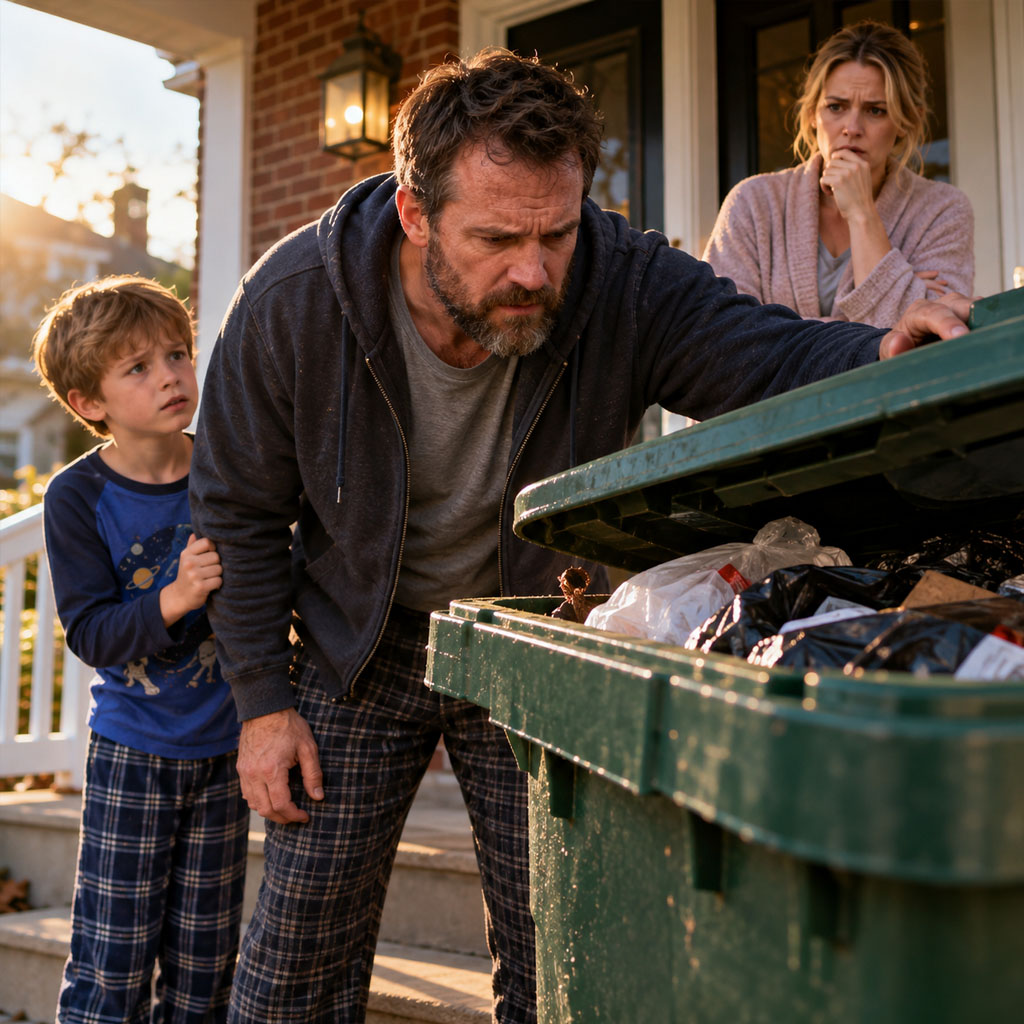
For three straight weeks, a garbage collector refused to empty my trash. Then, one Tuesday morning, he looked me in the eye and said, “Sir, your little boy has been trying to tell you something, and somebody in that house doesn’t want you to hear it.”
Chapter 2
I wanted to storm through my front door and demand answers from Lindsay. I wanted to know who had been visiting our house, why Chase had been locked in his bedroom, and what those strange papers meant. But Vernon stopped me before I reached my car.
“Go get your son first,” he said firmly. “The house isn’t going anywhere this morning.”
He was right. I drove to the elementary school’s early-morning program and signed Chase out. When he saw me standing in the doorway, his face lit up, but he immediately looked behind me.
That frightened me more than anything I’d heard on the watches.
In the car, I showed him the damaged devices. His eyes widened, and he pressed himself against the seat.
“Dad, I didn’t break them,” he whispered.
“I know, buddy. I know you didn’t.”
I climbed into the back seat beside him and took his hands.
“I owe you an apology. You told me the truth, and I didn’t believe you. I was wrong to yell, and I’m sorry.”
Chase burst into tears. He wrapped his arms around my neck and cried so hard that I could barely understand him.
When he finally calmed down, the truth came out.
Every Monday night, after I left for work, a man named Greg Ridley came to our house. Greg was an old friend of Lindsay’s from high school who operated a struggling home-renovation business. He drove a red pickup truck and carried a spare key that had belonged to my father.
Lindsay would send Chase to his bedroom early. Then she would fasten a metal hook on the outside of his door.
“She said it was because I might sleepwalk,” Chase explained. “But I’ve never sleepwalked, Dad.”
He heard them opening drawers in Grandpa’s study. Sometimes Greg photographed documents with his phone. Other times, he brought papers for Lindsay to examine.
Chase had tried telling me through his nightly weather recordings. When Lindsay discovered what he was doing, the watches began disappearing.
“Mr. Greg says you’re going to lose the house,” Chase said. “He says Mom has a video of you yelling, and the judge will make me live somewhere else.”
I held him tightly.
“Listen to me, son. Grown-ups don’t get to frighten you into keeping secrets about things that make you feel unsafe. You did the right thing by telling me.”
My next stop was Maple Hollow, the care facility where my father lived.
Dad’s memory was unreliable in the evenings, but mornings were usually different. When Chase and I arrived, he was sitting at a table sanding a wooden birdhouse.
“Well, there’s my favorite weather forecaster!” he said, smiling at Chase. “What’s the outlook?”
“Cloudy,” Chase answered softly.
Dad looked at me. His smile faded.
“Something’s wrong, Kent.”
I told him what I’d discovered, leaving out the details that might upset Chase. Then I asked whether Lindsay had brought him any documents to sign.
Dad stared at his hands.
“She came one evening with a man,” he recalled. “There was another woman with them, too. She had one of those notary stamps.”
“Do you remember what you signed?”
He shook his head.
“No, son. And that’s what bothers me. They came after supper, when my head isn’t always clear.”
My father had always been careful about his financial affairs. After Mom died, he’d instructed his attorney to make certain that no one could take control of his property unless two physicians confirmed that he could no longer manage his decisions.
“Two doctors,” Dad reminded me. “Not one. I insisted on that.”
I showed him the paper Vernon had recovered.
Dad recognized the medical office immediately.
“That’s the neurologist who checked my hand tremor years ago,” he said. “Why would somebody be practicing his signature?”
I didn’t have an answer.
A social worker at Maple Hollow recommended an attorney named Amanda Ashworth, who specialized in protecting older adults from financial exploitation. She listened carefully as I explained everything and played Chase’s recordings.
Then she examined the sheet of practiced signatures.
“This is serious,” she said. “I need to check something before we decide our next move.”
An hour later, she called me back into her office.
My father’s house sat on nearly an acre of land near the center of town. A regional hospital system had been buying nearby properties for a planned cancer treatment center. The previous year, they’d offered Dad six hundred forty thousand dollars for his house.
He had refused.
“My wife’s lilacs aren’t for sale,” he’d told them.
But Amanda had discovered something extraordinary.
Three weeks earlier, Lindsay had signed an agreement to sell the house on Dad’s behalf. The closing was scheduled for Friday morning.
The property had to be delivered vacant.
“That includes you and your son,” Amanda explained.
I felt sick.
“How can she sell something that doesn’t belong to her?”
“She has a power of attorney naming her as your father’s representative. If that document is legally effective, she may have considerable authority.”
I thought about the forged-looking signatures and Greg’s visits to Dad’s study.
“Something isn’t right,” I said.
Amanda nodded.
“And there’s another problem. Your wife could try to portray you as unstable to keep you away from the property.”
My phone had been ringing constantly throughout our conversation. When I finally checked it, I saw fourteen missed calls from Lindsay.
Then a text appeared.
WHERE IS CHASE? I’M CALLING THE POLICE.
By late afternoon, Lindsay had filed an emergency request for a protective order.
Her statement claimed I’d become increasingly aggressive since my father’s decline. She described the morning I’d yelled at Chase about his watch and included a video showing me raising my voice in the kitchen.
She also accused me of taking our son from school without informing her.
The magistrate issued a temporary order requiring me to stay away from Lindsay and the family home. Temporary custody of Chase was assigned to his mother pending further review.
Two deputies arrived at Amanda’s office that evening.
“Mr. Bridges,” one said gently, “we need you to release your son.”
Everything inside me wanted to argue.
Then I remembered Chase’s warning.
Judges don’t like angry dads.
I realized Lindsay had been preparing for this moment for weeks.
I kept my voice steady and told the deputies I would comply with the order. But I asked them to contact Detective Nina Hollis, who handled cases involving vulnerable adults and children.
Amanda had already spoken with her.
When Detective Hollis arrived and listened to the watches, her expression hardened. She explained that the court order had to be respected, but Chase’s account of being locked inside his bedroom required immediate attention.
After speaking with child protective services, arrangements were made for Chase to stay temporarily with Lindsay’s mother, Mary.
Mary was a retired school cafeteria manager with little patience for foolishness. She loved her daughter, but she loved her grandson, too. When she learned what Chase had been experiencing, she agreed to take him in.
Before he left, I bought him another watch, this time from a different manufacturer.
I connected it directly to my phone.
“Just you and me,” I told him. “Every night at eight-thirty, I’ll be listening.”
He recorded a short message to test it.
“Forecast clear, Dad.”
My phone chimed instantly.
For the first time that day, I smiled.
That evening, Amanda obtained copies of the documents Lindsay had submitted to establish her authority over Dad’s affairs. The power of attorney required written findings from two licensed physicians before it became effective.
One letter came from Maple Hollow’s doctor. It described Dad’s memory difficulties but did not declare him unable to manage his finances.
The second supposedly came from the neurologist whose signature appeared on Vernon’s discarded paper.
Amanda contacted the hospital system that had absorbed his former practice.
The doctor had retired four years earlier.
He hadn’t examined my father in seven years.
And the medical office named on the letter no longer existed.
Amanda placed the forged document beside the sheet Vernon had found.
“The signature matches the practice attempts,” she said. “We have strong evidence that somebody manufactured the medical finding needed to activate this power of attorney.”
I stared at the papers.
“So Lindsay never had the authority to sell the house?”
“That’s what the evidence indicates.”
I thought we should immediately cancel the closing, but Amanda had another concern.
Lindsay and Greg had already gone to extraordinary lengths to complete the sale. Detective Hollis had discovered that Greg owed a substantial amount of money on a private loan due Friday.
They were desperate.
“We need to protect your father and your son,” Amanda said. “And we need enough evidence to make sure this doesn’t simply start again under a different set of documents.”
That night, I checked into a roadside motel because I couldn’t legally return home. Sitting alone beneath a flickering desk lamp, I opened the video Lindsay had submitted to the court.
I watched it again and again.
Working in television had taught me to notice tiny interruptions most people never see. After several viewings, I noticed something strange.
The microwave clock behind me read 7:14.
Then, between two consecutive images, it jumped to 7:16.
Two minutes were missing.
I remembered those minutes.
Chase had insisted that he hadn’t lost his watch. I’d stopped shouting, realized I was wrong, and apologized.
Lindsay had removed all of that.
She hadn’t simply recorded my worst moment.
She had carefully erased the moment when I admitted my mistake.
Chapter 3
On Thursday morning, Amanda filed an emergency motion asking the court to reconsider the protective order. Meanwhile, Detective Hollis continued investigating the forged medical letter and the suspicious property sale.
But the biggest surprise came from my father.
He called me early that morning and told me Greg had visited him the previous evening with another document.
“He wanted me to sign something,” Dad said. “I told him I’d look at it in the morning.”
“Did you sign anything?”
“Of course not. Your mother made me promise never to sign important papers when I’m tired.”
I nearly cried hearing those words.
With Dad’s consent and the facility’s cooperation, Amanda arranged to be present when Greg returned. Detective Hollis observed the meeting.
Greg arrived carrying a leather folder and wearing the confident smile of a man who believed everyone else was easy to fool.
Inside the folder was a deed transferring my father’s house directly to Lindsay for ten dollars.
Dad read the document slowly.
Then he removed his glasses and looked at Greg.
“Son, this doesn’t protect my property. This gives it away.”
Greg laughed nervously.
“Mr. Bridges, you’re misunderstanding the paperwork.”
Dad leaned forward.
“I taught shop class for thirty-four years, Greg. I remember you. You were always better at explaining why your work was wrong than fixing it.”
Greg’s smile vanished.
When Detective Hollis identified herself, he immediately asked for an attorney. He left without obtaining Dad’s signature.
The woman who had accompanied him as a notary remained behind. Faced with questions about the earlier documents, she agreed to cooperate with investigators.
By early afternoon, I was sitting beside Amanda in the courthouse.
Lindsay was across the aisle with her attorney. She looked completely composed, wearing a navy suit and the same polished expression she used whenever we attended school meetings.
The magistrate asked whether the recording she’d submitted was complete.
“Yes, Your Honor,” Lindsay replied.
Amanda requested permission to demonstrate the editing.
I approached the courtroom monitor and displayed the video frame by frame.
I pointed to the microwave clock.
“Here it reads 7:14. In the next frame, it reads 7:16. The image skips forward, and there’s also a small break in the audio.”
I explained that I worked in broadcast control and routinely examined recordings for problems.
“Those missing minutes matter,” I said. “That’s when my son told me he hadn’t lost his watch. I apologized to him.”
I looked directly at the magistrate.
“I did raise my voice that morning. I was wrong, and I regret it. But my wife removed the part where I acknowledged that mistake.”
Then Amanda played the three watches.
Chase’s small voice filled the courtroom, describing Greg’s visits, the hook on his bedroom door, and his fear of losing his father.
Detective Hollis submitted the results of a child advocacy interview and photographs documenting the hook installed outside Chase’s room.
The magistrate listened without interruption.
After reviewing the evidence, she vacated the protective order and granted me temporary custody while the broader family proceedings continued.
She also referred Lindsay’s sworn statement for investigation.
I could hardly believe it.
For days, I’d felt as though somebody had stolen my voice. Now, for the first time, the truth had been heard.
That evening, I brought Chase home from his grandmother’s house. We couldn’t return to the brick house while the property dispute was being resolved, so Amanda helped us locate a small rental.
There was hardly any furniture. We ate pizza sitting on the living-room floor, and Chase slept on a mattress with new blue sheets.
But he was safe.
At eight-thirty, he recorded his nightly forecast while sitting three feet away from me.
“Tomorrow will be sunny,” he announced. “And I think it’s going to be a really good day.”
I hoped he was right.
Friday morning arrived cold and bright.
The sale was scheduled for ten o’clock at Riverside Title, an office above an old bank downtown.
Lindsay and Greg arrived dressed for business. They believed the property transaction could still be completed because the documents giving Lindsay authority had not yet been formally rejected.
They were mistaken.
Shortly before the meeting began, the title officer requested the original medical letters supporting the power of attorney. Lindsay placed them on the conference table.
Then the door opened.
My father entered in his wheelchair wearing his favorite gray blazer. I pushed him inside while Amanda walked beside us.
Detective Hollis followed.
“Good morning, Lindsay,” Dad said calmly. “I understand somebody’s been making decisions about my house.”
Lindsay went pale.
Amanda explained that she represented my father and challenged Lindsay’s authority to complete the transaction.
The detective then arranged a telephone conversation with the retired neurologist.
He confirmed that he’d closed his practice years earlier. He hadn’t examined Dad recently and had never written the letter dated September 30.
The buyer’s attorney closed his folder.
“Under these circumstances, my client cannot proceed.”
Greg jumped to his feet.
“I didn’t write that letter!”
Lindsay turned toward him.
For a moment, neither spoke.
Then she said quietly, “You copied the signature. You sat at my kitchen table doing it.”
Greg stared at her.
“You told me which papers to use!”
Years of trust, deception, and greed seemed to collapse into that single exchange.
Detective Hollis informed them that both were being arrested on charges connected to the forged documents and attempted financial exploitation.
Greg began protesting. Lindsay said she wanted an attorney.
My father watched silently.
When they were escorted out, he turned to me.
“Well, son,” he said, “I suppose we’re not selling the house today.”
I squeezed his shoulder.
“No, Dad. Not today.”
He looked toward the window.
“Your mother’s lilacs should be blooming again come spring. I’d hate to lose those.”
Chapter 4
The months that followed weren’t easy. Divorce proceedings began, criminal charges moved through the courts, and I spent more hours in attorneys’ offices than I’d ever imagined possible. But the most important thing was that Chase no longer had to wonder whether telling the truth would cost him his father.
The case against Lindsay and Greg grew stronger as investigators reviewed the documents and interviewed witnesses. The notary confirmed that she’d been present when Dad signed papers during one of his confused evenings. Records also established that the medical letter had been fabricated.
Lindsay eventually pleaded guilty to forgery and attempted financial exploitation. She received three years of court supervision, a restitution order, and was prohibited from returning to work in the state’s title and escrow industry.
Greg received a prison sentence for his role in the fraud.
The divorce court awarded me primary custody of Chase. Lindsay was permitted supervised visits, provided she followed the conditions imposed by the court.
I never celebrated what happened to her.
She was still Chase’s mother, and I knew her actions would leave scars that no courtroom decision could completely erase. But I also knew that protecting our son meant acknowledging what she’d done.
My father had his own decision to make.
The hospital still wanted his property for the cancer treatment center. This time, however, Dad negotiated through his own attorney and insisted that his choices be respected.
After several meetings, he agreed to sell the house at a higher price, with a special provision allowing us to remove the nine lilac bushes my mother had planted along the fence.
The doctors who evaluated Dad confirmed that, despite his fluctuating memory, he understood the transaction at the time he made the decision.
Dad signed the papers on a clear morning, with me sitting beside him.
“I loved that house,” he told me afterward. “But a house is supposed to protect the people inside it. When it can’t do that anymore, maybe it’s time to build a different kind of home.”
I never walked through its front door again.
I couldn’t separate the happy memories of my childhood from the thought of Chase lying awake behind a locked door, afraid to speak.
Instead, I helped the movers from outside. Mary, Lindsay’s mother, packed our family photographs, Dad’s tools, Mom’s recipe box, and the drawings Chase had taped to the refrigerator.
And Vernon Beasley showed up on his day off.
He arrived in his old pickup wearing jeans, work boots, and a faded baseball cap.
“Heard you boys could use some muscle,” he said.
Together, we carried Dad’s workbench out of the backyard shop.
I tried to thank him again, but he waved me off.
“Any decent man would’ve done the same thing.”
“No,” I said. “A lot of people would’ve emptied the can and driven away.”
Vernon looked down for a moment.
“Well, I have a grandson about Chase’s age. Couldn’t stand the thought of that little boy talking into a watch and nobody listening.”
I shook his hand.
“You gave me my son back.”
His eyes grew wet, and he pulled me into a brief, awkward hug.
A few weeks later, we moved into a single-story house on Willow Court, not far from Maple Hollow. It had wide hallways, a small workshop in the garage, and a sunny bedroom for Chase.
There were no hooks on the outside of any bedroom doors.
My father joined us in December after we arranged the assistance he needed. Some evenings, his memory still drifted, and he’d ask questions we’d already answered. But on good mornings, he and Chase spent hours in the garage building birdhouses and repairing old furniture.
We planted Mom’s nine lilac bushes along the back fence.
Dad supervised the work from a folding chair, offering advice even when nobody asked.
“Don’t bury them too deep,” he warned. “Those roots need room to breathe.”
Chase grinned.
“Grandpa, you’ve told us that three times.”
“Then you ought to remember it.”
Our new life wasn’t perfect. Some nights Chase still woke from bad dreams and came looking for me. Sometimes he asked difficult questions about his mother, and I did my best to answer without filling his heart with bitterness.
But slowly, he began laughing more.
He returned to drawing weather maps and announcing imaginary storm systems from the living-room wall. His teacher even let him present a short weather report during the school’s morning announcements.
As for Vernon, his company never fired him.
Amanda and Detective Hollis contacted the waste management company’s leadership and explained what he’d done. After reviewing the situation, the company revised its procedures so drivers could report concerns about someone’s safety without risking their jobs.
The workers started calling the change the Vernon Rule.
When Vernon retired that summer, he received his full pension, a cake from his coworkers, and a plaque recognizing his service.
Chase and I attended the celebration.
During the speeches, Vernon spotted us in the back of the room and waved Chase forward.
“This young fellow,” Vernon told everyone, “is the reason I learned that sometimes the most important part of your job isn’t what you’re paid to do.”
The room fell silent.
“Sometimes it’s what your conscience won’t let you ignore.”
People stood and applauded.
Chase looked embarrassed, but he smiled the whole way home.
I eventually returned to my regular overnight shift at the television station. The work was familiar, and I still enjoyed the quiet responsibility of keeping everything running.
But something about me had changed.
I paid more attention when people said they were frightened. I listened longer when my son tried to explain something. And I learned that admitting you’re wrong doesn’t make you a weaker father.
Sometimes it’s the only way to become a better one.
One winter evening, several months after everything had happened, I was sitting in the station’s control room when my phone chimed.
It was eight-thirty.
I opened Chase’s message.
“Hi, Dad! Forecast for tomorrow: clear skies, high of forty-one, and a little windy. Grandpa says our lilacs will survive the winter because their roots are strong. Mr. Vernon came over today with his granddaughter, and we made a weather map together. She wants to be on television, too.”
There was a pause.
Then Chase added, “Oh, and Dad? Thanks for believing me.”
I sat staring at the phone.
For a moment, the thirty-six monitors in front of me blurred.
I thought about the morning I’d shouted over eighty-nine dollars. I thought about the three watches lying broken in the garbage, and the man who’d carried our heavy trash container up the steps week after week because he couldn’t bear to throw away a child’s voice.
I thought about how close I’d come to losing the people I loved because I’d mistaken convenience for trust.
Then I recorded my reply.
“Forecast for tomorrow, buddy: a little cold, but plenty of sunshine. Grandpa’s right about those lilacs. They’ve survived worse winters than this.”
I took a breath.
“And Chase, I believe you. I always want you to know that.”
The message sent immediately.
Outside, snow began falling over Garnet Falls. I pictured our little house on Willow Court, my father sleeping peacefully down the hall, and Chase curled beneath his blankets, knowing his bedroom door would open whenever he needed it to.
For the first time in a long while, I felt certain that we were going to be all right.
I once believed that the worst thing you could lose was a home filled with family memories. Now I understand that a home isn’t the walls, the furniture, or even the place where you grew up.
It’s where a frightened child can tell the truth and know someone will listen.
And sometimes, the person who helps you understand that isn’t a judge, a lawyer, or someone with a fancy title.
Sometimes it’s a garbage man who refuses to drive away.