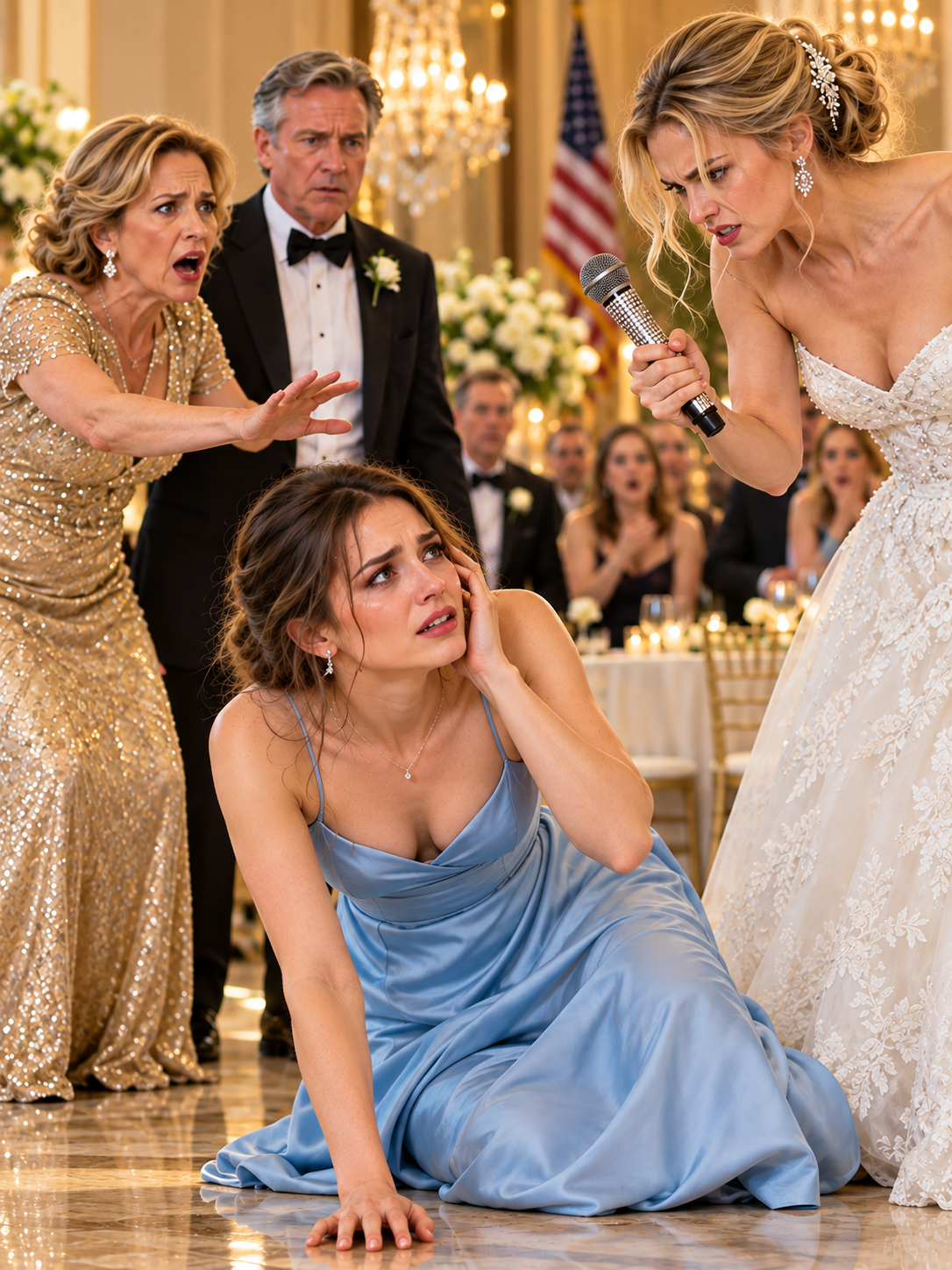
“Don’t bleed on your sister’s $12,000 dress!” Mom screamed as I knelt on the wedding floor, blood streaming from my temple. Sloane still gripped the rhinestone-covered microphone she’d smashed into my head, while two hundred guests stared and Dad looked away. I left alone for the ER. Then a scan exposed something my family had deliberately buried for twenty-one years.

PART 1 — THE WEDDING THAT EXPOSED A 21-YEAR LIE
“Get away from her dress, Maren! You’re getting blood on it!”
That was what my mother screamed while I was kneeling on the ballroom floor with blood running down the side of my face.
Not “Are you okay?”
Not “Somebody call an ambulance.”
She was worried about a wedding dress.
A $12,000 custom wedding dress, apparently worth considerably more than her youngest daughter’s head.
My sister Sloane stood three feet away, gripping the heavy metal microphone she’d just swung into my temple.
“Jesus, Maren,” she said. “It was an accident. Stop making everything about you.”
I looked at the blood on my fingers.
Then I looked at my parents.
Neither moved toward me.
And at twenty-nine years old, I finally understood something I’d spent most of my life trying to explain away.
In my family, I wasn’t a daughter.
I was an inconvenience.
What I didn’t know was that the blow to my head would uncover a second injury, an insurance settlement, and a financial crime that had been going on for more than a decade.
And by the time I finished digging, my sister’s $120,000 wedding would look like the cheapest mistake my family had ever made.
My name is Maren Whitmore. I’m twenty-nine, and I work as a commercial property appraiser for a major financial auditing firm in San Francisco.
My job involves examining property records, reviewing financial statements, and figuring out what people actually own versus what they want banks and investors to believe they own.
I’m good at it.
I bought my first house at twenty-seven. Nothing spectacular. Two bedrooms, a small backyard, and a garage that barely fits my car.
But every mortgage payment comes out of my paycheck.
No family money. No generous parents. No mystery inheritance.
My older sister, Sloane, lives differently.
She’s thirty-three and calls herself a lifestyle consultant.
Her Instagram shows designer handbags, luxury vacations, expensive restaurants, and captions about building a successful personal brand.
Our parents pay for most of it.
Dad, Tobias, owns a small consulting business. Mom, Genevieve, considers herself something of a local socialite.
Together, they’ve spent thirty-three years convincing Sloane she’s the most extraordinary person in Northern California.
When she failed a college course, the professor was incompetent.
When she totaled a BMW, the other driver must have been speeding.
When she accumulated $18,000 in credit card debt, Dad quietly paid the minimums until he could move the balance somewhere else.
Meanwhile, when I asked for help buying textbooks in college, Mom suggested I work another shift.
“Your sister needs more support,” she explained. “You’ve always been independent.”
Apparently, independence meant paying for everything while Sloane got rewarded for needing rescuing.
So when my parents announced they were spending $120,000 on Sloane’s wedding, I didn’t bother asking where the money came from.
They claimed they’d dipped into retirement savings.
I should have questioned that.
I didn’t.
Sloane was marrying Declan Mercer, a software engineer I’d always liked. He was patient, hardworking, and surprisingly normal for someone who’d agreed to marry my sister.
He’d once helped me replace a broken water heater without making a production out of it.
That alone made him the most useful person in my extended family.
I agreed to be a bridesmaid mostly because of him.
It was a mistake.
By nine that morning, Sloane had criticized my hair, complained about my makeup, and ordered me to carry her train through an entire photography session.
She’d also insisted I buy my own pale-blue silk bridesmaid dress.
“It’s only $680,” she’d said.
“Great. Put it on your Amex.”
She hadn’t laughed.
At the reception, nearly two hundred guests filled a luxurious vineyard estate in Sonoma County.
There were white roses everywhere, champagne towers, crystal chandeliers, and an open bar that probably cost more than my first semester of college.
I sat near the dance floor with a glass of water, checking the Uber app and calculating how soon I could leave without causing an international incident.
Then Sloane picked up the microphone.
It was a ridiculous custom piece with a heavy metal casing covered in rhinestones.
She thanked the guests, praised herself for planning such a beautiful wedding, and described Declan as the luckiest man alive.
Then she spotted me.
“And of course, we can’t forget my baby sister!”
I closed my eyes.
Here we go.
“Maren, stand up!”
I stayed seated.
Sloane laughed into the microphone.
“Twenty-nine years old, single, and still spending Friday nights with spreadsheets. Honestly, if she catches my bouquet, somebody should warn the flowers.”
A few guests laughed.
Others looked uncomfortable.
My mother gave me her familiar warning stare.
Smile. Take the joke. Don’t embarrass us.
Sloane wasn’t finished.
“Come on, Maren. Maybe tonight you’ll meet a man who doesn’t need a tax deduction to find you interesting.”
That did it.
I put down my water, picked up my purse, and stood.
Not to make a speech.
Not to start a fight.
I was leaving.
“Oh, look! She’s running away!”
Sloane followed me toward the edge of the ballroom.
“Don’t walk away while I’m talking to you!”
I turned.
She swung.
The microphone struck the right side of my head with a sound I can still remember.
My knees gave out.
I hit a cocktail table, sent two glasses crashing onto the floor, and landed hard against the hardwood.
For several seconds, everything sounded as though I were underwater.
Declan shouted something.
The DJ stopped the music.
Someone asked whether I needed help.
Sloane looked down at me.
“Oh my God. It slipped!”
Except it hadn’t.
The microphone was still in her hand.
Then my mother appeared, noticed the blood, and immediately pulled Sloane backward.
“Careful! Her dress!”
I pressed a cocktail napkin against my temple.
“Mom, I think I need a hospital.”
“Then go,” she snapped. “You don’t need to announce it to everyone.”
Dad stood beside her, checking the crowd.
He didn’t even ask whether I could walk.
I got myself outside and ordered an Uber.
The driver took one look at my dress and reached for his phone.
“Ma’am, do you want me to call 911?”
“Can you take me to Memorial Hospital?”
“You sure?”
“No,” I said. “But I’d appreciate getting there.”
The emergency room was busy.
A nurse took my blood pressure, checked my pupils, and immediately moved me into an examination room.
Dr. Hayes, the physician treating me, cleaned the cut while asking questions.
“What hit you?”
“A microphone.”
“Someone dropped it?”
“My sister swung it at me.”
His hand stopped.
“On purpose?”
“She says it slipped. She was still holding it afterward.”
He wrote something in my chart.
“Do you feel nauseated?”
“Yes.”
“Dizzy?”
“Very.”
“Any loss of consciousness?”
“I’m not sure.”
He ordered a CT scan.
Six stitches later, I was lying under fluorescent lights, wondering whether the wedding cake had even been served.
My phone showed a message from Declan.
Please tell me you’re okay. Which hospital?
Nothing from Mom.
Nothing from Dad.
Nothing from Sloane.
That shouldn’t have surprised me.
It still did.
When Dr. Hayes returned, he pulled a stool beside my bed.
“The CT doesn’t show any acute bleeding inside your skull. That’s good news. You do have a concussion, and I want you to follow the discharge instructions carefully.”
I nodded.
Then he enlarged another image.
“There’s something else.”
He turned the screen toward me.
A section of bone on the right side of my skull had an irregular, thickened contour.
“Did you have a serious head injury as a child?”
I frowned.
“I fell down some backyard steps when I was eight.”
“Were you hospitalized?”
“According to my parents, I went to a clinic. They said I had a minor concussion.”
He studied the image again.
“This looks like an old, healed depressed skull fracture. I can’t determine exactly when it happened from this scan, but it’s consistent with a significant injury.”
I stared at the screen.
“Like surgery significant?”
“Possibly. We’d need your old medical records to know.”
There was a pause.
Then he asked, “Do you remember the accident?”
I remembered a white ceiling.
A plastic bracelet around my wrist.
The strange sensation of waking up somewhere unfamiliar.
And my mother telling me not to invent stories about what happened.
“I remember pieces,” I said.
He explained how to request my childhood hospital records and suggested following up with a specialist.
Then he asked whether I wanted information about reporting the assault.
For the first time that night, someone had called what happened an assault without asking whether Sloane was having a difficult day.
“Yes,” I said. “I do.”
I spent the following afternoon in my darkened bedroom.
My head hurt whenever I moved too quickly.
My father left a voicemail around noon.
“Maren, your sister is very upset. Leaving the wedding like that embarrassed her in front of Declan’s family. You need to call and apologize so we can move forward.”
I replayed it.
Then I called him.
“Dad, I needed six stitches.”
“Well, nobody wanted you to get hurt.”
“I have a concussion.”
“You know Sloane gets emotional.”
“She hit me in the head with a metal microphone.”
“If you’d stayed seated instead of storming off—”
“Dad.”
He stopped.
“The CT scan showed an old skull fracture.”
Nothing.
“From when I was eight.”
Still nothing.
“The doctor thinks it was a major injury. Why did you tell me I only had a mild concussion?”
He cleared his throat.
“You fell down the steps, Maren. We’ve been through this.”
“Then why don’t I remember coming home from the hospital?”
“You were eight. Children forget things.”
“Did I have surgery?”
Another pause.
“Stop letting some emergency-room doctor put ideas in your head.”
He hung up.
That was my answer.
Or enough of one to start looking.
I requested records from Memorial Hospital’s archive and contacted the records department at the health system that had absorbed the original hospital.
I also called an attorney recommended by a professional colleague.
By the fourth day after the wedding, I had received the first batch of scanned records.
One document listed my admission date, twenty-one years earlier.
Age: eight.
Arrival: ambulance.
Condition: unconscious.
Diagnosis: depressed skull fracture, traumatic brain injury.
Procedure: emergency neurosurgical intervention.
I read those lines three times.
My parents had described the whole thing as a visit to a neighborhood clinic.
I’d actually spent time in pediatric intensive care.
Then I opened a social worker’s report.
The words were direct.
The patient had repeatedly stated that her twelve-year-old sister pushed her from a second-story balcony during an argument.
She had asked hospital staff not to allow her sister into her room.
Child Protective Services had investigated.
My parents told the investigators I was confused, prone to nightmares, and had fallen accidentally.
With no independent witness and insufficient evidence, the case was closed.
I sat at my kitchen table, staring at the report.
I remembered the balcony.
Blue shorts.
A plastic toy on the floor.
Sloane shouting that I was touching something that belonged to her.
Then a hand against my shoulder.
For twenty-one years, every time that memory surfaced, my parents corrected me.
You fell.
You’re remembering a dream.
Stop blaming your sister.
Now there was a document written before anyone had time to teach me their preferred version.
And it said I’d told the same story at eight years old.
The next document made everything worse.
It was an insurance settlement agreement.
My parents had filed a liability claim against their homeowners insurance, alleging a defective balcony railing.
The insurer had agreed to settle for $150,000.
The settlement provided for the money to be held for my benefit, with my parents responsible for administering it.
I looked at the beneficiary’s name.
Maren Whitmore.
One hundred and fifty thousand dollars.
My parents had told me they couldn’t afford to help with college.
I’d worked at a coffee shop before classes and waited tables most weekends.
I’d paid my student loans while Sloane vacationed in Cabo.
And apparently, there had been a financial account established in my name the entire time.
I called my attorney.
“I need to know where that money went.”
His answer was immediate.
“Then we get the trust documents and account records. Don’t confront them with guesses.”
He helped me request the records I was entitled to as the beneficiary.
What arrived was worse than any guess.
The trust had been depleted through a long series of withdrawals.
Copies of release authorizations carried signatures that were supposed to be mine.
They weren’t.
Some dated back to years when I had never been told the account existed.
There were transfers into my parents’ accounts, payments associated with Sloane’s expensive purchases, and one final withdrawal that I had to enlarge on my laptop.
Amount: $120,000.
Three months before the wedding.
The exact amount my parents had bragged about spending on Sloane’s big day.
My attorney cautioned that the full amount owed, including any lost earnings and damages, would have to be established through an accounting.
Our preliminary estimate was approaching $450,000.
I wasn’t looking at a misunderstanding.
I was looking at signatures I hadn’t written and money I hadn’t authorized anyone to spend.
I went to my parents’ house with copies of the records in a manila envelope.
Sloane was sitting on the living-room rug, opening wedding gifts.
Mom was recording them on a clipboard.
Dad was reading Golf Digest.
Nobody appeared especially traumatized by the fact that one daughter had left the wedding bleeding.
Sloane glanced at my bandage.
“Wow. You’re still doing the head thing?”
I set the envelope on the coffee table.
“Remember when I was eight?”
Dad lowered his magazine.
Mom stopped writing.
Sloane rolled her eyes.
“If this is another therapy speech, can you make it quick?”
I pulled out the hospital report.
“I didn’t fall down the backyard steps.”
Mom stood.
“Maren, please don’t start.”
“Sloane pushed me off the second-floor balcony.”
Dad closed his magazine.
“That’s enough.”
“I have the medical records. I have the CPS report.”
Sloane’s expression changed.
Only for a second.
Then she laughed.
“Seriously? You’re blaming me for something that happened when we were kids?”
“You put me in intensive care.”
“You were always clumsy.”
“And last weekend you hit me with a microphone.”
“Oh, for God’s sake.”
“Was that an accident too?”
She stood, dropping an unopened wedding gift onto the rug.
“You want to know something? Fine. I hit you. On purpose.”
Mom moved toward her.
“Sloane, stop talking.”
“No! I’m sick of her acting superior!”
Sloane pointed at my bandage.
“She sat there at my wedding like she was too good for everyone. I wanted to knock that smug look off her face.”
I looked at Dad.
He didn’t say a word.
Mom grabbed Sloane’s arm.
“She’s upset. We are not discussing this anymore.”
I took another document from the envelope.
“Then let’s discuss the $150,000 settlement.”
My father’s face changed.
I placed a copy of the withdrawals in front of him.
“Or the signatures you forged.”
Mom looked at the paperwork.
“Where did you get those?”
“From the people who actually keep records.”
I tapped the final transaction.
“One hundred and twenty thousand dollars, three months ago. Funny coincidence, considering the wedding cost exactly that.”
Dad’s voice dropped.
“Put those papers away.”
“Did you use my medical settlement to pay for her wedding?”
He didn’t answer.
Mom tried a different approach.
“Families help each other, Maren.”
“Interesting. I don’t remember voting on that.”
“We raised you!”
“And apparently billed me for the privilege.”
Sloane folded her arms.
“Oh, come on. You’re not exactly starving.”
I looked at the unopened gifts scattered around her feet.
“No. I worked for what I have.”
Then I collected the documents.
“You’ll hear from my attorney.”
Dad stood abruptly.
“Are you threatening your own parents?”
“No, Dad. I’m telling you where the paperwork is going.”
I walked out before anyone could invent another version.
The next morning, I sat across from Hollis, my boss and longtime mentor.
She was fifty, wore expensive tailored suits, and had an impressive ability to dismantle nonsense with one question.
She examined the bandage on my head.
“Who did that?”
“My sister.”
“Of course she did,” Hollis said after hearing the rest. “And your parents managed to make it a financial crime. Ambitious people.”
She connected me with a litigation specialist who began preserving the bank evidence and preparing a civil suit.
Then she asked about the wedding assault.
“Any witnesses?”
“Two hundred.”
“Reliable witnesses?”
“That’s a smaller number.”
“Video?”
“The venue has security cameras.”
“Then let’s make sure the footage isn’t overwritten.”
Hollis knew someone at the company that operated the vineyard.
She helped arrange for my attorney to contact the venue and request preservation of the recording.
Mr. Yates, the manager, confirmed that the incident had been captured.
After the proper arrangements were made to provide a copy, he called me personally.
“Ms. Whitmore, I’ve watched the footage,” he said.
“And?”
There was a pause.
“You should sit down before you watch it.”
I reviewed it with my attorney.
The video was silent, shot from a camera mounted above the ballroom.
I watched Sloane follow me.
Watched her move the microphone into her striking hand.
Watched her plant her feet.
Watched her swing directly at my head.
There was no stumble.
No accidental collision.
She’d aimed.
But what happened immediately afterward was what made me ask my attorney to replay the footage.
While I lay on the floor, Sloane looked down at me.
And smiled.
Then my mother rushed over.
Not toward me.
Toward the dress.
I watched her pull Sloane away from the blood.
My attorney stopped the recording.
“You have enough here to make a formal report,” he said. “And we should discuss how this affects the civil case.”
I picked up my phone.
Sloane had posted another photograph from her wedding.
She was smiling under the chandeliers, holding Declan’s hand.
The caption read:
Nothing can ruin true happiness. Family is everything.
In five days, Sloane and Declan were hosting a housewarming party at their new $2 million property.
My parents had helped organize it.
Most of the wedding guests would be there.
And Sloane had apparently spent the week telling everyone I’d gotten drunk, injured myself, and tried to blame her.
I opened the invitation.
Then I called my attorney.
“I want Declan to see everything.”
“Privately?” he asked.
I looked again at the photograph.
At my sister’s perfect smile.
At the husband who still believed he’d married a decent person.
“I’m going to give him a chance to hear the truth,” I said.
“And after that?”
I watched the paused video one last time.
“After that, they can explain themselves.”
END OF PART 1
PART 2 — THE PRICE OF A PERFECT FAMILY
Five days later, my sister hugged me in front of forty guests and whispered, “Don’t embarrass me tonight.”
I smiled for the photographs.
Then I handed her husband a black gift box.
Sloane’s smile disappeared.
She recognized the envelope inside.
And for the first time in her life, she couldn’t make our parents solve the problem for her.
The house was ridiculous.
Two million dollars bought Declan and Sloane a modern glass-and-stone mansion behind the gates of an expensive Bay Area neighborhood.
There were imported marble countertops, an outdoor kitchen, a swimming pool, and a garage large enough to hold every car I’d ever owned.
Declan had worked hard for it.
Sloane had worked hard choosing the furniture.
I parked my car behind a Tesla and checked my reflection.
Charcoal-gray pantsuit. Black heels. Simple diamond earrings I’d purchased after my first major promotion.
And a small white bandage clearly visible above my right ear.
I’d considered covering it with my hair.
Then I remembered Sloane telling everyone that I’d exaggerated my injury.
Let them see it.
I picked up the black gift box from the passenger seat.
Inside were copies of the childhood hospital records, the insurance settlement, the bank documents, and the civil complaint my attorney had prepared.
A USB drive containing the venue’s security footage rested on top.
I wasn’t bringing a housewarming gift.
I was bringing the one thing my family had never allowed inside their beautiful homes.
An accurate account of what happened.
My cousin Piper intercepted me near the entryway.
She was holding a martini and wearing a dress that looked uncomfortable enough to qualify as a medical device.
“Well, somebody finally decided to show up.”
“Hi, Piper.”
“I heard you made a huge scene at the wedding.”
“I had six stitches. The doctor was pretty dramatic about it.”
She rolled her eyes.
“You know what I mean. Aunt Genevieve was devastated.”
“Was she? Her dress is fine, in case you’re worried.”
Piper frowned.
“God, you’re exhausting.”
“And yet you keep coming over to talk to me.”
Before she could respond, Sloane appeared.
Emerald-green designer dress. Perfectly styled blonde hair. A diamond necklace that reflected the chandelier lights.
“Maren!”
She rushed forward and hugged me.
For the room, she said, “I’m so glad you came. I knew we’d work everything out!”
Then, close to my ear, she whispered, “You’d better behave yourself.”
I stepped back.
“Where’s Declan?”
Her eyes dropped to the box.
“What’s that?”
“Something for your husband.”
“You can leave gifts by the dining room.”
“I’d rather give it to him personally.”
Mom appeared beside us, carrying a champagne flute.
“Maren, honey, why don’t we have a quiet conversation first?”
“Because the last quiet conversation ended with Dad telling me forged signatures were a family matter.”
Her smile tightened.
“Not here.”
“Then you picked an unfortunate venue.”
I walked past them.
Declan stood near the living-room fireplace, discussing a software project with two colleagues.
When he saw me, he excused himself.
“Maren! I’ve been trying to reach you.”
“I know. Sorry. It’s been a complicated week.”
He looked at the bandage.
“Is your head healing?”
“Slowly.”
“I told Sloane I wanted to come see you, but she said you needed space.”
“I did. From her.”
His expression changed.
I offered him the box.
“This is for you.”
He gave a small, uncertain laugh.
“You didn’t need to buy us anything.”
“I didn’t.”
Declan looked down.
“Okay. Now I’m concerned.”
“You should open it.”
Sloane appeared at his shoulder.
“Babe, we can do gifts later.”
“It’s fine,” he said.
“No, seriously. Maren has been acting weird since the wedding.”
Declan looked at her.
“She’s recovering from a concussion, Sloane.”
“And I’ve been under a lot of stress!”
I placed the box in his hands.
“Declan, please.”
He pulled the ribbon loose.
Sloane reached for the lid.
“Don’t.”
It came out much sharper than she’d intended.
Several guests turned.
Declan frowned.
“Sloane, what’s going on?”
“Nothing. She’s just trying to ruin another celebration.”
He opened the box anyway.
The first document was the civil complaint.
Declan read the names.
Tobias Whitmore.
Genevieve Whitmore.
Then he read the allegations: breach of fiduciary duty, financial fraud, forged trust authorizations.
He looked at me.
“What’s this?”
“A lawsuit involving the trust established after my childhood head injury.”
He turned another page.
His mouth tightened.
“Your parents had a trust fund for you?”
“Yes.”
“How much?”
“The original settlement was $150,000. My attorney’s preliminary calculation puts the amount in dispute, including lost earnings, close to $450,000.”
Declan flipped through the bank statements.
I pointed to the final large withdrawal.
“That transfer happened three months before your wedding.”
He read the amount.
“One hundred and twenty thousand dollars.”
Then he looked at Sloane.
“Your parents said they were paying for the wedding with their retirement savings.”
Sloane folded her arms.
“That’s what they told me.”
Declan picked up another document.
The pediatric hospital report.
He read about the skull fracture.
The surgery.
The social worker’s interview.
The allegation that Sloane had pushed me from a second-floor balcony.
He stopped.
“Sloane?”
She shook her head.
“No. Absolutely not.”
“Did you push Maren off a balcony when you were twelve?”
“We were kids!”
Declan stared at her.
“That wasn’t my question.”
“It was twenty-one years ago!”
“Still not my question.”
By then, Mom and Dad had reached the fireplace.
Dad took one look at the papers and straightened his shoulders.
“Declan, this is an unfortunate misunderstanding.”
Declan held up the hospital report.
“Did Maren have emergency brain surgery when she was eight?”
Dad hesitated.
“Yes, but—”
“Did you tell her she’d only had a minor concussion?”
“We didn’t want to frighten her.”
“She was the patient.”
“She was a child!”
“And now she’s an adult who says you’ve been taking money from her account.”
Mom stepped forward.
“Declan, we have always considered you our son. Please don’t let Maren’s jealousy—”
He raised a hand.
“Genevieve. Did you use that money for our wedding?”
Mom looked at Dad.
That was enough.
Declan nodded once.
“Okay.”
Sloane grabbed his arm.
“Baby, please. You know how Maren is.”
He pulled away.
“No. Apparently, I don’t know how any of you are.”
Dad attempted to regain control.
“Maren has always been difficult. She’s spent her entire life competing with Sloane.”
I almost laughed.
“Dad, I have a career, my own house, and retirement savings. Sloane has six designer handbags and an unpaid American Express balance. What competition?”
A few people nearby made uncomfortable noises.
Piper lowered her martini.
Mom’s voice went shrill.
“Enough! This is private family business!”
“You made my head injury public when you told two hundred wedding guests I was being dramatic.”
Declan was still reading.
Then he found the USB drive.
“What’s on this?”
Sloane went very still.
I answered.
“The wedding reception.”
She shook her head.
“No.”
“Specifically, what happened when I tried to leave.”
Declan looked at her.
“You said the microphone slipped.”
“It did!”
I held out my hand.
“Then you’ll have no problem watching.”
Sloane moved between him and the television.
“Declan, please. We need to talk privately.”
He stared at her for several seconds.
“Is there something on that video you don’t want me to see?”
She didn’t answer.
Declan walked around her.
The living room had an eighty-inch television mounted above the fireplace.
He connected the USB drive and opened the recording.
The party conversation gradually stopped.
Someone turned down the jazz music.
Guests began gathering behind us.
On the screen, the wedding reception appeared.
Sloane stood near the center of the ballroom holding the microphone.
I sat at a table several feet away.
The footage had no sound.
Declan watched as I stood, picked up my purse, and headed for the exit.
Then Sloane followed me.
I heard someone behind us whisper, “Why is she going after her?”
On the television, my sister stepped into my path.
She shifted her grip on the microphone.
Set her feet.
And swung.
The impact knocked me sideways into the cocktail table.
A woman near the fireplace covered her mouth.
“Oh my God.”
Nobody spoke for several seconds.
Then the recording showed Sloane looking down at me.
Smiling.
Not laughing nervously.
Not reacting in shock.
Smiling at what she’d done.
Declan paused the video.
“Sloane.”
She was crying now.
“It was a mistake.”
He pressed play again.
We watched Mom run toward Sloane, pull her away from me, and inspect the expensive wedding gown.
Dad stood beside them.
I remained on the floor.
Declan stopped the recording.
He turned toward my parents.
“She was bleeding from the head.”
Mom pressed a hand to her necklace.
“We were all in shock.”
“You checked the dress.”
“It was a chaotic situation!”
“You checked the dress,” he repeated.
Mom opened her mouth.
Nothing came out.
Then Declan faced Sloane.
“You told me she walked into your microphone.”
“I panicked!”
“You told my parents she got drunk and hurt herself.”
“I didn’t want everyone blaming me!”
“You hit her deliberately.”
Sloane wiped at her cheeks.
“She makes me so angry sometimes.”
Declan actually laughed.
One short, disbelieving laugh.
“That’s your defense?”
“She’s been jealous of me our whole lives!”
“I’m looking at a video of you attacking someone who was walking away.”
Sloane stepped toward him.
“Please, baby.”
He moved back.
“Don’t call me that right now.”
Then he removed his wedding ring.
He placed it on the fireplace mantel.
“I can’t stay married to someone who does this and lies about it afterward.”
Sloane stared at the ring.
“You’re leaving me?”
“I’m calling a lawyer tomorrow.”
“You can’t throw away our marriage over one mistake!”
“One mistake?”
He gestured toward the screen.
“Which one? The assault? The lies afterward? Or the fact that you’ve spent a week telling me your injured sister is crazy?”
She started crying harder.
“I love you!”
Declan looked exhausted.
“Then you should have trusted me with the truth.”
Dad turned on me.
“Are you happy now?”
I looked at him.
“Not especially. I still have a concussion.”
“You’ve destroyed your sister’s marriage.”
“No. She did that. I just brought the video.”
Mom began crying.
“You’re tearing this family apart.”
I collected my documents.
“Mom, you spent twenty-one years pretending I fell down some steps. You don’t get to lecture me about family loyalty.”
Piper stood near the edge of the crowd.
She looked at Sloane, then at the paused video.
Finally, she turned to me.
“Maren, I didn’t know.”
“No,” I said. “You didn’t ask.”
She lowered her eyes.
I wasn’t interested in collecting apologies from people who’d laughed along with the abuse.
My attorney already had copies of the relevant records.
The police would receive the footage.
The civil case would determine what my parents owed.
And Declan would make his own decisions about his marriage.
I had no reason to stand there arguing anymore.
I walked toward the front door.
Behind me, Sloane screamed, “You’re ruining my life!”
I stopped.
Turned.
And looked at her.
“You hit me in the head at your wedding, and you think I’m the one who ruined your life?”
She stared at me.
I continued.
“You got twenty-one years of protection, Sloane. You got the money, the excuses, the cars, the vacations, and the wedding.”
I pointed toward the television.
“All I got was the truth.”
Then I left.
The next Monday, my parents were served with the civil lawsuit.
Their attorney contacted mine within forty-eight hours.
Dad initially insisted that every withdrawal had been legitimate.
Then my attorney requested the underlying authorizations, identity-verification records, and information about the accounts where the money had gone.
Suddenly, Dad became interested in negotiating.
The account history contained dozens of questionable transactions.
Fifty-two withdrawals and transfers required particular scrutiny.
Some signatures were plainly inconsistent with mine.
Others were attached to dates when I could document being somewhere entirely different.
My parents’ financial situation was worse than I’d imagined.
Dad’s business had been struggling for years.
The house was heavily mortgaged.
Credit card debt was piling up.
And their expensive lifestyle had consumed most of the stolen money.
My lawsuit didn’t magically foreclose on their house.
Their existing debts and missed payments were already pushing them toward that outcome.
But the legal expenses, repayment demands, and inability to obtain additional financing finally made their situation impossible to hide.
They needed to sell.
Fast.
Hollis connected me with a real estate investor interested in distressed properties.
After getting independent legal advice, I participated in a purchase arrangement through his company.
My parents accepted a cash offer that would allow their secured debts to be resolved and part of the disputed trust money to be repaid under a negotiated settlement.
They didn’t know I had an interest in the buying company until the transaction was nearly complete.
When Dad learned, he left me a voicemail.
“You bought our house out from under us?”
I listened to it in my office.
Then saved it for my attorney.
That house had been the center of my childhood.
The balcony was still there.
So was the backyard where my parents claimed I’d fallen.
I didn’t want to live in it.
I wanted the financial damage repaired.
The investment company renovated the property and eventually sold it.
My share of the proceeds went into my own investment account.
My parents moved into a small rental apartment.
Their reputation suffered, but the financial records did far more damage than neighborhood gossip ever could.
They resolved the civil case through a settlement requiring repayment of the misappropriated funds and an agreed amount addressing the lost earnings.
They also faced scrutiny over the withdrawals and false authorizations.
I didn’t need them to make another speech about how much they’d sacrificed as parents.
I needed the financial obligations documented and enforced.
For once, they had to pay a bill themselves.
Declan filed for divorce.
He contacted me through his attorney to obtain copies of the evidence relevant to the questions about the wedding money.
He also apologized.
Not for Sloane.
For believing her version of events without asking me what happened.
“I should have come to the hospital,” he told me during a phone call.
“You did text.”
“I let her convince me to stop asking questions.”
I considered that.
Then said, “Well, you’re asking them now.”
Sloane’s perfect new marriage collapsed before the wedding photographs were even delivered.
She eventually moved out of Declan’s house while the divorce attorneys worked through the arrangements.
Her influencer friends disappeared when the rumors became documented facts.
The luxury lifestyle she’d built around her husband’s income came to an abrupt stop.
Then investigators contacted her about the wedding assault.
The security footage, my medical records, and witness statements became part of the criminal case.
Sloane was charged.
For once, our parents couldn’t negotiate a private explanation that made the problem disappear.
Three days after learning that the case was moving forward, she called me from an unfamiliar number.
“Maren?”
I recognized her immediately.
“What do you want, Sloane?”
She was crying.
“Please don’t hang up.”
I sat on my couch and waited.
“I’m sorry,” she said. “I’m sorry about the wedding. About everything.”
“Okay.”
“Okay?”
“I heard you.”
She sniffled.
“Declan won’t answer my calls. Mom and Dad won’t let me stay with them. My lawyer says I could go to jail.”
I looked at the bandage I’d finally removed from my temple.
The stitches were gone.
The scar wasn’t.
“Maren, you have to tell the prosecutor you don’t want this.”
“No.”
“Please! We’re sisters!”
“You remembered that quickly.”
“I made a mistake!”
“You swung a metal microphone into my head.”
“I was angry!”
“And when I was eight?”
She stopped crying for a moment.
I waited.
Finally, she said, “We were arguing.”
“About what?”
“A toy. I don’t even remember.”
“You pushed me off the balcony.”
There was a long pause.
“I didn’t think you’d actually fall.”
I closed my eyes.
There it was.
Twenty-one years.
One sentence.
“You told Mom and Dad?” I asked.
“Yes.”
“And they told you to keep quiet?”
She began crying again.
“They said everything would be okay.”
For her, apparently, it had been.
For me, it meant surgery, years of confusion, and the constant knowledge that my own memories weren’t considered reliable.
Sloane started pleading again.
“You have to help me. I have nothing.”
I stood and walked to the kitchen window.
“I’m not going to lie for you, Sloane.”
“They’re going to ruin my life!”
“No. You’re going to answer for what you did.”
“Maren—”
“You could have called me from the hospital. You could have apologized after the wedding. You could have told Declan the truth.”
She was quiet.
“But you didn’t,” I continued. “You waited until there was video evidence and a criminal case.”
“Please.”
“Let your lawyer help you.”
I ended the call.
Then blocked the number.
Six months later, the cases had reached their final stages.
My parents’ civil settlement was complete, and their financial obligations were formally documented.
Sloane’s criminal case proceeded on the strength of the wedding video and supporting evidence.
Her attorney argued that she’d acted impulsively during an emotional confrontation.
The prosecution showed the recording.
The deliberate swing.
The injury.
Her behavior afterward.
She received an eighteen-month custodial sentence followed by three years of supervised probation.
I didn’t attend the sentencing.
I found out from my attorney while standing in the grocery store, deciding whether I wanted salmon or chicken for dinner.
For a moment, I stood beside the refrigerated display, holding my shopping basket.
Then I chose the salmon.
Paid with my own credit card.
And went home.
That probably sounds anticlimactic.
After all the yelling, lying, stolen money, and courtroom proceedings, I thought I might feel something spectacular.
I didn’t.
I felt tired.
Then I slept better than I had in years.
By spring, my life looked very different.
Hollis had promoted me into a senior leadership role at the firm.
My house was still the same modest two-bedroom place, although I’d finally replaced the ancient dishwasher.
I started spending weekends doing things I actually enjoyed.
Coffee with friends.
Hiking.
Browsing bookstores without checking my phone every ten minutes in case Mom demanded that I fix another problem for Sloane.
Declan and I stayed in occasional contact.
At first, it was mostly paperwork and updates from the attorneys.
Later, we met for coffee a few times.
We never pretended everything that happened was easy to discuss.
He had lost the marriage he believed he was building.
I’d lost the last excuse I’d been using to maintain a relationship with my parents.
But he understood something that most of my relatives didn’t.
You can care about people and still refuse to let them hurt you.
One morning, I stood in front of my bathroom mirror and pushed my hair behind my right ear.
The new scar was visible near my temple.
Beneath my hair, I could still feel the uneven ridge left by the childhood fracture.
Two injuries.
Twenty-one years apart.
Both inflicted by the same person.
My parents had spent most of my life insisting that I couldn’t trust my memory.
The hospital records told a different story.
And the wedding video made the pattern impossible to deny.
I used to wonder why my family never celebrated anything I accomplished.
Why I had to pay for everything myself.
Why my sister could behave terribly and still receive endless chances.
I finally stopped trying to find a reasonable explanation for unreasonable behavior.
My parents had made their choices.
So had Sloane.
Now I was making mine.
I wasn’t going back to Thanksgiving dinners where I was expected to finance dessert and tolerate insults.
I wasn’t sending money to cover somebody else’s credit card payment.
And I wasn’t apologizing for taking my own injuries seriously.
A few weeks later, Mom left one final voicemail.
“We’ve lost everything, Maren. I hope you’re satisfied.”
I listened while making coffee.
Then deleted it.
They hadn’t lost everything because I told the truth.
They’d lost their house because they spent money they didn’t have.
They’d lost access to my trust fund because it had never belonged to them.
And Sloane had lost her freedom because she deliberately assaulted someone and the evidence proved it.
Those were consequences.
Not revenge.
I poured my coffee into a travel mug, picked up my briefcase, and walked outside.
My car was parked in the driveway of the house I’d purchased with my own earnings.
My name was on the deed.
My bank accounts were mine.
My future was finally something I could plan without wondering what my family might take from me next.
I locked the front door.
As I reached my car, my phone buzzed.
A message from Hollis.
Big client meeting at nine. Bring your best arguments.
I smiled.
For the first time in years, somebody needed me to defend something that was actually worth defending.
And it wasn’t my sister.
It was my own work.
I got into the car and drove toward the office.
Twenty-one years ago, my parents told an eight-year-old girl that she fell because she was careless.
At twenty-nine, I discovered she’d been telling the truth all along.
And that the people who called her a liar had been spending the money meant to protect her.
They expected me to keep quiet.
I didn’t.