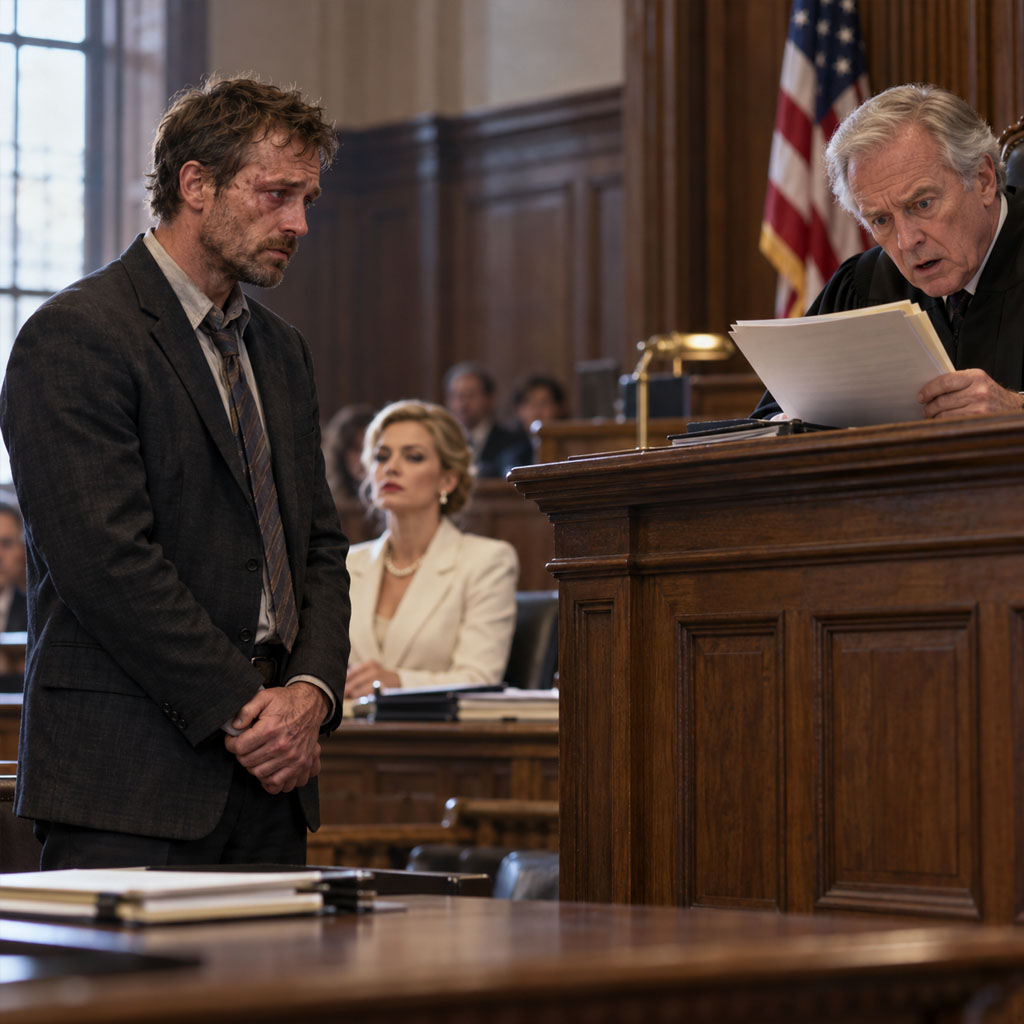
The judge had just called me a nobody when the court clerk opened my old file and went pale. Within minutes, that same judge would stand before me, trembling, and address me as “Sir.” But at that moment, sitting alone in a borrowed suit while my wealthy in-laws watched me with satisfaction, I had no idea that a forgotten piece of my childhood was about to change everything.
Chapter 2
Nobody moved as Judge Coleman rose from his chair. The attorneys exchanged bewildered looks, and Margaret Whitmore’s smile disappeared for the first time since I’d known her. I couldn’t understand what had happened because the page the clerk showed him contained nothing more remarkable than an old case number from my childhood.
The judge ordered a recess and led me down a narrow hallway. His chambers smelled of coffee and old books, and there was a framed child’s drawing hanging behind his desk. The moment I saw it, I stopped breathing.
It showed a blue lake, a diver beneath the water, and a small figure holding a rope at the surface. Above the picture, written in crooked letters, were the words “SOMEBODY WHO STAYS.” I remembered drawing it when I was ten years old, though I hadn’t seen it in nearly three decades.
“Where did you get that?” I asked.
Judge Coleman lowered himself into a chair. He seemed twenty years older than the man who’d insulted me in the courtroom. “You gave it to me, Daniel,” he said quietly. “When your last name was Harris.”
I stared at him, searching the lines of his face.
Then I remembered.
At ten, I’d lived with a father whose temper could turn an ordinary evening into a nightmare. After he put me in the hospital, a young public defender tried to convince the court that sending me home would be dangerous. That attorney wore cheap suits, crooked ties, and had a nervous habit of rubbing his forehead when he spoke.
“You were my lawyer,” I said.
He nodded.
“I was thirty-one, fresh out of law school, and I thought being right was enough to win a case,” he told me. “Your father had completed counseling and convinced the judge he’d changed. I argued against returning you to him, but I lost.”
I remembered waiting outside the courtroom, terrified of going home. I’d drawn that picture while the young lawyer sat beside me, trying to find something comforting to say. He’d promised to keep looking for a way to help me.
Six weeks later, I ran away.
“I searched for you,” Judge Coleman said. “By the time I found out you’d entered foster care, you’d been moved again. Eventually, the records told me you’d aged out. I kept that drawing because I never stopped wondering what happened to you.”
He pressed his hands together.
“And this morning, I sat in judgment of that same boy, now a grown man, and called him a nobody.”
For a long moment, neither of us spoke.
I wanted to be angry, but something about his expression reminded me of Walter when a difficult dive went wrong. It was the look of someone who understood the mistake but couldn’t travel backward and prevent it.
“I changed my last name after foster care,” I explained. “Carter was my grandmother’s maiden name. I wanted something that belonged to somebody who’d loved me.”
The judge nodded, then looked toward the drawing.
“I owe you an apology,” he said. “But I owe you something more important than an apology. I owe you a fair hearing.”
My heart tightened. “Does that mean you’ll reconsider everything they’ve said about me?”
“It means I cannot decide your case at all.”
He explained that our personal history created a conflict. If he ruled in my favor, the Whitmores could argue that guilt had influenced his judgment. If he ruled against me, I would always wonder whether he had tried too hard to appear impartial.
“I’ll transfer your case to Judge Helen Brooks in the neighboring circuit,” he said. “She has a reputation for examining every detail and tolerating very little nonsense.”
Then he opened another document.
“There’s something else troubling me,” he continued. “The court-appointed evaluator declared that he had no financial relationship with your wife’s family. I’m ordering a full disclosure of his professional financial connections before the next hearing.”
I thought about Dr. Leonard Price, the psychologist who’d interviewed me twice and produced a lengthy report describing me as emotionally withdrawn. He had suggested that my childhood trauma made me unreliable, and his conclusions had become the foundation of the Whitmores’ case.
“You think he lied?” I asked.
“I think we should stop guessing and start examining the evidence.”
He stood and removed the drawing from the wall. For a moment, he held it toward me, but I shook my head.
“Keep it until this is finished,” I told him. “I don’t want you to give me something because you feel guilty. I just want my son to come home because the truth finally matters.”
His eyes filled with tears.
“I believe the little boy who gave me this drawing grew into a remarkable man,” he said.
I looked away. Compliments had always made me uncomfortable, especially from people who’d seen the worst parts of my life.
Before I left, he told me the next hearing would take place in nine days.
Nine days to fight a family that had already taken nearly everything I owned.
Outside, Margaret waited beside her attorney near the courthouse steps. She approached me with her usual polished confidence, although something in her expression had changed.
“Whatever happened in there, Daniel, I hope you’re not getting unrealistic expectations,” she said. “Richard Coleman isn’t going to rescue you.”
“I don’t need rescuing,” I answered. “I need people to tell the truth.”
Her lawyer placed a hand on her elbow, and they walked away without another word.
That evening, Walter found me sitting on the dock behind his boathouse, staring at the lake. I’d told him about the judge, the drawing, and the transfer, but he seemed more interested in the nine days we had left.
“Then we’d better use them,” he said.
We started with the companies that had bought my house and business. I’d never questioned the buyers because the offers had come when I desperately needed money. Walter suggested searching the public corporate records, and I spent the next two days at the county library using an old computer.
What I discovered made my stomach turn.
The company that purchased my house had been created three days before Rebecca left me. Another company, formed that same afternoon, had bought my business. Both used the same registered agent, who happened to be the Whitmores’ attorney.
The property deed contained one more surprise.
The authorized buyer’s signature belonged to my father-in-law, Charles Whitmore.
They hadn’t simply taken advantage of my financial desperation. They had prepared for it before Rebecca ever walked out.
On the seventh day, the court-ordered disclosure from Dr. Price arrived. It showed that the Whitmore Family Foundation had provided his practice with a thirty-eight-thousand-dollar research grant. The final payment had cleared just days before he was appointed to evaluate me.
Walter studied the paperwork under the yellow light in his boathouse.
“They paid the fellow who said you weren’t fit to raise Ethan,” he muttered. “And then they bought your house when you couldn’t afford to defend yourself.”
I nodded, but my mind kept returning to the photograph from the marina.
“We still need to prove Ethan wasn’t alone,” I said.
Walter leaned forward.
“Claire,” he replied. “That nanny was standing beside him. And I remember something else. She was recording a video that afternoon.”
I looked up sharply.
Walter’s expression turned serious.
“Daniel, if that video still exists, everything they built this case on could fall apart.”
Chapter 3
I found Claire Morgan working at a roadside diner nearly two hours north of town. She was carrying a coffeepot when she spotted me through the window, and the color drained from her face. By the time I reached the entrance, she’d stepped outside, trembling.
“I can’t get involved,” she said before I could speak. “Mrs. Whitmore made me sign an agreement when they fired me. She said I’d owe fifty thousand dollars if I discussed anything about their family.”
I explained that a court could require relevant testimony regardless of what Margaret had threatened. Claire looked toward the diner, where customers were waiting for refills. She was twenty-six, living paycheck to paycheck, and clearly frightened.
“I never wanted to hurt you or Ethan,” she whispered.
“I know,” I said. “I only want the truth about that afternoon.”
She wiped her eyes and told me she’d recorded a short video at the marina. Rebecca had asked her to send occasional updates while Ethan was with me, so she’d filmed him eating his sandwich while Walter stood nearby. Claire had sent the recording to Rebecca’s phone, but the message had never been opened.
“I kept the original,” she said. “Something about the way Mrs. Whitmore acted afterward didn’t feel right.”
When she showed me the video, I almost cried.
There was Ethan, smiling from my truck’s tailgate with a sandwich in one hand. Claire’s voice could be heard behind the camera, and Walter appeared clearly in the background, watching the dock. The video showed exactly what I’d been saying since the beginning.
My son had never been abandoned.
Claire agreed to testify if the court required her presence. I thanked her, then drove back to Walter’s boathouse with the first real hope I’d felt in months.
The hearing began on a cold October morning. Judge Helen Brooks was a small woman with silver-rimmed glasses and a voice that made everyone pay attention without ever becoming loud. She had read the entire file, including my newly submitted documents.
The Whitmores’ attorney objected immediately, arguing that I had filed evidence improperly because I was representing myself. Judge Brooks examined the documents, confirmed they were properly submitted, and admitted them. Then she looked at me.
“Mr. Carter, you may call your first witness.”
Walter walked to the stand wearing a freshly ironed shirt. He explained his decades of experience supervising commercial divers and described exactly where everyone had been during the marina job. He told the court that Ethan had remained in sight of both adults throughout the afternoon.
“That boy was never alone,” Walter said firmly. “I was close enough to hear him ask for another sandwich.”
The attorney tried suggesting that Walter couldn’t supervise a child while monitoring my diving line. Walter gave him a patient look.
“Son, I’ve spent forty years watching two things at once,” he replied. “If I couldn’t manage that, Daniel wouldn’t be sitting here today.”
A few people smiled, but Judge Brooks remained serious.
Next came Claire.
She entered nervously, holding her subpoena so tightly that the paper had creased. Margaret shifted in her chair as Claire described being dismissed shortly after the petition was filed.
Then I showed her the photograph used against me.
“Do you recognize this picture?” I asked.
“Yes,” she answered. “It was taken at the marina. But I’m standing just outside the left edge. You can even see part of my blue sleeve.”
She explained that the picture had been cropped to exclude the adults supervising Ethan.
I then asked permission to introduce her original video and the message showing when it had been sent. Judge Brooks examined the information and allowed the recording to be played.
The courtroom monitor flickered.
Suddenly, Ethan’s little face filled the screen.
“Hi, Mommy!” he called cheerfully. “Daddy’s fixing the dock!”
He lifted a shell toward the camera. Behind him, Walter waved, and Claire laughed as she reminded Ethan not to drop his sandwich.
The recording lasted barely half a minute.
But those thirty seconds destroyed months of accusations.
When the screen went dark, Judge Brooks turned toward Rebecca.
“Mrs. Carter, were you aware this video existed?”
Rebecca’s lips trembled. “No, Your Honor.”
“Yet it was sent directly to your phone.”
Rebecca took out her phone with shaking hands. After a moment, she looked up, tears rolling down her cheeks.
“It’s there,” she whispered. “It was delivered that afternoon. I never opened it.”
Margaret leaned toward her.
“Rebecca, darling, remember what we discussed.”
Rebecca turned sharply.
“Stop it, Mom.”
The entire courtroom went silent.
Rebecca stood, gripping her phone.
“My mother told me Daniel left Ethan alone for an hour,” she said. “She showed me that picture and said Claire wasn’t there. She told me Daniel’s job made him dangerous and that I had to protect our son.”
Margaret stared straight ahead.
“I believed her,” Rebecca continued. “I was exhausted, and our marriage was struggling. Mom kept saying Daniel would never choose us over his work. Eventually, I started believing that too.”
She looked at me.
“I signed the petition without reading all of it. I didn’t know they were trying to take everything from him.”
My throat tightened as I watched her struggle to speak.
“I want my signature withdrawn from those accusations,” she told the judge. “And I want Daniel to know I’m sorry.”
Judge Brooks allowed Rebecca to finish before directing her to sit down. She made it clear that changing her position did not erase the need to examine what had happened. Then she asked me whether I had additional witnesses.
I did.
Dr. Leonard Price took the stand with the same calm expression he’d worn during my evaluation. I asked him about the research grant from the Whitmore Family Foundation, and his composure began to crack.
“That grant was unrelated to this custody matter,” he insisted.
“Was Margaret Whitmore chairwoman of the foundation when the money was approved?” I asked.
“Yes.”
“And did you disclose that relationship when you accepted the appointment to evaluate me?”
He hesitated.
“No, but I didn’t believe it created a conflict.”
I handed him a copy of his earlier sworn statement.
“You said you had no financial relationship with anyone connected to the case,” I reminded him.
The judge leaned forward.
“Doctor, please answer the question.”
His voice became very quiet.
“No. I did not disclose the grant.”
I had one final witness.
Charles Whitmore approached the stand looking as though he’d aged ten years in a single morning. He’d rarely spoken during family gatherings and had spent most of his marriage allowing Margaret to make the important decisions.
I showed him the documents proving that two companies connected to his family had purchased my house and business.
“Is that your signature on the property deed?” I asked.
“Yes.”
“Did you know those companies were formed before Rebecca left our home?”
Charles stared at the document.
“I knew Margaret wanted to establish some family holding companies,” he said. “I didn’t understand what they were buying.”
“Did you know they bought the property and equipment I sold to pay my legal expenses?”
He looked toward his wife.
For the first time, I saw something in his face that resembled anger.
“Margaret told me she was protecting Ethan’s future,” he said. “She handled the details. She always handles the details.”
“Did you ever read the papers before signing them?”
Charles lowered his head.
“No.”
Judge Brooks looked over her glasses.
“Mr. Whitmore, signing documents without reading them doesn’t eliminate responsibility for what those documents accomplish.”
He nodded slowly.
Then he said something I hadn’t expected.
“I understand that now, Your Honor. And I’m ashamed.”
Chapter 4
Judge Brooks spent nearly an hour reviewing the exhibits and testimony before delivering her findings. Nobody spoke during that time. Margaret sat perfectly straight, staring at the front wall, while Rebecca cried quietly into a tissue.
The judge concluded that the photograph had been misleadingly cropped and that the psychological evaluation was compromised by an undisclosed financial relationship. She also found substantial evidence that the property transactions had been arranged to exploit my mounting legal expenses.
“This court has an obligation to protect children,” she said. “It also has an obligation to ensure that those protections are not manipulated for personal control or financial advantage.”
I sat with my hands clasped so tightly they hurt.
Judge Brooks ruled that the evidence did not support the claims that I had endangered Ethan. She restored my custodial rights and ordered that his primary residence be with me, with Rebecca receiving regular parenting time. Margaret and Charles would have no independent custodial authority.
Then the judge addressed the financial damage.
The Whitmores were ordered to reimburse the legal expenses and other documented costs associated with the misconduct. The judge also directed further proceedings concerning the two property transactions, which had been designed to weaken my ability to defend myself.
Separate investigations were referred to the appropriate professional authorities regarding Dr. Price’s disclosure and the attorneys’ involvement. Judge Brooks made clear that those matters would receive independent review rather than being decided by accusations alone.
By the end of the hearing, I had won the right to bring my son home.
Yet the moment I remember most clearly came after the judge finished speaking.
Rebecca approached me in the hallway, still wearing the pale cardigan her mother had bought for her. She looked frightened, ashamed, and strangely relieved.
“I should have trusted you,” she said. “I should have opened that message.”
I wanted to tell her how many nights I’d spent wondering whether Ethan thought I’d abandoned him. I wanted to explain how it felt to sell our house and everything I’d worked for because someone with more money had decided I didn’t deserve to be a father.
Instead, I looked at the woman I’d once loved and saw someone who had finally begun thinking for herself.
“You should have asked me,” I said gently. “You should have asked Walter or Claire. You didn’t have to believe everything your mother told you.”
Rebecca nodded, crying harder.
“I know.”
For a moment, I considered telling her that she’d destroyed our marriage. But I realized there was no need. We both knew it, and saying it wouldn’t make either of us better parents.
“Ethan still needs his mother,” I said. “Whatever happened between us, I’m not going to make him choose who he loves.”
She pressed her hands against her mouth.
“Thank you,” she whispered.
I shook my head.
“Don’t thank me. Just make sure he never has to stand between us again.”
The weeks that followed were filled with paperwork, difficult conversations, and the slow process of rebuilding a life that had nearly disappeared. The property proceedings eventually resulted in the return of our house and my diving equipment, while the reimbursement allowed me to reopen my business. Walter helped me get the workboat running again, grumbling about how much maintenance I’d neglected while fighting in court.
Margaret resigned from the Whitmore Family Foundation after the investigations became public. Charles moved out of their estate and began trying to repair his relationship with Rebecca. I didn’t know whether either grandparent would ever truly understand what they’d done, and I stopped wasting my energy trying to make them.
What mattered was Ethan.
He came home on a Friday afternoon in November.
The porch swing was still hanging where I’d installed it years earlier. The tomato plants were gone, and the grass needed cutting, but the house still smelled faintly of old wood and the lemon cleaner Rebecca used to buy.
Ethan climbed out of Rebecca’s car wearing his favorite little rubber boots. He stood on the sidewalk for a moment, looking at me as though he needed to be certain I was real.
Then he ran.
I dropped to my knees just as he threw his arms around my neck.
“Daddy, are we staying here?”
I held him so tightly that I had to remind myself to loosen my grip.
“Yes, buddy,” I whispered. “We’re home.”
He pulled back and studied my face.
“Grandma said you couldn’t take care of me because you didn’t have a house anymore.”
I swallowed hard.
“Sometimes grown-ups say things that aren’t true,” I told him. “But I never stopped being your dad, even when we couldn’t be together.”
Ethan thought about that for a moment.
“Can we sit on the swing?”
We sat together as the afternoon faded, and he told me about school, his friends, and a science project involving a model volcano. I listened to every word. After months of courtrooms and accusations, those ordinary stories felt like gifts.
Then he reached into his jacket pocket and pulled out a short piece of yellow rope.
“I kept practicing,” he announced.
He looped the rope carefully, passed the end around, and tied a perfect bowline.
“Where does the rabbit go?” he asked.
“Up the hole, around the tree, and back down.”
He grinned.
“And who holds the rope?”
My eyes burned.
“Somebody who stays.”
Ethan leaned against my shoulder.
“I knew you’d come back, Daddy.”
I kissed the top of his head and held him while the porch swing moved gently beneath us.
A month later, I returned to the courthouse with Ethan. Judge Coleman had retired, but the silver-haired clerk, Mrs. Dawson, had agreed to meet us outside his old chambers.
She handed me a package wrapped in brown paper.
“Judge Coleman asked me to give you this when everything was settled,” she explained. “He said you’d understand.”
Inside was the drawing I’d made when I was ten.
The crayon lake had faded, and the paper was yellow around the edges. Someone had carefully repaired the old fold and placed it in a new frame.
On the back, in the judge’s handwriting, were the words:
“For the boy I couldn’t protect, and the father who never stopped protecting his own.”
I stood in that courthouse hallway for a long time.
For most of my life, I’d believed that being unwanted as a child had left something missing inside me. I’d worked hard, built a business, and tried to become the father I never had. But when the Whitmores took everything away, I’d started wondering whether they were right about me.
Maybe I really was unstable. Maybe I’d never be good enough. Maybe people like Margaret always won because they knew how to turn money into power and power into truth.
Then I’d seen that drawing.
A young lawyer had kept it for nearly thirty years, not because it was valuable, but because the frightened boy who made it had mattered to him.
Sometimes one person remembering that you mattered can change how you see your entire life.
Ethan slipped his hand into mine.
“Who’s the picture for, Daddy?”
“For us,” I answered. “And for somebody who tried to help me when I was little.”
“Did he help?”
I considered the question.
“He tried,” I said. “And sometimes trying matters, even when things don’t work out the way we want.”
That evening, we hung the drawing above Ethan’s bed. He stood back and examined it carefully, studying the little figure beneath the blue water and the smaller figure holding the rope.
“That looks like you,” he said, pointing at the diver.
I smiled.
“It does, doesn’t it?”
He pointed to the figure at the surface.
“Then that’s me.”
I looked at the drawing again, seeing it differently than I ever had before.
“Maybe it is,” I told him.
Ethan climbed into bed, and I tucked the blankets around him. Before turning off the light, he asked whether we could go fishing with Walter on Saturday. I promised we would if the weather was good.
As I reached the doorway, he called after me.
“Daddy?”
“Yeah, buddy?”
“You don’t have to worry about somebody holding your rope anymore.”
I turned around.
He was sitting up in bed, smiling.
“I’ll hold it for you.”
I crossed the room and hugged him again, unable to speak for several seconds.
All those months, I’d believed I was fighting to prove I deserved to be his father. But standing there, holding my little boy beneath a drawing made by another frightened child, I finally understood something.
Love wasn’t measured by how much money you had, the size of your house, or how important people thought you were. It was measured by the promises you kept when keeping them cost you something.
I had lost my savings, my home, my business, and nearly my hope. But I had refused to let go of the one person who needed me most.
And somehow, through all that darkness, I’d found something I thought childhood had taken from me forever.
A place where I belonged.
The next morning, Ethan and I ate pancakes at our kitchen table while sunlight filled the windows. There were bills to pay, boats to repair, and years of ordinary work ahead of us. Our lives weren’t perfect, and I knew there would be difficult days.
But when Ethan reached across the table and took my hand, I understood that I no longer needed to prove my worth to anyone who measured people by their possessions.
I was his father.
And I was staying.