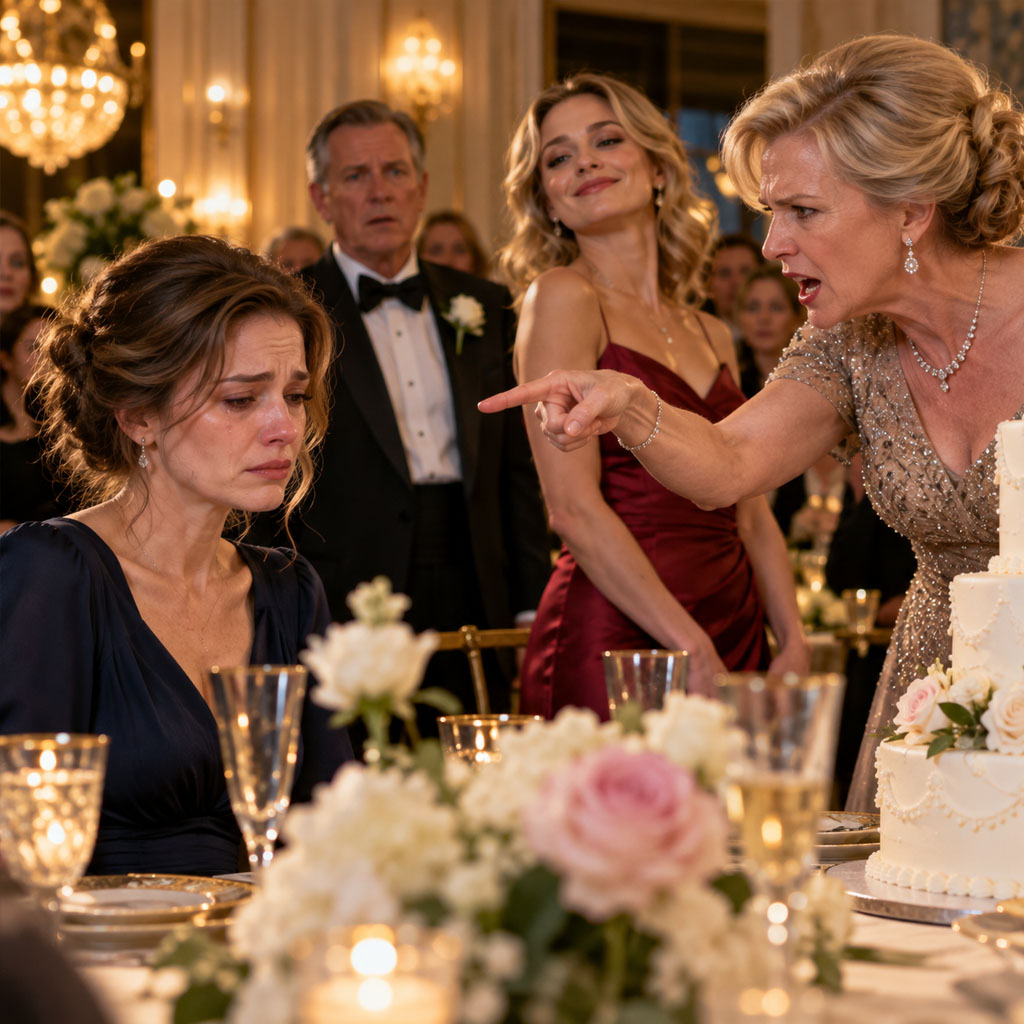
“You’ll never be half the daughter your sister is!” my mother announced in front of a hundred guests at her fortieth wedding anniversary celebration. The room went so quiet I could hear the ice settling in someone’s glass. My younger sister, Stacy, stood beside the anniversary cake wearing the same satisfied smile she had worn whenever somebody praised her for work I had done.
Chapter 2
I rented a furnished apartment in Canton overlooking the harbor. It had one bedroom, a narrow kitchen, and windows that caught the afternoon sunlight. For the first time in fifteen years, I had a home where nobody called my name from another room demanding something.
The following morning, I returned to Oldham Street while my parents were at church. Stacy was waiting in the kitchen, arms crossed, looking irritated.
“Mom says you’re being ridiculous,” she announced. “Everybody knows she didn’t mean it.”
“She meant every word.”
“Don’t make this complicated, Sophia.”
I placed a blue spiral notebook on the table.
“Everything you need is in here. Bills, appointments, repair companies, insurance information, and the church schedule. Since you do everything for Mom and Dad, you should have no trouble.”
Stacy flipped through the pages.
“Good grief. It’s just housework.”
“Then you’ll manage beautifully.”
I took Grandma’s old wooden scrub brush from its hook beside the back door and placed it in her hand.
“Saturday mornings start at seven.”
She stared at the brush as though it were a dead animal.
“You’ve always had more free time than me.”
I picked up my suitcases.
“Not anymore.”
That first Saturday, I woke before sunrise and nearly drove to my parents’ house out of habit. Instead, I made coffee in Grandma’s old copper pot and watched the harbor wake up. My coffee stayed hot all the way to the bottom of the cup.
It seemed like such a small thing.
But I cried anyway.
Within two weeks, the phone calls began. Mom said the laundry was piling up, Dad had missed an appointment, and Stacy couldn’t figure out the online banking. Then the church secretary asked whether I was still preparing the Easter cookies.
I politely redirected every question to Stacy.
My mother left thirty-one messages.
“Your father isn’t getting any younger, Sophia. I hope you’re proud of yourself.”
For once, I didn’t answer.
Instead, I called Mark.
We met at a diner near the high school where he still taught. He had gray at his temples now and a wedding band on his left hand. His phone displayed a picture of two smiling children.
Seeing them hurt in a way I hadn’t expected.
But I hadn’t come to discuss the life he had built without me.
“Mark, fifteen years ago, who told you I’d chosen my parents over our marriage?”
He looked down at his coffee.
“Your mother called me.”
I gripped my mug.
“What did she say?”
“She said you couldn’t bear to tell me yourself. She said you’d decided to stay because your father needed you, and I should stop making things difficult.”
“I never asked her to call you.”
Mark closed his eyes.
“I know that now. Katherine told me what happened at the anniversary party.”
“Why didn’t you ask me?”
He looked miserable.
“You’d been gone almost a year, Soph. Every time I asked when you were coming home, you said soon. Eventually, I believed what your mother told me.”
Neither of us spoke for a while.
“I should have fought harder,” he finally said.
“So should I.”
We parted outside the diner with a quiet embrace. I didn’t want his marriage or his family disrupted, and he couldn’t return the years we had lost. But I left knowing that my mother had deliberately interfered with the most important relationship of my life.
I had spent fifteen years believing I had been abandoned.
Now I understood how carefully my mother had arranged for me to remain available.
By Christmas, the marble steps on Oldham Street had turned gray. The neighbors noticed, and Mom was furious about the embarrassment. Stacy had tried hiring a cleaning service, but Mom refused to allow strangers to do what she considered a daughter’s responsibility.
Meanwhile, Zoe visited my apartment with exciting news.
She had been accepted to Maine Maritime Academy.
I hugged her so tightly she squealed.
“Aunt Sophia, you’re crushing me!”
“That’s because I’m proud of you!”
We celebrated with homemade hot chocolate while she talked about ships, navigation, and the Atlantic coast. She had saved enough money from summer jobs at a seafood restaurant to pay her enrollment deposit.
Then her smile faded.
“Mom says maybe I should start at community college instead. Grandma’s getting older, and everybody needs help.”
My stomach tightened.
“What do you want, sweetheart?”
“I want to go to Maine.”
“Then don’t forget that.”
A few weeks later, the home security company called me at two in the morning because Dad had forgotten the alarm code. I told them to change the primary contact to Stacy. The next day, Stacy called to complain that I had made her miss an appointment with a real estate client.
“You could have handled one little phone call,” she snapped.
“So can you.”
I hung up.
Soon afterward, I visited the church hall and found my name still listed for the Easter baking. I asked Helen, the parish secretary, to replace it with Stacy’s.
Helen studied the list.
“Are you sure, honey?”
“Mom says Stacy does everything. It’s time the church schedule reflected that.”
Helen remembered the anniversary dinner. She picked up a marker and wrote Stacy’s name over mine.
I thought that would settle the matter.
But one Saturday in March, while driving through my old neighborhood, I saw somebody kneeling on the marble steps.
The person wore an oversized winter coat and had a bucket of steaming water beside her.
It was Zoe.
She was using Grandma’s worn wooden brush, moving it back and forth in the same tired rhythm I remembered from childhood.
I parked and hurried over.
“Zoe! What are you doing?”
She looked up with a nervous smile.
“It’s okay, Aunt Sophia. It only takes forty minutes.”
Her hands were red from the cold.
“Your mother told you to do this?”
“She’s busy with work. Grandma needs help, and I’m young. Besides, I probably won’t go to Maine this year.”
I crouched beside her.
“Why not?”
She shrugged.
“Mom says I have plenty of time. I don’t have children or anything important keeping me busy.”
The words struck me like a physical blow.
I had heard them before.
Twenty years earlier, my mother had said almost exactly the same thing when she called me away from the life I was building.
I looked at the brush, the bucket, and my niece’s exhausted face.
The family hadn’t changed.
It had simply found another woman willing to kneel.
Chapter 3
I went straight to one of Stacy’s open houses that afternoon. She was showing a beautifully renovated rowhouse near Patterson Park, smiling at prospective buyers while pretending not to notice me. I waited until the visitors left before confronting her.
“Zoe was scrubbing the steps this morning.”
Stacy rolled her eyes.
“She’s helping her grandparents.”
“She has schoolwork, college plans, and a future of her own.”
“Don’t lecture me about my daughter.”
“Then stop making her responsible for a house full of adults.”
Stacy slammed a cabinet door.
“You walked away, Sophia. Somebody has to do what you abandoned.”
I looked at her carefully.
“Where did Zoe learn to say she has plenty of time because she doesn’t have children?”
Stacy looked away.
She started rearranging decorative lemons in a wooden bowl on the kitchen counter.
I suddenly understood that her silence was an answer.
That night, I nearly packed a suitcase and returned to my parents’ house. It would have been easy to take the brush away from Zoe, resume the chores, and keep everyone comfortable.
But that would only teach her that the oldest available woman must always sacrifice herself.
Instead, I decided Zoe deserved to know the truth and choose her own future.
On Palm Sunday, Dad unexpectedly sat beside me at church. During the service, he handed me a small cross he’d made from a palm leaf.
Afterward, he mentioned receiving some paperwork from his pension office.
“Stacy said you’d know what to do,” he admitted.
“Dad, you’re perfectly capable of reading a form.”
He studied me.
“Suppose I am.”
It was the closest he had come to acknowledging my absence.
The following Saturday, Katherine asked me to visit her house across the street. She was seventy-eight, sharp-eyed, and surrounded by photographs of our neighborhood going back half a century.
From her front window, we could see Zoe cleaning the marble steps.
Katherine watched her in silence.
“When your mother told me she’d called Mark, I praised her,” she finally confessed. “I said a good mother keeps her daughter close.”
I stared at her.
“You knew?”
“I knew she’d interfered. I didn’t understand what it would cost you.”
She pressed a trembling hand against her coffee cup.
“I watched your grandmother treat Stella that way. Then I watched Stella treat you the same. Now I’m watching it happen to Zoe.”
“What are you going to do?”
Katherine looked toward the street.
“What I should have done years ago.”
At Easter dinner in the church hall, the ladies thanked Stacy for another successful holiday fundraiser. Twenty dozen golden cookies sat on silver trays, arranged exactly as I had arranged them for fifteen years.
Stacy rose to accept the applause.
Katherine stood before she could speak.
“Those cookies were made by Zoe,” she announced. “And before this year, Sophia made them for fifteen years. Sophia also cleaned the steps, managed the house, arranged the medical appointments, and paid for repairs.”
A hush spread through the room.
Katherine looked directly at my mother.
“I watched three generations of women sacrifice their lives to prove they were good daughters. I’m ashamed that I praised it instead of questioning it.”
Stacy sat down hard.
Mom’s face tightened with fury.
That evening, Stacy arrived at my apartment.
She pushed past me, still wearing her Easter dress.
“You humiliated me!”
“I didn’t ask Katherine to say anything.”
“You’ve wanted everyone to feel sorry for you for years!”
I remained beside the open door.
“Why did you put Zoe in my place?”
Stacy’s expression changed.
“Because I can’t do everything!”
“Neither could I.”
She laughed bitterly.
“You stayed because you wanted to. Nobody forced you.”
Then she said something that made my blood run cold.
“Mom asked me to move in when Dad had his heart attack. I told her to call you instead.”
I stared at her.
“You suggested me?”
“I had a baby! My marriage was struggling! You didn’t have children, and your job was flexible.”
I remembered hearing Zoe crying in the background during Mom’s call all those years ago.
Stacy wiped her face.
“I was twenty, Sophia. I didn’t know you’d stay fifteen years.”
“But you never offered to take over.”
She looked away.
“Zoe will start community college. She can go away later.”
I took a slow breath.
“She has until April thirtieth to accept her place in Maine. You’re going to tell her what really happened.”
Stacy shook her head.
“Don’t you dare interfere in my family.”
“She’s part of mine, too.”
After she left, I sat awake until morning.
I loved Stacy despite everything. I had helped raise her, watched her take her first steps, and comforted her through childhood disappointments. But loving my sister didn’t mean helping her repeat the same injustice with her daughter.
I sent her a message giving her until Zoe’s enrollment deadline to explain the situation honestly.
She never answered.
Instead, Mom called to accuse me of threatening the family.
“Your father’s blood pressure is high enough already,” she complained. “If something happens to him, you’ll have yourself to blame.”
I looked out at the harbor.
“Mom, I’m not responsible for every problem in that house.”
She hung up.
The weeks passed.
Zoe began spending school nights at her grandparents’ home. Her college deposit remained unpaid. She told me she was thinking about postponing her plans because Grandma needed company.
I asked her one question.
“What do you want?”
After a long pause, she admitted, “I still want to go.”
On April thirtieth, I drove to Oldham Street shortly before midnight.
Zoe came outside wearing sweatpants and her grandfather’s old sweater. She carried her laptop, looking confused and worried.
“Is Grandpa okay?”
“He’s fine. Sit with me, sweetheart.”
We sat on the marble steps where I had spent so much of my life.
I told her about Grandma Anna, my parents’ first marriage, and the little apartment Dad had once tried to give us. I explained how Mom had been taught that a good daughter proved her love by surrendering her own dreams.
Then I told her what happened to my marriage.
I didn’t exaggerate, and I didn’t ask her to hate anyone.
I simply told the truth.
Zoe began crying.
“Mom really said you had more time because you didn’t have children?”
“Yes.”
“And that’s why you came home?”
“That’s why I came. I stayed because I kept believing that if I did enough, somebody would finally appreciate me.”
She stared at her hands.
“Grandma says I can go to college later.”
“I know.”
“Would I be selfish if I went now?”
I took her hand.
“No, sweetheart. Going to college isn’t abandoning your family.”
She opened her laptop.
The enrollment page was still waiting.
Her payment deadline was eight minutes away.
Zoe had saved the money herself. I watched while she entered her information and submitted the deposit.
A confirmation appeared on the screen.
She covered her mouth and started laughing through her tears.
“I did it.”
I hugged her.
“Yes, you did.”
Across the street, a curtain moved in my parents’ front window.
Mom had been watching.
For once, I didn’t care whether she approved.
Chapter 4
The following Sunday, Dad invited Katherine, Zoe, and me to dinner. He had purchased a bakery cake decorated with blue letters that read, “Congratulations, Zoe!” Stacy wasn’t there when we arrived, and Mom stood beside the dining room table looking as though she hadn’t slept.
“We shouldn’t celebrate a girl leaving her family,” she announced.
Dad put down the silver cake knife.
“Stella, sit down.”
Mom looked startled.
He waited until she obeyed.
“Zoe is going to school,” he said. “She’s not abandoning anybody.”
Mom turned toward my niece.
“You have no idea what your aunt gave up for us. You’ll never be half the—”
“Stop.”
Dad’s voice was quiet but firm.
Mom froze.
“That’s what your own mother said to you, Stella.”
The room fell silent.
Dad looked at the old silver knife.
“Easter morning, 1977. I came to get you and Sophia. Your mother stood in that doorway and told you that Georgia was a better daughter because she sent money home. She said you’d never be half the daughter your sister was.”
Mom stared at him.
“You remember that?”
“I remember every word.”
He swallowed.
“You kept scrubbing those steps, and I drove away. I told myself you’d made your choice, but I should have stayed and fought for our family.”
Katherine nodded slowly.
“I heard it from across the street.”
Dad turned toward me.
“And forty years later, your mother said almost the same thing to Sophia.”
My mother lowered her eyes.
For the first time in my life, she looked old rather than powerful.
Dad opened the blue notebook Stacy had returned to the house. He had spent the previous evening reading every page.
“Seven hundred eighty Saturdays,” he said quietly. “Twenty dozen cookies every Easter. Sixty-eight cardiology appointments. Every bill, every repair, every insurance form.”
He turned another page.
“Fourteen thousand dollars for the roof in 2019.”
I looked down.
I had taken that money from my savings because Dad’s pension hadn’t covered the expense. Mom had told everyone Stacy had arranged the repairs.
Dad closed the notebook.
“Why didn’t you tell me?”
“Would you have listened?”
He opened his mouth, then closed it again.
Finally, he nodded.
“Maybe not.”
Tears gathered in his eyes.
“I’ve been a coward, Sophia. I let your mother make every family decision because it was easier than arguing. And I let you carry the consequences.”
Mom began crying.
“I only wanted my children close.”
I looked at her.
“You wanted us available, Mom. That’s different.”
She pressed a tissue to her mouth.
“I gave up my own dreams for my mother.”
“I know. But you didn’t have to make me give up mine.”
The words stayed between us.
Dad reached for Zoe’s hand.
“You’re going to Maine,” he told her. “And I’m going to help with your expenses. Your grandmother and I can learn to manage our own house.”
Zoe smiled through her tears.
“Thank you, Grandpa.”
“And those steps,” he added, “are getting cleaned by somebody we pay.”
Katherine gave a satisfied nod.
“About time.”
My mother didn’t apologize that afternoon. I think admitting the truth frightened her more than losing control. She had spent nearly her entire life believing sacrifice was the only respectable way for a woman to love her family.
But the silence that followed was different from the silence I remembered as a child.
Nobody demanded that I fix it.
Over the summer, Dad learned to manage his medications, review his bills, and schedule his own appointments. He occasionally called to ask questions, but he no longer expected me to do everything for him.
One morning, a neighbor saw a cleaning contractor scrubbing the marble steps.
Dad opened the front door and called out, “I pay him fair and square! That’s how it should’ve been all along.”
The story traveled through the neighborhood by lunchtime.
Mom resigned as president of the church women’s committee in June. She still attended services, but she stopped making speeches about how daughters should honor their parents.
Stacy barely spoke to me.
I regretted that distance, although I understood why she resented me. For fifteen years, she’d received praise without carrying the burden. When I stopped accepting the arrangement, she had to confront how much she’d benefited from it.
Zoe continued loving her mother, but she no longer accepted every demand without question. Their relationship became strained for a while, then slowly began to improve.
Stacy eventually agreed to drive her daughter to Maine with Dad.
It wasn’t a complete reconciliation, but it was a beginning.
The morning of Zoe’s departure arrived in August.
I drove to Oldham Street and found Dad loading suitcases into his Buick. The marble steps were sparkling white, and a man carrying a bucket was walking toward his truck.
Dad handed him some cash.
“Thanks, Mike. See you next Saturday!”
Then he turned and winked at me.
“See? An old dog can learn a new trick.”
I laughed.
Zoe came rushing out of the house and wrapped her arms around me.
“Aunt Sophia, I’m really doing it!”
“You certainly are, Captain.”
“Not a captain yet.”
“Give it time.”
She held on a moment longer.
“Thank you for not making the decision for me.”
I kissed her forehead.
“It was always your decision, sweetheart.”
Stacy arrived carrying a cooler of sandwiches for the drive. She glanced at me but said nothing. As she climbed into the back seat, I noticed she had packed Zoe’s favorite cookies.
Mom appeared in the doorway.
She hugged Zoe and whispered something I couldn’t hear. Then she stepped back into the house without coming outside.
Dad spread a road map across the passenger seat while Zoe settled behind the wheel. She rolled down her window and grinned.
“Hey, Aunt Sophia! No more scrubbing steps on Saturdays, right?”
“Not unless you volunteer for it.”
“Not a chance!”
We laughed, and the Buick pulled away.
I stood on the sidewalk until their car disappeared around the corner.
For the first time, watching someone leave that house didn’t feel like losing them.
It felt like watching them become free.
Two weeks later, I was sitting outside my Canton apartment on a warm Saturday morning. There were leaves scattered across my own front steps, along with a little dust from the street. I had no intention of cleaning them before finishing my coffee.
My phone rang.
Zoe appeared on the screen, smiling from her dormitory room in Maine.
“Aunt Sophia, look what Grandpa installed!”
She turned the camera toward a bookshelf leaning noticeably to one side.
“He swears it’s level!”
I laughed so hard I nearly spilled my coffee.
“Tell him to stick with maps.”
Zoe grinned.
“I’ve got my first morning watch tomorrow. I’m nervous, but I love it here.”
“Then you’re exactly where you belong.”
After we hung up, I sat quietly, watching sunlight move across the buildings.
Another message appeared.
It was from Mom.
“Have you been eating properly?”
I read it twice.
There was no demand, no complaint about Dad, and no reminder that something needed fixing. For fifteen years, almost every message from her had been an instruction disguised as a question.
This one was simply a question.
I typed, “Yes, Mom. Have you?”
Her reply came several minutes later.
“Yes. Your father made breakfast.”
I smiled.
A moment later, another message arrived.
“I hope you’re happy in your new place.”
I looked around my apartment. The kitchen was small, the furniture didn’t match, and the harbor wind sometimes rattled the windows. But every object belonged to me, and every hour of my day was mine to decide how to spend.
I answered, “I am.”
Then, after a moment, I added, “I hope you’re doing well, too.”
I didn’t know whether my mother and I would ever have the relationship I’d wanted. Fifteen years of disappointment couldn’t be erased by a few kind messages, and I no longer expected an apology to give me back the life I’d surrendered.
But I was willing to leave a door open.
Just not at the expense of my freedom.
That afternoon, I finally walked past the little spare room in my apartment without thinking about the yellow nursery Mark and I had once prepared. The loss still existed, but it no longer defined everything I could become.
I had started taking weekend art classes, something I’d wanted to do since high school. I had friends who invited me to dinner without asking me to cook, and neighbors who offered help without keeping score.
Most importantly, I had a niece who was sailing toward the future she’d chosen for herself.
For generations, the women in my family had mistaken endless sacrifice for love. My grandmother demanded it from my mother, my mother demanded it from me, and my sister had nearly demanded it from Zoe.
That pattern ended on a cold marble doorstep when a seventeen-year-old girl chose her own future.
I finished my coffee while it was still warm.
The steps remained dusty, and the world did not fall apart.
At fifty-two, I had finally learned something that might have saved me years of heartache if someone had taught it to me sooner.
A loving daughter can say no. A good sister can walk away. And a family that truly loves you will not require you to spend your entire life proving that you deserve a place in it.
I had handed Stacy everything Mom insisted she did so well.
But the most important thing I took back was something neither of them could ever give me.
My own life.
THE END.