The school bus driver had called me seven times before I finally answered, and what she said made me question everything I believed about my family. “Mr. Bennett, your son is safe, but I’m not taking him home. Meet me at the police station, and whatever you do, don’t tell your wife.” Before I could ask what had happened, she hung up.
Chapter 2
Detective Collins led me into an interview room while Margaret stayed with Ethan. I told her everything I knew, including how carefully I packed his backpack and how Laura had been handling it that morning. When the detective asked who knew the combination to my gun safe, my stomach twisted.
“Only Laura and me,” I answered. “The combination is Ethan’s birthday.”
She wrote that down without responding.
An hour later, Laura arrived at the station wearing the purple medical scrubs from the dental office where she worked. She rushed toward Ethan, crying dramatically, but something about his reaction disturbed me. Instead of embracing his mother, he pulled away and searched the room for me.
Laura claimed she’d only placed the thank-you card inside his backpack. She insisted she knew nothing about the gun and suggested I might have forgotten putting it there. Then she told the detective I’d been unusually stressed and forgetful lately.
I couldn’t believe what I was hearing.
Before I could challenge her accusations, Ryan Mercer walked through the station doors in his sheriff’s uniform.
Ryan was popular around town. He coached youth football, attended school fundraisers, and always smiled for photographs with local families. His older brother, Victor Mercer, owned a large gravel business that I’d helped shut down two years earlier.
As a state bridge inspector, I’d discovered that Victor’s company had illegally removed gravel from the riverbed dangerously close to the old Mill Creek Bridge. The excavation had weakened one of its support piers, forcing expensive repairs and costing Victor his mining permit.
Ryan explained that he’d received an anonymous report about a student carrying a weapon. According to him, he’d been searching for Ethan to protect the school.
Detective Collins narrowed her eyes.
“Then why did you visit Ethan’s classroom thirty-five minutes before receiving that report?”
Ryan barely hesitated.
“Routine safety check,” he replied smoothly. “Ask the principal.”
Within hours, everything turned against me.
Because I owned the gun and admitted packing Ethan’s backpack every night, county authorities treated me as the primary suspect. Laura obtained an emergency protective order. I was forced from my home, placed on unpaid leave, and charged with child endangerment.
Worst of all, Ethan was sent home with her.
I watched him leave the police station holding Margaret’s hand until Laura called him. Before getting into her car, he turned around and whispered something I couldn’t hear.
Margaret later told me what he’d said.
“Please don’t let Daddy go to jail.”
My friend Frank let me stay in an old camper near the river. He brought groceries, extra blankets, and a space heater without asking uncomfortable questions. On my second evening there, he arrived carrying the fireproof document box from my bedroom closet.
“Thought you might need these papers,” he said.
Inside were my father’s will, insurance documents, and the trust agreement he’d created for Ethan.
My father had owned 180 acres along the river, including a valuable gravel deposit. Before his death, he’d placed the property in a trust for Ethan, appointing me trustee until my son reached twenty-five.
I hadn’t examined the agreement in years.
That night, I discovered a clause that changed everything.
If I were criminally charged with harming Ethan, I would automatically be suspended as trustee. His other living parent would become the replacement.
Laura.
My hands shook as I reread the paragraph.
The following morning, I carried the documents to my attorney, Harold Price, a seventy-year-old lawyer who’d known my father for decades.
After reading the trust agreement, Harold made several calls to the county records office.
What he discovered left us speechless.
Three weeks before the gun appeared in Ethan’s backpack, Laura had signed a preliminary agreement giving a newly formed company the right to extract gravel from Ethan’s property for twenty years.
She’d signed it as acting trustee.
A position she didn’t hold.
The company was owned by Victor Mercer.
Harold removed his glasses.
“Daniel, somebody planned this before your son ever carried that gun to school.”
Suddenly, everything made terrible sense.
Victor wanted access to the gravel my father had protected. Ryan wanted revenge for his brother’s financial losses. And Laura apparently wanted a future that didn’t include me.
But Harold warned that suspicion wasn’t enough.
“We need proof,” he said. “Something a prosecutor cannot ignore.”
That afternoon, Margaret agreed to meet me behind a small grocery store.
She handed me a sheet of notebook paper containing thirty dates.
“I’ve been driving the kindergarten route past your house for months,” she explained. “On those mornings, I kept seeing Ryan’s patrol vehicle parked behind your garage.”
I stared at her.
“Why didn’t you tell me?”
She lowered her eyes.
“I thought it wasn’t my business.”
Then she told me something worse.
On the afternoon she’d found Ethan frightened on her bus, he had explained that Laura told him to keep the backpack closed until Officer Ryan came to collect his surprise.
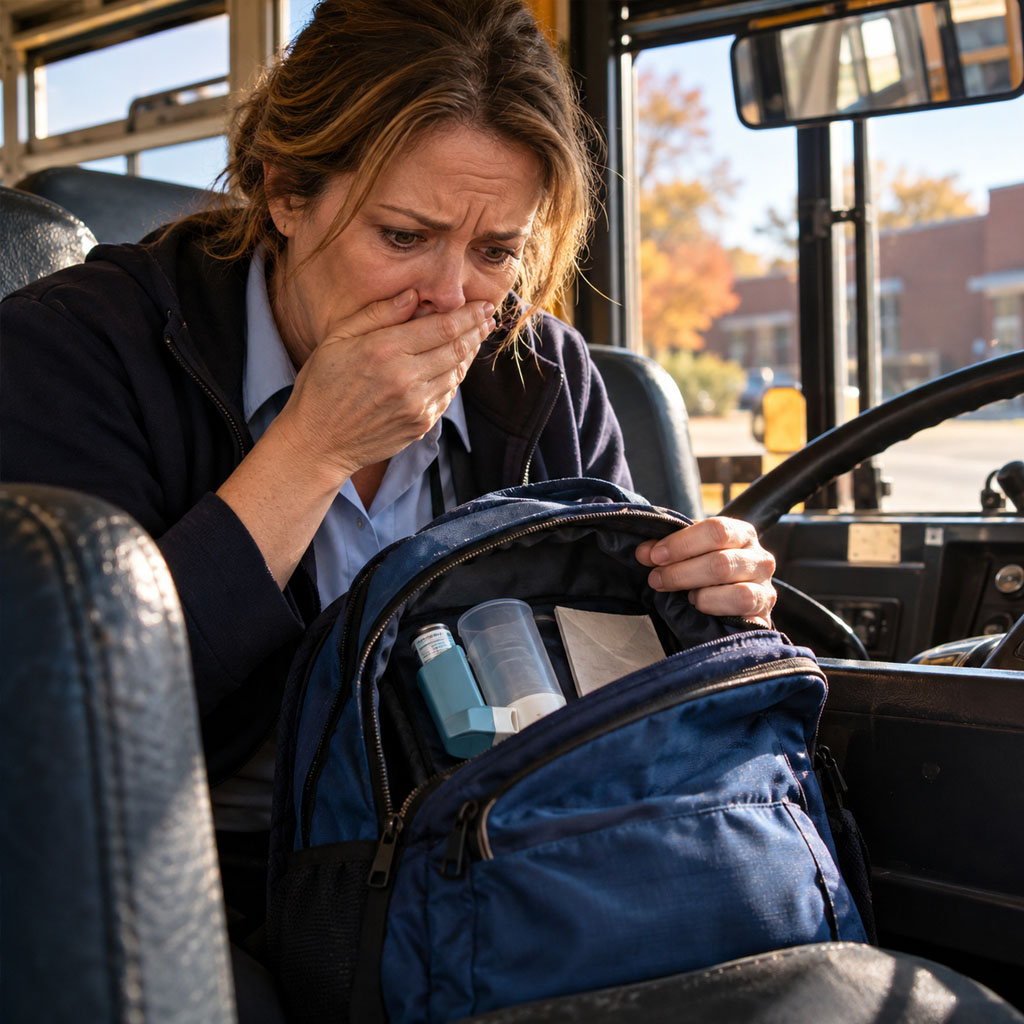
Ethan had opened the pocket only because he couldn’t find his inhaler.
Laura had removed it to make room for the gun.
That missing medication had frightened my son, but it had also disrupted whatever Ryan had planned.
For the first time, I understood why Margaret had refused to take Ethan home.
She hadn’t known the entire truth.
She’d simply recognized that sending him back might place him in danger.
Unfortunately, things were about to become much worse.
During my first supervised visit, Ethan ran across the room and wrapped his arms around my neck. We spent an hour building a miniature bridge from wooden craft sticks, something we’d done together since he was little.
Then he whispered, “Daddy, Officer Ryan eats dinner at our house now.”
I kept gluing sticks together because I couldn’t trust myself to speak.
“He sits in your chair,” Ethan continued. “Mommy says he’s helping us because you might go away.”
I swallowed hard.
“Listen to me, buddy. You haven’t done anything wrong.”
He nodded, then looked down.
“Mommy keeps my inhaler in the kitchen now. She says I’m old enough not to carry it everywhere.”
I immediately told the supervising social worker.
She promised to address the issue.
Six days later, Ethan suffered the worst asthma attack of his life.
Chapter 3
Margaret called me from the hospital that Tuesday evening. Ethan had been rushed there by ambulance after struggling to breathe at home. His inhaler had been downstairs in a kitchen drawer while he was alone in his bedroom.
I drove to the hospital, but the protective order prevented me from approaching him. I sat in my pickup at the far end of the parking lot, staring at the emergency entrance until my eyes burned.
After nearly three hours, Margaret came outside.
“He’s stable,” she said, climbing into the passenger seat. “They’ve given him breathing treatments and medication. He’s going to be all right.”
I bent over the steering wheel and cried.
Then Margaret told me Ryan had ridden in the ambulance with Ethan. When a nurse asked about the boy’s father, Ryan reportedly said I was no longer involved in his life.
Something inside me changed that night.
I stopped thinking about proving my innocence.
I started thinking about getting my son back before someone destroyed him.
The following morning, Victor Mercer visited me through a meeting arranged at the county jail after Ryan had arrested me on a suspicious ammunition charge. Ryan claimed to have found a box of bullets beneath my truck seat during a traffic stop.
I’d never seen those bullets before.
Victor offered me a simple bargain.
If I voluntarily resigned as trustee and allowed Laura to control Ethan’s property, the criminal problems could disappear. He claimed Laura would even consider a more generous custody arrangement.
“And my son?” I asked.
“He’ll be taken care of,” Victor replied.
I studied the resignation document.
“You already have a lease ready for the river property.”
Victor smiled.
“Your father wasted that land for forty years. I’m offering your boy a future.”
I remembered the weakened bridge supports, the illegal dredging, and the danger Victor’s greed had created.
“My father believed some things mattered more than money,” I said.
Victor’s smile disappeared.
“Then maybe you should think about what matters more than spending the next ten years in prison.”
I didn’t sign.
Instead, I contacted Detective Collins.
She’d continued investigating despite pressure from county officials to close the case. She showed me a copy of the anonymous school safety report Ryan claimed to have received.
It described the handgun, the purple towel, and the exact position of the thank-you card inside Ethan’s backpack.
The report had arrived before the police opened the bag.
Someone knew precisely how the items had been arranged.
“That report wasn’t sent by a concerned teacher,” Collins said. “It came from someone involved.”
But she needed stronger evidence to pursue charges against a sheriff’s deputy.
That’s when I remembered something about the Mill Creek Bridge.
For years, Frank and I had used special vibration sensors to monitor stress fractures in its steel supports. Those sensors could pick up sounds traveling through the girders, including human voices.
Even when phones couldn’t receive a signal beneath the bridge, vibrations could travel through the steel.
I explained the equipment to Collins and a state highway patrol investigator. Together with legal authorization for the recording, we arranged a meeting that would give Ryan a chance to tell the truth.
I called Victor and said I was ready to resign.
“But your brother brings the papers,” I insisted. “I want to hear him promise that Ethan stays out of this.”
Victor agreed.
We arranged to meet beneath the bridge early Saturday morning.
Before sunrise, Frank helped investigators position the recording equipment near the third support pier. Collins and the state investigator remained concealed near the southern end of the structure.
I walked alone onto the narrow inspection platform beneath the bridge.
The river moved sixty feet below my boots.
At seven o’clock, Ryan appeared.
He wasn’t wearing his uniform. He carried the resignation papers in one hand and approached me with the confidence of a man who believed he’d already won.
“Turn around,” he ordered.
He searched my jacket and pockets, checking for recording devices.
Finding nothing, he handed me the papers.
“Sign.”
I looked at him.
“Before I do, I want one answer.”
Ryan sighed.
“What now?”
“Who decided to take Ethan’s inhaler out of his backpack?”
His expression changed.
For several seconds, he said nothing.
Then he laughed.
“Laura did. She needed room for the gun.”
My heart pounded, but I kept my voice steady.
“You knew he had asthma.”
“He wasn’t supposed to need anything. The plan was simple. I visit his classroom, find the gun during a backpack check, and everybody sees me saving the school from a dangerous situation.”
He shrugged.
“Then the kid went to the nurse, and I couldn’t get near the bag. I had to send that report myself.”
I stared at him.
“And the ammunition you planted in my truck?”
Ryan smiled coldly.
“Insurance.”
He stepped closer, resting one shoulder against the steel girder.
“Victor gets the gravel. Laura gets the house and the trust. I get Laura. You get supervised visits if you’re smart enough to sign.”
I felt sick.
“You were willing to destroy a little boy’s life for a gravel pit?”
Ryan pushed the pen toward me.
“Don’t make this dramatic, Daniel. Nobody was supposed to get hurt.”
I thought of Ethan struggling for breath, alone and frightened, searching for medicine that wasn’t there.
“He almost died.”
Ryan rolled his eyes.
“He’s alive, isn’t he?”
At that moment, a faint metallic cough echoed through the steel.
Frank.
Ryan stopped smiling.
His eyes followed the girder until he spotted one of the small sensors attached near his shoulder.
He stepped backward.
“What the hell is that?”
Then he reached beneath his jacket and pulled out his handgun.
“Who’s here?”
I felt the cold railing against my back.
“State investigators,” I answered. “They heard everything.”
For one terrible second, I thought he would shoot me.
Then voices sounded from the far end of the bridge.
“Ryan Mercer! State police! Drop your weapon!”
Ryan looked toward the approaching officers.
He looked at the ladder behind him.
Then his eyes settled on the restricted section of inspection platform beyond the third pier.
A red warning ribbon blocked the walkway.
I’d placed it there myself after discovering severe corrosion beneath the metal grating.
“Don’t go that way,” I warned. “That platform isn’t safe.”
Ryan ducked beneath the ribbon.
He managed seven running steps.
On the eighth, the grating collapsed.
The sound of tearing steel echoed through the valley.
Ryan disappeared through the opening, and I heard a tremendous splash below.
I rushed toward the railing.
He surfaced in the river, gasping and struggling with one injured arm.
By some astonishing twist of fate, he’d landed in a deep pool created years earlier by his brother’s illegal dredging.
The same excavation that had almost destroyed the bridge had saved his life.
Officers reached him on the riverbank minutes later.
As they led him away, soaking wet and handcuffed, Detective Collins approached me.
“We got the recording,” she said.
I looked toward the river.
For the first time in weeks, I allowed myself to believe I might see Ethan come home.
Chapter 4
Once Ryan’s confession reached state investigators, the entire conspiracy unraveled.
A search of his personal vehicle uncovered a prepaid phone linked to the anonymous school report. Investigators also found ammunition matching the bullets he’d planted in my truck.
Laura’s messages revealed months of secret meetings with Ryan, discussions about the family trust, and plans to remove me as trustee. One photograph showed Ethan’s open backpack on the morning of school picture day, with the purple towel clearly visible inside.
Victor’s company records exposed the financial motive.
The gravel lease promised enormous profits, and the three conspirators had planned to divide the benefits once Laura gained control of Ethan’s inheritance.
Within days, all three were arrested.
The charges against me were dismissed. The protective order was lifted, and a judge returned Ethan to my care while the remaining family proceedings moved forward.
I will never forget the afternoon I brought him home.
He stood in the doorway holding his blue backpack, looking uncertain.
“Am I really staying with you?” he asked.
I knelt in front of him.
“Yes, buddy. You’re home.”
He looked toward the kitchen, where Laura used to stand preparing breakfast.
“Is Mommy coming back?”
That question hurt more than anything Ryan had said beneath the bridge.
I could have told him what his mother had done. I could have described her selfishness, her betrayal, and the danger she’d brought into his life.
But Ethan was nine years old.
He needed the truth, not the weight of an adult’s bitterness.
“Your mom made some very serious mistakes,” I told him gently. “The courts are handling what happened. None of it was your fault, and you never have to wonder whether you caused any of this.”
He leaned against me.
“Even the backpack?”
“Especially the backpack.”
I held him until he stopped trembling.
Months later, the trials concluded.
Ryan received a lengthy prison sentence for conspiracy, evidence tampering, false reporting, and endangering a child. Victor was convicted of conspiracy and additional offenses connected to his illegal dredging operation.
Laura accepted a plea agreement that resulted in a substantial prison sentence.
The fraudulent gravel lease was invalidated, and Ethan’s inheritance remained protected.
My employer reinstated me, and I returned to inspecting bridges.
Frank announced his retirement shortly afterward, claiming he’d spent enough years crawling beneath highways for one lifetime. On his last day, he handed me his old inspection hammer.
“Keep listening for the things other people miss,” he said.
I understood what he meant.
The Mill Creek Bridge received an entirely new inspection walkway that winter. Every damaged section was replaced, and I personally checked the final repairs.
But the most important rebuilding happened at home.
Ethan began seeing a counselor who helped him understand what had happened without blaming himself. His asthma treatment plan was reviewed, and I made certain his rescue medication was always accessible according to his doctor’s instructions.
Some nights, he still had nightmares.
Other nights, he slept peacefully with our old golden retriever curled beside his bed.
I learned not to expect healing to happen all at once.
There were difficult conversations, quiet tears, and mornings when Ethan needed a little extra reassurance before school. I listened whenever he wanted to talk and stayed beside him when he didn’t.
By December, he was laughing again.
School picture retake day arrived on a chilly Thursday morning.
I ironed his green shirt and tried to flatten his stubborn cowlick.
It sprang right back up.
Ethan grinned.
“Dad, you know that’s never gonna work.”
“Your grandfather had the same problem,” I told him.
“Then maybe you should stop fighting family tradition.”
I laughed harder than I had in months.
That evening, we packed his backpack together.
Homework went into the main compartment. His library book followed, along with his lunchbox.
Then I checked the front pocket.
His blue rescue inhaler was exactly where it belonged, beside its spacer and emergency instructions.
Ethan watched me zip the bag.
“Can we put something else in there?” he asked.
He showed me a folded drawing.
It pictured a bridge stretching across a wide river. Two figures stood beneath it, one tall and one small.
Underneath, in his careful fourth-grade handwriting, he’d written:
“Dad and me. We make things strong again.”
I couldn’t speak for several seconds.
Finally, I pulled him into my arms.
“That’s going right on the refrigerator,” I whispered.
When his new school photographs arrived in January, Ethan immediately selected one of the small wallet-sized prints.
He carried it downstairs the following morning and tucked it carefully into his jacket pocket.
As bus number seventeen pulled up outside our house, I stood beside him on the porch.
Margaret Wilson opened the folding doors with her familiar smile.
“Morning, Ethan!”
“Morning, Miss Margaret!”
He climbed the steps, then stopped beside her seat.
“I brought you something.”
He handed her the photograph.
It showed a smiling boy in a green shirt, his missing tooth still visible, with a blue backpack slung over one shoulder.
Margaret stared at the picture.
Then her eyes filled with tears.
“Well, would you look at that handsome young man,” she said softly.
Ethan leaned closer.
“Dad says you saved me.”
Margaret glanced toward where I stood in the driveway.
I couldn’t find words, so I simply nodded.
She smiled at Ethan.
“I just made sure you got where you needed to go, sweetheart.”
He gave her a quick hug before heading down the aisle.
As the bus pulled away, I watched him settle into his usual seat, laughing with another boy.
His backpack swung against the seat beside him.
He wasn’t frightened of it anymore.
Later that afternoon, Margaret told me she’d taped Ethan’s photograph to the sun visor above her driver’s seat.
Every morning, when she checked the mirror, she could see his smiling face.
She kept it there for years.
People around town eventually learned what Margaret had done that October afternoon.
Some praised her courage. Others wondered whether she’d broken school transportation rules by refusing to deliver Ethan to his usual stop.
Margaret never seemed particularly interested in either argument.
When a local reporter asked why she’d taken him to the city police instead of calling the school resource officer, she answered with the same plainspoken honesty that had guided her for nearly twenty years behind the wheel.
“That little boy was scared,” she said. “And I wasn’t about to take him someplace where he might be hurt.”
I think about her answer whenever I cross the Mill Creek Bridge.
For years, I believed my work was about recognizing weakness before something collapsed. I inspected steel beams, measured cracks, and searched for damage hidden beneath surfaces that looked perfectly sound.
But I had failed to recognize the damage growing inside my own home.
Margaret noticed what I hadn’t.
She saw a frightened child holding his backpack too tightly. She heard the fear in his voice and understood that something was wrong.
She didn’t have all the answers.
She didn’t know about the gravel lease, the secret relationship, or the conspiracy that nearly destroyed our family.
All she knew was that a child needed protection, and she refused to ignore him.
My son is older now, and that terrible autumn has become one chapter in a much longer life. There are still scars, but there is also laughter, forgiveness where it is possible, and the quiet comfort of knowing that our home is safe.
We still have the photograph from that December picture day.
It hangs in our hallway beside a picture of my father.
Sometimes Ethan stops to look at it, smiling at the ridiculous cowlick that no amount of water could flatten.
And whenever I see that little boy with his blue backpack, I remember how close I came to losing everything.
I also remember the woman who refused to follow an ordinary route on an extraordinary day.
She could have protected herself by following procedure and leaving the responsibility to someone else.
Instead, she protected my son.
That is something no prison sentence, court ruling, or amount of money could ever repay.
Because sometimes the person who saves a family isn’t a police officer, a lawyer, or even a parent.
Sometimes it’s a sixty-one-year-old school bus driver who looks into her mirror, sees a child in trouble, and decides that getting him home is not nearly as important as getting him somewhere safe.